



Gas Powered Commercial Vehicle Market Size, Companies, Share, Vehicle Production Volume, Sales Performance, Export & Import Analysis, Technology Adoption, Competitive Positioning, and Demand Trends
Gas Powered Commercial Vehicle Market (By Vehicle: Light Commercial Vehicles, Medium Commercial Vehicles, Heavy Commercial Vehicles; By Fuel: Compressed Natural Gas (CNG), Liquefied Natural Gas (LNG), Application, Freight Transport, Passenger Transport, Municipal Services; By Application: Freight Transport, Passenger Transport, Municipal Services; By End-User: Logistics, Construction, Public Transportation, Agriculture) - Global Industry Analysis, Size, Trends, Leading Companies, Regional Outlook, and Forecast 2026 to 2035
Source: https://www.precedenceresearch.com/gas-powered-commercial-vehicle-market
 Get a Sample
 Table Of Content


What is Gas Powered Commercial Vehicle Market Size in 2026?
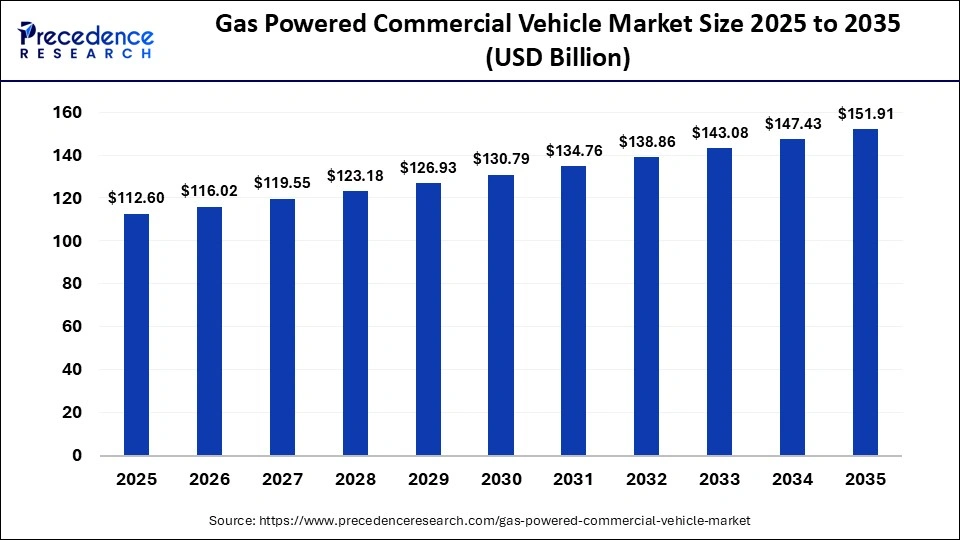
The global gas powered commercial vehicle market size was calculated at USD 112.60 billion in 2025 and is predicted to increase from USD 116.02 billion in 2026 to approximately USD 151.91 billion by 2035, expanding at a CAGR of 3.04% from 2026 to 2035. The market is experiencing robust growth, driven by the growing need for environmental sustainability, increased production of commercial vehicles, and rapidly expanding infrastructure for gas-powered commercial vehicles.
Key Takeaways
- North America dominated the global gas powered commercial vehicle market in 2025.
- Asia-Pacific is expected to grow at the fastest CAGR in the market during the forecast period.
- By vehicle type, the light commercial vehicles segment held a dominant position in the market in 2025.
- By vehicle type, the medium commercial vehicles segment is expected to grow at the fastest CAGR in the market between 2026 and 2035.
- By fuel type, the compressed natural gas (CNG) segment led the global market in 2025.
- By fuel type, the liquefied natural gas (LNG) segment is expected to grow with the highest CAGR in the market during the studied years.
- By application, the freight transport segment dominated the global market in 2025.
- By application, the passenger transport segment is expected to expand rapidly in the market in the coming years.
- By end-user, the logistics segment dominated the global market in 2025.
- By end-user, the public transportation segment is expected to expand rapidly in the market in the coming years.
What are Gas-Powered Commercial Vehicles?
Gas-powered commercial vehicles are vehicles that transport goods or passengers using internal combustion engines (ICEs). The gas powered commercial vehicle market continues to grow steadily, as fleet operators seek an affordable alternative and lower emissions than diesel, while maintaining productivity and drivability. The rise in fuel price volatility and emissions regulations is driving the adoption of compressed natural gas (CNG) and liquefied natural gas (LNG) vehicles. Major contributors to demand growth include urban logistics, buses of the public transport, and long-haul trucks.
Impact of AI on the Gas Powered Commercial Vehicle Market
Artificial Intelligence is changing the management of fleet optimization, predictive maintenance, and fuel efficiency for gas-powered commercial vehicles. AI-based telematics services identify the driving behaviour and fuel usage to minimize operational expenses. Machine learning is applied to smart engine control systems to increase the efficiency of the combustion process and reduce emissions. Moreover, AI-assisted route optimization and demand prediction can assist fleet operators in getting the most out of the assets and minimizing downtime.
Gas Powered Commercial Vehicle Market Trends
- Construction of LNG Infrastructure: The increasing LNG refuelling systems promote the use of long-haul gas-powered trucks globally. LNG infrastructure is built using gas liquefaction, storage, regasification, and power generation.
- Clean Fuel Fleet Government Incentives: Tax subsidies and tax credits promote the replacement of diesel by CNG vehicles in a fleet. Gas-powered vehicles are more environmentally sustainable, leading to a significant reduction in CO2 emissions.
- Telematics and Smart Fleet Systems Integration: State-of-the-art digital platforms are used to improve performance, safety, and optimal fuel consumption. AI enables route optimization and helps design efficient schedules and delivery routes, making adaptations in real time.
- Alternative Fuel Platform Investments by OEM: Large-scale producers increase specific natural gas vehicle platforms and engines. OEMs shift towards hydrogen, natural gas, propane, and related emerging fuels for commercial vehicles.
Market Scope
| Report Coverage | Details |
| Market Size in 2025 | USD 112.60 Billion |
| Market Size in 2026 | USD 116.02 Billion |
| Market Size by 2035 | USD 151.91 Billion |
| Market Growth Rate from 2026 to 2035 | CAGR of 3.04% |
| Dominating Region | North America |
| Fastest Growing Region | Asia Pacific |
| Base Year | 2025 |
| Forecast Period | 2026 to 2035 |
| Segments Covered | Vehicle Type, Fuel Type, Application, End-User, and region |
| Regions Covered | North America, Europe, Asia-Pacific, Latin America, and Middle East & Africa |
Segmental Insights
Vehicle Type Insights
Which Vehicle Type Segment Dominated the Gas Powered Commercial Vehicle Market?
The light commercial vehicles segment held the largest revenue share of the market in 2025, due to their widespread applications in both urban logistics and last-mile delivery. The fact that they operate at a lower cost and are relatively easier to integrate CNG systems makes them very appealing to small and medium-sized enterprises. Governments that encourage clean mobility in urban areas also increase LCV adoption.
The medium commercial vehicles segment is expected to gain the highest market share between 2026 and 2035, due to the fleet that moves to more environmentally friendly combustion options. Their commercial viability is improving as new engine efficiency and long driving range advances are being made. The increase in volatility in the prices of diesel is pushing fleet operators to move to NGV platforms. In addition, favorable emission regulations are fast-tracking the implementation of NGV fleets in the developed and developing economies.
Fuel Type Insights
How the Compressed Natural Gas (CNG) Segment Dominated the Market?
The compressed natural gas (CNG) segment held a dominant revenue share of the gas powered commercial vehicle market in 2025, because it is in large supply and the cost of infrastructure is less than that of LNG. It is especially applicable to short-haul and intra-city transportation. CO2 emissions produced by CNG cars are lower, and the maintenance costs of these vehicles are also lower compared to those of diesel vehicles. The segmental growth is attributed to powerful government incentives and the network of refuelling.
The liquefied natural gas (LNG) segment is expected to show the fastest growth over the forecast period, driven by the rising long-haul truck demands. LNG has a great density of energy, which gives it a better range and higher payload. The increase in cross-border freight movement is spreading faster, enhancing the adoption of LNG trucks. Investments in LNG corridors for heavy-duty vehicles are bound to have a considerable effect on the segment's growth.
Application Insights
How the Freight Transport Segment Led the Gas Powered Commercial Vehicle Market?
The freight transport segment contributed the biggest revenue share of the market in 2025, as logistics and cargo movement are highly fuel-consuming, and there is a high demand for alternative products that are cost-effective. Trucks that are powered by gas are much less expensive to operate in high-mileage operations. The segment enjoys the regulatory pressure to decarbonize supply chains and curtail fleet emissions.
The passenger transport segment is expected to grow at the fastest CAGR in the market between 2026 and 2035, driven by favorable government initiatives and the need for cost-efficient, cleaner alternatives. Government bodies encourage the general public to opt for public transport to reduce carbon emissions. CNG passenger vehicles are reported to emit 5-10% less CO2 compared to gasoline-powered passenger vehicles. They are also operationally friendly and comparatively affordable.
End-User Insights
What Made Logistics the Dominant Segment in the Gas Powered Commercial Vehicle Market?
The logistics segment accounted for the highest revenue share of the market in 2025, because it is very reliant on the commercial fleet of vehicles. Optimizing fuel costs is one of the main concerns of logistics operators, necessitating the use of natural gas. Fleet expansion is increasing due to the rapid expansion of organized retail and e-commerce channels. Savings in operations in the long term and compliance with emission regulations reinforce adoption among third-party logistics providers.
The public transportation segment is expected to grow with the highest CAGR in the market during the studied years. Infrastructural development is promoting the use of medium and heavy-duty gas-powered trucks. Contractors are switching over to cleaner fleets to meet the requirements of the environment at construction sites in cities. There should be infrastructure development programs sponsored by the government to speed up this shift.
Regional Insights
Why North America Dominated the Gas Powered Commercial Vehicle Market?
North America held a major revenue share of the market in 2025, because of the high development of refueling infrastructure and favorable regulatory standards. The region enjoys the fact that there is plenty of natural gas, which would guarantee that there would be no high fading of fuel prices.
Fleet operators are vigorously switching to alternative fuels to achieve emission-cutting regulations. The rise of engine platforms also enhances the growth in the region. There is still promotion through government incentives and carbon-reducing policies. Also, the presence of large OEMs increases the maturity and the innovativeness in the market.
Country-Level Analysis
The U.S. is the largest producer of natural gas and the interstate freight system. Canada trails behind with an increase in the heavy-duty transport LNG corridors. In the U.S., federal and state emission requirements are driving the modernization of the fleet. CNG buses are being strongly adopted by urban transit authorities to enhance air quality. To cut operational costs, private logistics companies are pursuing investments in natural gas fleets. The intercontinental trade in North America also enhances the deployment of long-haul LNG vehicles.
Why is Asia-Pacific the Fastest-Growing Region in the Market?
Asia-Pacific is expected to witness the fastest growth in the gas powered commercial vehicle market during the predicted timeframe, driven by rapid urbanization and industrialization. The need to reduce freight mobility costs, thereby creating a trend towards CNG and LNG vehicles. Governments in the region are taking up policies to control urban air pollution.
The increased investments in natural gas infrastructure enhance the reliability of supply. Further development of manufacturing and logistics processes contributes to the increase in demand for commercial vehicles. The increasing prices of fuel imports are also promoting the transition to locally supplied natural gas resources.
Country-Level Analysis
On the country level, China dominates the regional market, owing to the government support for the use of LNG heavy-duty trucks. India is building a considerable fleet of CNG stations to facilitate clean mobility. Japan is also encouraging LNG-powered commercial vessels for long-haul usage. South Korea is developing new fuel technologies to reduce its reliance on energy.
Southeast Asian countries are slowly embracing the use of CNG buses to fight pollution in urban areas. These national programs make the Asia-Pacific a high-growth market power in the international market.
Will Europe Grow in the Gas Powered Commercial Vehicle Market?
Europe is expected to grow at a considerable CAGR in the upcoming period, due to strict emission requirements and decarbonization goals. The shifting trend towards decreasing the use of diesel in the region is boosting the adoption of CNG and LNG commercial vehicles. Improved policy encouragement in green mobility programs boosts fleet electrification and gas-based substitutes.
CNG buses are being adopted due to modernization programs in the field of public transport. Growth in the number of LNG fuelling points along highways increases the viability of heavy-duty vehicles. The market growth is also being assisted by growing corporate sustainability goals.
Country-Level Analysis
At the country level, Germany is at the centre stage given its high automotive manufacturing. Italy traditionally is the first in the usage of CNG vehicles and has a well-developed infrastructure.
France is broadening its LNG routes to aid freight decarbonization. To achieve emission goals, Spain is investing in municipal fleets that use gas. The UK is working on the low emission freight solutions to meet climate targets. All these measures are part of the solidified growth strategies of Europe.
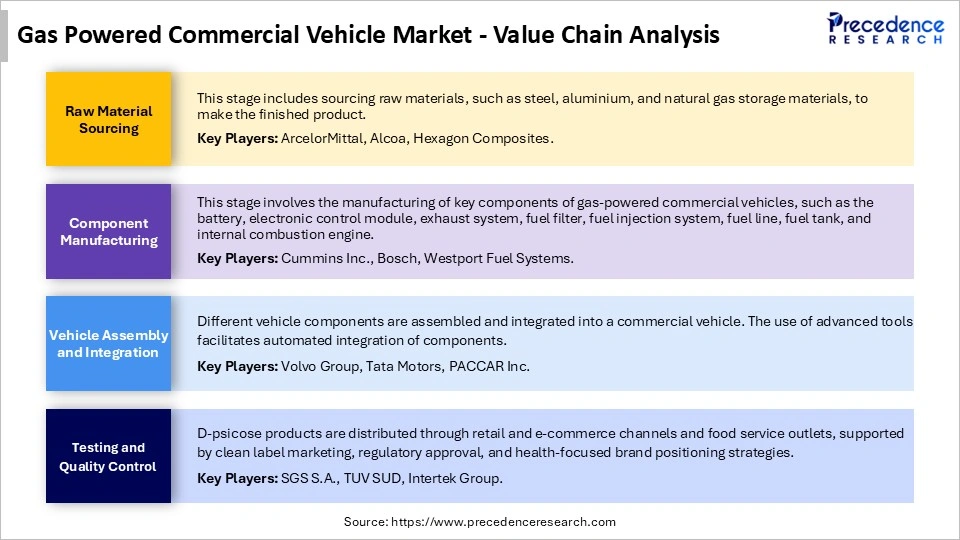
Gas Powered Commercial Vehicle Market Value Chain Analysis
Top Companies in the Gas Powered Commercial Vehicle Market
- Volvo Group
- Daimler AG
- IVECO S.p.A.
- Scania AB
- MAN SE
- CNH Industrial N.V.
- Ford Motor Company
- General Motors Company
- Fiat Chrysler Automobiles N.V.
- Tata Motors Ltd.
- Ashok Leyland Ltd.
- BYD Company Ltd.
- Hyundai Motor Company
- Isuzu Motors Ltd.
- Hino Motors, Ltd.
Recent Developments in the Gas Powered Commercial Vehicle Market
- In October 2025, Hino Motors, in collaboration with Toyota Motor Corporation, announced the launch of Profia Z FCV, Japan's first mass-produced fuel-cell heavy-duty truck. The hydrogen-powered model delivers approximately 650 km of driving range with rapid refueling, supporting zero-emission long-distance freight operations. (source: https://www.electrive.com)
- In March 2025, Tata Motors launched India's first hydrogen-powered heavy-duty truck trials, deploying 16 advanced vehicles powered by hydrogen internal combustion and fuel cell technologies on major freight routes. Initiated under the National Green Hydrogen Mission and flagged off by Union Ministers, the two-year pilot marks a significant step toward decarbonizing long-haul commercial transport. (source: https://www.tatamotors.com)
Segments Covered in the Report
By Vehicle
- Light Commercial Vehicles
- Medium Commercial Vehicles
- Heavy Commercial Vehicles
By Fuel
- Compressed Natural Gas (CNG)
- Liquefied Natural Gas (LNG)
- Application
- Freight Transport
- Passenger Transport
- Municipal Services
By Application
- Freight Transport
- Passenger Transport
- Municipal Services
By End-User
- Logistics
- Construction
- Public Transportation
- Agriculture
By Region
- North America
- Europe
- Asia-Pacific
- Latin America
- Middle East & Africa
For inquiries regarding discounts, bulk purchases, or customization requests, please contact us at sales@precedenceresearch.com
Frequently Asked Questions





Ask For Sample
No cookie-cutter, only authentic analysis – take the 1st step to become a Precedence Research client
 Get a Sample




 sales@precedenceresearch.com
 Schedule a Meeting
