



Green Power Market Size, Key Companies, Company Market Share, Power Generation Capacity, Energy Consumption, Pricing Trends, Investment Analysis, Competitive Positioning, and Demand Forecast
According to energy and power expert Laxmi Narayan, the green power market has reached USD 84.06 billion in 2026 and is expected to grow to USD 212.08 billion by 2035, registering a CAGR of 10.92%. The green power market companies such as Adani Group, Enel SpA, GE Renewable Energy are playing a key role in market expansion, with major opportunities emerging across By Power, Application, End User segments.
Source: https://www.precedenceresearch.com/green-power-market
 Get a Sample
 Table Of Content


What Is Driving the Growth of the Global Green Power Market?
The global green power market size accounted for USD 75.26 billion in 2025, and is anticipated to hit around USD 84.06 billion by 2026, and is predicted to reach around USD 212.08 billion by 2035, growing at a CAGR of 10.92% from 2026 to 2035. Accessible renewable resources and favorable government policies are driving exponential growth in the market. The perks of investments benefiting both new and existing businesses make it a sustainable choice to expand energy and unveil new job categories as per individuals' expertise.
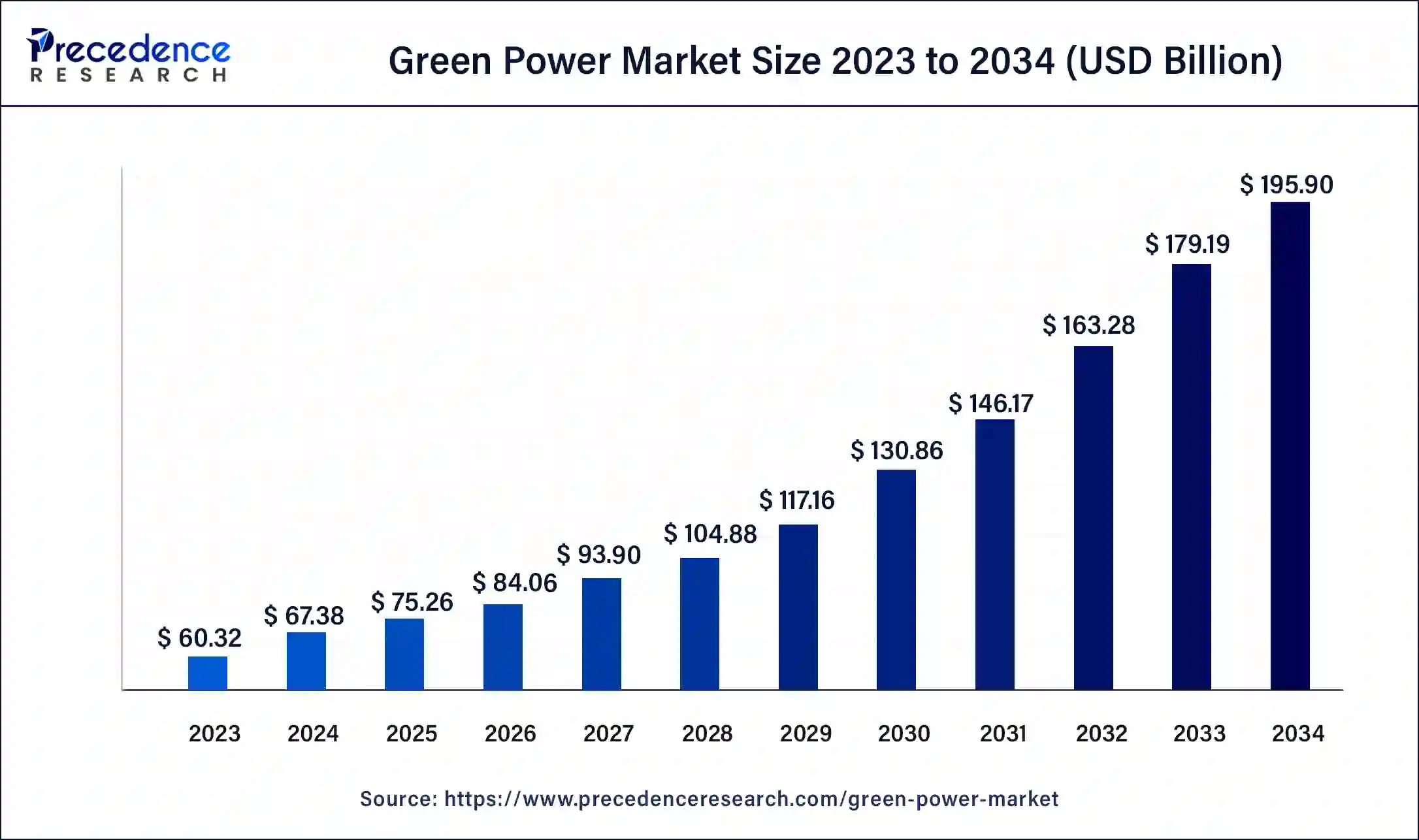
Green Power Market Key Takeaways
- In terms of revenue, the market is valued at $75.26 billion in 2025.
- It is projected to reach $195.90 billion by 2035.
- The market is expected to grow at a CAGR of 11.26% from 2026 to 2035.
- By power, the hydropower segment dominated the global market in 2025.
- By end User, the utility segment held the largest share of the market in 2025.
Strategic Overview of the Global Green Power Industry
When electricity is produced with the help of solar, wind, geothermal, bio gas, eligible biomass or hydroelectric sources it is called as green power. Green power is important as it replaces the fossil fuels with environment friendly alternatives that help in reducing the negative effects. The energy produced can be called green which does not cause pollution and not all the sources of renewable energy are green.
Green resources help in avoiding the drilling and mining operations that damage the ecosystem. The most common forms of green power are solar power, wind power, hydropower, geothermal energy, biomass, and biofuels. If the entire lifecycle of the green energy sources is taken into account, they release a very less amount of greenhouse gases as compared to the fossil fuels. The sources of green power can naturally replenish themselves compared to natural gas or coal, which takes millions of years to replenish.
Artificial Intelligence: The Next Growth Catalyst in Green Power
In the domain of green power, artificial intelligence is poised to revolutionize the scene by enhancing the efficiencies and reliability of renewable sources. From predictive forecasts to making the yield of solar and wind energy maximized through analyzing weather and performance data, AI delivers it all. In addition to that, maintenance prediction keeps turbines and panels up by spotting faults early.
In grid management, it provides balancing of supply and demand in real-time through support to smart grids and through demand-response programs; while for energy storage, it gives charging cycle optimization with the objective to prioritize consumption of renewables. In the green hydrogen new emerging industry, the technique helps in enhancing efficiency in electrolysis to cut costs. Also, AI enhances market forecasting and promotion strategies to enable the producer to respond to changes in energy prices, making green electricity more reliable and economically feasible, thereby supporting the further decarbonization efforts on a global scale.
Green Projects Strengthening Roots of Industrials and Commercials
The advantages of green projects to the vast commercial and industrial sector are cost-effectiveness and quick acceptance in the highly modernized world. The government has been a constant support, a backbone for the green ideas to shrink carbon emissions and help companies to align with the environmental regulations. Sustainable commercial buildings and energy-efficient infrastructure are the power pillars for the eco-conscious ideas. A lower bill is good news for businesses that risk their respective profits and losses each day. The favorable corporate reputation attracts sustainable stakeholders, investors, and customers, completing the tree of fruitful engagements, which marks a boon to the sectors.
Green Power Market Growth Factors
Green power represents a low-cost solution for the energy needs across the world. The accessibility of green energy and low cost makes it a better option for developing nations. Depending upon the region's geography, green energy has the capacity to replace the fossil fuels in the future. The green energy is a clean source of energy. It is not just good for the planet but it is also good for the health of the people and animals as they have clean air for breathing. Green power is a stable energy power which may not have a lot of price fluctuations due to the geopolitical crisis or any supply chain disruptions. In order to meet the target of net zero emissions, many jobs are created worldwide in this sector.
As the energy produced by the green sources is locally produced and it does not involve any centralized source so it happens to be more flexible. By bringing together various green energy sources and with advancements that are being made with regards to production and development of these resources, the needs of the future generations could be met by green sources and one could believe that the fossil fuels could be replaced. Green power is a zero carbon footprint option which is environment and future friendly.
- Rising global emphasis on sustainability is pressing for carbon emission reduction and more use of renewable energy.
- Supportive government policies and initiatives nurture the transition from fossil fuels to green energy.
- Technological improvements bring efficiencies and cut costs for energy conversion, storage, and transmission.
- Green energy generated within the country enhances energy security by reducing the import of fuels and securing the supply.
- Green energy being nurtured will provide employment and aid in sustainable economic development.
Market Outlook
- Market Growth Overview: The Green Power market is declining technology costs, ambitious government policies, and increasing corporate sustainability commitments. The record deployments of solar and wind energy, coupled with significant investments in energy storage to enhance grid reliability and efficiency.
- Sustainability Trends: Sustainability trends focus on ethical sourcing of critical minerals and minimizing land use impacts on biodiversity through innovative practices like agrivoltaics. Furthermore, the market is driven by ambitious corporate ESG commitments and the development of sustainable energy storage solutions and green hydrogen to decarbonize hard-to-abate sectors.
- Major Investors: Major investors in the market include NextEra Energy, Iberdrola SA, and Adani Group.
- Startup Economy: The startup economy in the market is focused on a vibrant ecosystem focused on technological innovation, using AI and advanced software to solve niche, high-value problems like energy storage and grid management. These ventures attract significant venture capital and often partner with larger companies to accelerate the transition to clean energy.
Market Report Coverage and Key Metrics
| Report Highlights | Details |
| Market Size in 2025 | USD 75.26 Billion |
| Market Size in 2026 | USD 84.06 Billion |
| Market Size by 2035 | USD 195.90 Billion |
| Market Growth Rate from 2026 to 2035 | CAGR of 11.26% |
| Base Year | 2025 |
| Forecast Period | 2026 to 2035 |
| Largest Market | North America |
| Segments Covered | Power, Application, End User, and Region |
| Regions Covered | North America, Europe, Asia Pacific, Latin America, Middle East & Africa (MEA) |
Market Dynamics
Driver
Resources and Tech Perk
The complementing tech-driven approaches and inexhaustible resources are a perk to the market growth and expansion. The supportive policies for the same and government mandates spur effective progress in tech innovations. Wind turbines and solar photovoltaic systems are alleviating the installation and production costs. This drives affordability in the market. Sources such as water, wind, and sun are a smooth and favorable pathway for all businesses running on sustainable factors. Brands are engaging and promoting the green impact in their commercial-scale tactics, highlighting the importance of the market hype.
Restraint
Unfavorable Lands and limited minerals
The huge solar and wind farms depend on crucial minerals such as rare earths, cobalt, and lithium. Further, the appropriate land size happens to be a challenge for farmers seeking sustainable approaches at an affordable cost. The late installation of clean energy due to the disturbance in the materials supply chain can disrupt the energy supply to the farmlands and households. The effective and limited materials required to respond to green energy are in heavy demand.
Opportunities
Combatting Businesses
The green projects offer massive business opportunities to experts with impactful knowledge of sustainable technology, systems, or any of the ideas profiting the regional economy. The developing lands are promoting agrivoltaics, whereas renewable-sponsored EV charging infrastructure is unlocking new business ideas. The conversion of agricultural residues into biofuels and biogas is driving significant expansion of the market into developing entrepreneurship. With this, entrepreneurship is supported by the green dynamics.
Market Segmentation Analysis
Power Insights
Which Power Segment Dominated the Green Power Market?
The solar energy segment dominated the market in 2025 and is expected to rise at the fastest CAGR during the period 2026 to 2035. The solar grids and solar thermal systems in the operating and sustainable influenced places are confirming effective deals of distributed rooftop engagements and utility-scale solar parks in the emerging and responsible space. Whereas the role of fossil fuels in job creation is encouraging remarkable involvement of grid resilience and self-generated electricity at the business centers responsible for regional profit. Alongside the vast areas of farms, are visibly see solar power as a source of energy medium benefiting households and farming as well. The increased electricity cost and net-zero climate goals drive the effective expansion of this segment in the market spectrum.
Application Insights
How the Electricity Generation Segment Dominated the Green Power Market?
The electricity generation segment held the largest market share in 2025 due to the rise in green power generations' combatting eco-friendly renewable resources that supply power to homes and promote public infrastructure. It further eliminates carbon emissions to highlight the differences market leaders miss when explaining the sustainable use of electricity. The excellence of rooftop solar and cogeneration setups is a clean, green boon to commercial and residential areas. Whereas well-known active green hydrogen and electric vehicles shifts featuring the best-in-class use of electrified eco-friendly solutions propel the value and footprint of the market in these modern electrifying sectors.
The transportation segment is predicted to rise at the highest CAGR during the period 2026 to 2035. Electric vehicles are gaining traction in the market due to their robust batteries. Further, the unification of Vehicle-to-grid enables EVs to manage the feed power and surplus renewable generation to charge the grid. This helps wind and solar systems to last longer. The transport energy unification cuts the dependency on gas and coal plants. This has pumped the national power demand across countries. The mobility policies for EVs expanded the demand cycle of national electricity, meeting sustainable standards via renewable sources, promising performance.
End User Insights
Why Did the Utility Segment Lead the Green Power Market?
The utility segment led the market in 2025 due to rapid heavy spending and building a strong foundation for utility-scale solar and wind infrastructure. Grid advancements best supporting modern utilities' legacy systems that promote the idea of IoT and artificial intelligence. The Battery Energy Storage Systems (BESS) integration helps the segment enter advanced battery operations and cooperate with the explored surplus solar/wind. The segment growth has been extended into the retail-scale operations, confirming great revenue for the market.
The industrial segment is expected to grow at a robust CAGR during the period 2026 to 2035. The green manufacturing trend and impressive opportunities for transformation are encouraging industrial leaders to think of ‘out of the box' green deals. The on-site wind and solar arrays bring a boost to cost stability to lock in the idea of deployment of the same. The oil and gas leaders are bolstering the base of the market with their green hydrogen approaches and gigawatt-fueled renewable potential. Whereas, the providers are up with decent, cost-competitive power for domestic industries and technology champions.
Market Regional Analysis: North America, Europe, Asia-Pacific
How North America Dominated in the Green Power Market in 2025?
North America's technological innovation, making renewable energy more cost-competitive and enabling the integration of energy storage. High consumer demand and robust corporate sustainability commitments further accelerate the market's growth, solidifying North America's leadership position in green power.
U.S. Green Power Trends:
The U.S. is experiencing a rise in domestic manufacturing and corporate commitments to net-zero goals, which are fueling demand for clean energy solutions. Despite challenges such as grid capacity limitations, innovations in baseload power like geothermal and small modular reactors are gaining traction.
Asia Pacific Green Power Market Trends:
The Asia Pacific soaring energy demand and massive government investments in renewable energy and infrastructure development. The declining costs of solar and wind technologies, coupled with ambitious corporate sustainability commitments, are accelerating the transition away from fossil fuels.
China Green Power Market Trends:
The U.S. aggressive government targets and vast investments in technology and infrastructure. Record-breaking solar and wind installations, along with massive investments in ultra-high-voltage grid infrastructure and energy storage, are enabling clean energy to increasingly displace fossil fuels.
How is Europe Rising in the Green Power Market?
Europe's regions have robust regulations, ambitious carbon-neutrality goals, and a clear regulatory environment that attracts substantial investment. The region is leading global innovation in offshore wind technology and aggressively developing a green hydrogen economy to decarbonize hard-to-abate sectors.
United Kingdom Green Power Trends
The U.K. demands significant investment in grid modernization and energy storage solutions to manage intermittent renewables. This growth is further accelerated by corporate power purchase agreements and diversification into novel technologies.
How is Latin America Rising in the Green Power Market?
Latin America is experiencing abundant natural resources, increasing energy demand, and supportive government policies focused on sustainable development. The region benefits from exceptional solar and wind potential and is attracting substantial international investment and competitive energy auctions.
Brazil's green power market is thriving due to a strong foundation in hydropower and the rapid expansion of solar and wind energy, driven by supportive government policies and abundant natural resources. The significant private investment through corporate power purchase agreements (PPAs), and an accelerated shift to advanced technologies
How is the Middle East & Africa driving the Green Power Market?
The Middle East and Africa's growth is driven by a surging domestic energy demand for cooling, and desalination is met by large-scale, cost-effective utility projects like the Benban Solar Park. The region is leveraging green power to diversify economies, enhance energy security, and establish itself as a potential global hub for green hydrogen production.
Saudi Arabia Green Power Trends:
The massive expansion in utility-scale solar and wind projects, and significant investments in energy storage. The country is also strategically positioning itself as a global leader in green hydrogen production to diversify its economy and enhance energy security.
Green Power Market Value Chain Analysis
- Technology & Component Manufacturing
This foundational stage involves the design, development, and manufacturing of core components such as solar panels, wind turbines, batteries for energy storage, and related power electronics. Companies in this stage focus on R&D to improve efficiency, reduce costs, and ensure the reliability and sustainability of green power technologies.
Key Players: Longi Solar, Vestas Wind Systems A/S, Siemens Gamesa Renewable Energy, First Solar, Tesla, LG Energy Solution. - Project Development & Financing
At this crucial stage, developers identify suitable locations for green power projects, secure permits, arrange financing, and manage the engineering, procurement, and construction (EPC) processes. This phase requires strong expertise in regulatory compliance, project management, and financial structuring to attract necessary capital from investors and banks.
Key Players: NextEra Energy Resources, Ørsted A/S, General Electric, ACWA Power, Engie SA, Clean Energy Collective. - Generation & Transmission
In this stage, the green power generation facilities (e.g., solar farms, wind parks) are operated to produce electricity, which is then transmitted over high-voltage power lines to regional substations. Key players ensure the efficient and reliable operation of power plants and the maintenance of the grid infrastructure.
Key Players: Utility companies (e.g., NextEra Energy, Duke Energy), independent power producers (IPPs), and grid operators/TSOs (Transmission System Operators). - Distribution & Retail
Once transmitted, the electricity is distributed through local power grids to end-users (residential, commercial, industrial). Retailers then sell this power to consumers, manage billing, and offer various pricing plans or green power options (like Renewable Energy Certificates or PPAs) to meet consumer demands for clean energy.
Key Players: Retail utility providers, electric cooperatives, municipal utilities, and electricity brokers/retailers (e.g., Green Mountain Energy, Arcadia) - End-Use Consumption & Services
The final stage involves the consumption of green power by residential, commercial, and industrial customers. This stage also includes services related to energy efficiency, demand response, and the utilization of decentralized energy resources (DERs) like rooftop solar and electric vehicles to manage and optimize power consumption.
Key Players: Individual consumers, commercial businesses, industrial firms, and energy management service providers.
Market Competitive Landscape: Leading Companies and Strategies
The green power market is emerging with an immersive thought of incorporating green projects in the operating sectors. Most of the huge businesses are collaborating with the eco-friendly experts to meet the sustainable standards marked mandatory in a few regions. Close inspection sparks sincerity among the industrial and commercial leaders who cooperate with the regional ecosystem. Popular energy utilities and developers such as Tata Power, NTPC Green Energy, ReNew, and Adani Green Energy support the market with their core programs and clean solutions. Alongside, equipment manufacturers like Waaree Renewable Technologies (WRTL) and Suzlon Energy are tech-enthusiast manufacturers rapidly modernizing renewable systems with the heavy deployment of fine tech energies in their operations.
Following this, the service segment receives massive strength and backup from manufacturers' respective innovations. Corporate initiatives such as Corporate Power Purchase Agreements and Global Renewable Alliance extend collaborations to double the renewable energy deployment in the future. Adani Green Energy's AGEL efforts aim to unify massive wind and solar assets to further serve affordable, round-the-clock, robust, clean, and green power. Whereas ReNew provides multi-tech renewable solutions such as hydro, wind, and solar, linked with decarbonisation interventions and energy storage specifically for corporate clients.
Green Power Market Companies
- Adani Group: The Adani Group is a major Indian conglomerate contributing to the green power market through its subsidiary, Adani Green Energy Limited, which develops, operates, and maintains large-scale solar, wind, and hybrid projects. They are one of the world's largest renewable energy companies, with a significant portfolio of operational and under-construction projects across India
- Enel SpA: Enel is a multinational power company that plays a crucial role in the market through its Enel Green Power division, focusing on developing and managing renewable energy plants worldwide, including hydro, wind, solar, and geothermal. They are significant investors in the U.S. and Latin American markets, driving innovation and sustainable energy solutions.
- GE Renewable Energy: GE Renewable Energy contributes significantly by providing a wide portfolio of products and services, including onshore and offshore wind turbines, hydro solutions, and solar power equipment. They focus on technological innovation, such as Haliade-X turbines for offshore wind, to improve efficiency and reduce the cost of green power generation.
- Brookfield Renewable Corporation: This company is one of the largest publicly traded pure-play renewable power platforms globally, with a diverse portfolio of hydro, wind, solar, and energy storage facilities. They actively invest in, develop, and operate clean energy assets across North and South America, Europe, and Asia, contributing to global decarbonization efforts.
- Siemens Gamesa Renewable Energy: Siemens Gamesa is a leading engineering and manufacturing company that designs, produces, and installs onshore and offshore wind turbines worldwide. They are at the forefront of technological advancements in wind power, consistently aiming to lower the cost of energy and increase the capacity of wind farms.
- Tata Power: As one of India's largest integrated power companies, Tata Power is a major contributor to the green power market through its extensive portfolio of solar, wind, and hydro generation assets. The company is actively developing microgrids and promoting rooftop solar and electric vehicle charging infrastructure to further the adoption of clean energy in India.
- Vestas Wind Systems: Vestas is a global leader in sustainable energy solutions, specializing in the design, manufacture, installation, and servicing of wind turbines. With a strong focus on R&D, the company continuously improves turbine efficiency and reliability, playing a crucial role in expanding global wind energy capacity.
- Iberdrola SA: Iberdrola is a global utility company and a major investor in the green power market, with a strong focus on developing wind and solar projects and investing in grid infrastructure and energy storage. They are key players in the U.S. (via Avangrid), Europe, and Latin America, promoting electrification and decarbonization.
- JinkoSolar Holding: JinkoSolar is one of the largest and most innovative solar panel manufacturers in the world, supplying high-efficiency solar modules to utility-scale, commercial, and residential projects globally. Their technological leadership in solar PV cells and modules helps drive down the cost of solar energy and accelerates its global adoption.
- NextEra Energy: NextEra Energy is a leading clean energy company in North America, primarily through its subsidiary NextEra Energy Resources, which is a major generator of wind and solar power. They are significant investors in energy storage and play a crucial role in integrating renewable energy into the grid across the United States.
- Suzlon Energy Limited: Suzlon is a prominent Indian wind turbine manufacturer and a leading player in the Indian renewable energy sector, offering end-to-end solutions from development to operation and maintenance of wind farms. They contribute significantly to India's green power capacity and are at the forefront of the country's transition to clean energy.
Recent Developments in the Green Power Market (2025–2026)
- In June 2026, Uzbekistan, Azerbaijan and Kazakhstan came together to give a modernized shape to the plans for the Caspian Green Energy Corridor that will enable renewable electricity from Central Asia to expand to European industries. (Ref: https://astanatimes.com)
- In June 2026, NALCO planned to spend Rs 30,000 cr for expanding and bolstering the aluminum production potential via a 1,000 MW captive power plant and a new strong aluminum smelter. This highlights NALCO's financial backing efforts for green approaches. (Ref: https://www.aninews.in)
- In June 2026, Somany Ceramics Limited introduced a comprehensive solar power development series throughout its own manufacturing facilities. This strategic, sustainable move will alleviate the dependency on conventional grid electricity. This green change will surely impress the eco-friendly trend-setter companies. (Ref: https://thecsruniverse.com)
- In September 2025, Saatvik Green Energy, a Gurugram solar panels manufacturer, plans to launch a Rs 900-crore public issue on September 19, with pricing details on September 16. (Source: https://www.moneycontrol.com)
- In July 2025, Tata Power Skill Development Institute inaugurated a Green Energy Skill Centre in Rohini, New Delhi, to train on renewable energy technologies, preparing a future-ready workforce. The event featured key officials from various organizations. (Source: https://www.tatapower.com)
Segment Covered in the Report
By Power
- Wind Energy
- Solar Energy
- Geothermal Energy
- Hydropower
- Bioenergy
By Application
- Electricity generation
- Transportation
- Heating
- Others
By End User
- Utility
- Residential
- Industrial
- Commercial
By Region
- North America
- Latin America
- Europe
- Asia-pacific
- Middle and East Africa
For inquiries regarding discounts, bulk purchases, or customization requests, please contact us at sales@precedenceresearch.com
Frequently Asked Questions
Tags





Ask For Sample
No cookie-cutter, only authentic analysis – take the 1st step to become a Precedence Research client
 Get a Sample




 sales@precedenceresearch.com
 Schedule a Meeting
