



High-Performance Liquid Chromatography Market Size, Key Companies, Company Product Portfolio, Technology Adoption, R&D Investment, Application Trends, Competitive Positioning, and Forecast
High-Performance Liquid Chromatography Market (By Product: Instruments, Consumables& Accessories, Software; By Application: Clinical Research, Environmental, Forensic, Others; By End-User: Pharmaceutical & Biotechnology Companies, Academic & Research Institutions, Others) - Global Industry Analysis, Size, Trends, Leading Companies, Regional Outlook, and Forecast 2026 to 2035
Source: https://www.precedenceresearch.com/high-performance-liquid-chromatography-market
 Get a Sample
 Table Of Content


What is the High-performance Liquid Chromatography Market Size?
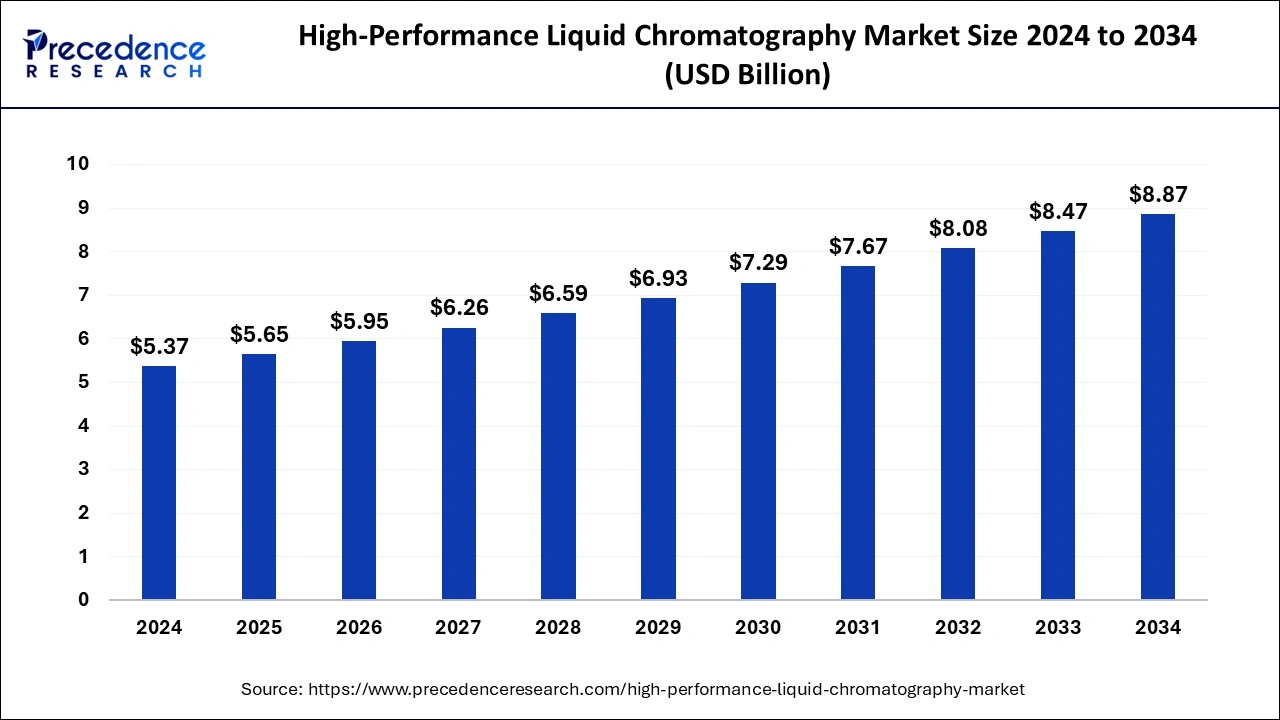
The global high-performance liquid chromatography market size is accounted at USD 5.65 billion in 2025 and predicted to increase from USD 5.95 billion in 2026 to approximately USD 9.26 billion by 2035, representing a CAGR of 5.06% from 2026 to 2035. The global high-performance liquid chromatography market is driven by rising pharmaceutical research, expanding drug development, increasing quality-control requirements, and growing adoption across biotechnology, food, and environmental testing.
High-performance Liquid Chromatography Market Key Takeaways
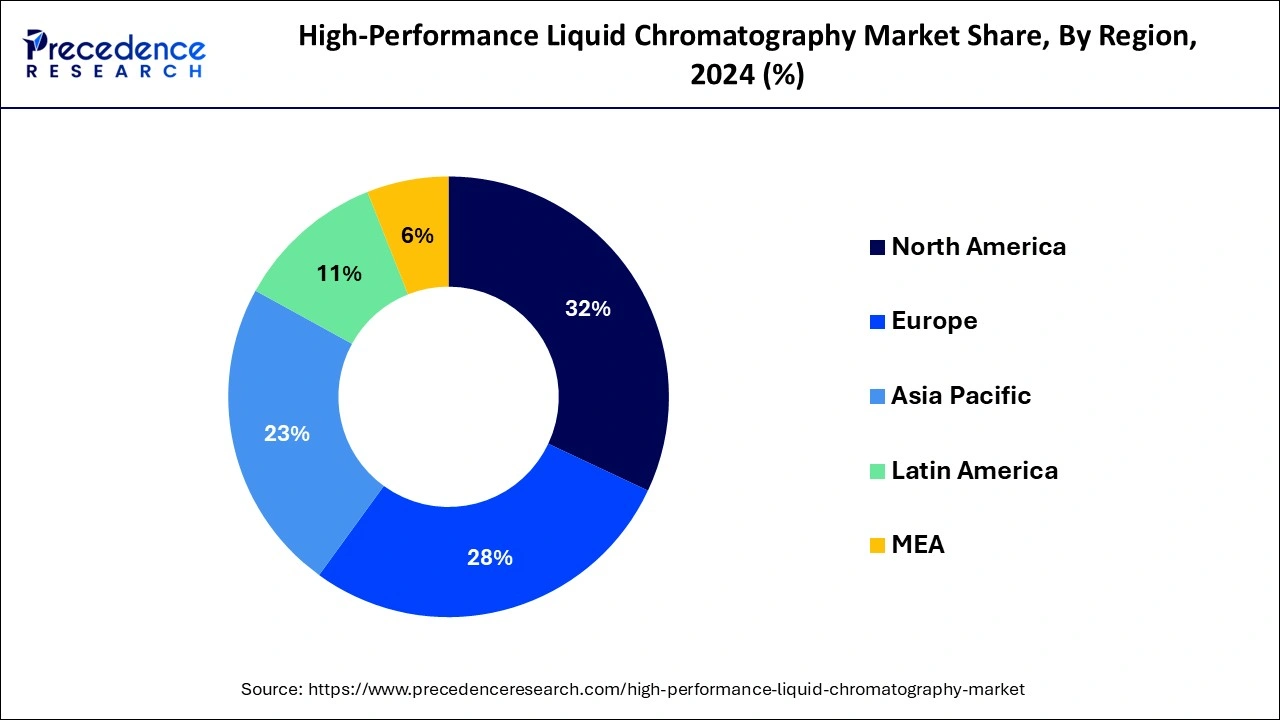
- North America generated more than 32% of revenue share in 2025.
- Asia-Pacific is predicted to grow at a remarkable CAGR between 2026 and 2035.
- By product, the instruments segment captured more than 46% of revenue share in 2025.
- By application, the clinical research segment generated more than 36% of the revenue share in 2025.
- By end-user, the forensic segment is expected to grow at a moderate CAGR between 2026 and 2035.
Market Overview
A form of column chromatography known as high-performance liquid chromatography (HPLC) involves the high-pressure injection of an analyte into a solvent through a column with chromatographic packing material that serves as both the stationary phase and the mobile phase. The sample is transported by a helium or nitrogen-moving carrier gas stream.
Any component in a sample that can dissolve in a liquid can be separated and identified with HPLC at trace quantities as low as parts per trillion. HPLC is utilized in a wide range of scientific and industrial applications due to its versatility, including environmental, pharmaceutical, chemicals, and forensics. This is anticipated to augment the growth of the market during the forecast period.
High-performance Liquid Chromatography Market Growth Factors
The technological advancements in high-performance liquid chromatography (HPLC) that has improved the dependability and robustness of liquid chromatography operations are anticipated to drive market growth in the years to come. The latest HPLC systems, for instance, provide multidimensional capabilities, dual-injection systems, and intermediate pressure alternatives that increase the technique's usefulness for a number of research applications.
Furthermore, the pharmaceutical and biotechnology industries are major users of HPLC for drug discovery, development, and quality control. The increasing demand for these products is also likely to augment the growth of the high-performance liquid chromatography market within the estimated timeframe.
Major high-performance liquid chromatography manufacturers who are extending their product lines for niche markets such preparative purification, two-dimensional liquid chromatography, amino acid analysis, method development, and clinical diagnostics are also driving the market growth. For instance, Novasep introduced their Hipersep Process M HPLC system in October 2021 with the goal of purifying oligonucleotides, peptides, insulin, and other pharmaceutically important compounds at a commercial scale.
Additionally, the use of HPLC in the biopharmaceutical industry is anticipated to increase as protein-based treatments such bispecific antibodies and antibody-drug conjugates gain popularity. The increasing adoption of HPLC in emerging markets, such as China, India, and Brazil, is driving the growth of the high-performance liquid chromatography market.
These markets offer significant growth opportunities due to the large and growing pharmaceutical and biotechnology industries, as well as increasing investments in research and development activities.
Market Trends in the Future
- AI Enhanced Analysis: The use of artificial intelligence and machine learning in chromatographic method development, peak identification, anomaly detection, and data interpretation is set to rise and enhance the accuracy of analysis, minimize time processing, and enable complicated laboratory work.
- Eco-friendly HPLC: Sustainable chromatography will call for less use of solvents, reusable materials, energy-efficient equipment, and eco-friendly mobile phases and help a lab minimize its negative effect on the environment without compromising quality of analysis or meeting regulations.
- Biopharma Uses: Growing biologics, biosimilars, peptides, and advanced therapies will create higher demand for high-performance liquid chromatography method for impurity profiling, quality control, characterization, and process monitoring during drug development and production.
- Mobile Systems: Application of the small modern portable HPLC systems is expected to increase for field tests, point-of-care usage, food safety testing, and environment monitoring, making it possible to conduct tests where an ordinary laboratory cannot be used.
- Automated Processes: There will be more and more laboratories that integrate HPLC machines with robots, autosamplers, laboratory information systems, and cloud systems, enabling higher throughput, following uniform procedure, remote supervision, and getting more consistent results.
High-Performance Liquid Chromatography Market Outlook
- Industry Overview: The use of HPLC continues to be regarded as an essential analytical tool in pharmaceutical quality control activities, impurity detection, assay determination, development of medicines, and characterization of biologics. Its established role in validated analytical procedures further emphasizes the increasing requirement of HPLC in the pharmaceutical, biotechnology, food, environmental and research laboratories.
- Global Expansion: Usage of HPLC must develop along with the growth of the pharmaceutical manufacturing, biotechnology research, contract testing, and laboratory modernization, particularly in the Asia Pacific region and other developing locations. Rising analytical needs of complex molecules and biologics push laboratories for upgrading operations toward UHPLC and HPLC–MS-compatible workflow.
- Sustainability Trends: HPLC equipment manufacturers have undertaken developments such as small solvent use, reduced waste generation, durable columns, energy-efficient machinery, and automated workflow in order to minimize the damage to environment.
- Start-up Ecosystem: New companies and enterprises are working on the opportunities in automation, AI-assisted chromatography, laboratory interconnectivity, modern detectors, and data analysis. Analytical quality by design is also coming into vogue, especially with regard to improving method robustness and repeatability.
Market Scope
| Report Coverage | Details |
| Market Size in 2025 | USD 5.65 Billion |
| Market Size by 2035 | USD 9.26 Billion |
| Growth Rate from 2026 to 2035 | CAGR of 5.06% |
| Largest Market | North America |
| Base Year | 2025 |
| Forecast Period | 2026 to 2035 |
| Segments Covered | By Product, By Application, and By End-User |
| Regions Covered | North America, Europe, Asia-Pacific, Latin America, and Middle East & Africa |
Market Dynamics
Driver
Growing pharmaceutical industry
Pharmaceuticals are defined as products like pharmaceuticals and medicines that are used to treat, prevent, or cure diseases and other conditions. Due to this, it goes without saying that the standards in the pharmaceutical sector are extremely high. Simply put, there can be no place for danger when it comes to patient care. The precision and accuracy of high-performance liquid chromatography (HPLC) are recognized. Despite the method's high costs, it is ideally suited for the kind of exact identification and quantification needed for pharmaceuticals.
Pharmaceutical products (drugs and medicine products) are examined using HPLC to determine what components are present. The technique is used to identify, categorize, and quantify the different parts of items as well as how many of each there are.
The quantities of each component, for instance, might alter a product's overall performance and strength, giving developers a greater understanding of a drug's qualities. They can also use it to find and measure any contaminants in medicinal products.
The pharmaceutical industry is growing rapidly. The demand for generic drugs, brand-name pharmaceuticals, and over-the-counter (OTC) medications will rise as the population ages in many developed countries. In particular, the need for medications for chronic diseases will increase in the long run. Also, due to advancements in healthcare systems and rising disposable family incomes, the demand for pharmaceuticals in emerging economies is also expected to rise.
Manufacturers of generic and over-the-counter medications will be the first to gain from this breakthrough. Pharmaceutical and biotech companies typically have easy access to outside funding from banks and investors, which help them, maintain high R&D costs which is further contributing to the growth of the industry. Thus, the growing pharmaceutical industry is expected to increase the demand for high-performance liquid chromatography technology within the estimated timeframe.
Restraints
High costs of HPLC
The price of high-performance liquid chromatography has increased dramatically along with the development of chromatographic methods and materials. A single-column component of today's most advanced chromatography systems can cost as much as $1000 on its own and upwards of $35,000 for the entire system. These systems have substantial equipment, pricey sensors, and intricate internal mechanics.
HPLC analysis requires the use of pricey mobile phase solvents, and consumables like sample, columns, and solvent filters, glassware, vials, etc. have ongoing expenditures. In HPLC analysis, mobile phase solvents represent the biggest expense. As much as possible, analyses of samples needing the same mobile phase and column should be grouped together.
These systems have a base cost, but on top of that, they can be expensive to operate and maintain. The escalating expense of chromatography has, however, been the target of numerous endeavors. Researchers have made progress in developing affordable and efficient chromatography methods.
Opportunities
Increasing developments in the HPLC technology
The traditional HPLC methodology has undergone a number of improvements, and these more recent methods include Ultra-Performance Liquid Chromatography (UPLC), Rapid Resolution Liquid Chromatography (RRLC), Ultra-Fast Liquid Chromatography (UFLC), and Nano Liquid Chromatography (Nano LC). UPLC provides faster and more efficient separations, while automation improves the speed and accuracy of analysis.
Due to its high throughput quantitative analysis, UPLC has applications in the development of new drugs. It supports the study of amino acids, the detection of pesticides, the evaluation of herbal items, and the testing of conventional treatments. The identification of metabolites, bio-analysis/bioequivalence studies, ADME screening, and dissolution tests are all aided by it. Furthermore, it has been discovered that the ultra-fast liquid chromatography (UFLC) approach performs at a speed that is approximately ten times faster than conventional liquid chromatographic procedures, with approximately three times greater separation even at normal pressure levels.
According to reports, the UFLC approach minimizes the technique's departure from the van Demeter theory by optimizing column performance. The method guarantees rapid analysis without compromising analytical accuracy and dependability. These advancements are anticipated to create lucrative growth opportunities for the market in the years to come.
Segments Insights
Product Insights
On the basis of product, the instruments segment held the largest revenue share of around 46% in 2025. This is spurred by the popularity of integrated HPLC systems and the accessibility of cutting-edge detectors. The development of systems that can provide greater productivity and application specificity is the main emphasis of manufacturers in this field. In addition, detectors like the Solvere carbon selective detector from Activated Research Corporation, which works with both aqueous and organic solvents, are expanding the range of sample types for which HPLC procedures can be applied. Also, the expansion of the healthcare sector is favorably impacting the growth of the entire market.
Application Insights
Based on the application, the clinical research segment held the largest market share of over 36% in 2025. Clinical laboratories use HPLC to examine intricate biological fluids including plasma, blood, and serum, assisting in the creation of precise, targeted medications. The pharmaceutical industry's increased R&D spending, the rising prevalence of disorders, the focus on rare diseases, and the development of several orphan medications are the main drivers of the growth of the segment. Furthermore, the growing landscape of clinical trial activities is also likely to support the segmental growth of the high-performance liquid chromatography technology within the estimated timeframe.
On the other hand, the forensic segment is likely to grow at the moderate CAGR during the forecast period. HPLC analysis is used by forensic and toxicology labs to screen, quantify, and confirm compounds used in drug tests and criminal investigations. Robust analytical techniques are urgently required for studies on the measurement of drugs of abuse.
In order to manage the constantly changing landscape of new novel psychoactive substances and boost method throughput to meet rising demand, hospital, and screening laboratories are now required to do research into new methods and tools for their screening protocols. This is likely to support the segment growth of the high-performance liquid chromatography market during the forecast period.
Regional Insights
U.S. High-Performance Liquid Chromatography Market Size and Growth 2026 To 2035
The U.S. high-performance liquid chromatography market size reached USD 1.27 billion in 2025 and is anticipated to be worth around USD 2.13 billion by 2035, poised to grow at a CAGR of 5.40% from 2026 to 2035.
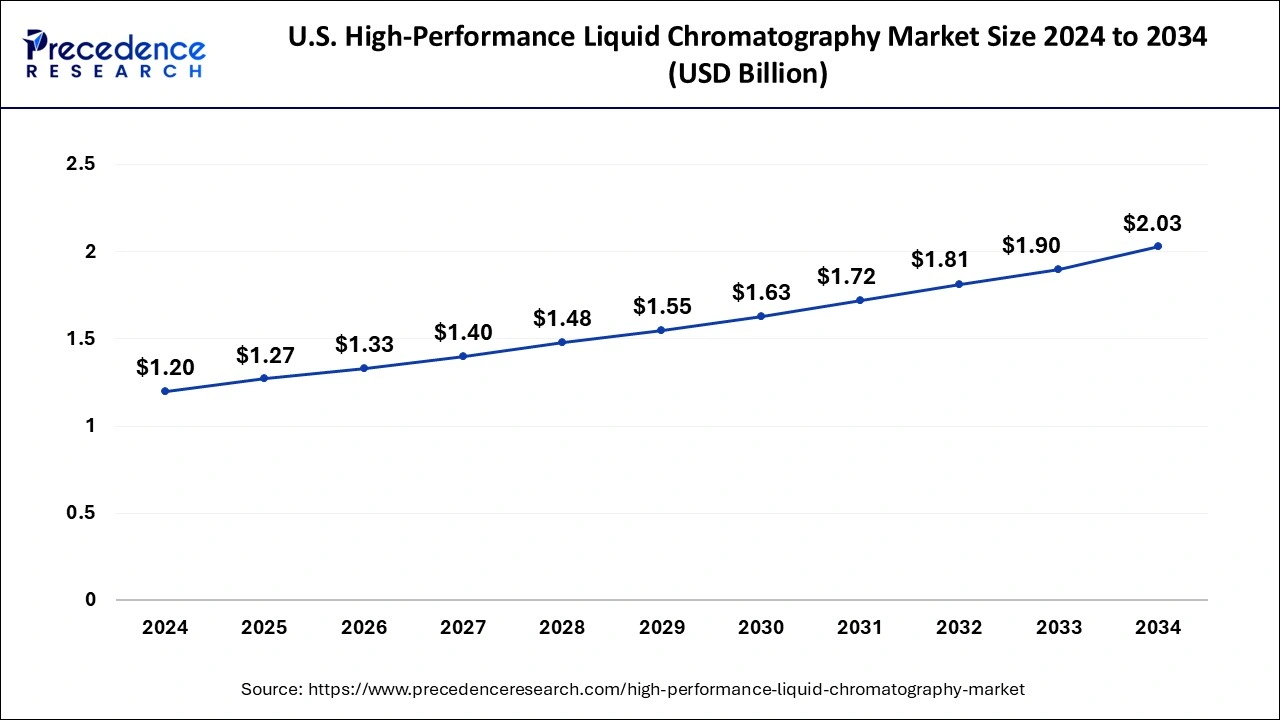
The U.S. high-performance liquid chromatography market is expanding with a significant growth rate due to the presence of several key players, highly established biotech and pharma industries, high-quality analytical techniques to develop various drugs, along with quality checks. Growing governments' support in terms of funding is again a major factor driving the region's growth. Efficient diagnostic tools have been developed by leading players with technical advancements further backed by the market's demand, fueling innovative approaches to resolve healthcare conditions with precise diagnosis. Highly skilled workforce, strong infrastructure, and government initiatives, PKS funding are key drivers of the U.S. high-performance liquid chromatography market.
North America has held the largest revenue share of over 32% in 2024. This is owing to the early adoption of technologies in the region even in the healthcare industry. The market for high-performance liquid chromatography in the United States is anticipated to grow significantly during the forecast period as a result of the growing pharmaceutical industry as well as the increasing occurrence of various disorders. Furthermore, the presence of key companies is also likely to contribute to the regional growth of the high-performance liquid chromatography market within the estimated timeframe.
Asia-Pacific High-Performance Liquid Chromatography Market Trends
Asia-Pacific is expected to grow at the fastest CAGR during the forecast period. This is owing to the presence of a large patient pool in the region. The growing manufacturing of generics in economies like India and China is also likely to augment the adoption of HPLC for testing and quality control which is driving the market growth in the region. Further, the growing investment in research and development in the healthcare systems along with the increasing need to advance the healthcare industry is also likely to support the regional growth of the high-performance liquid chromatography market during the forecast period.
China Market Trends
China is the leader in Asia Pacific due to its strong pharmaceutical manufacturing, growing biopharmaceutical research, increasing demands for quality testing, and the development of laboratory infrastructure.
The European high-performance liquid chromatography market is significantly expanding owing to technological advancements and improved healthcare facilities in the region. Increased priority for personalized medicine and growing healthcare expenditure are again drivers of the market on a large scale. The region holds a strong biotechnology and pharmaceutical industry, along with a focus on research and development in it, due to the increasing prevalence of chronic diseases and demographic shifts. Leading countries in the Europe region, includes the UK and Germany, are also engaging with significant research and development projects to innovate drugs for severe health concerns, positioning them as a frontier in the Europe high-performance liquid chromatography market.
Germany Market Trends
Germany is one of the foremost European countries, thanks to its flourishing pharmaceutical and chemical industries, state-of-the-art research centers, and developed laboratory infrastructure. This is the reason applicability of HPLC in pharmaceutical quality control, chemical analysis, food processing, environmental analysis, and research keeps growing.
Middle East & Africa High-Performance Liquid Chromatography Market Trends
The Middle East & Africa is an emerging HPLC market as medicinal products manufacturing, healthcare systems, food safety tests, and laboratory science grow in scope. Both the increasing emphasis on quality of printed products of pharmaceuticals and the improvement of laboratory facilities are paving the way for hPLC devices use in the laboratory.
Saudi Arabia Market Trends
Saudi Arabia is the leading country in the region, due to progress in the healthcare industry, development of pharmaceutical industry, improvement in R&D systems and the growing importance of laboratories. The growing need for pharmaceutical tests, completeness of clinical trials, food quality, and compliance tests will bring new opportunities to HPLC.
Latin America High-Performance Liquid Chromatography Market Trends
Latin America is experiencing an increase in demand for HPLC due to the growth of sectors such as pharmaceutical manufacturing, food processing, environmental testing, and research. The rising need for laboratory modernization and quality control is one of the main reason for the adoption of advanced analytical systems. Besides, the ongoing development of healthcare and life sciences brings about a new set of applications for HPLC across the region.
Brazil Market Trends
Brazil is the leading country in Latin America being supported by it`s pharmaceutical, food and beverage, chemical, and research sectors. HPLC is being widely adopted in laboratories specializing in quality control, drug development, food safety testing, and environmental analysis thanks to the country`s strong industrial and laboratory base.
Competitive Landscape
The High-Performance Liquid Chromatography market has a semi-consolidated structure, with several players in the field of analytical technology competing with the companies providing specialized instruments and consumables. The competition revolves around parameters like precision, automation, throughput, and application-specific capabilities.
Market leaders include Agilent Technologies, Waters Corporation, Thermo Fisher Scientific, Shimadzu and Danaher, which have their strong position due to well-established strategies in terms of advanced systems, goods variety, powerful distribution systems and established connections with customers who work in pharmaceutical, biotechnology, food and environmental testing spheres.
Companies are strengthening their position by introducing new products, chromatographic innovations, software integration, partnerships, and investments aimed at research and development of automation and data management.
Issues like high costs of research and development, legislative regulations, high degree of knowledge and experience required to enter this market field, patents and have already have established customers will be considered as barriers to entry to the market.
High-performance Liquid Chromatography Market Companies
- Thermo Fisher Scientific, Inc.
- Agilent Technologies, Inc.
- Shimadzu Corporation
- Sartorius AG
- Merck KGaA
- Waters
- YOUNGIN Chromass
- Phenomenex, Inc.
- PerkinElmer Inc.
- Tosoh Bioscience
- KNAUER Wissenschaftliche Geräte GmbH
- Sykam GmbH
Recent Developments
- In April 2026: Shimadzu launched the Nexera X4 UHPLC, featuring a four-drive binary pump, low-dispersion Nexflow technology, micro-volume injection, and ultra-fast analysis. The system targets pharmaceutical, food, environmental, and chemical laboratories requiring high-speed, high-resolution separations. (Source: https://www.labmanager.com)
- In April 2026: Merck introduced its first bio-based solvent portfolio for HPLC, using renewable feedstocks as alternatives to conventional fossil-based solvents. The portfolio supports established chromatography workflows while reducing environmental impact and maintaining analytical performance for demanding laboratory applications. (Source: merckgroup.com)
- In April 2024, the water corps unveiled the alliance iS Bio high-performance liquid chromatography system, which is designed to resolve operational and analytical challenges encountered by laboratories of biopharma quality control. This system converges highly advanced bio-separation technology along within-built instrument intelligence features to enhance the efficiency of QC analysts working in a biopharma. (Source: https://ir.waters.com)
Segments Covered in the Report
By Product
- Instruments
- Consumables& Accessories
- Software
By Application
- Clinical Research
- Environmental
- Forensic
- Others
By End-User
- Pharmaceutical & Biotechnology Companies
- Academic & Research Institutions
- Others
By Geography
- North America
- Europe
- Asia-Pacific
- Latin America
- The Middle East and Africa
For inquiries regarding discounts, bulk purchases, or customization requests, please contact us at sales@precedenceresearch.com
Frequently Asked Questions





Ask For Sample
No cookie-cutter, only authentic analysis – take the 1st step to become a Precedence Research client
 Get a Sample



 sales@precedenceresearch.com
 Schedule a Meeting
