


High Purity Ultra Pure Gas Market Size, Share and Forecast 2026–2035: Semiconductor Fab Expansion and On-Site Gas Plants Drive Demand for Ultra-High-Purity Nitrogen, Argon, Hydrogen and Noble Gases
Vidyesh Swar, a Chemical and Materials Industry Expert, estimates the high-purity ultra-pure gas market at USD 42.40 billion in 2026 to USD 56.74 billion by 2035, growing at a CAGR of 6.00%. Major high-purity ultra-pure gas market companies such as Linde, Air Liquide, Air Products are competing across key material and application segments, including product type, supply mode, end use, region
Source: https://www.precedenceresearch.com/high-purity-ultra-pure-gas-market
 Get a Sample
 Table Of Content


High Purity Ultra Pure Gas Market Growth, Innovations, and Market Size Forecast 2035
The high purity ultra pure gas market is forecasted to expand from USD 42.40 billion in 2026 to USD 56.74 billion by 2035, growing at a CAGR of 6.00% from 2026 to 2035.
Key Takeaways
Market Size & Growth Outlook
- Market size in 2025: USD 42.40 billion
- Estimated market size in 2026: USD 44.94 billion
- Projected market size by 2035: USD 75.93 billion
- CAGR (2026–2035): 6.00%
Regional Market Spotlight
- Asia Pacific held the largest market share in 2025, at 46.20% (USD 19.59 billion). It is also expected to be the fastest-growing region, with a CAGR of 6.42% from 2025 to 2035.
- North America accounted for 24.80% (USD 10.52 billion) of the market in 2025.
- Europe accounted for 19.40% (USD 8.23 billion) of the market in 2025.
Segmental Spotlight
- By product type, High-Purity Atmospheric Gases held the largest share in 2025, at 52.60% (USD 22.30 billion).
- By supply mode, Tonnage (On-Site & Pipeline) accounted for 44.60% (USD 18.91 billion) of the market in 2025.
- By end use, Electronics & Semiconductors held the largest share in 2025, at 34.40% (USD 14.59 billion).
High Purity Ultra Pure Gas Market Size and Forecast, 2025–2035 (USD Billion)
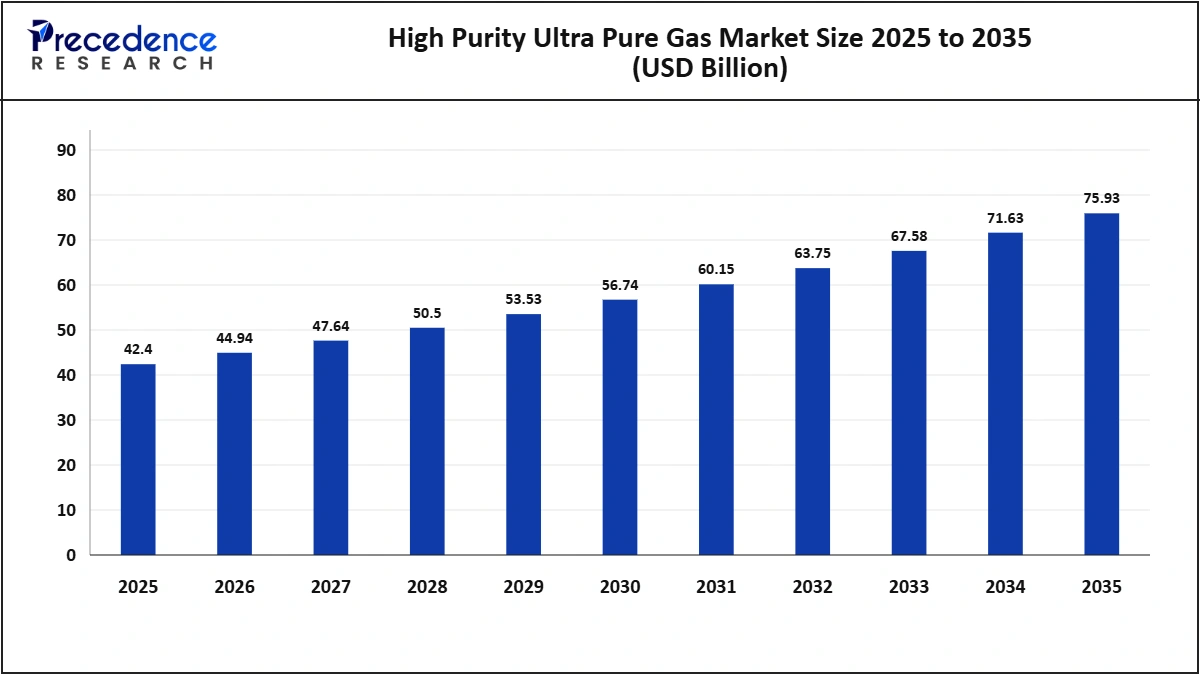
Note: 2025 is the base year, while the figures from 2026 to 2035 are forecasts.
Sources: Expert interviews, secondary sources, Precedence Research database, and Precedence Research analysts.
The high purity ultra pure gas market is expected to grow from USD 42.40 billion in 2025 to USD 75.93 billion by 2035. This growth is mainly driven by the need for very pure gases in advanced semiconductor factories, metal production, chemical plants, hospitals, and laboratories.
These industries need gases with very few impurities, and many require a continuous supply through on-site plants and pipelines. Every new advanced semiconductor factory also needs a dedicated supply of ultra-high-purity gases. As a result, the market is expected to reach USD 56.74 billion by 2030 and grow at a CAGR of 6.00% from 2026 to 2035.
- Analyst View: We estimated the market by calculating the amount of high-purity and ultra-high-purity gas used across different products, supply methods, industries, and regions. We then applied the average prices for gases supplied through on-site plants, liquid deliveries, and packaged cylinders. The estimates also account for the higher prices of gases made specifically for electronics manufacturing.
Semiconductor demand is based on existing and new factory capacity and the amount of gas used to process each wafer. Demand from other industries is based on production levels and gas use in laboratories and medical facilities. We compared the total estimate with the high-purity gas and electronics-related revenue of leading industrial gas companies and with published market estimates. This comparison places our base-year estimate slightly above similar figures. The expected growth reflects new semiconductor factories and stricter purity requirements, while changes in semiconductor investment may affect the pace of growth.
Market Trends
- Gas companies are building dedicated on-site gas plants for new semiconductor factories.
- Advanced chip manufacturing processes require gases with even higher purity levels.
- Low-carbon hydrogen is becoming more important in semiconductor manufacturing.
- The shift of chip manufacturing back to countries such as the United States and Japan is creating new demand for gas plants.
- Companies are working to make noble gas supply chains more reliable and diverse.
- Long-term supply contracts are helping secure gas supplies for factories producing AI chips.
Drivers, Restraints and Opportunities
Driver
New semiconductor factories for AI chips, advanced logic chips and memory chips need large amounts of ultra-pure gases. Advanced manufacturing processes also require stricter purity standards. The shift of chip production to the United States, Japan, and Europe is creating additional demand. Growing use of high-purity gases in healthcare and laboratories is supporting the market as well. Hydrogen is also being used more widely in electronics manufacturing and energy applications.
Restraint
Semiconductor investment can rise and fall depending on market conditions. Delays in factory construction can postpone gas demand. Building on-site gas plants also requires large investments. Political and international events can interrupt noble gas supplies, while high energy costs can increase the cost of producing gases through air separation. Strict safety and quality standards add to operating expenses.
Opportunity
Low-carbon hydrogen and carbon capture can create new business opportunities for gas suppliers serving semiconductor factories. New factories in North America, Europe, Japan, and India offer opportunities to secure long-term supply contracts. Specialty gases used in advanced chip coating and etching processes can command higher prices. Gas recycling and recovery services can help customers reduce costs. Growth in biotechnology and healthcare is also increasing demand for high-purity gases.
Market Segmentation: 2025 Share and Value
High Purity Ultra Pure Gas Market By Product Type 2025 Share & Size
| Segments | 2025 Share | 2025 Market Value |
| High-Purity Atmospheric Gases | 52.60% | USD 22.30 billion |
| Noble Gases | 14.80% | USD 6.28 billion |
| Carbon Gases | 9.40% | USD 3.99 billion |
| Hydrogen | 13.60% | USD 5.77 billion |
| Other Gases | 9.60% | USD 4.07 billion |
Note: 2025 is the base year.
Sources: Expert interviews, secondary sources, Precedence Research database, and Precedence Research analysts.
High-purity atmospheric gases held 52.60% of the market, worth USD 22.30 billion, in 2025. This is mainly because semiconductor factories use ultra-pure nitrogen to clean equipment and maintain environments that prevent unwanted chemical reactions. Oxygen and argon are also used in chip manufacturing, metal production, and welding.
Large amounts of these gases are produced at customer sites through air separation units built for individual factories and industrial plants.
Hydrogen accounted for 13.60% of the market, worth USD 5.77 billion, in 2025. It is the fastest-growing product type because it is used in wafer processing, heat treatment, and oxide removal. The growing supply of low-carbon hydrogen is also supporting this segment.
Noble gases accounted for 14.80% of the market, worth USD 6.28 billion. This group includes helium, which is used for cooling, and neon, which is used in lithography lasers. Carbon gases accounted for 9.40% (USD 3.99 billion), while other gases accounted for 9.60% (USD 4.07 billion).
High Purity Ultra Pure Gas Market by Supply Mode 2025 Share & Size
| Segments | 2025 Share | 2025 Market Value |
| Tonnage (On-Site & Pipeline) | 44.60% | USD 18.91 billion |
| Merchant Liquid | 30.20% | USD 12.80 billion |
| Cylinders & Packaged Gas | 25.20% | USD 10.68 billion |
Note: 2025 is the base year.
Sources: Expert interviews, secondary sources, Precedence Research database, and Precedence Research analysts.
Tonnage supply through on-site plants and pipelines accounted for 44.60% of the market, worth USD 18.91 billion, in 2025. It is also the fastest-growing supply method because new semiconductor factories and large industrial plants often sign long-term contracts for dedicated gas facilities.
Merchant liquid accounted for 30.20% of the market, worth USD 12.80 billion. These gases are transported by tanker and supplied to medium-sized customers. Cylinders and packaged gases accounted for 25.20%, worth USD 10.68 billion. This supply method is commonly used by laboratories, hospitals, and smaller customers that need lower volumes.
High Purity Ultra Pure Gas Market by End Use 2025 Share & Size
| Segments | 2025 Share | 2025 Market Value |
| Electronics & Semiconductors | 34.40% | USD 14.59 billion |
| Metal Production | 18.20% | USD 7.72 billion |
| Chemicals | 14.60% | USD 6.19 billion |
| Medical & Healthcare | 11.40% | USD 4.83 billion |
| Energy & Power | 8.20% | USD 3.48 billion |
| Food & Beverages & Others | 13.20% | USD 5.60 billion |
Note: 2025 is the base year.
Sources: Expert interviews, secondary sources, Precedence Research database, and Precedence Research analysts.
Electronics and semiconductors accounted for 34.40% of the market, worth USD 14.59 billion, in 2025. Chip, display, and solar panel manufacturing require very pure gases in large quantities. This is also the fastest-growing end-use segment because new factories are being built to meet demand for AI chips.
Metal production accounted for 18.20% of the market, worth USD 7.72 billion. Chemicals accounted for 14.60% (USD 6.19 billion), medical and healthcare applications accounted for 11.40% (USD 4.83 billion), and energy and power accounted for 8.20% (USD 3.48 billion). Food and beverages and other applications together accounted for 13.20%, worth USD 5.60 billion.
- Analyst View: We estimated the value of each segment by matching gas consumption and prices with product types, supply methods, and end-use industries. We also considered the revenue mix of industrial gas companies. Atmospheric gases lead because they are used in large volumes, while electronics and semiconductors lead because of the demand from chip factories and the higher prices of gases that meet strict purity requirements. We expect hydrogen, on-site gas supply, and semiconductor applications to gain market share.
Regional Analysis
High Purity Ultra Pure Gas Market by Region 2025 Share & Size
| Region | 2025 Share | 2025 Market Value |
| Asia Pacific | 46.20% | USD 19.59 billion |
| North America | 24.80% | USD 10.52 billion |
| Europe | 19.40% | USD 8.23 billion |
| Middle East & Africa | 5.40% | USD 2.29 billion |
| Latin America | 4.20% | USD 1.78 billion |
Note: 2025 is the base year.
Sources: Expert interviews, secondary sources, Precedence Research database, and Precedence Research analysts.
Asia Pacific held the largest market share in 2025, at 46.20% (USD 19.59 billion), and is also expected to be the fastest-growing region. Taiwan, South Korea, China and Japan are home to many of the world's semiconductor and display factories. Continued investment in new factories across these countries is supporting demand for high-purity gases.
North America accounted for 24.80% of the market, worth USD 10.52 billion. The return of semiconductor manufacturing to the region is creating demand for new on-site gas plants. Major factory projects in Arizona, Texas, Ohio and New York are supporting this growth.
Europe accounted for 19.40% of the market, worth USD 8.23 billion. Its chemical, metal, healthcare, and semiconductor industries support demand. The Middle East and Africa accounted for 5.40% (USD 2.29 billion), while Latin America accounted for 4.20% (USD 1.78 billion). Energy, metal production, and healthcare are important sources of demand in these regions.
Asia Pacific accounted for 46.20% of the market, worth USD 19.59 billion, in 2025. It is the largest and fastest-growing regional market. In 2025, Linde agreed to add an eighth on-site air separation unit at Samsung's Pyeongtaek complex in South Korea. In 2026, Air Liquide announced investments of EUR 200 million in Hiroshima and more than EUR 170 million at another Japanese logic chip factory. Linde LienHwa also plans to invest about USD 800 million in new gas plants for semiconductor factories in Taiwan.
North America accounted for 24.80% of the market, worth USD 10.52 billion, in 2025. In 2026, Linde announced a USD 1 billion expansion of its on-site gas complex in Phoenix to supply two new semiconductor factories. Air Liquide also plans a USD 160 million low-carbon hydrogen facility to support a factory in Arizona. Demand from healthcare and laboratories provides additional support for the market.
Europe accounted for 19.40% of the market, worth USD 8.23 billion, in 2025. The chemical, metal, and healthcare industries are major users of high-purity gases. Semiconductor projects in Germany, Ireland and France are creating additional demand. Industrial gas companies are also investing in lower-carbon production methods.
The Middle East and Africa accounted for 5.40% of the market, worth USD 2.29 billion, in 2025. The energy, petrochemical, and metal industries are the main sources of demand. Growing healthcare investment in Gulf countries is also increasing the use of medical gases.
Latin America accounted for 4.20% of the market, worth USD 1.78 billion, in 2025. Metal production, mining, and healthcare are the main sources of demand in Brazil, Mexico, and Chile. Electronics manufacturing in Mexico also contributes to the market.
Analyst View: We estimated regional market shares using gas consumption, supply methods, and prices in each region. We also considered semiconductor factory capacity when estimating electronics demand. Asia Pacific leads because many semiconductor factories are located there. We expect the region to grow the fastest because it continues to attract major investment in semiconductor manufacturing. North America is also expected to grow quickly as more chip production moves back to the region.
Top 10 Companies in the High Purity Ultra Pure Gas Market
| Rank | Company Name | Market-Specific Revenue (USD Billion) | 2025 Share | Key Products / Business | Headquarters |
| 1 | Linde | 9.20 | 21.70% | On-site, merchant and electronic specialty gases | United Kingdom |
| 2 | Air Liquide | 8.40 | 19.81% | Ultra-pure carrier gases and electronics materials | France |
| 3 | Air Products | 4.80 | 11.32% | Tonnage and electronic gases | United States |
| 4 | Nippon Sanso Holdings | 3.60 | 8.49% | Taiyo Nippon Sanso and Matheson gases | Japan |
| 5 | Messer | 1.40 | 3.30% | Industrial and specialty gases | Germany |
| 6 | Iwatani | 0.80 | 1.89% | Hydrogen and high-purity gases | Japan |
| 7 | SOL Group | 0.50 | 1.18% | Technical and medical gases | Italy |
| 8 | Yingde Gases | 0.48 | 1.13% | On-site industrial gases | China |
| 9 | Resonac | 0.30 | 0.71% | Electronic specialty gases | Japan |
| 10 | INOX Air Products | 0.24 | 0.57% | Industrial and medical gases | India |
Note: Company revenues and market shares are 2025 estimates.
Sources: Company press releases, expert interviews, secondary sources, Precedence Research database and Precedence Research analysts.
Linde led the high-purity ultra-pure gas market in 2025, with an estimated 21.70% share and USD 9.20 billion in revenue. Air Liquide ranked second, with a 19.81% share (USD 8.40 billion), followed by Air Products, with an 11.32% share (USD 4.80 billion).
Linde has a strong position because it operates many large on-site gas plants that supply semiconductor manufacturers. These include its major electronics supply facility at Samsung's Pyeongtaek complex. In 2026, Linde also secured a long-term supply agreement with a leading chipmaker. The agreement includes a USD 1 billion expansion in Phoenix and about USD 800 million in planned new plants in Taiwan through Linde LienHwa.
Air Liquide is another major competitor. It supplies ultra-pure carrier gases and materials for electronics manufacturing and announced several major investments to supply semiconductor factories in Japan and the United States in 2026.
Air Products supplies large-volume industrial gases and electronic gases worldwide. Nippon Sanso Holdings has a strong presence in Japan, Asia and North America through its Taiyo Nippon Sanso and Matheson businesses. Messer, Iwatani, SOL Group, Yingde Gases, Resonac and INOX Air Products also compete in different regional markets.
The top 10 companies accounted for an estimated 70.09% of the market, worth USD 29.72 billion, in 2025. The remaining 29.91%, worth USD 12.68 billion, was shared by regional industrial gas companies, specialty gas producers, and gas purification equipment suppliers.
The market is highly concentrated among a small number of global industrial gas companies. This is mainly because building on-site gas plants requires major investment and long-term agreements with customers. Companies compete on gas purity, reliable supply, their ability to finance and build plants quickly, safety, low-carbon production, and prices agreed under long-term contracts.
Recent Developments
- April 2025: Linde agreed to increase its supply of high-purity gases to Samsung's Pyeongtaek semiconductor complex by adding an eighth on-site air separation unit. The new unit was expected to begin supplying gases around mid-2026. (Source: linde.com)
- April 2026: Air Liquide announced a EUR 200 million investment in two gas production units in Hiroshima, Japan. The units are expected to supply high-purity nitrogen, oxygen, and argon to a leading semiconductor manufacturer from 2028. (Source: airliquide.com)
- July 2026: Linde announced a USD 1 billion investment to expand its on-site gas complex in Phoenix under a long-term supply agreement with a major semiconductor manufacturer. The company also outlined plans for about USD 800 million in new plants in Taiwan. (Source: linde.com)
Market Segments
By Product Type
- High-Purity Atmospheric Gases
- Noble Gases
- Carbon Gases
- Hydrogen
- Other Gases
By Supply Mode
- Tonnage (On-Site & Pipeline)
- Merchant Liquid
- Cylinders & Packaged Gas
By End Use
- Electronics & Semiconductors
- Metal Production
- Chemicals
- Medical & Healthcare
- Energy & Power
- Food & Beverages & Others
By Region
- North America (U.S., Canada, Mexico)
- Europe (Germany, U.K., France, Italy, Spain, Rest of Europe)
- Asia Pacific (China, Japan, India, South Korea, Taiwan, Rest of Asia Pacific)
- Latin America (Brazil, Argentina, Rest of Latin America)
- Middle East & Africa (GCC, South Africa, Rest of MEA)
Research Methodology
This report covers high-purity and ultra-high-purity atmospheric gases, noble gases, carbon gases, hydrogen and other gases supplied through on-site gas plants, liquid deliveries and cylinders across the world.
The 2025 base-year market size was estimated by calculating gas consumption and average selling prices across product types, supply methods, end-use industries and regions. The result was then compared with the high-purity gas and electronics-related revenue of leading industrial gas companies.
Market values for individual segments, regions and companies were estimated using product types, supply methods, end uses and regional demand. Key estimates were checked against company disclosures, regulatory information, industry data and published third-party estimates. Figures or inputs that could not be matched or reconciled were excluded.
All segment, regional and company estimates were aligned with the same 2025 base year. The forecast for 2026–2035 was then calculated using a constant CAGR from the 2025 base and checked for consistency.
Analyst View: Overall Market
The high-purity ultra-pure gas market is closely linked to industrial production. Demand is increasingly being driven by the construction of new semiconductor factories, which require large investments in on-site gas supply systems and long-term supply agreements.
Our estimate is based on gas consumption, supply methods, and prices across different end-use industries. This means the forecast depends on semiconductor factory capacity, industrial production, and the need for higher gas purity. The biggest growth opportunities come from new factories built to produce AI chips and from hydrogen applications. The main risks include changes in semiconductor investment and high energy costs.
Sources and References
- Silicon UK. "Linde to expand supply of industrial gases to Samsung in South Korea". 2025-04-29. Linde Samsung agreement. (Source: silicon.co.uk)
- Evertiq. "Air Liquide invests €200M in Japan to support chip manufacturer". 2026-04-20. Air Liquide Hiroshima. (Source: evertiq.com)
- CHEManager. "Air Liquide invests over $160 million in the US to supply advanced chip manufacturing". 2026-07-16. Air Liquide Arizona. (Source: chemanager-online.com)
- Evertiq. "Linde wins semiconductor supply deal, to invest $1 billion in US". 2026-08-04. Linde Phoenix and Taiwan. (Source: evertiq.com)
- Evertiq. "Air Liquide invests over €170M to support chip manufacturer in Japan". 2026-10-02. Air Liquide Japan logic fab. (Source: evertiq.com)
For inquiries regarding discounts, bulk purchases, or customization requests, please contact us at sales@precedenceresearch.com
Frequently Asked Questions





Ask For Sample
No cookie-cutter, only authentic analysis – take the 1st step to become a Precedence Research client
 Get a Sample




 sales@precedenceresearch.com
 Schedule a Meeting