



Hydrogen Combustion Engine Market Size, Vehicle Production Volume, Sales Performance, Export & Import Analysis, Technology Adoption, Market Share, and Demand Trends
The hydrogen combustion engine market growth is driven by rising demand for low-carbon heavy-duty transportation, stringent government decarbonization targets, expanding hydrogen infrastructure, increasing demand for alternative fuels, technological advancements in hydrogen combustion, and growing adoption across commercial vehicles, construction equipment, agriculture, mining, and other industrial applications.
Source: https://www.precedenceresearch.com/hydrogen-combustion-engine-market
 Get a Sample
 Table Of Content


The global hydrogen combustion engine market size is projected to be valued at USD 38.42 billion in 2026 and is expected to hit around USD 88.98 billion by 2035 with a registered CAGR of 9.78% over the forecast period 2026 to 2035. The hydrogen combustion engine market is driven by rising demand for low carbon heavy duty transportation, government decarbonization targets and growing hydrogen infrastructure.
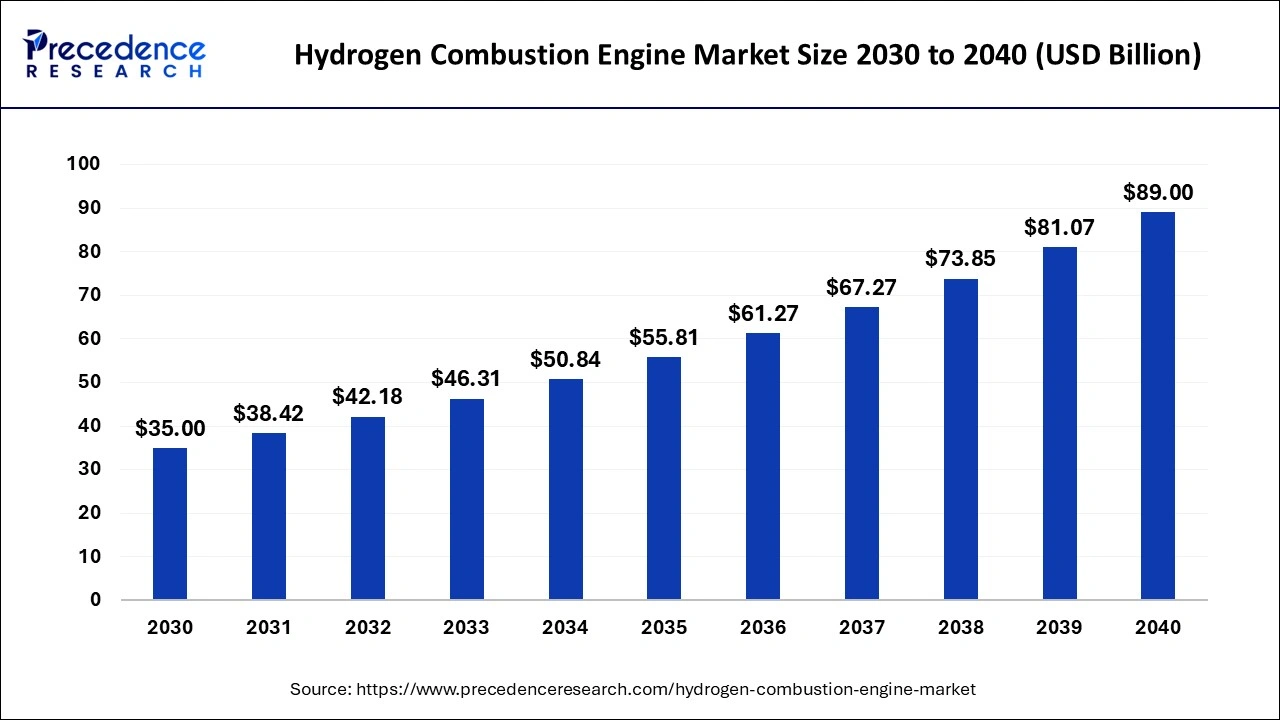
For vehicle propulsion, hydrogen-combustion engines typically modified versions of traditional gasoline-fueled combustion engines are necessary. These engines can benefit from modern technology, providing a zero-emissions option for particular applications while promoting the expansion of hydrogen infrastructure across the world.
Key Takeways
- North America dominated the global hydrogen combustion engine market with the largest market share of 45% in 2025.
- By technology, the proton membrane exchange segment has held a major market share of 58% in 2025.
- By application, the Passenger vehicle segment contributed the significant market share in 2025.
Market Overview
The hydrogen combustion engine market includes engines that burn hydrogen as a fuel instead of conventional petrol or diesel. The manufacturers are shifting towards cleaner alternatives to conventional diesel engines for heavy duty and off road applications. The demand is growing across heavy trucks, buses, construction machinery, agricultural equipment, mining vehicles, and other industrial power systems. Companies such as Cummins, JCB, and DEUTZ are investing in hydrogen engine development. Hydrogen combustion engines are suitable for existing engine manufacturing and servicing infrastructure, which encourages manufacturers in adopting. The strict government regulations and growing hydrogen programs further support investment in hydrogen production.
Growth Factors
Alternative fuels may emerge to offer combustion engines a fresh lease on life while gasoline and diesel may be on the way out. This may portend a future when we burn hydrogen. Hydrogen has been positioned as a fuel in vehicles like the Honda Clarity and Toyota Mirai that can be used to generate energy to power what is nominally an EV. However, the fuel need not be burnt in a fuel-cell stack; it might also be done so in a combustion engine. As industrialization and global energy consumption rise, there is a daily rise in the need for fossil fuels. In order to meet the rising need for energy, several nations are searching for alternate energy sources
An alternative fuel with excellent qualities and great efficiency is hydrogen. It is anticipated that the development of hydrogen-powered vehicles would lower fuel usage and exhaust-related air pollution. The results of utilizing hydrogen as an extra fuel are looked at, along with the usage of hydrogen as a fuel in automobiles and the most recent experimental research in the literature. The implications of using hydrogen as a supplementary fuel for internal combustion gasoline, diesel, and LPG engines on engine performance and exhaust pollutants are discussed. Engine power and torque are most significantly boosted for gasoline engines depending on the amount of hydrogen injected into the fuel system, while they are diminished for diesel and LPG engines. Chemically speaking, gasoline and LPG engines emit fewer toxic exhaust gases, however, some diesel engines produce more nitrogen oxide. Furthermore, it is acknowledged that the use of hydrogen in all engine types would have a favorable impact on the environment.
The main benefits of hydrogen combustion over fossil-based fuels are the wide range of flammability and extremely high flame speed figures. With substantially greater fuel economy and very low NOx emissions, it may be effectively employed for lean burn combustion. Heavy-duty 2 L single-cylinder testing at various engine speeds and loads will be used to demonstrate the potential of lean-burn hydrogen combustion for NOx reduction.
- Hydrogen combustion engines may make use of current technology, offer a zero-emissions alternative for particular use cases, and help the expansion of hydrogen infrastructure.
- The global market for hydrogen fuel cells is expanding as a result of the rising demand for fuel cell electric cars.
- The market for hydrogen fuel cells is expanding as a result of rising sales of fuel cell electric vehicles, which shows the growing demand for such vehicles.
- Companies in the hydrogen fuel cell industry are creating new technologies to make hydrogen fuel cells lighter, cheaper to manufacture, and requiring less components. Technology advancements increase the effectiveness of hydrogen fuel cells.
- The popularity of phosphoric acid as a fuel cell electrolyte, which includes its stability, low vapour pressure, tolerance to carbon monoxide, and capacity to use air as the cathode reactant gas, is largely responsible for the increase in demand for its usage in hydrogen cars.
Market Outlook
- Industry growth overview - The hydrogen combustion engine market is gaining attention in heavy trucks, construction equipment, agriculture and power generation. The growth is driven by strict carbon neutral targets and global incentives.
- Global expansion - North America, Europe, and Asia Pacific are leading development, while China, Japan, Germany and the United States are advancing commercial projects.
- Sustainability trends - The market is moving towards cleaner hydrogen fuels, higher efficiency combustion and hybrid systems. The adoption of these engines helps in meeting sustainability goals by reducing carbon emissions.
- Major Investors - The global engine and vehicle manufacturers and energy companies are investing in engine development and infrastructure development. Major investors in the market include Cummins, Toyota, JCB, SEUTZ, and other industrial players.
- Startup ecosystem - The startup ecosystem in the market is focusing on combustion control, fuel systems and engine conversion technologies.
Hydrogen Combustion Engine Market Scope
| Report Coverage | Details |
| Market Size in 2026 | USD 38.42 Billion |
| Market Size by 2035 | USD 88.98 Billion |
| Growth Rate from 2026 to 2035 | 9.78% |
| Leading Region | North America |
| Fastest Growing Region | Asia Pacific |
| Forecast Period | 2026 to 2035 |
| By Technology | Proton Membrane Exchange, Phosphoric Acid Fuel Cell, and Others |
| By Application | Passenger Vehicle, Commercial Vehicle, Ships, and Others |
| Regions Covered | North America, Europe, Asia-Pacific, Latin America, and Middle East & Africa |
Hydrogen Combustion Engine Market Dynamics
Drivers
- Governmental initiatives to promote the use of fuel-cell cars are increasing - In many nations, government activities are anticipated to be extremely important in promoting fuel cell electric cars. A number of nations are putting their plans into action to outlaw gasoline and diesel automobiles by the years 2030 to 2040 in order to cut pollution and promote the sale of hydrogen fuel cell vehicles. For instance, the Japanese government declared its intention to deploy 80,000 fuel cell vehicles and 900 additional hydrogen recharging stations by the year 2030. Governments also assist OEMs and automakers by sponsoring a number of initiatives involving hydrogen-powered vehicles. For instance, in July 2019. California's high-speed rail project received backing from the US Department of Transportation and the State of California in the amount of $929 million in federal grant money. In order to create more effective hydrogen-powered fuel cells for German trains, the German Ministry of Transport and Digital Infrastructure granted Siemens, Canadian fuel cell producer Ballard Power Systems, and RWTH Aachen University a $12.53 contract in 2018.
- Wide flammability range - Wide variety of fuel-air combinations may ignite hydrogen, which has a broad range of flammability. In reality, hydrogen may operate on a "lean" combination, in which there is less fuel present than what is required for combustion with the available air. Because of the improved fuel efficiency and typically lower-end combustion temperature, less pollution, including NOx, is released through the exhaust.
- High auto-ignition temperature - A hydrogen engine may run at greater compression ratios than a hydrocarbon engine because hydrogen has a higher auto-ignition temperature. Greater thermal efficiency, or less energy loss during burning, is produced by a higher compression ratio.
Challenges
High costs involved in the management and generation of hydrogen
- By electrolyzing water with a strong electric current to separate the hydrogen and oxygen atoms, hydrogen is typically produced from water. Due to the significant energy costs involved, electrolysis is a somewhat pricey operation. The bulk and space requirements for hydrogen as well as fuel management and storage onboard aircraft provide difficulties for designers. Compared to aircraft powered by conventional jet fuel, hydrogen-powered aircraft must carry a significantly greater amount of fuel due to the high volume-to-energy attribute of liquid hydrogen. This increases air drag and reduces the aircraft's fuel efficiency.
- One characteristic of hydrogen is that its density is much lower than that of gasoline. To maintain its usefulness and efficiency as a power source, it must be compressed, made liquid, and stored in the same way at lower temperatures. Because of this, it is necessary to transport and store hydrogen at high-pressure conditions, making the use of hydrogen for transportation and everyday purposes currently impractical. Aside from that, switching to hydrogen-powered automobiles and planes comes at a significant expense. The new customized automobiles demand significant financial commitments to develop and produce. Therefore, these factors might restrain the demand for hydrogen-powered internal combustion engines.
Opportunities
- Rising demand for automobiles with fuel cells - Fuel cell technology is perfect for transportation and automotive applications because it provides long driving ranges, quiet operation, quick refilling, and zero emissions of harmful gases and air pollutants. Additionally, the market for hydrogen internal combustion engines is seeing potential growth due to the surge in demand for fuel cells as a more environmentally friendly option to conventional cells.
Segmental Insights
Technology Insights
The primary component of the market for hydrogen combustion engines is the proton exchange membrane. The worldwide hydrogen combustion engine market is divided into proton membrane exchange and phosphoric acid fuel cells, and other technologies based on those. The proton exchange membrane, which transports protons from the anode to the cathode across the membrane, is crucial to the successful completion of the electrochemical process. In a hydrogen engine, oxygen is reduced at the cathode, and hydrogen is delivered, which is then oxidized at the anode. The segment's adoption is predicted to rise fast over the projection period, supporting this expectation. Additionally, liquid phosphoric acid is utilized as the electrolyte present in the phosphoric acid fuel cells, or also known as PAFC. Due to its reliability, effectiveness, and affordability, this is frequently used and has fueled the market's expansion throughout the foreseeable future.
Application Insights
Commercial vehicles are four-wheeled conveyances used for goods transportation. Commercial vehicles on the road are those that transport people, goods, or both. This group of vehicles includes buses, trucks, vans, and others that are comparable. Every economy needs commercial vehicles as they are necessary for the mobility of both people as well as products.
A road vehicle, like a car, van, or truck, that is primarily used to transport people rather than cargo is known as a passenger vehicle. Manufacturers of passenger cars have developed a market niche for appealing to the country's middle class with affordable costs, high-quality features, compact sizes, and straightforward financing choices. For instance, according to the International Organization of Motor Vehicle Manufacturers, worldwide automobile manufacturing fell by 16% to fewer than 78 million cars or sales levels from 2010. (OICA).
Regional Insights
According to geography, North America is anticipated to have a significant market share for hydrogen combustion engines throughout the anticipated time frame. This is due to the rising R&D expenditures made to create cutting-edge solutions and meet end-user demands. Additionally, the U.S. government's programs for ecological sources are promoting market expansion throughout the area. Although the hydrogen combustion engine is still in its infancy, policymakers are being prompted to support the use of hydrogen internal combustion engines by the negative effects of CO2 emissions in industrialized and rising countries, like the United States and China. The government in Europe has requested manufacturers to reduce CO2 emissions for new on-highway vehicles by about 30% starting in 2030. Similar objectives for reducing emissions have been set by the United States and China. As a result, the domestic market participants in the relevant regions are seeing prospects for expansion.
During the projected period, the hydrogen combustion engine market is anticipated to exhibit the greatest CAGR in Asia-Pacific. This is supported by the region's key market players' expansion and rising fuel prices, which will drive market development in the ensuing years.
U.S. Market Trends
The United States represents the largest share of the hydrogen combustion engine market in North America. The growth is driven by increasing industrial decarbonization initiatives and strong adoption of clean energy. The country is increasing its investment in hydrogen infrastructure and research and development. Industries are also promoting hydrogen engines as a practical option where battery electrification id difficult. The government in the region is supporting adoption of hydrogen engines, which further drives market growth in the United States.
What are the Drivers of the Asia-Pacific Hydrogen Combustion Engine Market?
Asia-Pacific is expected to grow at a notable CAGR in the foreseeable future. The increasing prices of gasoline and the surging rate of emissions have prompted automakers to develop hydrogen engines. Governments of several nations, such as India, China, South Korea, and Japan, are launching numerous policies to increase the adoption of eco-friendly vehicles. This region is home to several automotive brands such as Toyota, Honda, and Komatsu, which are engaged in designing hydrogen engines for commercial vehicles.
China Market Trends
China accounts for the largest share of the hydrogen combustion engine market in Asia-Pacific in 2025. The growth is driven by its large commercial vehicle industry and strong domestic engine manufacturers. The country is developing national safety standards covering hydrogen vehicle engines, fuel systems, leakage, and other key components. The country is shifting hydrogen engines from research towards commercial vehicle applications in heavy trucks and hybrid powertrains. These factors are further expanding the market growth in China.
How is the European Hydrogen Combustion Engine Market Boosted?
Europe is considered to be a significantly growing area, due to the surging focus of the government on lowering CO2 emissions, potentiating the demand for hydrogen-powered vehicles. Also, leading automotive brands such as Volvo and BMW are constantly testing their hydrogen engines to gain trust among consumers. Some engine makers are investing rapidly in opening new manufacturing centers to increase the production of hydrogen engines.
Germany Market Trends
Germany leads the European hydrogen combustion engine market in 2025 due to its established automotive and industrial engine sector. The manufacturers in the country are developing hydrogen compatible combustion engines for industrial and transportation use. The technology is attracting more manufacturers as it retains familiar engine manufacturing capabilities while reducing dependence on conventional diesel. The country is focusing on industrial decarbonization, which encourages combustion innovation, emissions control and heavy duty applications in the market.
What are the Trends of the Hydrogen Combustion Engine Market in Latin America?
Latin America is expected to grow at a considerable CAGR in the upcoming period. The growing adoption of hydrogen trucks by the logistics operators across Brazil and Argentina has driven the market expansion. Governments are making significant investments in establishing hydrogen refueling centers to increase the popularity of hydrogen vehicles. The presence of numerous automotive laboratories allows engineers to check the quality of hydrogen engines.
Brazil Market Trends
Brazil accounts for the largest share of the Latin American hydrogen combustion engine market in 2025. Hydrogen combustion engines can be widely used in heavy transportation, mining and other applications where electrification is difficult. The country has abundant renewable energy resources that provide a strong foundation for low carbon hydrogen production. The government in Brazil is strengthening its National hydrogen framework and supporting research and development projects.
Which Factors Boost the Hydrogen Combustion Engine Market in the Middle East and Africa?
The Middle East and Africa region is expected to show lucrative growth during the forecast period. The increasing deployment of hydrogen buses by the fleet operators in Saudi Arabia and the UAE boosts the market growth. In South Africa, the automakers are setting up new research and development centers to produce different types of automotive engines. In addition, the growing use of hydrogen engines in commercial ships to enhance cross-border trade activities further drives the industrial expansion.
Saudi Arabia Market Trends
Saudi Arabia represents the leading market within the Middle East and Africa hydrogen combustion engine market in 2025, supported by increasing investment like NEOM, in massive multi-gigawatt renewable energy facilities and mobility infrastructure. The country's abundant solar and wind resources are supporting large scale hydrogen production. The adoption of hydrogen combustion engines is driven by heavy duty transport, mining, construction equipment, and industrial vehicles.
Competitive Landscape
The hydrogen combustion engine market is consolidated in nature, as the leading players constitute more than 60% of the total revenue of the industry. The prominent players dealing in this sector include Komatsu, Rio Tinto, Honda, Toyota, JCB, BMW, Volvo, and MAN. These companies are constantly engaged in the research and development of hydrogen engines and adopting strategic moves such as partnerships, innovations, and business expansions to maintain their dominance in this sector.
The surging geopolitical tension in different parts of the world and the lack of well-established hydrogen infrastructure in developing nations have negatively impacted the businesses of the market players. The increasing focus of the government on deploying zero-emission vehicles for public transportation has urged the leading companies to invest in this field. The advancements in direct injection & pre-chamber technology are likely to drive the industry in the coming years.
Top Companies in the Hydrogen Combustion Engine Market and Their Offerings
- Cummins Inc. - The United States based company is one of the leading developers of hydrogen internal combustion engines.
- Key offerings - 6.7 litre and 15 liter hydrogen engines for commercial vehicles, trucks, buses and other heavy duty applications.
- JCB - The United Kingdom based company developing hydrogen combustion technology for off highway machinery.
- Key offerings - A 4.8 liter hydrogen powered combustion engine designed for backhoe loaders, excavators and other construction equipment.
- MAN Truck & Bus / MAN Energy Solutions - A German company that develops large engines and power systems for transport and industrial applications.
- Key offerings - MAN hTGX heavy-duty truck powered by an H4576 inline six hydrogen combustion engine
- DEUTZ AG - A Germany based company providing hydrogen options to replace diesel configurations.
- Key offerings - the TCG 7.8 H2 engine, a 6 cylinder hydrogen engine producing around 200kW.
- Toyota Motor Corporation - A Japan based company developed hydrogen fueled internal combustion engines for motorsport.
- Key offerings - A 1.6 liter turbocharged three cylinder hydrogen ICE and a Hydrogen ICE Hilux pickup prototype.
Hydrogen Combustion Engine Market Companies
- Rio Tinto
- Komatsu
- Honda
- Toyota
- JCB
- BMW
- MAN
Recent Developments
- In May 2026, Volvo Trucks launched a new hydrogen combustion engine. This engine was designed to lessen fuel consumption, lower emissions, lower noise, and enhance drivability.
- (Source: https://www.volvotrucks.com/en-en)
- In March 2026, Bosch launched the C100. C100 is a new range of hydrogen fuel-cell engines designed for urban buses.
- (Source: https://bus-news.com)
- In December 2025, Johnson Matthey (JM) opened a new hydrogen internal combustion engine (H₂ICE) production center in Gothenburg. This new center was established to develop a wide range of hydrogen engines for heavy-duty trucks and buses. (Source: https://matthey.com)
- In July 2021, Hyzon Motors Inc. announced a new commercial vehicle that may reduce the weight and manufacturing costs of a commercial vehicle fuelled by Hyzon's hydrogen fuel. The US-based Hyzon Motors Inc. manufactures commercial cars using hydrogen fuel cells that emit no emissions. Modern technology mixes lightweight composite materials with a metal system structure.
- Hydron Motors and Decarbonization Plus announced a corporate merger on February 9th, 2021. The firm will be able to completely fund and support Hyzon's long-established goal for expansion in the hydrogen fuel cell-powered, emission-free commercial transportation sector thanks to this purchase.
Segment Covered in the Report
By Technology
- Proton membrane exchange
- Phosphoric acid fuel cell
- Others
By Application
- Passenger vehicle
- Commercial vehicle
- Ships
- Others
By Geography
- North America
- Europe
- Asia-Pacific
- Latin America
- Middle East & Africa (MEA)
For inquiries regarding discounts, bulk purchases, or customization requests, please contact us at sales@precedenceresearch.com
Frequently Asked Questions





Ask For Sample
No cookie-cutter, only authentic analysis – take the 1st step to become a Precedence Research client
 Get a Sample




 sales@precedenceresearch.com
 Schedule a Meeting
