



Hydropower Market Size, Key Companies, Company Market Share, Power Generation Capacity, Energy Consumption, Pricing Trends, Investment Analysis, Competitive Positioning, and Demand Forecast
Hydropower Market (By Type: Mini Hydropower, Micro Hydropower; By Capacity: Above 100 MW, Under 10 MW, Others; By Component: Civil Construction, Electromechanical Equipment, Electric, Power Infrastructure, Others; By End-User: Industrial, Utility, Others) - Global Industry Analysis, Size, Trends, Leading Companies, Regional Outlook, and Forecast 2026 to 2035
Source: https://www.precedenceresearch.com/hydropower-market
 Get a Sample
 Table Of Content


What is the Hydropower Market Size?
The global hydropower market size is calculated at USD 278.71 billion in 2025 and is predicted to increase from USD 291.81 billion in 2026 to approximately USD 439.73 billion by 2035, expanding at a CAGR of 4.67% from 2026 to 2035. The hydropower market is driven by rising demand for renewable energy and investments in clean power generation
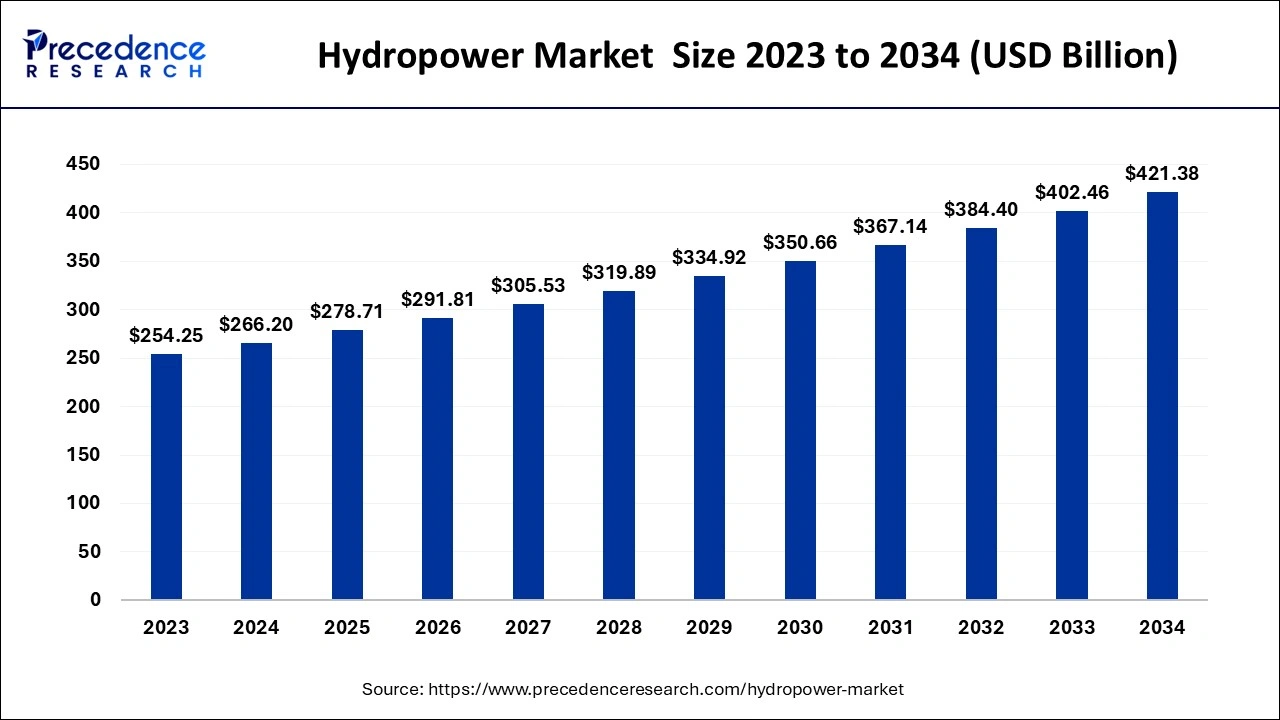
Market Highlights
- Asia Pacific dominated hydropower market in 2025.
- By type, the micro hydropower dominated the market in 2025.
- By component, the civil construction segment led the market in 2025.
Market Overview
The kinetic energy that is contained within the moving water is utilized to produce renewable energy source in the form of electricity that can be utilized for a varied number of purposes. The increasing demand for renewable energy sources all over the world pertaining to the rapid climate change that has taken place along with the global warming has helped the market to record a considerable revenue over the period of time due to the huge number of potential consumers that it is experiencing all over the world who are opting for renewable sources of energy instead of the conventional utilization of fossil fuels.
The key market players are making huge investments with a view to introduce modern technology that will help to harness renewable sources of energy which will help to fulfill the needs and demands of power of the huge population residing all over the world. Increasing demand for saving energy all over the world is also helping the hydropower market to record a considerable growth over the period of time which is expected to grow further during the future as well.
The utilization of the kinetic energy of the flowing water for the purpose of generation of electricity has emerged as a tremendous opportunity for the key market players to produce a huge amount of power that can be provided to the people as and when required and hence fulfill the demands of the people. Increasing concern regarding global warming and the greenhouse gases has pushed the government of a number of countries to take part in the production of energy with the help of hydropower projects that will help to solve the problem of shortage of electricity and energy in the various sectors of the world.
Key AI Integration in the Hydropower Market
AI is revolutionizing the hydropower sector with its ability to enhance operational efficiency, predictive maintenance, and resource and information management. Surveys conducted with the help of artificial intelligence can provide early alerts of potential issues with each turbine, allowing them to schedule turbine maintenance during appropriate periods of the day for minimal downtime and maintenance costs. AI automation can also be used as a component of plant control systems, allowing for game-changing real-time decision-making and contributing to stabilising the grid.
Hydropower Market Growth Factors
The increasing demand for saving power has emerged as a major growth factor for the hydropower generation projects which is expected to show a tremendous boost over the period of time pertaining to the increasing demand for renewable sources of energy. A huge number of potential consumers all over the world are opting for renewable sources of energy with a view to protect the environment from the greenhouse emissions and rapid climate change.
The government is actively participating in the purpose of saving energy as well as producing a greater number of renewable sources of energy that will in turn help to solve the problem of shortage of power and hence meet the demands of a huge number of people all over the world. The emergence of the key market players in the hydropower industry has helped the market to introduce new technologies into the sector with the help of the rapid research and development programs that are carried out to increase the productivity of the hydropower projects.
The increasing demand for better power supply pertaining to the constant power outages has boosted demand for small hydropower projects that are able to fulfill the needs of the potential consumers all over the world. The active participation of the government to provide better services to the people has increased the total number of users that are opting for power supply from small hydropower systems which is expected to propel the growth of the market during the forecast period at a faster rate.
- Increasing demand for saving power
- Increasing demand for renewable sources of energy
- Increasing awareness regarding global warming
- Increasing instances of power outages
Market Outlook
- Industry Growth Overview: Hydropower is expected to see a continuous increase in Demand due to an increase in the amount of renewable energy developed, improving reliability of electricity Systems, and making use of low-carbon sources of Energy.
- Sustainability Trends: Development will be moving towards sustainable designs including eco-friendly designs, fish passage systems, low-impact turbines, environmentally-inclusive planning. Furthermore, organizations will be developing carbon-neutral energy resolutions increasing the rate of adoption.
- Global Expansion: Characteristics of emerging markets the construction of hydropower infrastructure is quickly becoming a priority for emerging markets of the Asia-Pacific region, Africa, South America, as those regions experience energy deficits and need to fulfil their climate change obligations to the global community.
Hydropower Market Trends
- Growing Renewable Energy Adoption: This new focus on the clean energy transition and carbon reduction is leading to improved hydropower development. Governments invest in renewable infrastructure to ensure the security of supply, while reducing dependence on fossil fuels.
- Technological Advancements in Hydropower Systems: Due to the efficiency of turbines and innovations in digital monitoring and automated control, hydropower generation is becoming more efficient. Ingenuity is bringing new technologies that can help with managing even more resources, enhancing operation reliability, and achieving affordable life cycle power generation costs.
- Increasing Small and Micro Hydropower Projects: With the rising demand for decentralised energy solutions, small and micro hydropower projects are taking off. They can provide reliable power, provided that they are not always connected to electricity grids, especially in parts of Africa.
- Modernization of Existing Hydropower Plants:The increasing decentralised energy demand is contributing to the take-off of small and micro hydropower projects. These systems provide dependable electricity power supplies, particularly where there is poor access to an electric grid in parts of Africa.
- Government Support and Investments: The hydropower market is growing due to policy support and the goals and investments for the renewable energy transition. Hydro power is becoming more popular globally for supporting the sustainable energy and climate agenda.
Strategic Growth Opportunities
- High Growth Commercial Opportunities: The increasing demand for renewable energy and grid stability solutions is providing opportunities for growth in the hydropower industry, modernization, and pumped storage initiatives. The trend of funding clean energy projects is projected to contribute to commercial sustainable development in the long-term.
- Emerging Technology Opportunities: The opportunities that lie in the integration of AI, digital twins, automation, and advanced monitoring systems in the context of hydropower include enhancing efficiency and operational performance. Smart hydropower solutions can improve predictiveness and reliability of plant operations, resource optimization, and predictive maintenance.
- Geographic Expansion Opportunities: The growing demand for electricity and renewable energy investments in emerging markets of APAC, Africa, and Latin America offer great opportunities. Further Development of Hydropower in developing areas can enhance Market Penetration.
- White Space Analysis: There are potential opportunities for small-scale hydropower, pumped-storage, and hybrid renewable energy projects. There are new opportunities for expanding access to energy and upgrading old hydropower plants.
Future Outlook and Strategic Recommendations
- Long-Term Industry Outlook: The hydropower market will be steadily expanding as countries' focus shifts towards the transition of the renewable sector and carbon reduction. Additional investment will be made in sustainable, shared infrastructure and storage facilities, which will enable market development.
- Emerging Business Models: Public-Private Partnerships (P3), EaaS (Energy as a Service), and DAM (Digital Asset Management) are rising in importance for new business models. These models can serve as a way to enhance the project's financial sustainability, the efficiency of the stakeholders, and the generation of long-term revenues.
- Strategic Recommendations for Stakeholders: Stakeholders need to concentrate on using technological alternatives, upgrading existing plants, as well as creating eco-friendly hydropower solutions. The expansion of partnerships will contribute to competitive positioning, entering emerging markets, and investing in innovation.
Market Scope
| Report Coverage | Details |
| Market Size in 2025 | USD 278.71 Billion |
| Market Size in 2026 | USD 291.81 Billion |
| Market Size by 2035 | USD 439.73 Billion |
| Growth Rate from 2026 to 2035 | CAGR of 4.67% |
| Base Year | 2025 |
| Forecast Period | 2026 to 2035 |
| Segments Covered | Type, Capacity, Component, End-User, and region |
Market Dynamics
Drivers
- Increasing demand for electricity - The total demand for electricity is rapidly increasing due to the huge number of industries and manufacturing units that are emerging in the global market which requires a heavy supply of energy for continuing their functioning. The household sector has seen a tremendous boost in the consumption of electricity pertaining to the varied number of electrical appliances that are utilized on a daily basis.
- Increasing demand for renewable sources of energy - Rapid consumption of electricity has increased the demand for renewable sources which help to reduce the overall consumption of fossil fuels for the generation of electricity. With a view to reduce the global warming and rapid climate change people have started adopting the usage of renewable sources of energy on a larger scale.
Opportunities
- Participation of the government - The initiative that is taken up by the government for increasing the generation of power with the help of hydropower stations has helped the market to record a considerable revenue over the period of time by providing it with multiple opportunities. The rapidly increasing support of the government for hydropower projects has also provided great opportunities to the growth of the market during the forecast period.
- Easy replacement and maintenance - Maintenance and replacement of micro hydropower projects emerge as a major opportunity for the growth of the market pertaining to the availability of commercially sold generators and turbines in the market which need to be assembled for the generation of electricity.
Challenges
- Insufficient resources for a generation - The number of resources that are available for the generation of hydropower has emerged as a major challenge for the growth of the industry. The number of facilities that are available in the under developed and developing countries is proving to be a major obstacle for the growth of the hydropower market. The government of the underdeveloped nations have landed into various collaborations with the developed nations for developing the hydropower projects to facilitate the production of energy at a larger scale.
Hydropower Market Segment Insights
Type Insights
On the basis of type, the segment of micro hydropower has emerged as the largest global segment pertaining to the increasing demand for this type of hydropower projects which range up to 1 MW that helped to provide energy to the rural sector and small community which resides in the remote areas and do not have access to the large-scale power production plants. The huge number of people that are dependent on the micro hydropower projects for the supply of energy has emerged as a major driving force for this particular segment which is expected to grow further pertaining to the suitability of this type for the smaller sectors.
The essential components that are required are included in the micro hydropower projects which are turbines, pumps, pipelines, alternators, electricity distribution wiring, regulators and conveyance channels which together help to form the entire hydropower system. A complete package which consists of generators and turbines are sold commercially that are assembled for the individual hydropower projects and helps to make the entire system very easy for managing and replacing in case a maintenance issue arises.
Capacity Insights
On the basis of capacity, the segment of up to one MW has emerged as the largest global segment of the standalone systems which provides electricity to the smaller sectors of the society which do not have an access to the larger hydropower plants. The availability of resources such as flowing water in the foothills and through mountain ranges has emerged as a major reason for the increasing demand for this particular segment with a view to provide energy.
The next segment which has been discussed under this category is one MW to ten MW capacity which are usually used for feeding the main grid. The factors such as cost saving and negative environmental conditions is expected to help this segment to record a considerable revenue over the forecast period.
Component Insights
On the basis of component, the civil construction segment has hit largest share in 2025. The small power projects hold a substantial share in the total cost of the civil construction sector. The setting up of the entire system requires a particular arrangement which needs to be made for allowing the water to enter the turbines properly to obtain the best possible results. The level of the water head needs to be raised and the construction of the dams requires the inclusion of civil professionals into the system which helps this segment to record a considerable revenue over a period of time.
The inclusion of civil construction professionals into the system helps to make the entire project more economical as compared to the other options available in the market. The next segment which has been discussed under this category includes power infrastructure and electromechanical equipment which are showing a considerable growth over the period of time pertaining to the increasing demand for technically better and advanced designs which will help to generate more amount of energy within the limited available resources.
Hydropower Market Regional Insights
What is the Asia Pacific Hydropower Market Size?
The Asia Pacific hydropower market size is evaluated at USD 122.56 billion in 2026 and is predicted to be worth around USD 187.50 billion by 2035, rising at a CAGR of 4.81% from 2026 to 2035.
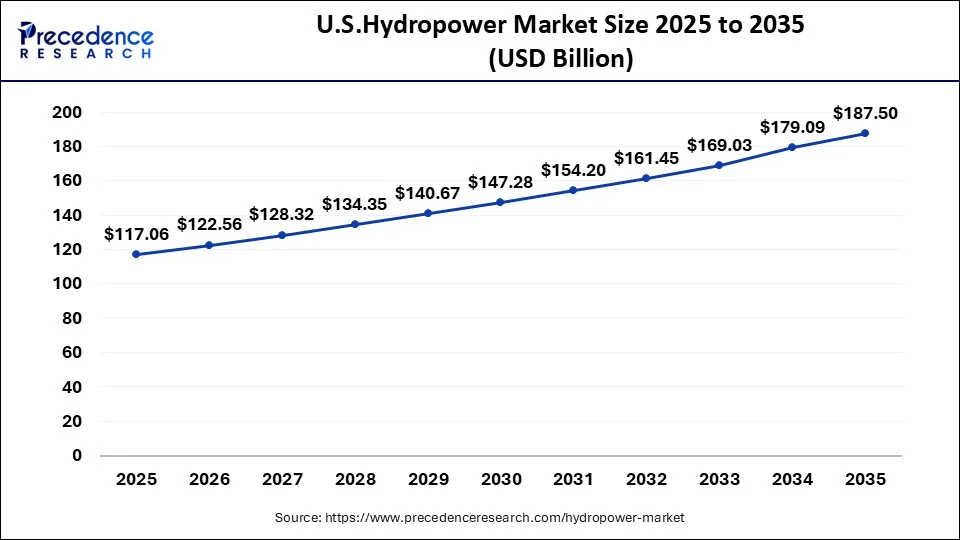
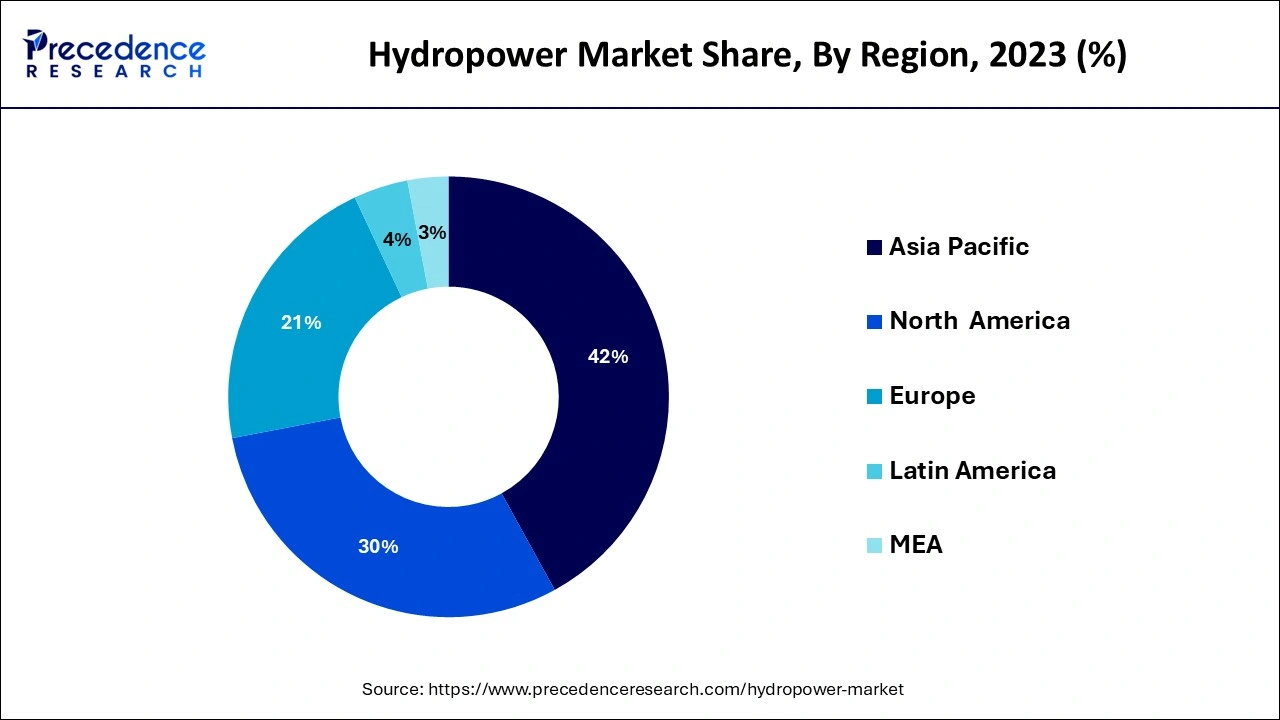
On the basis of geography, the region of Asia Pacific has held largest market share of over 42% in 2025 which has been supported by the minimum cost of production of renewable energy sources and the rapid reduction in the total cost of infrastructure. The increasing demand for electricity has been fulfilled with the help of hydropower projects which has helped to make this region a leading market player among the other competitors in the market. The setting up of micro and mini hydropower stations across the region has also proved to be a major opportunity for the growth of this region. The increasing investments made by the key market players for the generation of electricity and supplying the rural areas has helped the market to record a considerable revenue over the period of time.
China Hydropower Market Trends
China's market is driven by the country's commitment to many renewable energy sources. As the largest manufacturer of hydropower worldwide, China has invested heavily in infrastructure development, aiming to improve capacity and efficiency. This focus on sustainability works with national policies that prioritize lowering carbon emissions and promoting clean energy.
Why is North America the Fastest-Growing Region in the Hydropower Market?
North America is the fastest growing market for the hydropower market with a significant CAGR during the forecast period, fueled by increasing investments in renewable energy, upgrades to aging infrastructure, and favorable government policies. The region is actively shifting from fossil fuels to cleaner energy options, with hydropower playing a vital role in decarbonization initiatives. Innovations in technology, such as small hydro and pumped storage projects, are gaining popularity. Moreover, collaborations between public and private sectors, along with federal incentives, are promoting the expansion of new hydropower capacities. The rising focus on energy security and sustainable development further boosts the demand for reliable and low-emission power generation throughout the region.
United States Hydropower Market & Trends
The United States stands at the forefront of the hydropower market in North America, supported by its extensive water resources and established hydro infrastructure. The U.S. Department of Energy continues to provide funding for hydro modernization initiatives and small-scale hydro projects. With a growing emphasis on grid stability and energy diversification, pumped-storage hydropower is starting to gain popularity. Strategic efforts to combine hydropower with solar and wind energy systems also aid its advancement in the U.S. energy landscape
What are the Factors for the Increasing Investment in Latin American Hydropower Projects?
Latin America has emerged as an increasingly attractive location for hydropower development thanks to its wealth of rivers, favourable project economics, and government support for renewable energy independence. Countries like Brazil, Colombia, and Chile have numerous large projects underway as they rapidly build new dams, develop pumped-storage systems, and upgrade their current infrastructure. With strong natural water resources and available land that is well-suited to large hydropower development, Latin America is positioned to receive increasing amounts of international investment in hydropower.
Brazil Hydropower Market Trends
The Brazilian government has implemented various policies targeted at improving the efficiency and even sustainability of hydropower projects. These initiatives involve investments in modernizing existing facilities and encouraging the development of new plants, mainly in regions with untapped potential. Moreover, the aim of environmental sustainability has contributed to increased scrutiny of hydropower projects, thus necessitating a balance between energy demands and ecological preservation.
How Has Europe Maintained it's Leadership Role in Modernizing Hydropower and Developing Green Energy Policies?
Europe continues to lead the way in innovation in hydropower through the progress of modernizing the region's extensive and aged hydropower fleet, as well as the development of new and improved pumped-storage capacity to enable maintaining grid stability through renewable resources. With ambitious decarbonization targets from the EU, as well as renewable energy targets by member nations like Norway, Austria, and France, there is a strong push within Europe to implement technologies such as automation, digital operating systems, and low-impact hydropower.
The region of Europe has also shown a tremendous growth owing to the increasing shift towards renewable sources of energy and rapid adoption of small hydropower projects which is expected to boost the market in this particular region during the forecast period.
Hydropower Market Trends in Europe
Most European hydropower capacity, nearly 60%, is over 40 years old, contributing to major investments in upgrading turbines, rising safety, and improving efficiency. Hydropower's ability to offer rapid, flexible power makes it essential for handling the intermittency of solar and wind.
Italy Hydropower Market Trends
Italy's market is attributed to expansion in early industrialization along with power generation, large-scale dam construction, world wars, rural electrification programs, energy demands, deregulation, and even market reforms. Growth is being driven by modernization and efficiency upgrades of aging plants using advanced turbines and digital monitoring systems to maximize output and grid reliability.
Government Initiatives
China
This 14th China Five-Year Plan put a special focus on renewable energy development, such as massive-scale hydropower and pumped-storage development. The country is still pursuing investments in major projects like the Baihetan Hydropower Station to boost the nation's clean energy generation capacity of the nation.
India
The Government of India has launched some programs and schemes, including the Hydropower Purchase Obligation (HPO) under the Renewable Energy Policy, to promote the use of hydropower. There are other big hydropower projects, such as the Danube Multipurpose Project, which is being supported by the government and boosts energy power.
United States
The U.S. government's hydropower modernization and efficiency programs were launched to help achieve this goal under the Infrastructure Investment and Jobs Act (IIJA). Projects in operation include upgrades to existing hydropower projects and the establishment of pumped storage projects.
Brazil
Supporting hydropower, Brazil is still expanding the industry with the support of its national energy planning programs – initiated by the Ministry of Mines and Energy (MME). Construction of plants like Belo Monte Hydroelectric Plant is a substantial investment in hydropower facility buildings.
Norway
Hydropower modernization is government-supported with a policy for renewable energy in Norway, and upgrading of existing installations. The country keeps investing in projects to optimize turbine efficiency and generate more renewable electricity.
Canada
Canada encourages the development of hydropower through generational programs like the Canada Infrastructure Bank (CIB) clean power investments and the provincial renewable energy programs. Investments are targeted at revamping hydropower plants and enhancing the production of clean electricity.
European Union
Hydropower development is supported by the European Union with the European Green Deal and the plan for renewable energy of REPowerEU. Such measures promote the modernisation of hydropower assets, development of energy storage systems and integration of renewables into the grid.
Value Chain Analysis for the Hydropower Market
- Resource Extraction
It functions through a cycle of capturing kinetic energy from water, along with creating physical structures, reservoirs, dams, and turbines, to harness this energy for electricity generation.
Key Players: Voith GmbH & Co. KGaA, General Electric Company, ABB Ltd - Power Generation
It operates by converting the kinetic energy of flowing water into electricity via a mechanical process, including turbines and generators.
Key Players: Voith, Andritz, Siemens, and GE Renewable Energy - Distribution Network Management
It aims to integrate, control, and improve small-to-medium-scale hydropower plants within the existing electrical grids.
Key Players: NHPC Limited, SJVN Limited, Power Grid Corporation of India Limited, Hydro-Québec
Competitive Landscape
The hydropower business is a fierce competitive landscape with companies such as Siemens Energy, GE, Voith GmbH & Co. KGaA, TOSHIBA CORPORATION, and FLOVEL Energy Private Limited all on the lookout for innovation and growth opportunities. New turbine systems and digital solutions are being developed, and technologically appropriate hydropower is being used to improve company performance. The strategic partnerships, modernisations, and investments in new infrastructure and machinery are important elements.
There is a growing trend whereby market participants are working closely with governments, utilities, as well as energy developers, to develop hydropower projects around the world. Industry is highlighting the usage of AI, automation, and predictive maintenance towards improving operational efficiencies. The increased demand for renewables, the need for grid stability, and sustainable energy continue to shape approaches to competition.
Market Companies and Their Offerings
- Siemens Energy
Headquarters: Munich, Germany
Siemens Energy provides a full line of energy-related products and solutions from gas and steam turbines to transformers, grid technologies, and hydrogen electrolyzers.
- General Electric Vernova
Headquarters: Cambridge (Massachusetts), USA
GE Vernova offers high-tech power generation solutions and systems, including digital energy management solutions, gas turbines, wind turbines, and hydropower solutions.
- Voith GmbH & Co. KGaA
Headquarters: Heidenheim, Germany
Within the business areas, Voith specializes in hydropower, paper, and industrial technologies. The company offers services and products including hydro turbines, generators, automation, and modernization of hydro power plants.
- TOSHIBA CORPORATION
Headquarters: Tokyo, Japan
Toshiba develops energy infrastructure and industrial systems mainly for the overseas market. It provides Hydroelectric turbines, Generators, Power transmission equipment, and Smart energy solutions.
- FLOVEL Energy Private Limited
Headquarters: Bengaluru, Karnataka, India
FLOVEL Energy aims are to deliver small and medium hydropower project solutions. The company provides hydro turbines, generators, EPC services, modernization, and O&M services.
- ANDRITZ
Headquarters: Graz, Austria
ANDRITZ is a worldwide supplier of hydropower and industrial process technologies. It offers services like hydro turbines, generators, electromechanical equipment, plant automation systems, and plant rebuilding services.
Hydropower Market Companies
- Siemens Energy
- General Electric (GE)
- Voith GmbH & Co. KGaA
- TOSHIBA CORPORATION
- FLOVEL Energy Private Limited
- ANDRITZ
- Natel Energy
- Gilkes
- Bharat Heavy Electricals Limited
- SNC-Lavalin Group
- Kolektor
- Mavel, a.s.
- Canyon Hydro
Investment Landscape
- In March 2026, the Government of India cleared the proposal of BPSS for the development of small hydro power under the Indian government with an outlay of Rs. The total installed capacity of small hydro power projects is about 1500 MW, and investments made are 2584.60 crore. In general, it was expected that the scheme would be attractive to investors and would support a growth in the small hydropower capacity power plants throughout the country. (Source: https://www.pmindia.gov.in)
- In 2026, the World Bank approved the financing package for the promotion of hydro development in Bhutan with the objective of advancing the growing clean energy trade in the region and access to sustainable energy. The project seeks to increase the provision of renewable energy facilities and infrastructure and encourage long-term sustainable energy solutions. (Source: https://www.worldbank.org)
Recent Developments
- In July 2025, Brookfield and Google signed a USD 3 billion framework to invest in up to 3,000 MW of hydroelectric in any place in the U.S. ISO markets. The partnership aims to augment the amount of clean energy and ensure a sustainable supply of renewable electricity. (Source: https://bam.brookfield.com)
- In March, 2025, ENGIE Brasil Energia acquired two hydropower plants in South America, which increased the capacity of the region. The acquisition of companies has surged since 2014, as part of its efforts to ramp up clean energy. (Source: https://www.engie.com.br)
- In February 2025, Scatec divested its hydropower assets in Africa for USD 167m to TotalEnergies. This deal is part of an ongoing trend of global investments in the renewable energy sector becoming more dynamic and with a more optimised portfolio. (Source: https://www.scatec.com)
- In August 2024, Tata Power and Druk Green Power Corporation (DGPC) entered into a partnership to create the 600 MW Khorlochhu Hydropower facility. DGPC will own 60%, while Tata Power will hold a 40% equity stake in the venture. This development is anticipated to enhance energy security for the region while supporting Tata Power's commitment to a greener future.
- In May 2023, Nepal granted Satluj Jal Vidyut Nigam (SJVN) of India permission to initiate a second hydropower project within its borders. Currently, the company is working on the 900-MW Arun-III hydroelectric project situated on the Arun River in Eastern Nepal. This project is expected to be completed in 2024. The Investment Board Nepal (IBN) has approved the construction of the 669 MW Lower Arun hydropower project in southeastern Nepal.
- In October 2023, CTG's Baihetan hydropower station received the 2023 FIDIC Outstanding Project Award, marking the fifth occasion CTG has been honored with this prestigious award. The commissioning of Baihetan signified the accomplishment of the world's largest clean energy corridor, which comprises six major hydropower plants developed by CTG along the Yangtze River, boasting a total installed capacity of 16GW.
- A Colombian electricity provider, Isagen SA, was granted a contract to purchase a couple of 19.9 MW hydropower plants of smaller scale in February 2021 in the region of Antioquia. The production of renewable energy has been increased by this company with the help of this particular project which has costed it around USD 194.8 million.
Segments Covered in the Report
By Type
- Mini Hydropower
- Micro Hydropower
By Capacity
- Above 100 MW
- Under 10 MW
- Others
By Component
- Civil Construction
- Electromechanical Equipment
- Electric
- Power Infrastructure
- Others
By End-User
- Industrial
- Utility
- Others
By Regional
- North America
- Europe
- Asia-Pacific
- Latin America
- Middle East & Africa (MEA)
For inquiries regarding discounts, bulk purchases, or customization requests, please contact us at sales@precedenceresearch.com
Frequently Asked Questions
Tags





Ask For Sample
No cookie-cutter, only authentic analysis – take the 1st step to become a Precedence Research client
 Get a Sample




 sales@precedenceresearch.com
 Schedule a Meeting
