



Immunoprecipitation Market Size, Companies, Share, Patient Volume, Treatment Adoption Rates, Pricing Analysis, Regulatory Landscape, Competitive Positioning, and Demand Forecast
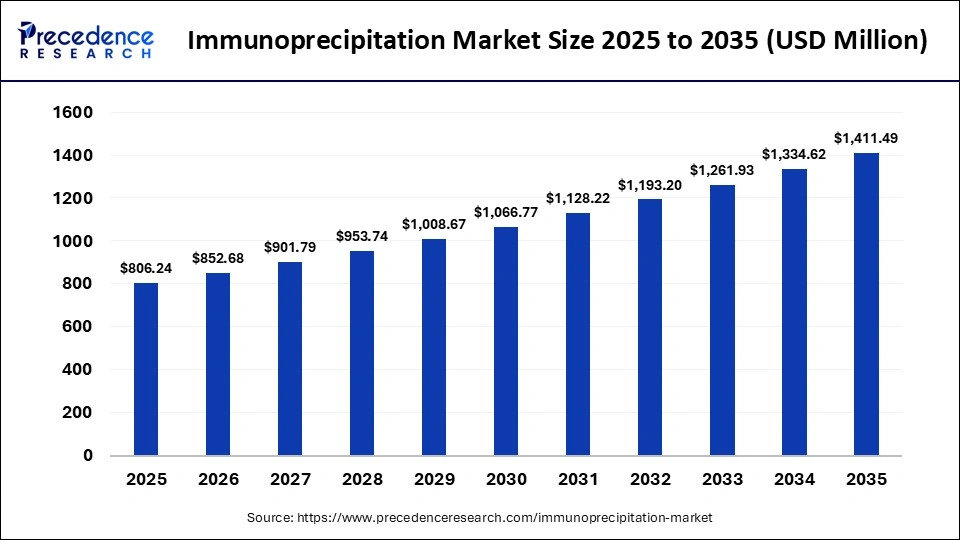
Rohan Patil, a Healthcare Industry Expert, highlights that the immunoprecipitation market has reached USD 852.68 million in 2026 and is on track to reach USD 1411.49 million by 2035, advancing at a CAGR of 5.76%. Key immunoprecipitation market companies shaping the market include Thermo Fisher Scientific Inc., Merck KGaA, Novus Biologicals, Takara Bio Inc., Abcam Limited, while major growth segments span By Product, By Type, By End-Use, By Region.
Source: https://www.precedenceresearch.com/immunoprecipitation-market
 Get a Sample
 Table Of Content


What is the Immunoprecipitation Market Size in 2026?
The global immunoprecipitation market size was calculated at USD 806.24 million in 2025 and is predicted to increase from USD 852.68 million in 2026 to approximately USD 1,411.49 million by 2035, expanding at a CAGR of 5.76% from 2026 to 2035. With investigators now moving to such a difficult protein site of interaction, immunoprecipitation is gradually becoming a necessary component of various fields, from contemporary proteomics and molecular diagnostics to targeted drug development.
Key Takeaways
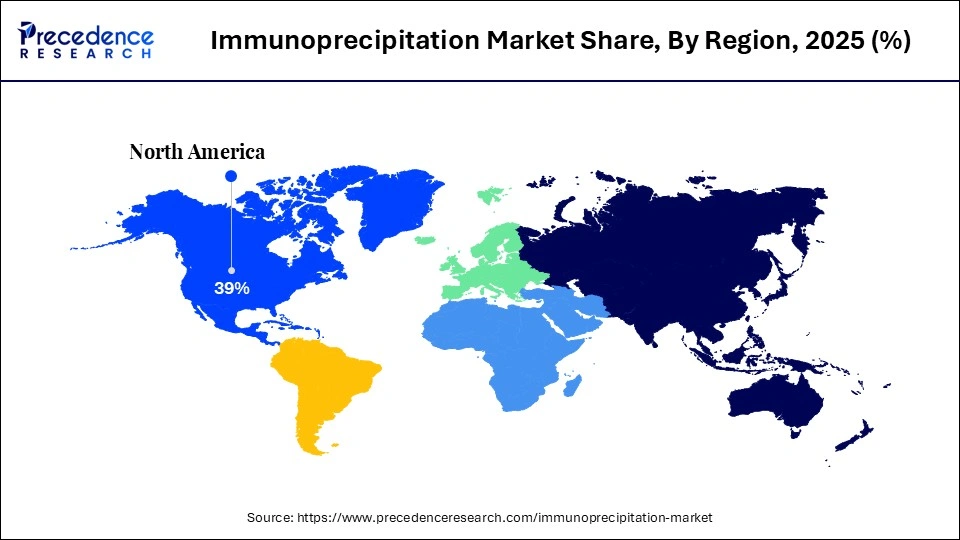
- North America dominated the market with the largest market share of 39% in 2025.
- Asia Pacific is expected to grow at the fastest CAGR in the market during the forecast period.
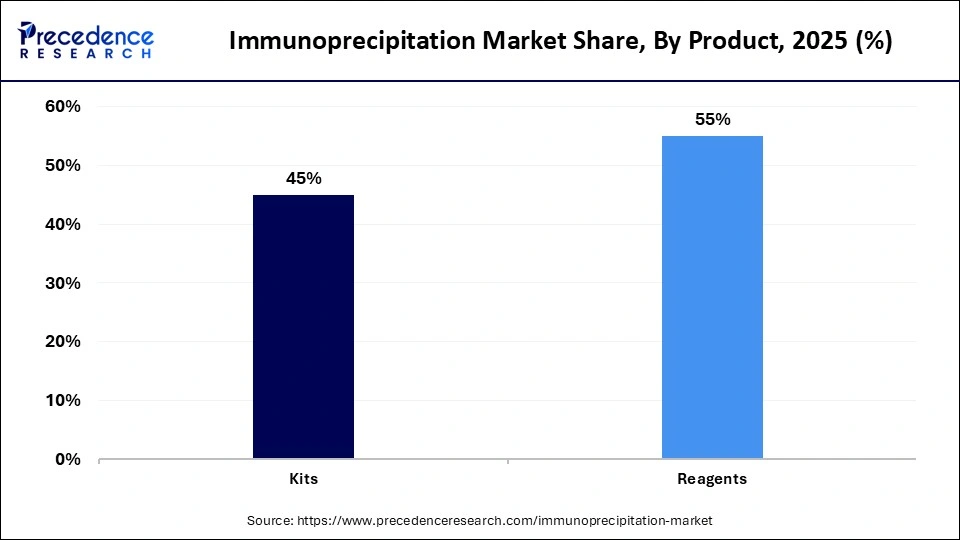
- By product, the reagents segment accounted for a market share of 55% in 2025.
- By product, the kits segment is expected to grow at the fastest CAGR in the market between 2026 and 2035.
- By type, the individual protein immunoprecipitation segment accounted for the highest revenue share in the market in 2025.
- By type, the tagged protein immunoprecipitation segment is expected to expand rapidly in the market in the coming years.
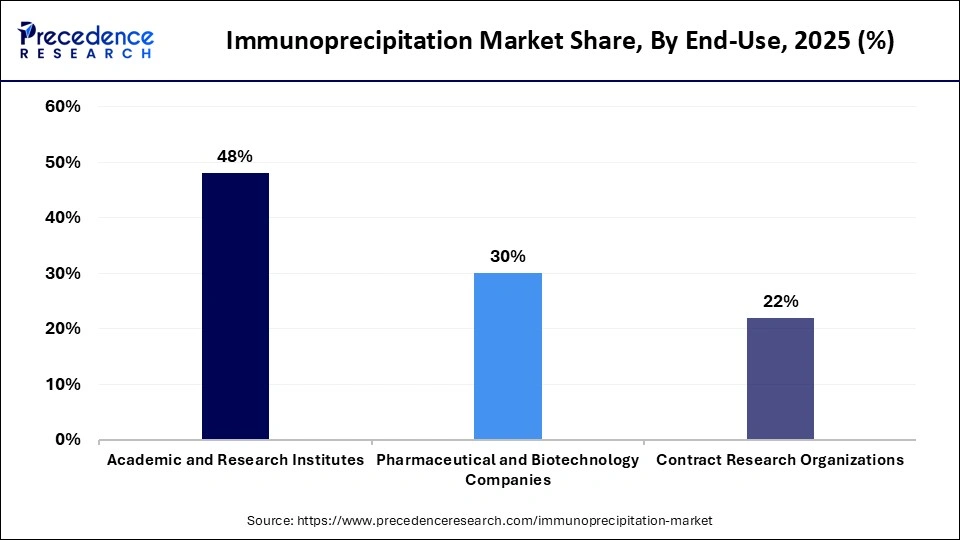
- By end use, the academic and research institutes segment contributed the biggest market share of 48% in 2025.
- By end use, the contract research organizations segment is expected to grow with the highest CAGR in the market between 2026 and 2035.
What is the Immunoprecipitation Market?
The immunoprecipitation industry is based on a deceptively straightforward laboratory concept using antibodies as molecular magnets to separate targeted proteins from a crowded biological mix. But small experiments in a test tube often produce big findings about how proteins cooperate, signal, or misbehave in disease.
The market for immunoprecipitation materials, antibodies, magnetic beads, reagents, and ready-to-use kits is increasing steadily as proteomics, epigenetics, and drug discovery advance. Pharmaceutical corporations, biotech enterprises, and research institutions use these tools to decode protein networks, identify biomarkers, and explore the hidden machinery of cells driving cancer, genetic disorders, and emerging therapeutic targets.
Impact of AI in the Immunoprecipitation Market
Artificial intelligence (AI) is progressively integrating into immunoprecipitation procedures, enhancing rather than replacing traditional experimental methods. Machine learning algorithms can forecast antibody antigen interactions, enabling researchers to select antibodies with superior binding specificity before any hands on experimentation.
Additionally, AI plays a critical role in the analysis of extensive datasets produced by techniques like chromatin immunoprecipitation sequencing; it reveals patterns of protein DNA binding that might otherwise remain obscured within raw genomic information. AI is transforming immunoprecipitation into a more efficient and intelligent proteomics research, biomarker identification, and precision medicine advancements.
Trends Influencing the Immunoprecipitation Market
- Increasing Preference for Ready-Made Immunoprecipitation Kits: The kits can help reduce protocol variation in experimentation and may shorten the setup period of such experiments. As busy labs work on many projects simultaneously, standardized workflows provide a sustainable solution to make reproducible experiments on protein interactions.
- Integration with Proteomics and Multi-Omics Studies: Mass spectrometry and sequencing technologies are increasingly being combined with immunoprecipitation. Instead of just isolating single proteins, researchers now set up end to end interaction networks. The methodology is turning into an integral framework for the examination of complex cellular signaling pathways.
- Growing Need in Biopharmaceutical Drug Development: As targeted biologics and antibody therapies are a focus for pharmaceutical companies, protein behavior has become increasingly important. Immunoprecipitation enables scientists to establish targets, analyze protein complexes, and test a treatment mechanism, organically embedding itself into early stage drug development.
Market Scope
| Report Coverage | Details |
| Market Size in 2025 | USD 806.24 Million |
| Market Size in 2026 | USD 852.68 Million |
| Market Size by 2035 | USD 1411.49 Million |
| Market Growth Rate from 2026 to 2035 | CAGR of 5.76% |
| Dominating Region | North America |
| Fastest Growing Region | Asia Pacific |
| Base Year | 2025 |
| Forecast Period | 2026 to 2035 |
| Segments Covered | Product, Type, End-Use, and Region |
| Regions Covered | North America, Europe, Asia-Pacific, Latin America, and Middle East & Africa |
Market Dynamics
Drivers
Expansion of Biopharmaceutical and Antibody Drug Development
Biologics are increasingly emphasizing protein-level assessment (in particular, antibody therapy). Immunoprecipitation provides a powerful method for sampling and evaluating target proteins across the drug development and validation process. As monoclonal antibodies and targeted biologics assume increasing importance for cancer and autoimmune disease, laboratories are now demanding reagents and kits that are increasingly specific for targeted use in these tissues, leading to continued growth in protein purification and molecular analysis technology sectors.
Restraint
High Cost of High-Quality Antibody
Accuracy is expensive in the end Immunoprecipitation experiments require extremely expensive, specialized antibodies and tailored buffers with magnetic bead systems, and with them come huge costs For smaller labs or academic institutions that tend to be financially constrained, maintaining a reliable supply of better-quality reagents can be a challenge in terms of finances that could impede wider adoption in newer research fields.
Opportunities
Personalized Medicine and Identification of Biomarkers
The direction of modern medicine is increasingly toward personalized treatments, where finding disease-specific biomarkers becomes essential. Immunoprecipitation is crucial in isolating proteins that relate to disease processes, making it possible for people carrying out new diagnostic markers and therapeutic targets. With precision medicine coming into the spotlight and also making targeted biologics, this kind of technology should soon become quite indispensable during initial discovery phases.
Segmental Insights
Product Insights
Immunoprecipitation Market Share, By Product, 2025 (%)
| Product | 2025 |
| Kits | 45% |
| Reagents | 55% |
Which Product Segment Dominated the Immunoprecipitation Market?
The reagents segment held a dominant revenue share in the market in 2025, as reagents are employed in almost all protocols carried out in research laboratories. Antibodies, buffers, and magnetic or agarose beads provide essential assets that empower scientists to personalize their experiments to the demands of each of their subjects. That dependence was not only habitual; it demonstrated a desire to control. In sophisticated protein interaction studies where small adjustments could lead to far more favorable results, scientists preferred to adjust conditions independently, rather than with preset systems.
The kits segment is expected to show the fastest growth over the forecast period, as laboratories balance convenience with accuracy. Immunoprecipitation kits are ready to use, simplifying workflows, reducing experimental variation, and increasing time efficiency in high-throughput environments. With ever tightening research deadlines and the need for reproducible data, these kits should shift from being an optional instrument to the standard practice in academic facilities and industrial settings.
Type Insights
Which Type Segment Led the Immunoprecipitation Market?
The individual protein immunoprecipitation segment led the market in 2025, driven by a long-running focus in studies of single protein isolation to develop insights into different roles and interactions of proteins in biology, which may guide the molecular level. This approach has brought clarity and precision, especially in studies centered around diseases where identifying a single protein may provide significant therapeutic information. With high reliability and well-known protocols, it is the standard for many laboratories.
The tagged protein immunoprecipitation segment is expected to gain the highest market share between 2026 and 2035, due to recombinant DNA technology and protein engineering innovations. Tag integration helps detect and purify, while reducing the need for highly specific antibodies. As experimental techniques become increasingly sophisticated and cleaner output is required in a reproducible manner, tagged systems are being envisioned to gain in popularity, particularly among large-scale proteomics and high-throughput screening projects.
End-Use Insights
Immunoprecipitation Market Share, By End-Use, 2025 (%)
| End-Use | 2025 |
| Academic and Research Institutes | 48% |
| Pharmaceutical and Biotechnology Companies | 30% |
| Contract Research Organizations | 22% |
How the Academic and Research Institutes Segment Dominated the Immunoprecipitation Market?
The academic and research institutes segment contributed the biggest revenue share in the market in 2025, as these organizations consistently drive demand by conducting experiments, obtaining grants to support projects, and conducting extensive research on disease mechanisms. The environment promotes flexibility and discovery, making immunoprecipitation an integral yet routine tool for examining protein interactions and cellular functions.
The contract research organizations segment is expected to witness the fastest growth in the market over the forecast period, as pharmaceutical and biotechnology companies increasingly delegate research tasks to enhance efficiency while alleviating operational pressures. CROs provide scalability, specialized knowledge, and faster turnaround times. With drug development pipelines becoming increasingly complex and large-scale, it is probable that CROs will have a significant role to play in conducting immunoprecipitation-based studies within structured environments that prioritize deadlines.
Regional Insights
North America Immunoprecipitation Market Size and Growth 2026 to 2035
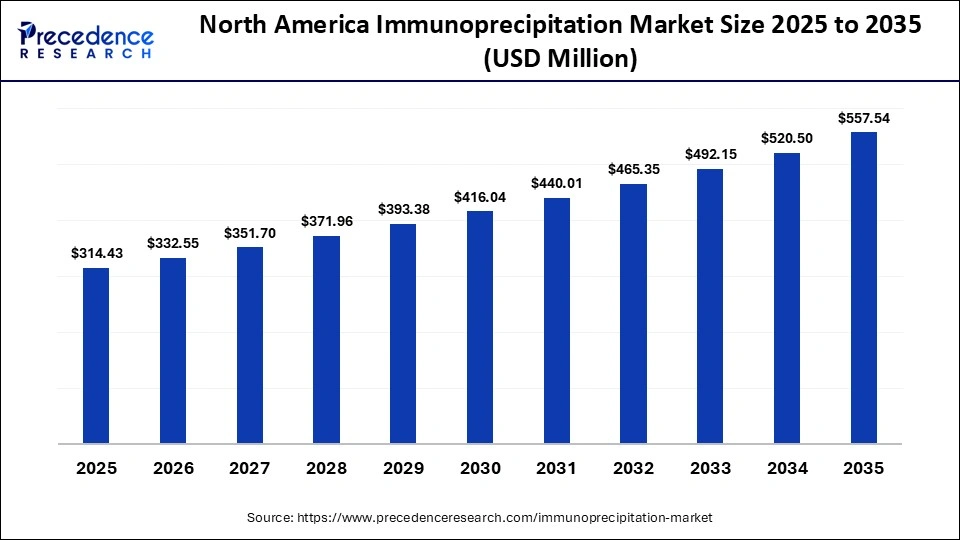
The North America immunoprecipitation market size is estimated at USD 314.43 million in 2025 and is projected to reach approximately USD 557.54 million by 2035, with a 5.89% CAGR from 2026 to 2035.
Why North America Dominated the Immunoprecipitation Market?
North America held a major revenue share in the market in 2025, owing to a lively research ecosystem that is free from downtime. The presence of well-resourced labs and mature biotechnology institutes fostered a steady flow of proteomics-related efforts, which maintained demand. In the region, the infrastructure was not the only advantage, but also the continuity; experiments continued unbroken, project pipelines were vigorous, and tools like immunoprecipitation were regularly applied.
U.S. Immunoprecipitation Market Size and Growth 2026 to 2035
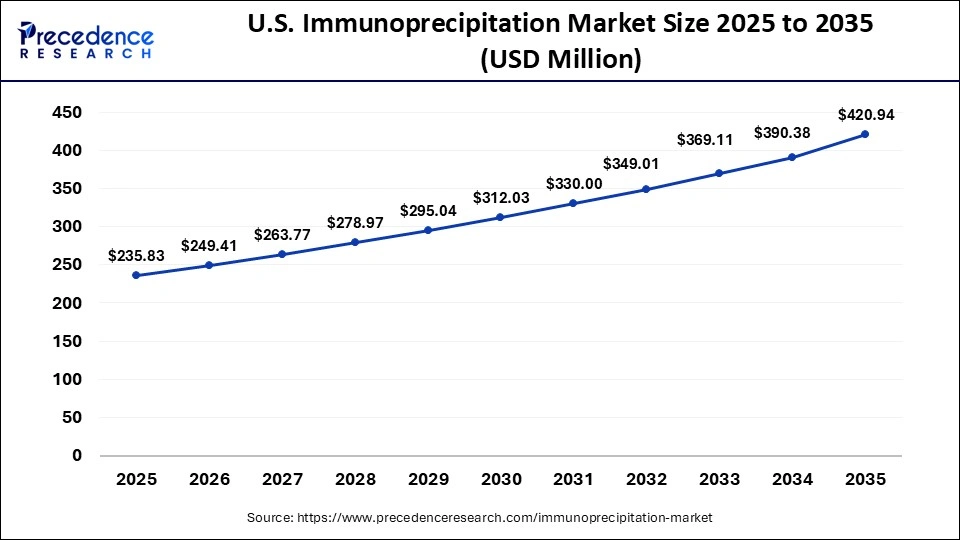
The U.S. immunoprecipitation market size is calculated at USD 235.83 million in 2025 and is expected to reach nearly USD 420.94 million in 2035, accelerating at a strong CAGR of 5.96% between 2026 and 2035.
U.S. Market Trends
The U.S. is the dominant country in the North American market. The market is driven by research grants, the increasing academia-industry collaboration, and growing research activities. Within this framework, immunoprecipitation evolved from being a simple technique by way of which results were determined to one that became an everyday practice used in order to validate results and refine hypotheses. The country's ability to sustain continuous research activity throughout time cemented its status at the frontier of cutting-edge molecular biology approaches.
Why is Asia Pacific Experiencing the Fastest Growth in the Immunoprecipitation Market?
Asia Pacific is expected to experience the fastest growth during the predicted timeframe, due to a drastic change in scientific progress. The evolution of biotechnology infrastructure, the rise in government investment, and the increase in research institutions are all slowly modifying the environment. Laboratories in this sector are evolving from just using techniques such as immunoprecipitation to embracing them as vital research tools. And as the domestic pharmaceutical industries grow, the demand for reliable protein analysis methods will only continue to ramp up.
China Market Trends
The Chinese market is growing rapidly in the Asia Pacific, and an overarching ambition for supremacy in biotechnology and life sciences. Ongoing investments in the creation of a research backbone, development of talent, and encouragement of pharmaceutical innovation are reshaping this picture. Laboratories are growing rapidly; along with that growth comes an escalating reliance on techniques such as immunoprecipitation for both protein analysis and biomarker identification. This is a fast move, but also a strategic move in the long term.
How is Europe Growing in the Immunoprecipitation Market?
Europe is expected to grow at a considerable CAGR in the upcoming period, due to increasing investments in life science research, growing proteomics research, and the rising demand for advanced molecular biology technologies. Increased attention in the precision medicine, cancer biomarker discovery, and drug development fields is driving high interest in immunoprecipitation use in research laboratories and biotechnology firms. There are also existing academic connections and growing investment in biomedical research programs by local governments. Additionally, the rise of protein interaction analysis technologies and laboratory automation systems is fuelling the market growth.
Country-Level Analysis
Germany is the leader in Europe due to the strength of its biotechnology sector, the high level of its pharmaceutical research, and the growing investment in proteomics and genomics research. The UK is experiencing a huge expansion with increased partnerships between universities and biopharma firms working in molecular diagnostics and personalized medicine research. In addition, France is becoming an important market thanks to growing life science research programmes and a growing acceptance of high-throughput lab technologies.
Will the Middle East and Africa Grow in the Immunoprecipitation Market?
The Middle East and Africa region is expected to grow at a notable CAGR in the foreseeable future because of the improvement of biomedical research infrastructure, growing investments in the healthcare research arena, and the use of molecular biology technologies in academic and clinical laboratories. Governments and healthcare organizations are putting effort into enhancing the research capacity of biotechnology and expanding lab modernization programs to facilitate advanced research in diagnostics and therapeutic sciences.
Country-Level Analysis
Saudi Arabia's presence in the regional market is growing, reflecting high investments in biotechnology research, the growth of academic research centers, and the Saudi government's backing of healthcare innovation initiatives. The UAE has experienced significant development, with advanced laboratory facilities being established, healthcare modernization initiatives, and the expansion of pharmaceutical research activities.
Competitive Landscape
The immunoprecipitation market is moderately consolidated. Advanced antibody technologies, protein isolation kits, and automated research platforms are the key differentiators among the major companies in the market, including biotechnology companies, life science reagent manufacturers, and laboratory solution providers. Thermo Fisher Scientific, Merck KGaA, Bio-Rad Laboratories, and Abcam have established solid market positions with a wide range of products, collaborations with various research institutions around the world, and a robust distribution network in both the academic and pharmaceutical research fields.
Some of the key strategic moves that are influencing market dynamics include acquisitions of biotechnology companies, collaborations with research institutes, expansion of reagent manufacturing plants, and the introduction of new superior protein analysis solutions. To bolster research efforts and expedite drug discovery processes, businesses are adopting AI-powered protein interaction analysis tools, high-throughput screening techniques, and multiplex assay systems.
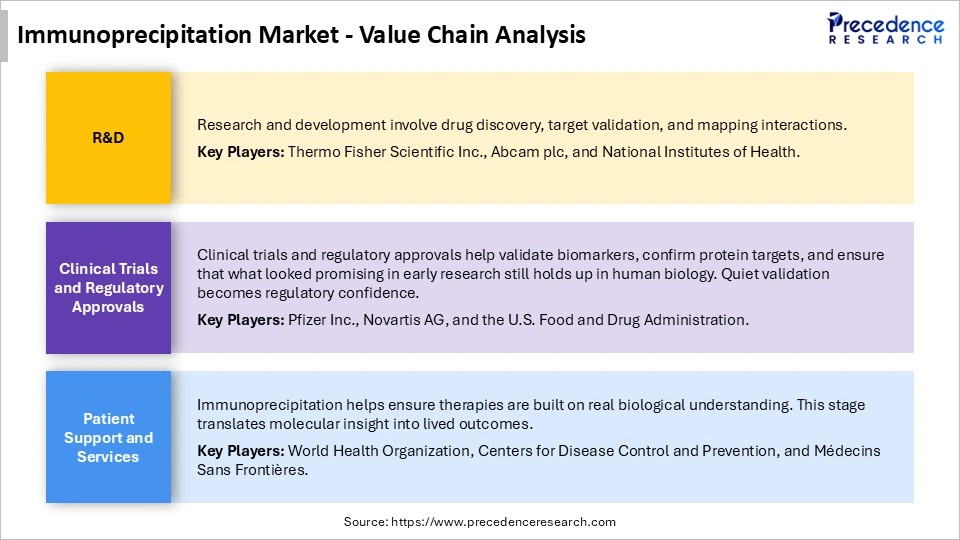
Immunoprecipitation Market Value Chain Analysis
Immunoprecipitation Market Companies
- Thermo Fisher Scientific Inc.
- Merck KGaA
- Novus Biologicals
- Takara Bio Inc.
- Abcam Limited
- BioLegend, Inc.
- Bio-Rad Laboratories, Inc.
- GenScript
- Biologics International Corp
- Proteintech
- Creative Diagnostics
Recent Developments
- In June 2024, a study published in the New England Journal of Medicine unveiled a significant breakthrough by combining immunoprecipitation and ELISA for the diagnosis and monitoring of kidney diseases associated with nephrotic syndrome. Researchers identified anti nephrin autoantibodies as a reliable biomarker for tracing disease progression.(Source: https://medicaldialogues.in)
- In January 2024, Quantum Si Inc. revealed a new approach that uses immunoprecipitation to extract low-abundance IL-6 proteins from human serum and is compatible with the company's next generation protein sequencing workflow. The method involves an on bead digestion protocol that eliminates the sample elution step, proceeding directly to the preparation of digested peptide libraries.(Source: https://www.news-medical.net)
Segments Covered in the Report
By Product
- Kits
- Reagents
By Type
- Individual Protein Immunoprecipitation
- Protein Complex Immunoprecipitation
- Chromatin Immunoprecipitation
- Ribonucleoprotein Immunoprecipitation
- Tagged Proteins Immunoprecipitation
By End-Use
- Academic and Research Institutes
- Pharmaceutical and Biotechnology Companies
- Contract Research Organizations
By Region
- North America
- Latin America
- Europe
- Asia-pacific
- Middle and East Africa
For inquiries regarding discounts, bulk purchases, or customization requests, please contact us at sales@precedenceresearch.com
Frequently Asked Questions
Tags





Ask For Sample
No cookie-cutter, only authentic analysis – take the 1st step to become a Precedence Research client
 Get a Sample




 sales@precedenceresearch.com
 Schedule a Meeting
