



India Biofuels Market Size, Share and Trends 2026 to 2035
India Biofuels Market (By Fuel Type: Biodiesel and Bioethanol; By Feedstock: Coarse Grain, Non-agri Feedstock, Biomass, Vegetable Oil, Sugar Crop, Jatropha, and Others) Industry Size, Share, Growth, Trends 2025-2035
 Get a Sample
 Table Of Content


The India biofuels market size is calculated at USD 820 Million in 2025 and is predicted to attain around USD 1580.2 Million by 2035, expanding at a CAGR of 6.78% from 2026 to 2035. The Market is mainly driven by strong government initiatives such as the Ethanol Blending Programme (EBP), a high reliance on crude oil imports, and the availability of agricultural feedstock.
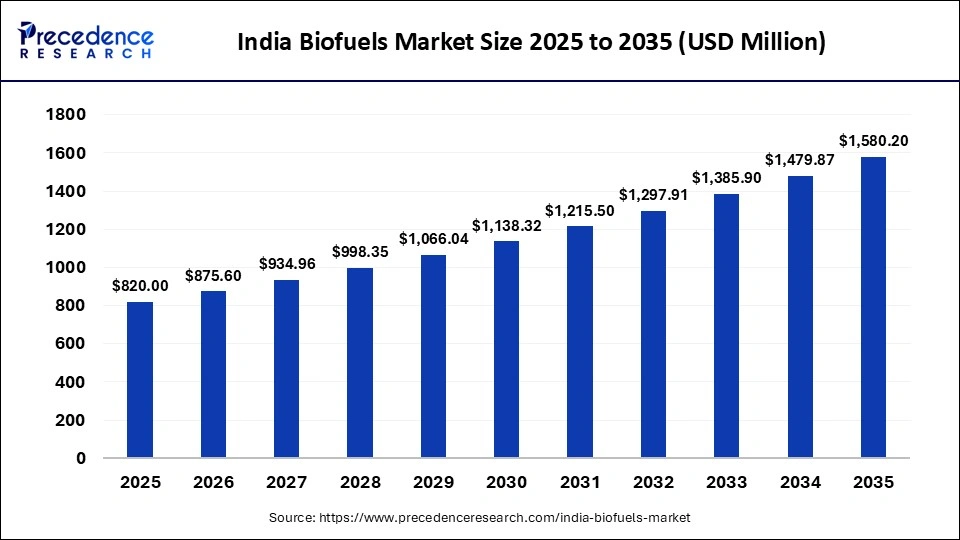
India Biofuels Market Statical Scope
| Reports Attributes | Statistics |
| Market Size in 2025 | USD 820 Million |
| Market Size in 2026 | USD 875.6 Million |
| Market Size by 2035 | USD 1580.2 Million |
| CAGR 2026 to 2035 | 6.78% |
| Base Year | 2025 |
| Forecast Period | 2026 to 2035 |
The Indian biofuels market is important for many key reasons, including improving the rural economy by turning agricultural waste into income, improving national energy security by decreasing dependence on imported crude oil, and significantly lowering lifecycle carbon emissions to achieve climate objectives. India imports about 85-88% of its crude oil, making its economy susceptible to global price fluctuations. By increasing the production of bioethanol and compressed biogas (CBG), the country keeps financial resources within its borders. The market connects agriculture with energy.
Strong ethanol blending goals (like the E20 mandate) provide profitable and stable income for sugarcane and grain farmers, while using agricultural waste for biogas production helps reduce harmful stubble burning. As one of the largest energy consumers globally, India uses biofuels to fulfill its international climate obligations. Biofuels emit fewer pollutants during burning and support the development of sustainable, circular-economy practices. India aims to become a future global leader in Sustainable Aviation Fuel (SAF). With domestic production costs potentially being up to 40% lower than global standards, using crop residues for aviation fuels unlocks very profitable export opportunities.
India Biofuels Market, By Fuel Type, 2025 (%)
| Segments | Shares (%) |
| Bioethanol | 52.65% |
| Biodiesel | 47.35% |
- Biodiesel - The biodiesel sector, with a share of 47.35% in 2025, plays a vital role in India's biofuels market by ensuring energy security through the replacement of imported fossil fuels. It also significantly reduces greenhouse gas emissions and avoids the food versus fuel dilemma by using non-edible oils, agricultural waste, and used cooking oil, which helps boost rural economies.
- Bioethanol - The bioethanol sector, with a share of 52.65% in 2025, is the leading and most essential part of India's biofuels market. It is crucial as it significantly reduces India's large crude oil import costs, meets the ambitious E20 (20% ethanol blend) target, and generates important new income sources for the agricultural industry.
India Biofuels Market, By Feedstock, 2025 (%)
| Segments | Shares (%) |
| Biomass | 21.35% |
| Sugar Crop | 19.25% |
| Coarse Grain | 18.45% |
| Vegetable Oil | 16.80% |
| Non-agri Feedstock | 11.70% |
| Others | 6.30% |
| Jatropha | 6.15% |
- Coarse Grain - The coarse grain sector, with a share of 18.45% in 2025, mainly consisting of maize and broken rice, is essential to India's biofuels market as it addresses seasonal sugarcane shortages, ensures stable distillery operations throughout the year, and helps the government's goal of maintaining high ethanol blending mandates without jeopardizing food security.
- Non-agri Feedstock - The non-agricultural feedstock sector, with a share of 11.70% in 2025, which includes agricultural stubble, municipal solid waste, and used cooking oil, is important in India's biofuels market because it helps avoid the food versus fuel crisis, reduces harmful stubble burning, and promotes rural economic development while decreasing the country's heavy reliance on crude oil imports.
- Biomass - The biomass sector, with a share of 21.35% in 2025, dominates India's biofuels market as it offers abundant, affordable feedstock while addressing significant environmental issues. It directly supports India's aim to reduce dependence on imported fossil fuels, reduce carbon emissions, and provide extra income for the agricultural sector.
Competitive Landscape
The Indian biofuels market is very consolidated and is driven by strong government Ethanol Blending Programs (EBP), which are moving towards a 20% national average blending requirement. The market is dominated by large state-owned oil companies, big agricultural groups, and specialized biotech firms that focus on developing 1G and 2G ethanol and biodiesel solutions.
- Indian Oil Corporation Ltd. (IOCL) is a leader among oil marketing companies (OMCs). IOCL runs several facilities for blending ethanol and biodiesel. They are actively promoting 2G (second-generation) ethanol made from agricultural waste through their advanced bio-refineries.
- Bharat Petroleum Corporation Ltd. (BPCL) & Hindustan Petroleum Corporation Ltd. (HPCL) are significantly investing in the long-term purchase of ethanol from distilleries and have teamed up with technology providers to establish 2G ethanol plants, such as HPCL's bio-refinery in Bathinda, Punjab.
- Reliance Industries Ltd. (RIL) is the largest private entity in India's energy sector. They concentrate on producing bio-oil and other advanced biofuels, making
- substantial investments in circular economy models and transforming municipal and agricultural waste into fuel for transportation.
- Praj Industries Ltd. A global leader in process engineering, Praj offers technology and complete solutions for bioethanol and biodiesel plants. They are the top provider of 1G and 2G ethanol technology in India, supplying modular solutions to major sugar and grain distilleries.
- Shree Renuka Sugars Ltd. & Balrampur Chini Mills Ltd. As leading sugar producers in India, they have integrated their operations to channel molasses and sugarcane juice directly into ethanol production.
- Emami Agrotech Ltd. A significant player in the edible oil and biodiesel market, they use non-edible oils and cooking oil (UCO) to create biodiesel.
- Abellon Clean Energy specializes in biomass pellets, briquettes, and solid biofuels for industrial and commercial heating, and is also looking into liquid biofuels.
- My Eco Energy creates Indizel, a biodiesel alternative that complies with Euro VI standards and works with current diesel engines without needing any vehicle changes.
- Southern Online Bio Technologies Ltd. runs large biodiesel facilities and has been a leader in using a multi-feedstock method that incorporates non-edible seeds (such as Pongamia) and animal fats.
Segments Covered in the Report
By Fuel Type
- Biodiesel
- Bioethanol
By Feedstock
- Coarse Grain
- Non-agri Feedstock
- Biomass
- Vegetable Oil
- Sugar Crop
- Jatropha
- Others
For inquiries regarding discounts, bulk purchases, or customization requests, please contact us at sales@precedenceresearch.com
Frequently Asked Questions





Ask For Sample
No cookie-cutter, only authentic analysis – take the 1st step to become a Precedence Research client




 sales@precedenceresearch.com
 Schedule a Meeting



