



India Biosolids Management Market Size, Share and Trends 2026 to 2035
India Biosolids Management Market (By Process/Treatment Method: Anaerobic Digestion, Aerobic Digestion (including Heat Drying), Composting, Land Application, Incineration/Thermal Treatment, Landfilling, and Nutrient Removal/Recovery; By Product Type/Quality: Class A (Pathogen-Free, Safe for Unrestricted Use), Class A EQ (Exceptional Quality), Class B (Less Stringent, Limited-Use), and Class AB/Intermediate; By Application: Agricultural Land Application, Non-Agricultural Land Application, Energy Recovery, and Other Uses; By End-User: Municipalities (Wastewater Authorities), Industrial Facilities, Farmers/Agricultural Businesses, and Landscapers/Land Restoration Entities) Industry Size, Share, Growth, Trends 2025-2035
Source: https://www.precedenceresearch.com/india-biosolids-management-market
 Get a Sample
 Table Of Content


The India biosolids management market size is calculated at USD 61.05 Million in 2025 and is predicted to attain around USD 127.59 Million by 2035, expanding at a CAGR of 7.65% from 2026 to 2035. The India Market is mainly driven by rapid urban growth, strict government environmental rules like the Swachh Bharat Abhiyan, and the pressing need for eco-friendly agricultural fertilizers.
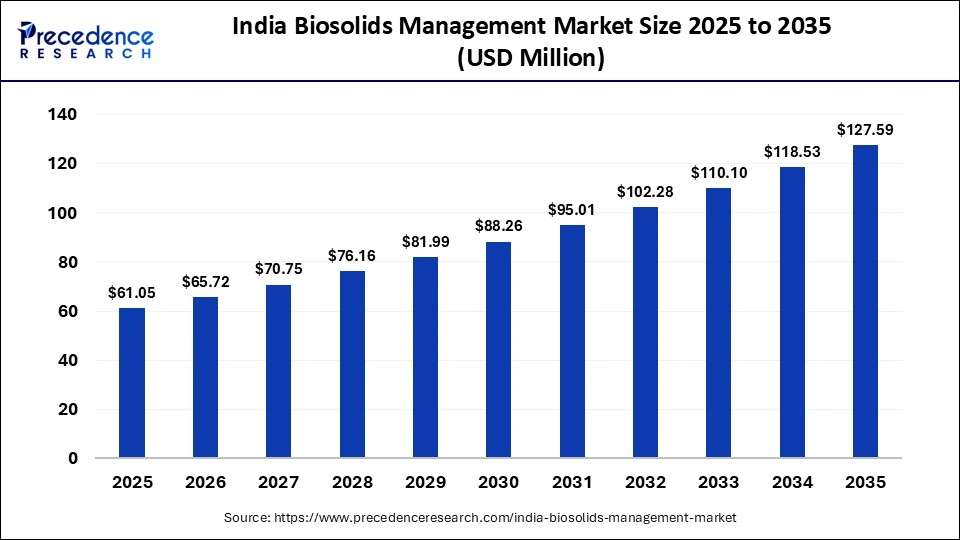
India Biosolids Management Market Statical Scope
| Reports Attributes | Statistics |
| Market Size in 2025 | USD 61.05 Million |
| Market Size in 2026 | USD 65.72 Million |
| Market Size by 2035 | USD 127.59 Million |
| CAGR 2026 to 2035 | 7.65% |
| Base Year | 2025 |
| Forecast Period | 2026 to 2035 |
Effective biosolids management in India is crucial for the country's environmental health and agricultural sustainability, converting tonnes of sewage sludge daily into useful bio-fertilizers. This method addresses soil degradation, decreases dependence on chemical fertilizers, and supports national circular economy objectives. Biosolids contain high levels of nitrogen, phosphorus, and potassium (NPK). Applying them to land helps restore damaged soils and can replace thousands of tonnes of synthetic urea each day.
With rapid urbanization, India has established many Sewage Treatment Plants (STPs) and Faecal Sludge Treatment Plants (FSTPs). Proper management ensures these facilities do not overflow and contaminate water bodies. Transforming sludge into biogas or high-quality compost helps the government's Swachh Bharat and Namami Gange initiatives, turning a municipal challenge into an economic opportunity.
India Biosolids Management Market, By Process/Treatment Method, 2025
| Segments | Shares (%) |
| Anaerobic Digestion | 22.80% |
| Aerobic Digestion (including Heat Drying) | 18.90% |
| Composting | 19.60% |
| Land Application | 15.40% |
| Incineration/Thermal Treatment | 8.70% |
| Landfilling | 7.80% |
| Nutrient Removal/Recovery | 6.80% |
- Anaerobic Digestion - The anaerobic digestion (AD) segment, with a share of 22.80% in 2025, plays a dominant role in India's biosolids management market as it meets the country's energy security and waste reduction goals. By breaking down organic waste without oxygen, AD alleviates landfill pressure and generates valuable biogas and nutrient-rich digestate, supporting government initiatives for a circular economy.
- Aerobic Digestion (including heat drying) - The aerobic digestion and heat drying segment, with a share of 18.90% in 2025, is essential in the Indian biosolids market as it converts hazardous sewage sludge into sterile, nutrient-rich organic fertilizer. This process is crucial for complying with strict environmental regulations, addressing land limitations, and decreasing dependence on imported synthetic fertilizers.
- Composting - The composting segment, with a share of 19.60% in 2025, is important in the Indian Biosolids Management Market as it provides a sustainable and cost-effective way to turn raw sewage sludge and organic municipal waste into safe, nutrient-rich agricultural fertilizer. By transforming biosolids into stable, pathogen-free compost, cities reduce waste in overflowing landfills, prevent groundwater contamination, and replace costly imported chemical fertilizers to enhance crop yields.
India Biosolids Management Market, By Product Type/Quality, 2025
| Segments | Shares (%) |
| Class A (Pathogen-Free, Safe for Unrestricted Use) | 34.60% |
| Class A EQ (Exceptional Quality) | 18.70% |
| Class B (Less Stringent, Limited-Use) | 31.50% |
| Class AB/Intermediate | 15.20% |
- Class A (pathogen-free, safe for unrestricted use) - The Class A segment, with a share of 34.60% in 2025, leads the India Biosolids Management Market as it permits the unrestricted use of treated wastewater sludge as fertilizer and soil amendment in residential, agricultural, and urban settings. By nearly eliminating all pathogens and carefully managing heavy metals, Class A biosolids navigate the serious health, social, and regulatory challenges that restrict the use of lower-grade (Class B) sludge.
- Class A EQ (Exceptional Quality) - The Class A EQ (Exceptional Quality) segment, with a share of 18.70% in 2025, is vital in India's biosolids management market as it addresses the country's serious biosolid contamination issues. By reducing pathogens to undetectable levels and limiting heavy metals to strict standards, Class A EQ enables unrestricted use in agriculture and urban landscaping.
India Biosolids Management Market, By Application, 2025
| Segments | Shares (%) |
| Agricultural Land Application | 44.80% |
| Non-Agricultural Land Application (e.g., Landscaping, Forestry, Land Reclamation) | 22.70% |
| Energy Recovery (Biogas Production, Heat/Energy Generation) | 20.90% |
| Other Uses (e.g., Compost, Industrial) | 11.60% |
- Agricultural Land Application - The agricultural land application segment, with a share of 44.80% in 2025, plays a dominant role in the India Biosolids Management Market by converting municipal and faecal sludge into valuable, affordable organic fertilizers. This method supports the circular economy by tackling the significant urban waste problem and improving degraded agricultural soils.
- Non-Agricultural Land Application (e.g., landscaping, forestry, land reclamation) - The non-agricultural land application segment, with a share of 22.70% in 2025, is also significant in the India Biosolids Management Market as it offers a safe and controlled way to dispose of urban wastewater sludge, reducing toxic exposure risks and helping in ecological restoration, landscaping, and forestry.
India Biosolids Management Market, By End-User, 2025
| Segments | Shares (%) |
| Municipalities (Wastewater Authorities) | 47.50% |
| Industrial Facilities (e.g., Food Processing, Manufacturing) | 21.80% |
| Farmers/Agricultural Businesses | 18.90% |
| Landscapers/Land Restoration Entities | 11.80% |
- Municipalities (wastewater authorities) - The Municipalities (Wastewater Authorities) segment, with a share of 47.50% in 2025, is the leading driver of the India Biosolids Management Market. As the largest producers of domestic sewage sludge, local governments are essential for the market's infrastructure, funding, and circular economy initiatives. Their importance stems from the large volumes of raw feedstock, national sanitation requirements, and the pressing need for sustainable fertilizer options.
- Industrial Facilities (e.g., food processing, manufacturing) - The industrial facilities segment, with a share of 21.80% in 2025, is crucial in the India biosolids management market as these facilities produce significant amounts of organic sludge, especially in the food processing and pulp and paper sectors. Since industrial biosolids often contain high levels of heavy metals and chemicals, they increase the demand for advanced treatment and compliance technologies.
Competitive Landscape
India's biosolids management market is evolving from raw sludge disposal to resource recovery, driven by the Indian waste management sector. Leading companies are concentrating on advanced digestion, bio-CNG production, and turning treated sludge into organic bio-fertilizers.
- Veolia India offers extensive municipal and industrial wastewater services, recovering resources through patented digestion technologies. They convert sludge into biogas and Class A biosolids for safe use in agriculture.
- VA Tech WABAG Ltd. is a prominent Indian multinational focused on water and wastewater treatment. Their unique sludge treatment methods facilitate sludge drying, digestion, and energy recovery, supporting circular economy principles.
- Thermax Limited provides cutting-edge wastewater and effluent treatment solutions, including zero liquid discharge (ZLD) systems. They offer sludge dewatering technologies and bio-methanation facilities to transform biological sludge into renewable energy.
- SUSBIO (Sustainable Biosolutions) implements compact, containerized, and prefabricated Sewage Treatment Plants (STPs) and Effluent Treatment Plants (ETPs). They offer biological treatments that minimize excess sludge production and convert organic waste into environmentally friendly compost.
- Vivam Agrotech, based in Pune, focuses on solid waste and wastewater valorization. They produce vermicompost and decentralized biogas plants that convert organic sludge and municipal waste into energy and organic fertilizer.
Segments Covered in the Report
By Process/Treatment Method
- Anaerobic Digestion
- Aerobic Digestion (including Heat Drying)
- Composting
- Land Application
- Incineration/Thermal Treatment
- Landfilling
- Nutrient Removal/Recovery
By Product Type/Quality
- Class A (Pathogen-Free, Safe for Unrestricted Use)
- Class A EQ (Exceptional Quality)
- Class B (Less Stringent, Limited-Use)
- Class AB/Intermediate
By Application
- Agricultural Land Application
- Non-Agricultural Land Application
- Energy Recovery
- Other Uses
By End-User
- Municipalities (Wastewater Authorities)
- Industrial Facilities
- Farmers/Agricultural Businesses
- Landscapers/Land Restoration Entities
For inquiries regarding discounts, bulk purchases, or customization requests, please contact us at sales@precedenceresearch.com
Frequently Asked Questions





Ask For Sample
No cookie-cutter, only authentic analysis – take the 1st step to become a Precedence Research client
 Get a Sample




 sales@precedenceresearch.com
 Schedule a Meeting
