



India E-bike Market Size, Share and Trends 2026 to 2035
India E-bike Market (By Class: Class 1, Class 2, and Class 3; By Speed: Up to 25 km/h and 25–45 km/h; By Battery Type: Lithium-ion, Nickel Metal Hydride (NiMH), Lead Acid, and Others; By Motor Type: Hub, Mid-drive, and Others; By Mode: Pedal Assist, Throttle, Speed Pedelecs, Scooter or Motorcycle, and Others; By Application: Mountain/Trekking, City/Urban, Cargo, and Others; By Component: Battery, Electric Motor, Frame with Fork, Wheels, Crank Gear, Brake System, and Motor Controller; By Ownership: Shared and Personal) Industry Size, Share, Growth, Trends 2025-2035
Source:https://www.precedenceresearch.com/india-e-bike-market
 Get a Sample
 Table Of Content


The India E-bike market size is calculated at USD 2.53 billion in 2025 and is predicted to attain around USD 6.67 billion by 2035, expanding at a CAGR of 10.18% from 2026 to 2035. The market is mainly driven by high fuel prices, severe urban traffic jams, supportive government policies and subsidies, rising environmental awareness, and a growing need for efficient last-mile delivery and logistics services.
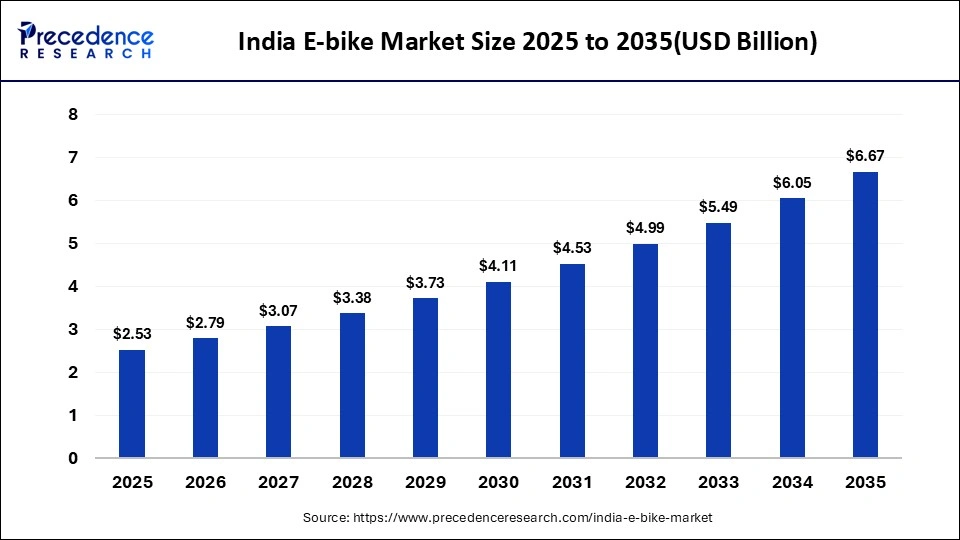
India E-bike Market Statical Scope
| Reports Attributes | Statistics |
| Market Size in 2025 | USD 2.53 Billion |
| Market Size in 2026 | USD 2.79 Billion |
| Market Size by 2035 | USD 6.67 Billion |
| CAGR 2026 to 2035 | 10.18% |
| Base Year | 2025 |
| Forecast Period | 2026 to 2035 |
The market is important as it provides an affordable and eco-friendly solution to urban congestion and high fuel prices, reshapes last-mile logistics for the expanding gig economy, and aligns with national objectives for green manufacturing and carbon reduction through government support. Urban areas experience significant traffic issues, making compact and agile e-bikes a practical choice for commuters. The quick adoption by delivery services like Blinkit, Zepto, Swiggy, and Zomato reduces operational and fuel costs.
Pedal-assist e-bikes, which are limited to speeds of 25 km/h, typically do not need a license, registration, or insurance, making them accessible for everyday users. Rising petrol prices are pushing consumers towards micro-mobility options that are very cost-effective to operate. National programs like production-linked incentive (PLI) schemes and state-level EV policies enhance local component manufacturing and promote sustainable transportation infrastructure.
India E-bike Market, By Class, 2025 (%)
| Segments | Shares (%) |
| Class 1 | 28.00% |
| Class 2 | 42.00% |
| Class 3 | 30.00% |
- Class 1 - The Class 1 segment, with a share of 28% in 2025, which allows pedal-assist up to 25 km/h or 20 mph without a throttle, is essential in India's e-bike market. It provides an affordable, regulation-compliant, and physically engaging transportation option that suits local urban commuting and the growing focus on health trends.
- Class 2 - The Class 2 e-bike segment, with a share of 42% in 2025, featuring a throttle system that can reach speeds of 20 mph (32 km/h) without the need for constant pedaling, is important in India. It aligns with local commuting patterns, offers utility in heavy traffic, and serves as a bridge between traditional bicycles and expensive electric scooters.
India E-bike Market, By Speed, 2025 (%)
| Segments | Shares (%) |
| Up to 25 km/h | 68.00% |
| 25–45 km/h | 32.00% |
- Up to 25 km/h - The segment that allows speeds up to 25 km/h, with a share of 68% in 2025, leads India's e-bike market as it benefits from legal exemptions under the Central Motor Vehicles Rules (CMVR). E-bikes with a motor capacity of up to 250W and a maximum speed of 25 km/h do not require a driving license, RTO registration, or insurance. This classification promotes widespread market adoption and scalability.
- 25-45 km/h - The 25–45 km/h e-bike segment, with a share of 32% in 2025, which includes speed pedelecs and high-performance models, is significant in India as it connects slower recreational bicycles with regulated motor vehicles. It addresses the increasing demand for urban commuting and commercial delivery, where higher speeds are necessary to navigate mixed traffic.
India E-bike Market, By Battery Type, 2025 (%)
| Segments | Shares (%) |
| Lithium-ion | 82.00% |
| Nickel Metal Hydride (NiMH) | 4.00% |
| Lead Acid | 11.00% |
| Others | 3.00% |
- Lithium-ion - The lithium-ion segment, with a share of 82% in 2025, leads India's e-bike market. It is crucial due to its high energy density, long lifespan, quick charging capabilities, and lightweight design compared to older lead-acid batteries.
- Nickel Metal Hydride (NiMH) - The Nickel Metal Hydride (NiMH) segment, with a share of 4% in 2025, continues to play a role in the Indian e-bike and electric vehicle market as a stable, temperature-resistant, and safe alternative to lead-acid and some lithium-ion options.
India E-bike Market, By Mode, 2025 (%)
| Segments | Shares (%) |
| Pedal Assist | 48.00% |
| Throttle | 22.00% |
| Speed Pedelecs | 8.00% |
| Scooter or Motorcycle | 17.00% |
| Others | 5.00% |
- Pedal Assist - The pedal-assist category, with a share of 48% in 2025, leads the Indian E-bike Market, being the top choice for city commuters and fitness enthusiasts. It offers excellent battery efficiency, a natural cycling experience, and avoids the need for heavy vehicle registration or licensing, making it perfect for those who are budget-conscious and health-oriented.
- Throttle - The throttle category, with a share of 22% in 2025, is crucial in the Indian e-bike market, due to pure motor acceleration without the need to pedal, which is essential for navigating heavy urban traffic, supporting gig-economy delivery workers, and providing an affordable, scooter-like option for budget-minded commuters under 250W regulations.
India E-bike Market, By Application, 2025 (%)
| Segments | Shares (%) |
| Mountain/Trekking | 15.00% |
| City/Urban | 58.00% |
| Cargo | 18.00% |
| Others | 9.00% |
- Mountain/trekking - The mountain and trekking category, with a share of 15% in 2025, plays a key role in the Indian e-bike market as it supports the growing demand for adventure tourism, fitness activities, and challenging terrains. This high-value niche offers strong profit margins and attracts lifestyle consumers and outdoor lovers exploring areas like the Western Ghats and the Himalayan foothills.
- City/urban - The city and urban category, with a share of 58% in 2025, leads the Indian E-bike Market as it addresses common commuter issues such as heavy traffic, high fuel prices, and last-mile connectivity challenges. Short daily trips align well with e-range capacities, while low electricity costs and compact designs make city travel and home charging convenient.
India E-bike Market, By Component, 2025 (%)
| Segments | Shares (%) |
| Battery | 35.00% |
| Electric Motor | 20.00% |
| Frame with Fork | 13.00% |
| Wheels | 9.00% |
| Crank Gear | 8.00% |
| Brake System | 7.00% |
| Motor Controller | 8.00% |
- Battery - The battery category, with a share of 35% in 2025, dominates the Indian e-bike market, driven by vehicle cost, riding range, and safety. Being the most expensive single component, the battery affects overall affordability. It also drives technological advancements from heavy lead-acid batteries to lightweight lithium-ion cells, influencing consumer adoption as fuel prices rise.
- Electric Motor - The electric motor category, with a share of 20% in 2025, is vital in India e-bike market as it affects vehicle performance, payload capacity, and energy efficiency in tough local conditions like extreme heat, heavy traffic, and steep hills. It directly impacts cost, reliability, and consumer interest for budget-conscious daily commuters and last-mile delivery services.
Competitive Landscape
The Indian market for e-bikes and electric two-wheelers is growing quickly, fueled by urban traffic, green energy initiatives, and government support. While brands like EMotorad and Hero Lectro are increasing the popularity of pedal-assist electric bicycles, the term "e-bike" in India largely includes high-speed electric scooters and motorcycles. The market is a mix of venture capital-backed tech startups and established automotive companies.
- EMotorad is a leader in stylish, smart electric mountain and commuter bikes, with key models like the EMotorad T-Rex Plus and the performance-oriented Viper.
- Hero Lectro, the electric division of Hero Cycles, provides strong urban and recreational e-bikes, including the Lectro C5X and the Lectro Winn series.
- Ninety One Cycles (AlphaVector) is recognized for its tech-savvy commuter and lifestyle e-bikes under the Meraki brand, such as the Meraki-S.
- Motovolt specializes in versatile urban e-bikes designed for heavy loads, making them popular for last-mile delivery and daily commuting, like the Motovolt URBn.
- Toutche Electric is known for its lifestyle and trekking electric bicycles under the Heileo brand.
- Revolt Motors is well-known for its AI-powered commuter electric motorcycles, including the Revolt RV400.
- Ather Energy and Ola Electric are leading the market for high-speed electric two-wheelers, offering smart, connected technology with models like the Ather 450X and Ola S1, which compete with traditional motorcycles.
- TVS and Bajaj are traditional automotive leaders promoting widespread adoption with models like the TVS iQube and Bajaj Chetak.
Segments Covered in the Report
By Class
- Class 1
- Class 2
- Class 3
By Speed
- Up to 25 km/h
- 25–45 km/h
By Battery Type
- Lithium-ion
- Nickel Metal Hydride (NiMH)
- Lead Acid
- Others
By Motor Type
- Hub
- Mid-drive
- Others
By Mode
- Pedal Assist
- Throttle
- Speed Pedelecs
- Scooter or Motorcycle
- Others
By Application
- Mountain/Trekking
- City/Urban
- Cargo
- Others
By Component
- Battery
- Electric Motor
- Frame with Fork
- Wheels
- Crank Gear
- Brake System
- Motor Controller
By Ownership
- Shared
- Personal
For inquiries regarding discounts, bulk purchases, or customization requests, please contact us at sales@precedenceresearch.com
Frequently Asked Questions





Ask For Sample
No cookie-cutter, only authentic analysis – take the 1st step to become a Precedence Research client




 sales@precedenceresearch.com
 Schedule a Meeting



