



Insect Protein Market Trends, Companies, Revenue / Sales Performance, Food Production, Processing Capacity, Sales Volume, Distribution Performance, Competitive Landscape, and Industry Outlook
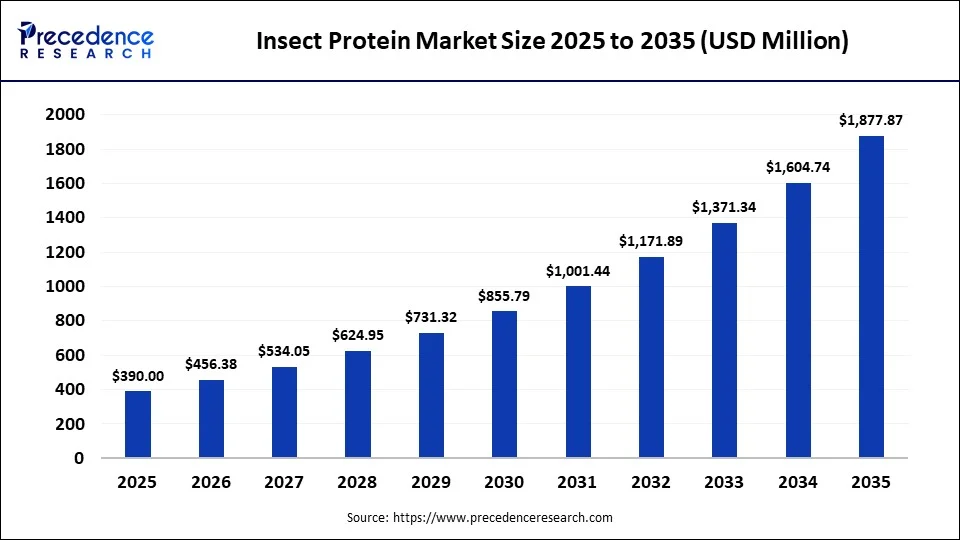
Sudeep Pednekar is a food and beverage sector research analyst, specializing in alternative protein research, insect protein production, feed applications, feed processing, and regulatory developments. His research focuses on emerging insect-protein platforms and analyzing demand in animal feed, pet food, human nutrition, aquaculture, and nutraceuticals. His analysis is useful for comparative benchmarking and strategic planning for ingredient manufacturers, insect-farming companies, food and feed producers, investors, and other stakeholders. The market growth is expected to reach USD 1.88 billion by 2035.
Source: https://www.precedenceresearch.com/insect-protein-market
 Get a Sample
 Table Of Content


Insect Protein Market Size and Forecast 2026 ot 2035
With more than 5 years of experience in food and alternative-protein market analysis, Sudeep Pednekar believes the insect protein market is now at a more commercial and technological stage. The industry is making the transition from early commercialization and is gaining momentum. Due to increased investments in controlled-environment insect farming, the increased use of black soldier fly and superworm protein, the development of automation for insect harvesting and processing, and the growing incorporation of these insects in animal feeds, pet food, aquaculture, and human nutrition applications. Technological advances, especially in Europe, are also expanding options for available insect species and ingredient forms. The analyst feels that the rise in large-scale black soldier fly production, the use of circular feedstocks, growing demand for sustainable protein ingredients, and growing B2B applications will drive market growth.
Key Takeaways
- By insect type, the crickets segment led the market with a 28% share in 2025.
- By protein form, the insect protein powder segment captured a major revenue share of 43% in 2025.
- By application, the animal feed segment captured the largest insect protein market share of 32% in 2025.
- By end-use, the food and beverage segment captured the largest market share of 73% in 2025.
Ten-Year Trajectory: $390.00M - $1,877.87 Million
The market growth is expected to reach USD 1,877.87 million by 2035. This is a 10-year growth multiple of 4.8 times, as per the stated compound trajectory based on the stated CAGR of 17.02% and modeled from the stated 2026 base value of USD 456.38 million. I believe that it takes much longer to double the value of the market than to triple it, and in fact, over the five years from 2025 to 2031 alone. The value of the market is nearly tripled, with more than half of the entire decade's worth of value creation occurring in the first six years.
The front-loaded shape is not just interesting. It does carry with it real strategic implications. It pays companies and investors who invest and secure processing capacity, farming facilities, and distribution networks ahead of time. The absolute market is the smallest during the years that the market grows at its fastest rate. Therefore becomes the most competitive. If a business waits until the market grows to the size that makes it worthwhile for that business to invest, then that business is in for the lion's share of the market's growth in that decade.
Key Insight: This market is more about timing than size. Compounding puts a lot of weight on the front end, which is why it's a watch category as opposed to a build-now category.
Source: Precedence Research Database
The Biological Edge: Insects Need a Fraction of the Feed
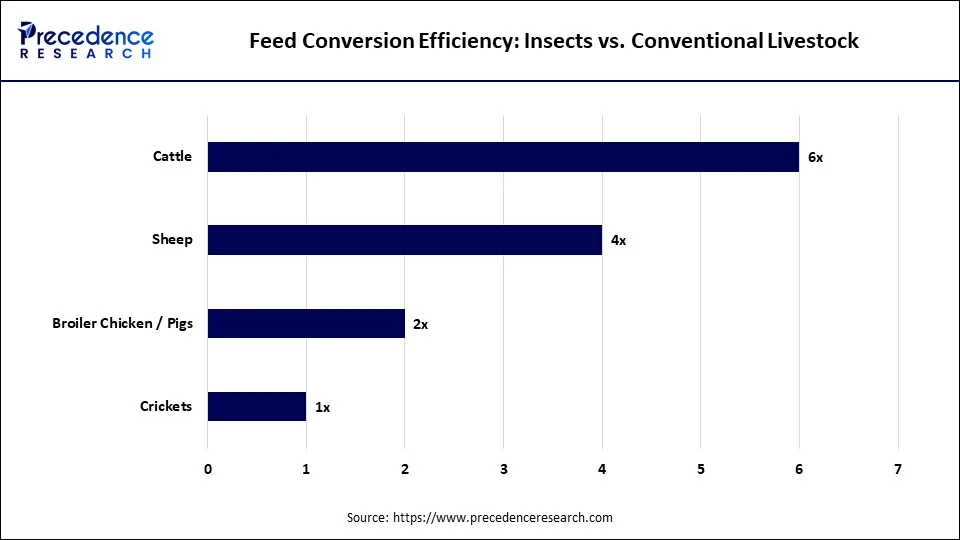
The greatest structural cost difference insect protein has over traditional livestock is feed conversion efficiency, and that's a big difference. FAO comparative data on feed conversion efficiency for various species suggest that crickets need about 6 times less feed. This produces 1 kg of protein on feed than cattle, and about 2 times less feed than broiler chickens. Cattle are poorly efficient at producing muscle protein from feed. Because proportionately large amounts of feed are used to keep the large warm-blooded body alive. That gap has been filled up, but it has been filled up by a small margin only after decades of selective breeding.
Crickets and insects in general are cold-blooded and expend very little metabolic energy maintaining their body temperature. Further putting a higher proportion of ingested feed into body mass. It is not a marketing claim; it is a thermodynamic one. It means that in the real world, conventional livestock cannot close this gap with additional breeding improvements. The cost structure is represented in the biology of the animal itself. This is the sort of sustainable edge that is hard to replicate and will usually make the investment of long-term capital in a category worthwhile.
Key Insight: The 6 times feed advantage over cattle and 2 times advantage over broiler chickens is simply due to basic thermodynamics.
Source: FAO, "Insects for Food and Feed" (fao.org/edible-insects); FAO 2013 report "The Contribution of Insects to Food Security, Livelihoods and the Environment."
The Sustainability Case is Not Marketing, It's Measurable
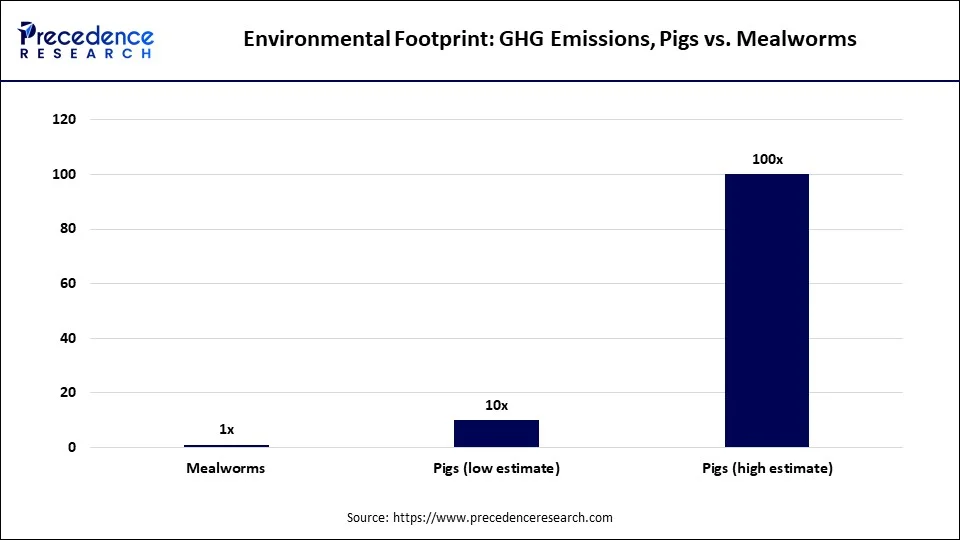
The environmental argument is the biggest factor that regulators and corporate buyers interested in ESG care about, and it's not hard to see why. FAO and peer-reviewed studies of insect-based sustainable feed production. Indicating that pigs produce anywhere from 10 to 100 times more greenhouse gas emissions than mealworms per kg of live weight. That is quite a broad swath of emission comparisons to have, and that is exactly the point and not a blemish on the argument.
That's a conservative estimate of tenfold reduction per kg of production. There is enough reason to consider premium positioning for the insect-derived ingredients in carbon-conscious food and feed procurement without taking into account the upper end of the range. A category of ingredients that can genuinely achieve an order-of-magnitude reduction in carbon footprint compared to something mainstream like pork. Those teams are genuinely defensible sourcing decisions rather than a purely reputational one.
Key Insight: Even if one takes the most generous of the two figures (ten times pigs vs. a hundred times mealworms), a buyer who is only concerned with a marketing story, and not a true carbon account, would be justified in making a premium buying decision.
Source: FAO (fao.org/edible-insects); PMC, "The Role of Insects in Sustainable Animal Feed Production" (pmc.ncbi.nlm.nih.gov/articles/PMC11010863).
Europe's Regulatory Runway is now Seven Approvals Deep
| Date | Milestone | Detail |
| Jun 2021 | Dried mealworm larvae | The first insect in the EU to be approved as a novel food was the yellow mealworm, Tenebrio molitor. |
| Nov 2021 | Migratory locust | Locusta migratoria (migratory locust) was added as an approved insect ingredient, in addition to other forms. |
| Feb 2022 | House cricket | House cricket, Acheta domesticus, was also authorized and may be used in a wider range of food applications in all formats: frozen, dried, and powder. |
| Jan 2023 | Defatted cricket powder & lesser mealworm | Approvals are also on the rise for partially defatted forms of Acheta domesticus powder and Alphitobius diaperinus (lesser mealworm) larvae. |
| Jan 2025 | UV-treated mealworm powder | A UV treated mealworm powder received its seventh EU approval as a novel food and, due to the complementary effect of the UV treatment, specifically the vitamin D3 added, an extra functional-nutrition proposition. |
| 2025 (ongoing) | 10 EFSA positive opinions issued | As more and more species receive positive safety evaluations, the European regulatory pipeline is slowly expanding from the handful of species already approved. |
Key Insight: The EU market is shifting from a narrow group of insects authorized as food to a wider range of insect species and formats approved as food. This will begin to increase the food manufacturers' and ingredient suppliers' reach.
Source: European Commission, Food Safety - Novel Food Authorisations (food.ec.europa.eu/food-safety/novel-food); IPIFF, "EU Novel Food Legislation" (ipiff.org).
From Substrate to Shelf: The Insect Protein Value Chain
| Step | Stage | Description |
| 01 | Breeding & Farming | Controlled-environment rearing of larvae/adults on organic substrate. |
| 02 | Feedstock Management | Food/agri by-products and organic waste as circular substrate input. |
| 03 | Harvesting | Biomass collection at optimal larval/pupal stage. |
| 04 | Processing | Drying, milling, defatting, extraction, hydrolysis or fermentation. |
| 05 | Ingredient Manufacturing | Powder, isolate, concentrate, hydrolysate or blend formats. |
| 06 | Formulation | Food, feed, pet food, sports nutrition and nutraceutical brands. |
| 07 | Distribution |
Direct B2B sales, distributors, online retail, specialty stores. |
Key Insight: While distribution channels of direct B2B sales are still the primary distribution channel, it indicates that insect protein is still in its early stages, primarily as an ingredient-based business, rather than a consumer product. Building solid connections with food, feed, pet-food, and nutrition manufacturers, therefore, may be more crucial for new entrants than establishing a big retail presence.
Source: Precedence Research Database
Processing is Moving Up the Value Curve
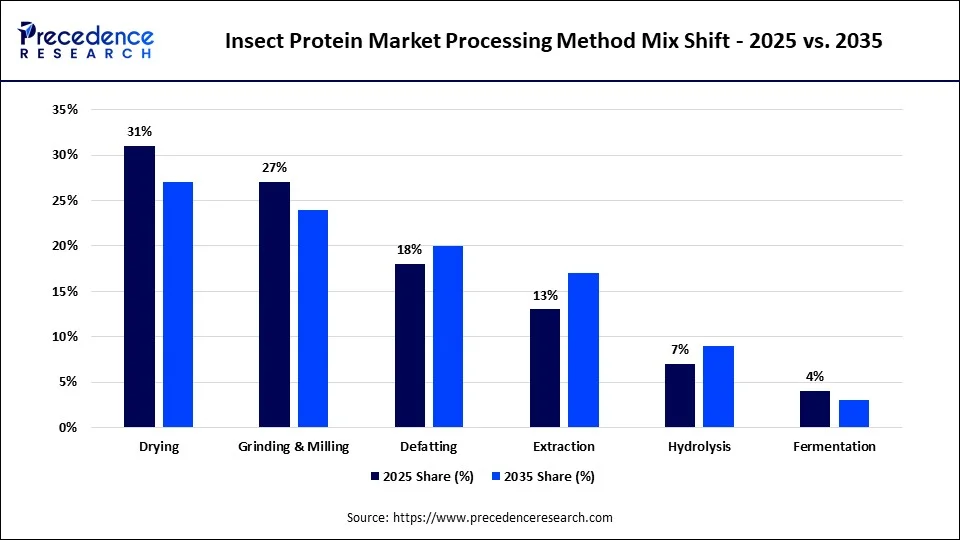
The processing method mix within this market is changing in a manner that indicates margin expansion and not just volume growth. The two most fundamental and least expensive processes by volume continue to be drying and grinding in 2025, as they are typically the first to be considered when processing large volumes of feed-grade product. Because they use relatively simple equipment. But the two fastest-growing processing methods are hydrolysis with +21.2% CAGR and extraction with +20.6% CAGR. Both are in a meaningful position above the market's overall growth rate of 17.02%.
Hydrolysis and extraction, however, are more capital-intensive and technically demanding processes. They require breaking the proteins down into smaller, more bioavailable fragments or isolating specific protein fractions from the raw insect biomass. But result in a product that has a materially superior price point, especially for applications such as sports nutrition and specialty pet food where digestibility and purity are relevant to the end buyer. That processing capability is more difficult to create than just drying and grinding. It will require more specialist equipment, too, and, as a result of that, will be less common and more defensible for the company to own than raw farming scale alone. As a result, the capacity in advanced processing will be more important to the company as a competitive differentiator than raw farming scale alone as the market matures.
Key Insight: Hydrolysis and extraction are adding to the market's basic drying and grinding backbone at a faster rate, and constructing them is more difficult than constructing more drying and grinding. Owning these will become more of a defensible competitive advantage than owning more of the drying and grinding.
Source: Precedence Research Database
The Demand Base Already Exists; It's Just Not Industrialized
I believe one of the more counterintuitive facts underpinning this market is that it is not starting from zero cultural acceptance the way many novel food categories do. More than 2000 species of insects are already eaten regularly in some part of the world. Over 2 billion people already regularly consume insects as part of their diet, and there are more than 100 governments that have entomophagy traditions. That's a really big existing base of demand, and it changes the nature of Western market growth. The problem is not to convince consumers from scratch that eating insects is acceptable.
But to come up with a formulation and a brand that packages insect protein into something familiar, such as protein bars, shakes, or pet food, without making insects a novel food item to the consumer. That is a huge deal for a go-to-market strategy, as it is a problem in most parts of the world. This is already solved in the behavior it is trying to scale, meaning it can be addressed on a much quicker timescale and with a much smaller marketing budget than a problem from scratch affecting consumer education.
Key Insight: With roughly two billion people already eating insects regularly across more than a hundred countries, Western market growth is fundamentally a formulation and branding challenge rather than a consumer education problem starting from zero.
Source: FAO, "Insects for Food and Feed" (fao.org/edible-insects).
This is a B2B Ingredient Market Wearing a Consumer-Trend Story
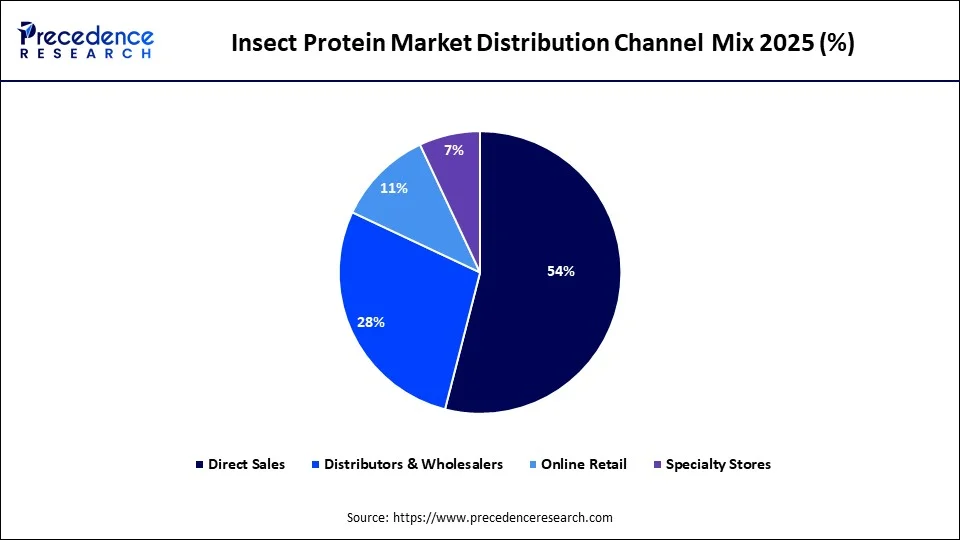
Although the market for insect protein is showing a lot of interest among consumers, Aman estimated that it is still mainly a B2B market. Direct sales make up 54% of the market, followed by 28% distributor/wholesaler distribution, for a total of 82%. Specialty stores make up 7%, and online retail products are 11%. The rapid growth segment, which is expected to grow at a CAGR of 18%, is online retail. But the base of players is small, so any potential changes in the overall distribution mix won't be significant before 2030. For the market segment, it's more important than a consumer-centric retail strategy to establish relationships with feed manufacturers, food-ingredient manufacturers, pet-food manufacturers, and procurement.
Key Insight: Over 80% of distribution is in direct sales, and direct distributors are the go-to-market for insect protein companies.
Source: Precedence Research Database
Competitive Structure: Specialization by Species, Not Broad Portfolios
| Company | Headquarters | Core Species | Primary Application | Strategic Signal |
| Ynsect | France | Mealworm | Feed, Food, Fertilizer | Operates the largest single insect-protein production facility in the world. |
| Innovafeed | France | Black Soldier Fly | Aquafeed, Pet Food | Raised €51 million in June 2026 and is consolidating production at its Nesle site. |
| Protix | Netherlands | Black Soldier Fly | Aquaculture, Pet Food | Opened a new facility in Poland and is deploying AI-driven breeding systems. |
| EnviroFlight (Darling) | United States | Black Soldier Fly | Poultry, Pet, Aqua Feed | Backing an AAFCO-supported expansion into poultry feed applications. |
| Aspire Food Group | Canada/United States | Cricket | Human Food | Running AI-automated cricket farming at commercial scale. |
| AgriProtein | South Africa | Black Soldier Fly | Animal Feed |
Africa's leading commercial-scale entrant in the category. |
Key Insight: Commercial momentum will be driven by both production economics and an increased number of feed applications by BSF. It is expected to grow at 19.0% CAGR and will likely emerge as one of the fastest-growing insect categories and may become the top category by 2035.
Recent Develpoements in Insect Protein Market
JAN 2025 - EUROPEAN COMMISSION
UV-treated mealworm powder authorized as the EU's 7th insect novel food
The whole larvae of Tenebrio molitor were approved as novel foods by the European Commission in the form of powder treated with UV light. The applications that were authorized included bread, pasta, cheese, and other food products. Thus, the authorization was for marketing alone, rather than exclusive manufacture.
WHY IT MATTERS: It extends the scope of legal insect ingredients in the most advanced regulatory market in Europe. The vitamin D3 fortification further allows manufacturers to market mealworm powder not just as an alternative protein, but as a functional nutrition ingredient as well.
SOURCE: European Commission, Food Safety - Novel Food Authorisations (food.ec.europa.eu/food-safety/novel-food/authorisations/approval-insect-novel-food_en)
Apr 2025 - PROTIX
ProteinX black soldier fly protein shows positive salmon-feed trial results
Protix announced commercial trials with the protein black soldier fly for salmon have yielded positive results. The trials showed positive results for salmon production, salmon quality, and feed economics.
WHY IT MATTERS: It's important because the aquaculture industry will be one of the areas where BSF protein will be used in the highest quality feeds. In addition, it shows that insect protein is not just about sustainability, but can actually compete for functional properties.
SOURCE: Precedence Research Database Market Analytics, "Insect Protein Market Size, Share & Forecast Analysis to 2030"
2025 - EFSA
Ten positive safety opinions published on insect novel foods
In 2025, the European Food Safety Authority (EFSA) gave ten positive safety opinions on insect derived novel foods, building on nine opinions issued by end-2024.
WHY IT MATTERS: The number of positive safety evaluations increases continually, and more species and species formats are commercially available in Europe. The situation may provide new opportunities for processors, ingredient suppliers and food manufacturers in the coming few years.
SOURCE: IPIFF, "EU Novel Food Legislation" (ipiff.org/insects-novel-food-eu-legislation-2)
2025 - PROTIX
New funding secured for a black soldier fly facility in Poland
As part of its European expansion, Protix was able to raise capital for a new production plant in Poland.
WHY IT MATTERS: If there is more capacity available in Central and Eastern Europe, there will be better access to BSF ingredients and more supply capacity will be available outside of Western Europe's existing production base.
SOURCE: Precedence Research Database Market Insights
2025 - YNSECT
Capacity expansion completed in France
Ynsect kept building on its capacity to produce superworms in France, making it one of the biggest specialised mealworm producers.
WHY IT MATTERS: It's relevant because more capacity means it can support both food and feed applications and provides scale in markets where the availability of regular supply is a major hurdle to wider use.
Jun 2026 - INNOVAFEED
Raises €51M ($59M) to scale Black Soldier Fly production
Innovafeed secured €51 million in funds from existing shareholders, including Creadev, Qatar Investment Authority, Temasek, FFC, ABC Impact and ADM. Those funds come as a reaffirmation of its BSF production platform's industrialisation and will enable it to continue commercial production in its French facility, Nesle.
WHY IT MATTERS: Institutional and strategic investors' investment is a sign of increasing confidence in the commercial viability of BSF production. The involvement of ADM is especially noteworthy as it links insect protein to the already established global agribusiness platform.
SOURCE: Precedence Research Database
2026 - MAXBITES
Insect-protein pet food brand enters Canadian retail, U.S. expansion planned
MaxBites' products for pets made from insect protein were introduced in Canadian retail and online outlets, and it announced its intention to go into the U.S. market later in 2026.
WHY IT MATTERS: It shows the transition of insect protein from product development to wider distribution in retail. Insect protein can be used for hypoallergenics and alternative protein positioning, which is a specific area of pet food that is appealing.
SOURCE: PetfoodIndustry.com, "Insect protein pet food market poised for rapid growth" (petfoodindustry.com/insect-based-cat-and-dog-food/news/15822052)
Insect Protein Market Companies
Ynsect - FRANCE
- Role: Mealworm protein & fertilizer producer.
- Relevance: Ynsect has established itself in large-scale mealworm production and an integrated model that covers all meals, feed, and related applications.
Innovafeed - FRANCE
- Role: Black Soldier Fly protein for aquafeed and pet food.
- Relevance: Innovafeed has been quite active in the production of black soldier flies and has received significant investments from institutional and strategic investors. Its connection with ADM further validates it from the wider agricultural and feed sector.
Protix - NETHERLANDS
- Role: BSF larvae for aquaculture, pet food, animal feed.
- Relevance: Protix has developed a robust BSF platform with automated production, breeding technology, data analytics and growing manufacturing capacity. It can also take advantage of the growing demand for insect ingredients in feeds in Europe.
EnviroFlight (Darling Ingredients)-UNITED STATES
- Role: BSF-based feed ingredients.
- Relevance: EnviroFlight is a strong linkage between the longstanding animal-feed industry and insect protein. It is also working on regulatory acceptance of BSF ingredients that could help in making BSF more widely used in U.S. poultry and livestock feed markets.
Aspire Food Group - CANADA / UNITED STATES
- Role: Cricket protein for human food.
- Relevance: Aspire has been working on automating cricket production and cricket protein for food-grade applications. Its technology-based method provides it with a differentiated place in the North American edible-insect market.
AgriProtein - SOUTH AFRICA
- Role: BSF-based animal feed.
- Relevance: AgriProtein has gained a solid foothold in the insect-protein market in Africa, especially in terms of large-scale production and the transformation of organic resources into valuable feed ingredients.
Entobel - VIETNAM
- Role: BSF protein and oil for aquafeed.
- Relevance: Entobel is working on producing insect protein in Southeast Asia, a region with high feed demand and promising future prospects for alternative protein production.
Hexafly - IRELAND
- Role: BSF-based feed and oil products.
- Relevance: Hexafly is a new player in Europe and is based on partnerships and strategic expansion to consolidate its market position with a growing dominance of larger, better-funded platforms.
Source: Precedence Research Database
Regional Analysis
Regional Share Shift, 2025 vs. 2035
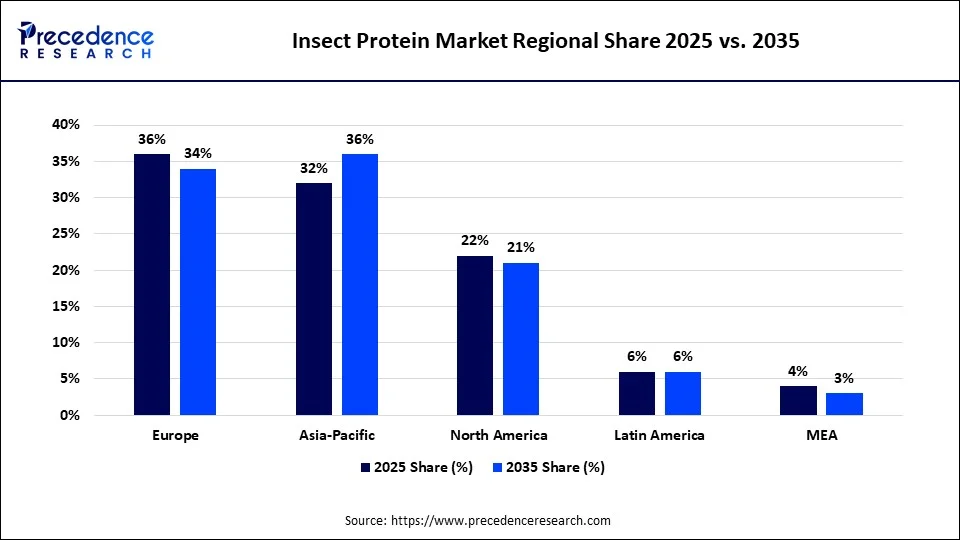
Europe is ahead in the race for insect protein, as it has taken the regulatory lead and has more explicit guidelines for the acceptance of insect proteins as foods and feed. The regulatory benefit can be the reason why products have already been marketed and capacities developed in Europe before many other regions. Europe led with 36% of the regional share in 2025, but this number is projected to settle down to 34% by 2035.
Asia-Pacific will close this lag at a breakneck speed and will come to account for 36% market share by 2035 from 32% in 2025. The region benefits from strong knowledge of insect-based foods in multiple markets due to a growing number of markets for agro- and feed production and a growing demand for protein. Production capacity is also growing faster across the region. The percentage share in North America is forecast to decline from 22% to 21%, while Latin America is expected to keep constant at 6%, and the Middle East & Africa is projected to go down from 4% to 3%.
This is more about the growth acceleration of Asia-Pacific and not because of the world's fading market opportunity in Europe. The Asia-Pacific region will have one-third (36%) of the market share by 2035, thus revolutionizing competition in the region.
Key Insight: Ongoing leadership of Europe with 36% of market share will be taken over by Asia-Pacific, moving from 32% in 2025 to 36% in 2035, for all intents and purposes an equal opportunity region in the near future.
Source: Precedence Research Database
Regional Growth Momentum (CAGR Ranking)
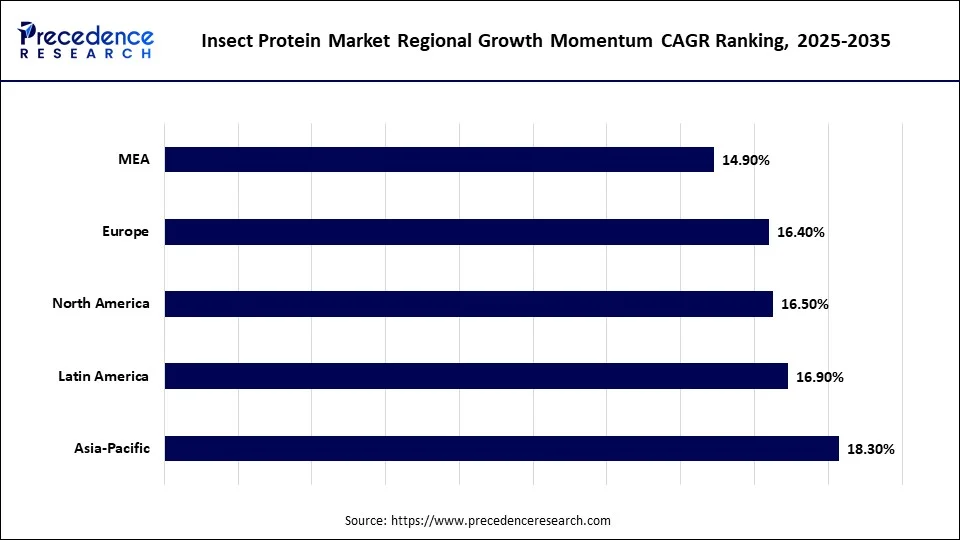
Europe started as the growth leader, but at a slower rate compared to the global market through the forecast period. The region is expected to grow at 16.4% CAGR over 2025-2035, due to its relatively more advanced regulatory framework, production capabilities, and rising use of insect ingredients in food and feed products.
The highest growth momentum is for Asia-Pacific at 18.3% CAGR. It has a proven track record of use in multiple markets, increasing production, growing interest in alternative protein, and investment in commercial production offer great promise for the future. At 16.9%, Latin America is not far behind, and North America and Europe are not far behind at 16.5% and 16.4%. In the Middle East & Africa, growth is at 14.9%.
Key Insight: Asia-Pacific not only offers the highest CAGR of 18.3% but also a solid market foundation for these investment decisions, making Asia-Pacific both a market and growth priority for capacity and partnership investment.
Source: Precedence Research Database
Segment Deep-Dive
Black Soldier Fly Overtakes Crickets as the #1 Insect Type
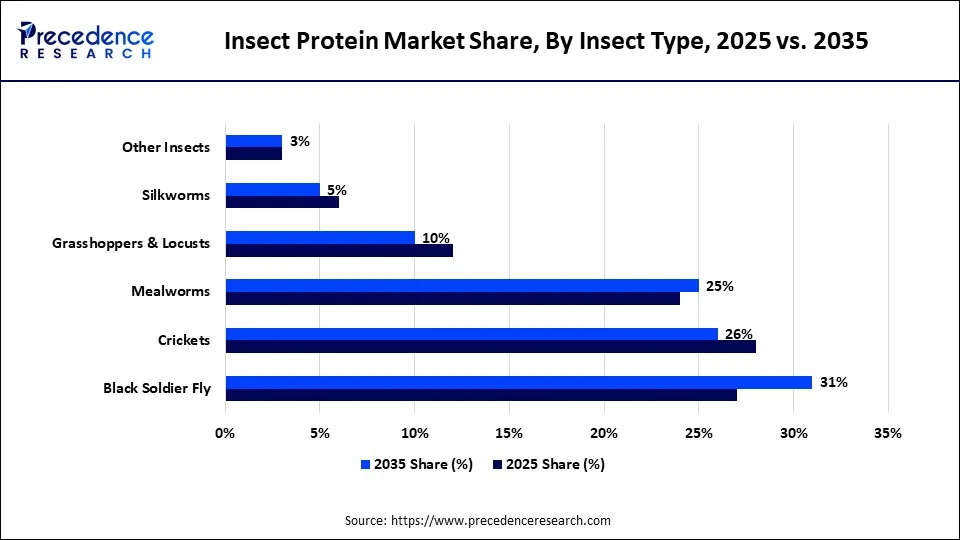
The category of insect type with the largest share in 2025 was crickets, with 28% of market share. They have long been the most commercially cultivated insect for direct human consumption. Primarily in Southeast Asia and are increasingly into Western snack and protein bar products. By 2035, crickets will have the lowest share, increasing by 16.2% CAGR, the smallest of the three largest insect groups in this dataset.
On the other hand, the actual number of black soldier fly units is on the move to the number one spot. It is growing much faster than any other insect type in the market at 19.0 % CAGR, up from a 27.0% share in 2025 to a 31.0% share in 2035. The advantage BSF has gained is due not to its superiority as an organism, but to its underlying use case. The BSF is the insect of choice for feed-focused, industrial-scale producers. Because the larva is highly effective at converting low-value organic waste streams such as food waste and agricultural byproducts into protein and fat that are ideal for aquafeed and pet food.
Key Insight: The category's center of gravity is shifting from human-food-oriented crickets toward feed-efficient black soldier fly. Rather than one insect being biologically superior to another. The center of gravity for the category is moving from crickets that are used for human food to the black soldier fly, which is better at converting feed into food.
Source: Precedence Research Database
Powder Still Rules Volume, Isolates and Hydrolysates Own Growth
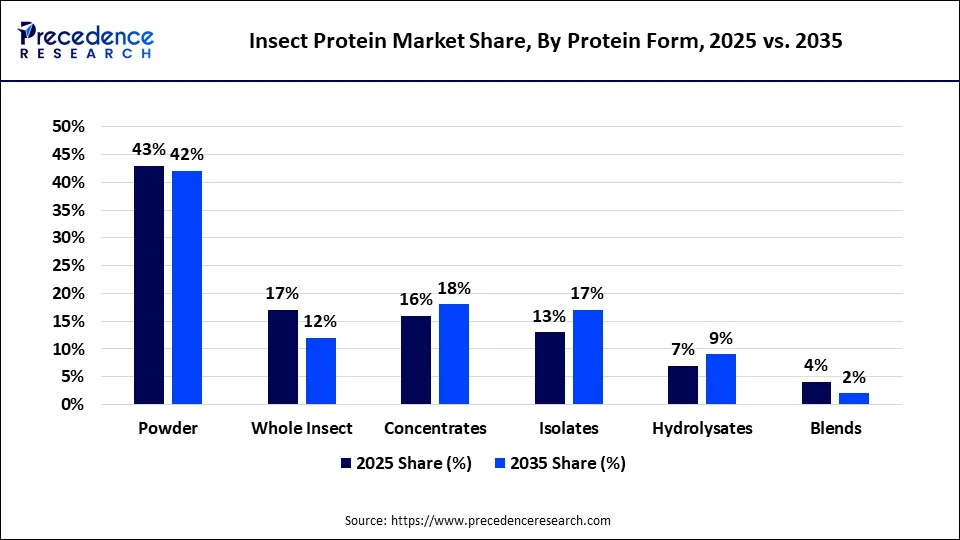
In 2025, insect protein powder accounted for the largest market share, 43.0%, of the protein form category, as it is the easiest, lowest-cost processed form. That share will only increase slightly to 42.0% in 2035, but still increasing at a solid 16.8% CAGR. That insect powder isn't going anywhere as the volume backbone of the market continues its growth story.
The share of insect protein isolates increases from 13.0% to 17.0%, increasing at 20.1% CAGR, while the fastest growing of all protein forms in the market. Also, insect protein hydrolysates increase their share from 7.0% to 9.0% at 20.7% CAGR. In sports nutrition products, the protein density per serving is the key value proposition, and isolates provide a much higher protein concentration and a minimal amount of non-protein impurities, and in specialty pet food and clinical or medical nutrition products. Hydrolysates are pre-broken down into smaller peptide chains that digest and absorb more quickly, resulting in a premium price.
Key Insight: Isolates and hydrolysates are growing at about twice the rate of whole insect protein. That is more a reflection of the willingness of the buyers to pay for functional purity and digestibility than on just the amount of protein content.
Source: Precedence Research Database
Human Food Overtakes Animal Feed as the Largest Application
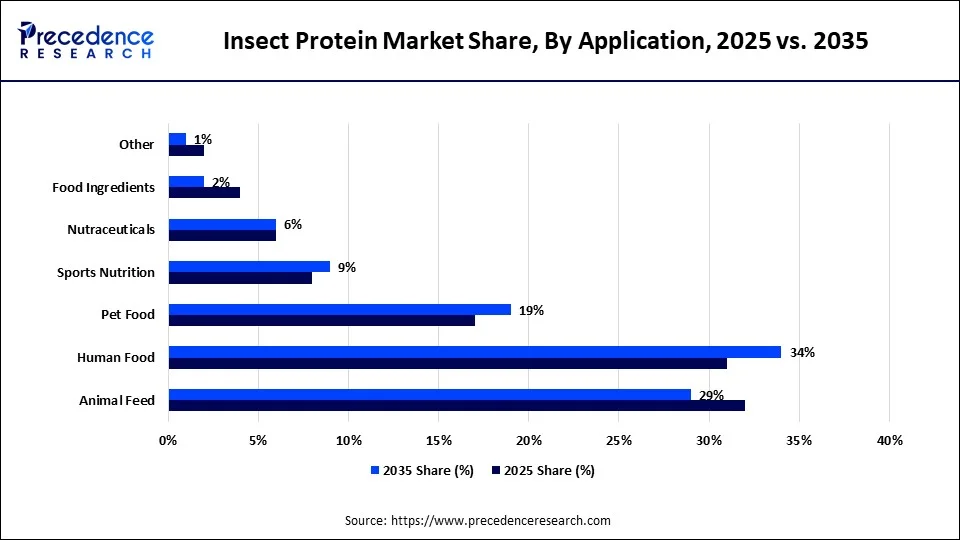
Aditi interprets that, in 2025, the application share for animal feed was still the highest at 32%. Highlighting the market's agricultural roots, as fishmeal or soymeal were no longer the dominant protein source for fish feed or fishmeal production. This was increasingly being pushed by livestock, poultry, and aquaculture producers due to its high cost and environmental footprint. Animal feed's share is falling to 29% by 2035 as the category grows at 15.8 % CAGR, which is the second-slowest growth pace among all segment categories.
The application is being taken over by human food as it has increased its share from 31.0% in 2025 to 34.0% by 2035 at 18.1 % CAGR. Commanding a much better growth rate than the market's overall growth rate. It truly is a transformative change in the core idea of a category. This is a market that began as an agricultural feed input, but is rapidly transforming into a category for consumer foods and beverages. That has a tremendous impact on who ought to be paying attention to it, because it means the people buying into the market, not just the agricultural feed buyers. They are the buyers who are far more likely to be making purchases.
Key Insight: Although animal feed is the larger absolute category for this market, over the next ten years, the largest absolute increase in application will be human food, and arguably the biggest structural change throughout this entire report is the conversion from agricultural input to consumer nutrition.
Source: Precedence Research Database
Food & Beverage Extends Its Lead as the Core End-Use
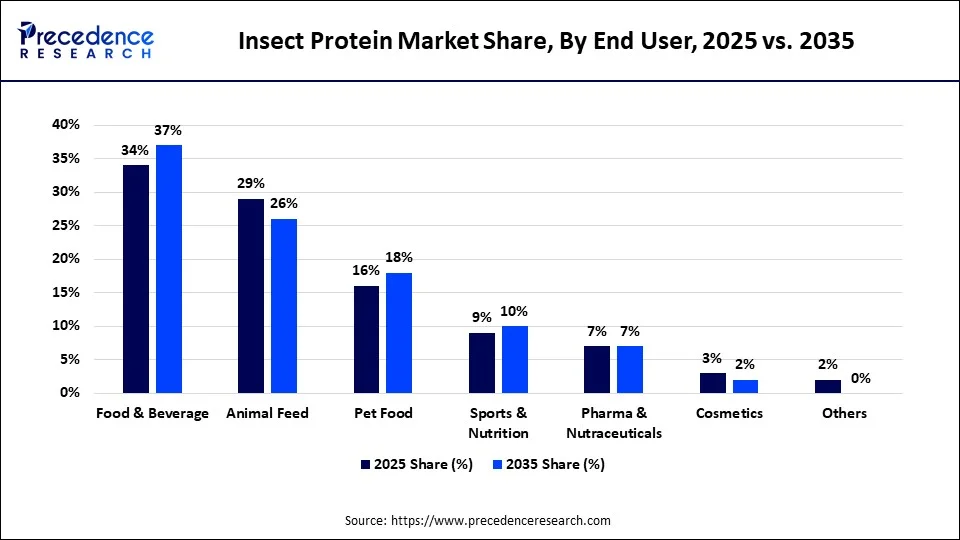
Food and beverage already held the largest end-use share in this market in 2025 at 34.0% market share. This also extends its lead further, climbing to a 37.0% share by 2035 at an 18.0% CAGR. I interpret this to mean that food and beverage is the sole category in the entire dataset to gain more than a single percentage point of share. Due to incremental dollars are being spent on consumer nutrition, not feed or pharmaceuticals.
Key Insight: There is only one end-use segment that is netting more than a single point of share through 2035, and that is food and beverage, which is also reinforcing the direction taken by the application segment, and was confirmed by a second, independent data perspective.
Source: Precedence Research Database
Expert Insights
The center of gravity of this market is really shifting from agricultural feed input to consumer nutrition. That is evidenced by the application data and the end-use data. The Asia-Pacific region's share in capacity and partnership decisions should be given more weight than the region's actual share. That would indicate that it enjoys an existing entomophagy base and is the fastest-growing region in the market.
It is also important to note that this is a front-loaded market, so there is an increased level of risk associated with timing when compared to most markets of this size. The competitive positioning that is established between now and approximately 2031. This will likely have a greater impact than positioning decisions made in the second half of the forecast period. Because over half of the decade's proportional value creation will occur during the first 6 years of the forecast period. When deciding if insect protein is worth considering now, or worth considering when it's as big as it feels comfortable to be, a company or investor is really choosing which side of the growth curve in a market to ride.
Our Experts
Sudeep Pednekar led the primary market research, developed the methodology, and analyzed segmentation, regional trends, competition, and forecasts, forming the report's analytical foundation.
Aman was responsible for collecting and validating regulatory filings, company financial data, commodity pricing, and other independently sourced quantitative datasets, strengthening the evidence base behind the market estimations.
Aditi reviewed the complete research document, performed quality checks, validated findings, refined content, corrected inconsistencies, and finalized the report, ensuring accuracy and clarity.
Complete Market Segmentation
The Full Segmentation Structure
Every category tracked in the underlying dataset, beyond the four segments selected for deep-dive analysis.
By Insect Type
- Crickets
- Mealworms
- Black Soldier Fly
- Grasshoppers & Locusts
- Silkworms
- Other Insects
By Protine Form
- Whole Insect Protein
- Insect Protein Powder
- Insect Protein Isolates
- Insect Protein Concentrates
- Insect Protein Hydrolysates
- Insect Protein Blends
By Processing Method
- Drying
- Grinding & Milling
- Defatting
- Extraction
- Hydrolysis
- Fermentation
By Application
- Human Food
- Animal Feed
- Pet Food
- Sports Nutrition
- Nutraceuticals
- Food Ingredients
- Other Applications
By End-Use
- Food & Beverage
- Animal Feed
- Pet Food
- Sports & Nutrition
- Pharmaceuticals & Nutraceuticals
- Cosmetics & Personal Care
- Others
By Distribution Channel
- Direct Sales
- Distributors & Wholesalers
- Online Retail
- Specialty Stores
By Region
- North America
- Europe
- Asia-Pacific
- Latin America
- Middle East and Africa
Questions This Report Deliberately Leaves Open
- What are the two or three countries which offer the best route for BSF capacity growth, outside of the existing EU regulatory markets?
- What can a new player do to stand out with Ÿnsect, Innovafeed, and Protix - by species, region, or use?
- Is the anticipated increase of isolates/hydrolysates worth investing in extraction facilities, or would it be better to license from existing processors?
- Before feed manufacturers start considering the costs of feed over sustainability and functionality, how much premium will insect protein need to offer?
- Which countries in Asia Pacific have a history of eating insects and have regulations that are conducive to commercial investment?
- As several BSF producers expand their operations simultaneously, will the feedstock's source of organic waste be a limiting factor?
- So, what does the growing EFSA safety-opinion pipeline reveal about the insect species most likely to go commercial in Europe in the next 24 months?
- Will much of the anticipated strong growth in human-food applications be attributable to new consumers or increased consumption by current users?
- So where could be the best place for insect-protein products to get to market, positioned around hypoallergenic benefits, from a pet-food standpoint?
- Is the risk/reward opportunity higher in the years ahead for investing in insect-farming technologies or processing technologies like extraction and hydrolysis?
- What would the regulatory ramp-up, volatile feed prices and consumer acceptance breakthroughs mean for the market's future in 2035?
- Is Ynsect's scale effect sustainable when other BSF producers with increased capital invest in competing to increase their production capacity?
- What are the highest risk B2B customer relationships for disintermediation because of the increase in direct procurement channels?
- How long will the online retailing of insect proteins go before the nature of the insect-protein industry is fundamentally B2B in nature and restricts the amount of consumer-direct business?
- Are there structural market restrictions in North America, or is it just a lag in Europe in terms of regulations and commercialisation?
- What are the most likely applications in which conventional protein sources (soy, fishmeal, whey) will be replaced by insect proteins?
- Is it the need for supply security, sustainability goals, or the potential to create new streams of revenue that is fueling agribusiness interest in insect-protein businesses?
- With the small but growing insect-protein market outpacing the protein market generally, how should sports-nutrition companies time the introduction of their products?
References
- Precedence Research Database Market Data - Insect Protein Market
Market value, CAGR, and full segmentation/regional share tables (2025, 2035, CAGR by category) supplied directly for this analysis. - FAO - "Insects for Food and Feed"
https://www.fao.org/edible-insects/en
Food and Agriculture Organization of the United Nations. Data used: feed conversion ratios, GHG emission comparisons, entomophagy consumption base statistics. - FAO - "The Contribution of Insects to Food Security, Livelihoods and the Environment"
https://www.fao.org/4/i3264e/i3264e00.pdf
FAO, 2013. Data used: insect vs. cattle feed conversion ratio, pig vs. mealworm GHG comparison. - PMC - "The Role of Insects in Sustainable Animal Feed Production for Environmentally Friendly Agriculture: A Review"
https://pmc.ncbi.nlm.nih.gov/articles/PMC11010863/
Peer-reviewed review. Data used: GHG emissions and feed conversion context. - European Commission - Novel Food Authorisations (Insects)
https://food.ec.europa.eu/food-safety/novel-food/authorisations/approval-insect-novel-food_en
Data used: EU novel-food regulatory approval timeline for insect species. - IPIFF - "EU Novel Food Legislation and Other EU Requirements Applying to Insect Food Producers"
https://ipiff.org/insects-novel-food-eu-legislation-2/
International Platform of Insects for Food and Feed. Data used: 2025 EFSA opinion count and approval pipeline status. - PetfoodIndustry.com - "Report: Insect Protein Pet Food Market Poised for Rapid Growth"
https://www.petfoodindustry.com/insect-based-cat-and-dog-food/news/15822052/report-insect-protein-pet-food-market-poised-for-rapid-growth
Data used: MaxBites Canada/U.S. retail expansion development.
For inquiries regarding discounts, bulk purchases, or customization requests, please contact us at sales@precedenceresearch.com
Frequently Asked Questions





Ask For Sample
No cookie-cutter, only authentic analysis – take the 1st step to become a Precedence Research client
 Get a Sample




 sales@precedenceresearch.com
 Schedule a Meeting
