






 Request Consultation
AI email assistants are revolutionizing business communication by automating workflows and enhancing productivity. This blog explores their benefits, industry applications, and emerging trends. Discover how AI-driven tools are shaping the future of workplace efficiency.
According to Google, AI models like Gemma are making complex administrative tasks easier by handling customer inquiries and managing emails. An AI email assistant from Google is a smart Gmail add-on that utilizes AI technology to transform email management. The add-on includes features such as email summarizer, answer generation, and email translation in 13 languages. Moreover, the ‘Improve Draft’ feature suggests changes and improvements, and analyzes text features for sarcasm and ethical issues.
Advancements in Intelligent and Smart AI Systems
- Google’s Commitment to Advancing an AI Email Tool: AI tools are driving the industrial revolution across major tech sectors. For instance, in June 2025, Demis Hassabis, the head of Google DeepMind, revealed his efforts along with his team on next-generation email that will result in the daily sorting through emails, replying to the important ones, and avoiding the need to apologize for missing an important message. Google addressed the challenges and potential solutions associated with the most urgent problem, the tyranny of the email inbox.
- Great Impact of AI-Powered Communication Tools: AI-powered productivity tools brought efficiency and streamlined processes in industrial sectors and businesses. It has become important to maintain authenticity and engagement in email communication. As a result, businesses are heavily investing in sourcing accurate first-party data to better understand and meet individual customer needs.
What is the AI Email Assistant Market Size in 2026?
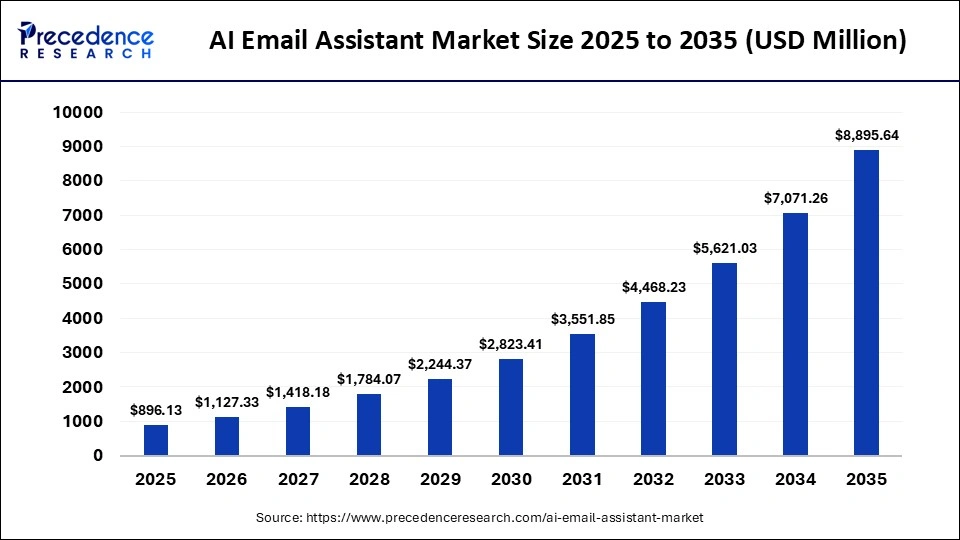
The global AI email assistant market was valued at USD 896.13 million in 2025 and is projected to grow from USD 1,127.33 million in 2026 to approximately USD 8,895.64 million by 2035, registering a CAGR of 25.80% during the forecast period from 2026 to 2035. The market growth is driven by the increasing adoption of AI-powered email generators and automation software that help manage inboxes, suggest replies, organize messages, draft emails, prioritize important communications, and automate tasks such as meeting scheduling.
Get a Free Sample Report with Key Market Trends: https://www.precedenceresearch.com/sample/8223
Key Functions of Traditional Automation Tools vs. AI Assistants
| Sr. No. | Traditional Automation | AI Personal Assistants |
| 1 | To follow rigid rules | To understand context and nuance |
| 2 | To ensure exact inputs | To work with natural language |
| 3 | To break when scenarios change | To adapt to new situations |
| 4 | To automate simple tasks | To handle complex workflows |
| 5 | To ensure constant maintenance | To improve through use |
Impulse of the Expanding AI Email Assistant Industry
Shift to Remote and Hybrid Work: The ongoing trend of remote and hybrid work has raised the need for digital communication tools to maintain improved productivity across all teams. Companies are increasingly adopting AI, generative AI, predictive analytics, digital tools, mobile applications, and real-time monitoring tools to ensure transparency in work culture.
Hyper-Personalization: A personalized email content enhances productivity, trust, and transparency among businesses. AI tools are pivotal in analyzing real-time behavioral data, time of day, and purchase history to create messages.
AI Assistant Landscape
| Sr. No. | AI Assistant Industry-Specific Compliance | AI Assistant Security Best Practices | Benefits of Custom AI Assistant Development | Key Features of Enterprise-Grade Custom AI Assistants |
| 1 | HIPAA for HealthTech | Zero-trust architecture | Domain-specific expertise | Multi-modal capabilities |
| 2 | SOC 2 for SaaS | Encryption everywhere | Seamless integration | Workflow orchestration |
| 3 | Financial regulations for FinTech | Regular security audits | Competitive advantage | Learning and adaptation |
| 4 | - | Incident response plans | Scalability and control | Role-based access |
Emerging Trends in the AI Assistant Adoption across Industries
- EdTech Platforms: These platforms use AI assistants to automate grading, personalize learning experiences, and provide instant student support. In the education sector, automation is connecting with humans to give a promising learning experience.
- Adoption in Enterprise and HealthTech Organizations: The universal key benefits of AI email assistants are email management, document creation, meeting coordination, and data analysis. Furthermore, HealthTech organizations use AI assistants for medical record analysis, patient communication, and treatment plan optimization. These assistants need privacy controls and enterprise-grade security from day one.
- Adoption in FinTech Companies: They use AI assistants to generate investment summaries, automate compliance reporting, and offer personalized financial advice at scale. The high standards of financial services are raised by the increased focus on audit trails and explainable AI before their implementation.
AI Technology is Shaping the Future of Work
- AI Personal Assistants: Numerous tasks performed by AI personal assistants are adding events to the calendar, automating customer service, giving recommendations, holding a natural conversation, making phone calls, making a ‘to-do’ list, providing facts and information, scheduling meetings, sending text messages, setting alarms and reminders, and many more. Technologies standing behind AI assistants are large language models, natural language processing, and machine learning that enable continuous improvement.
- AI Assistants to meet Organizational Needs: Different AI assistant solutions include enterprise ecosystem solutions, specialized productivity tools, and custom-built AI assistants. Enterprise ecosystem solutions like Google Workspace AI and Microsoft Copilot are designed for organizations to offer integration with familiar tools. Specialized productivity tools, such as Jasper, Notion AI, and Otter.ai, excel at specific tasks like content creation, project management, and meeting transcription. Moreover, the custom-built AI assistants are designed around specific data sources, business logic, and workflows.
Overcoming Common Challenges in the Adoption of AI Assistants
| Sr. No. | Challenges | Solutions/Best Practices |
| 1 | A fear of many employees is job displacement due to AI personal assistants. |
|
| 2 | The use of dozens of different software tools by modern organizations. |
|
Investments are Driving Breakthroughs in Information and Communication Technology (ICT)
- In January 2026, Zocks, the leading player in building an AI assistant for financial advisers, raised $45 million in a series B funding round, backed by Lightspeed Venture Partners and QED Investors. The company and its collaborators are focused on high-security privacy areas, including financial services.(Source: https://news.crunchbase.com)
- In December 2025, Google committed $8 million to advance India’s AI future by expanding its initiatives in healthcare, agriculture, education, and language technologies. The company has set a strong commitment to strengthening AI research and practical applications in India.(Source: https://www.angelone.in)
Impact of AI Assistants on Businesses
- Handling Meeting Management and Scheduling: AI personal assistants analyze calendar patterns, protect a deep work time, and understand energy levels throughout the day. AI suggests optimal times after requesting a meeting based on the schedules of all participants. It also automatically sends prep materials and declines meetings that are out of one’s priorities.
- Email and Communication Automation: Modern AI personal assistants automatically categorize emails by urgency, project, and required action. They draft responses in one’s voice and collect information from the calendar, customer relationship management, and previous conversations. They also handle entire email threads autonomously for daily inquiries.
- AI-Powered Task and Project Management: AI personal assistants figure out how to complete project tasks efficiently. They also estimate realistic timelines and break down complex projects into manageable tasks. They also automatically adjust schedules and identify bottlenecks before they become problems. They suggest resource reallocation to keep projects on track.
- Research and Information Synthesis: AI personal assistants compile detailed reports in minutes instead of spending hours on research. They eliminate the need to spend hours researching competitive analysis, market trends, or regulatory changes. AI assistants understand one’s specific context, access data, and synthesize information in a desirable format. They analyze competitive intelligence and customer feedback trends from multiple sources. They also generate strategic recommendations based on business objectives.
- AI-Driven Decision Support and Analytics: AI personal assistants are used for strategic decision support, which can identify patterns that can be missed by humans and process vast amounts of data. They present insights in actionable formats and excel at scenario analysis. They predict the situations that may arise with revenue after increasing prices for customers.
Government Initiatives are Gaining Traction across Diverse Sectors
- In March 2026, the Ministry of Electronics and Information Technology (MeitY) of India accelerated the launch of 50 AI curation units across major ministries to strengthen the country’s AI data infrastructure and support the IndiaAI mission. These units are set to identify high-value datasets and integrate them into the IndiaAI datasets platform named AlKosh.(Source: https://www.varindia.com)
- In March 2025, the U.S. General Services Administration (GSA) launched an early-stage AI tool to support staff in their daily work, advance the agency’s commitment to technological innovation, and secure digital solutions. The GSA also looks after staff feedback to refine the capabilities of AI tools and ensure its high standards of performance.(Source: https://www.gsa.gov)
Flagship Players in the AI Email Assistant Industry and Their Offerings
- Microsoft: Microsoft 365 Copilot, Copilot Pro, outlook 2024, Copilot studio.
- Google: Help Me Write, AI-powered summarization, smart reply, smart compose, AI inbox, Gmail side panel, proofread.
- Zoho: Lead generation agents, autonomous follow-ups, “Ask Zia” interface, generative drafting, tone and style refinement, sentiment and emotion analysis, and smart slash commands.
- Grammarly: Superhuman Go, specialized AI writing agents, superhuman mail bundle.
- Superhuman: Superhuman Go, integrated Coda workspace, advanced writing assistance, split inbox with auto labels, Ask AI, write with AI, auto summarize, instant reply.
- Shortwave: Tasklet, Ghostwriter, mobile AI assistant, advanced scheduling, AI-powered search, instant summaries, multi-step reasoning.
Expert Advise
Our analysts suggest that AI-based email assistant tools simplify complex manual workflows, solving a daily, unavoidable problem for every professional. Businesses can achieve a strong ROI as AI agents streamline workflows and reduce costs. Companies providing AI email agents can generate recurring revenues through their subscription-based models and easy upselling. The AI email assistant industry is a large, growing market with a universal use case across diverse domains and has strong SaaS economics. Moreover, the future of AI email assistants is promising, driven by the need for autonomous tools and the demand for hyper-personalization.
About the Authors

Aditi Shivarkar
Aditi, Vice President at Precedence Research, brings over 15 years of expertise at the intersection of technology, innovation, and strategic market intelligence. A visionary leader, she excels in transforming complex data into actionable insights that empower businesses to thrive in dynamic markets. Her leadership combines analytical precision with forward-thinking strategy, driving measurable growth, competitive advantage, and lasting impact across industries.



Aman Singh
Aman Singh with over 13 years of progressive expertise at the intersection of technology, innovation, and strategic market intelligence, Aman Singh stands as a leading authority in global research and consulting. Renowned for his ability to decode complex technological transformations, he provides forward-looking insights that drive strategic decision-making. At Precedence Research, Aman leads a global team of analysts, fostering a culture of research excellence, analytical precision, and visionary thinking.

Piyush Pawar
Piyush Pawar brings over a decade of experience as Senior Manager, Sales & Business Growth, acting as the essential liaison between clients and our research authors. He translates sophisticated insights into practical strategies, ensuring client objectives are met with precision. Piyush’s expertise in market dynamics, relationship management, and strategic execution enables organizations to leverage intelligence effectively, achieving operational excellence, innovation, and sustained growth.