






 Request Consultation
Anti-jamming GPS systems provide secure, reliable, and accurate navigation by mitigating interference and signal jamming. Critical for military, aviation, drones, and commercial operations, these systems protect GNSS receivers, ensure precise timing, and prevent operational failures. With technologies like nulling, beam steering, and civilian anti-jamming methods, organizations can maintain uninterrupted positioning, safeguard critical infrastructure, and enhance operational safety in high-interference environments.
What is the Significance of Anti-Jamming GPS Systems?
Anti-Jamming GPS is engineered to ensure reliable and accurate positioning, navigation, and timing (PNT) by mitigating the effects of unintentional signal interference and noise. By employing technologies, these systems allow drones, aviation, military, and critical infrastructure to operate securely without misleading or losing connectivity. Anti-jamming GPS prevents GNSS receivers from losing track of satellites, which is important for preventing drone crashes, maritime navigation failures, and airplane landing errors. It protects timing synchronization to enhance financial transactions, cellular networks, and power grids by preventing data corruption or systemic failures.
What is the Anti Jamming GPS Market Size in 2026?
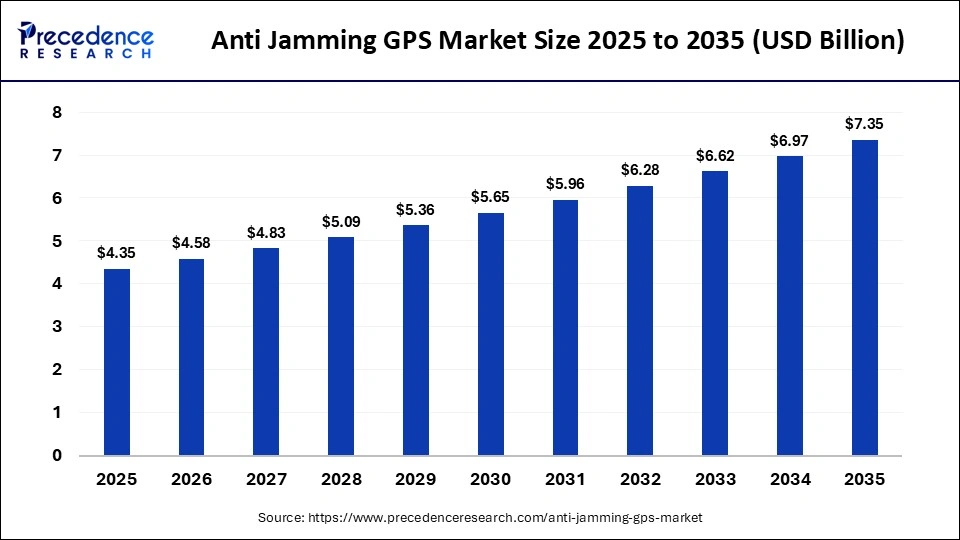
The global anti jamming GPS market size was calculated at USD 4.35 billion in 2025 and is predicted to increase from USD 4.58 billion in 2026 to approximately USD 7.35 billion by 2035, expanding at a CAGR of 5.38% from 2026 to 2035
What are the Types of Jamming Techniques?
Several types of jamming techniques adopted by the end-users include the nulling technique, the beam steering technique, and the civilian technique.
- Nulling Technique: Nulling techniques are advanced processes used to eliminate or reduce unwanted noise, signals, or interference, along with maintaining the integrity of the desired signal. This technique is highly effective in several modern communication systems, including GNSS receivers and UAV communications, as it can suppress high-power jammers without any extra bandwidth.
- Beam Steering: Beam steering techniques work by electronically directing electromagnetic and optical beams without any mechanical movement. It offers numerous advantages such as increased speed, improved reliability, higher precision, reduced maintenance, and the ability to create targeted beams for delivering superior signal quality in 5G, radar, and LiDAR systems. By precisely directing signals, this technology lowers interference and optimizes gain, which leads to advanced signal-to-noise ratios and enhanced spectrum usage.
- Civilian Technique: Civilian techniques are generally used in anti-jamming activities, for protecting GNSS (Global Navigation Satellite System) signals, by delivering numerous advantages such as rapid deployment, cost-effectiveness, and high integration flexibility for commercial and critical infrastructure. These techniques enhance the efficiency of critical civilian infrastructure, such as power grids, financial systems, telecommunications, and logistics.
Leading the Charge: Top Companies in the Anti-Jamming GPS Industry
The leading players in the anti-jamming GPS industry are mentioned below in the table
|
Brands |
Description |
|
|
Northrop Grumman is a major American aerospace and defense technology company headquartered in Falls Church, Virginia, ranking as the 5th largest U.S. federal defense contractor. It specializes in autonomous systems, aerospace (including the B-2 Spirit), space systems, and advanced electronics, employing over 100,000 people globally to support national security and military customers. |
|
|
RTX Corporation (formerly Raytheon Technologies) is a premier global aerospace and defense company, providing advanced systems for military, commercial, and space applications. Headquartered in Arlington, Virginia, it operates through three primary businesses, Collins Aerospace, Pratt & Whitney, and Raytheon, with over 185,000 employees focused on defense and aviation technology. |
|
|
Lockheed Martin, headquartered in Bethesda, Maryland, is a leading global aerospace, defense, and security company with over 120,000 employees. This company was founded through a 1995 merger. It specializes in advanced military aircraft, space systems, and rotary systems for the U.S. and allied nations |
|
|
Thales Group is a global leader in advanced technologies, specializing in aerospace, defense, security, and digital identity. Headquartered in France with over 83,000 employees globally, it provides systems for connectivity, data protection, and critical infrastructure. |
|
|
Rockwell Collins, now rebranded as Collins Aerospace, is a global leader in high-integrity aviation, defense, and communication solutions. This brand was founded in 1933 and is based in Cedar Rapids, Iowa. It provides advanced avionics, flight controls, cabin interiors, and mission systems for commercial and military aircraft. |
|
|
The Boeing Company, founded in 1916, is a premier global aerospace leader and top U.S. exporter, specializing in manufacturing commercial jetliners, defense systems, and space technology for customers in over 150 countries. This company operates through several key segments, including commercial airplanes, defense, space & security, and global services. |
|
|
L3Harris Technologies is a leading American aerospace and defense technology company, formed in 2019, specializing in mission-critical solutions across air, land, sea, space, and cyber domains. This company is headquartered in Florida and is a top global defense contractor providing advanced communications, sensors, electronic warfare, and intelligence, surveillance, and reconnaissance (ISR) systems to government and commercial customers. |
|
|
General Dynamics is a major American aerospace and defense company headquartered in Reston, Virginia. It is one of the world's largest defense contractors. It specializes in four main areas: aerospace (Gulfstream jets), combat systems (tanks/vehicles), marine systems (submarines), and information technology solutions. |
|
|
Elbit Systems is a leading international high-technology defense company based in Israel, specializing in developing and upgrading airborne, land, and naval systems, drones, C4ISR, and cyber intelligence for global defense and homeland security markets. |
|
|
Meteksan Defence, established in 2006 under Bilkent Holding, is a premier Turkish defense technology company specializing in high-tech radar, electronic warfare, communication, and underwater systems. They design and export advanced, independent solutions for UAVs, surface/underwater platforms, and missiles, such as the ULAQ USV and KAPAN anti-drone systems |


Who Needs Anti-Jamming GPS? A Look at the Essential End-Users
Numerous end-users of anti-jamming GPS systems include government agencies, private security companies, military forces, and commercial enterprises.
- Government Agencies: Anti-jamming GPS systems are widely adopted by government agencies to protect positioning, navigation, and timing (PNT) signals from intentional jamming and spoofing activities. In addition, these systems ensure that government assets, infrastructure, and personnel maintain accurate, reliable, secure location and time data across high-interference environments.
- Private Security Companies: Private security companies are rapidly adopting anti-jamming GPS systems to prevent the theft of high-value assets and confidential items by ensuring tracking devices remain operational during criminal activities. These systems can detect, filter, and mitigate intentional radio frequency interference, which allows security teams to trigger alerts, maintain real-time visibility, and initiate recovery protocols during electronic sabotage activities.
- Military Forces: Anti-jamming GPS is used by the armed forces to deliver continuous, accurate positioning, navigation, and timing (PNT) in warfare zones where terrorists use advanced jammers to block or spoof signals. The surging adoption of controlled reception pattern antennas (CRPA) by the military forces helps in detecting, filtering, and suppressing interference to protect prominent operations.

| China has around 2035000 active military manpower in 2025, followed by India and the U.S. |
- Commercial Enterprises: Numerous commercial enterprises, such as BFSI companies, power and utilities brands, fleet operators, and shipping entities, have started deploying anti-jamming GPS systems. The deployment of these systems enhances cargo security, prevents navigation disruption, delivers protection against thieves, and provides superior safety against desynchronization.

| The number of tank container fleets globally in 2023 was 801800, which rose to 848400 in 2024. |
Defense Investments Fueling the Demand for Anti-Jamming Servers
- In March 2026, the government of Canada announced to invest around US$ 25.7 billion. Through this investment, the Canadian authority aims at strengthening the defense infrastructure across the Arctic region.
- In February 2026, the French Government invested 57 billion euros. This investment aims at strengthening the defense sector across France.
- In January 2026, the U.S. government announced funding of US$ 1.43 trillion. This funding is used to develop the defense and military capabilities across the U.S. region.
- In December 2025, the Israeli government invested around US$108 billion. This investment is aimed at strengthening the military sector across this nation.
- In November 2025, the government of Germany invested 82.69 billion euros. This investment is made to strengthen the defense capabilities of this country.
What’s Fueling the Demand for Anti-Jamming Technology
The prominent factors boosting the demand for anti-jamming systems include surging military conflicts, increasing incidents of network spoofing, and the rapid proliferation of private security agencies.
- Growing Military Activity: The increasing cases of military operations in the Middle East amid ongoing tensions between Iran and the U.S. have increased the demand for anti-jamming technologies.
- Surging Incidents of Network Spoofing: Network spoofing is initiated by attackers to forge data packets, email headers, or network protocols by creating fake IP addresses (IP spoofing), and alter ARP tables, or redirect DNS requests to intercept traffic, steal data, launch distributed denial of service (DDoS) attacks, and bypass security controls. This, in turn rises the application of anti-jamming GPS systems.
- Rapid Proliferation of Private Security Agencies: The rise in the number of private security agencies in several countries, such as Canada, the UAE, and the UK, has increased the demand for software-based anti-jamming solutions.
Restraining Factors Holding Back the Anti-Jamming GPS Industry
The main problems of this industry comprise technological obstructions, export issues, and semiconductor shortages.
- Technological Disturbances: The technological limitations of anti-jamming solutions to integrate with modern radar systems have hindered industrial expansion.
- Export Problems: The international disputes of prominent countries, such as the U.S. and Germany, have created export-related issues of defense items across the world.
- Shortages of Semiconductors : The shortage of semiconductors globally has caused panic among defense companies to develop GPS jamming equipment.
What is the Future of this Industry?
The future of this industry lies in the rapid deployment of GPS III satellites and research activities associated with modular anti-jam solutions. In addition, the integration of Machine Learning in anti-jamming software, along with the surging adoption of M-code signal in the defense sector for higher resistance, is likely to reshape the industry in the future.
Conclusion
It can be concluded that the anti-jamming GPS industry is poised for significant growth in the coming years. The advancements in several types of anti-jamming technologies, coupled with the increasing demand for high-quality anti-jammers from the end-users, have enabled the industry leaders to invest rapidly in this industry.
The growing military incidents, surging cases of spoofing, and the increasing popularity of private security agencies have contributed to industrial development. Several pain points, including semiconductor problems, export-related issues, and technical limitations, are being faced by the companies dealing in this sector. The growth opportunities of this industry comprise M-code signal, modular anti-jam systems, ML-based anti-jamming software, and GPS III satellites.
About the Authors

Aditi Shivarkar
Aditi, Vice President at Precedence Research, brings over 15 years of expertise at the intersection of technology, innovation, and strategic market intelligence. A visionary leader, she excels in transforming complex data into actionable insights that empower businesses to thrive in dynamic markets. Her leadership combines analytical precision with forward-thinking strategy, driving measurable growth, competitive advantage, and lasting impact across industries.



Aman Singh
Aman Singh with over 13 years of progressive expertise at the intersection of technology, innovation, and strategic market intelligence, Aman Singh stands as a leading authority in global research and consulting. Renowned for his ability to decode complex technological transformations, he provides forward-looking insights that drive strategic decision-making. At Precedence Research, Aman leads a global team of analysts, fostering a culture of research excellence, analytical precision, and visionary thinking.

Piyush Pawar
Piyush Pawar brings over a decade of experience as Senior Manager, Sales & Business Growth, acting as the essential liaison between clients and our research authors. He translates sophisticated insights into practical strategies, ensuring client objectives are met with precision. Piyush’s expertise in market dynamics, relationship management, and strategic execution enables organizations to leverage intelligence effectively, achieving operational excellence, innovation, and sustained growth.