



Anti Jamming GPS Market Trends, Companies, Revenue / Sales Performance, Manufacturing Yield, Fab Capacity, Export & Import Dynamics, Supply Chain Analysis, Competitive Landscape, and Growth Forecast
Anti Jamming GPS Market (By Platform: Ground-Based, Airborne, Naval, Space-Based; By Technology: Military-Grade GPS, Software-Based Anti-Jamming, Phased Array Antennas, Adaptive Filter Technology; By Application: Military and Defense, Civilian and Commercial, Law Enforcement and Public Safety, Critical Infrastructure Protection; By End-User: Government Agencies, Private Security Companies, Military Forces, Commercial Enterprises) - Global Industry Analysis, Size, Trends, Leading Companies, Regional Outlook, and Forecast 2026 to 2035
Source: https://www.precedenceresearch.com/anti-jamming-gps-market
 Get a Sample
 Table Of Content


What is the Anti Jamming GPS Market Size in 2026?
The global anti jamming GPS market size accounted for USD 4.35 billion in 2025 and is predicted to increase from USD 4.58 billion in 2026 to approximately USD 7.35 billion by 2035, expanding at a CAGR of 5.38% from 2026 to 2035. The market is driven by rising war tensions across regions, along with technological advancements in the aerospace sector.
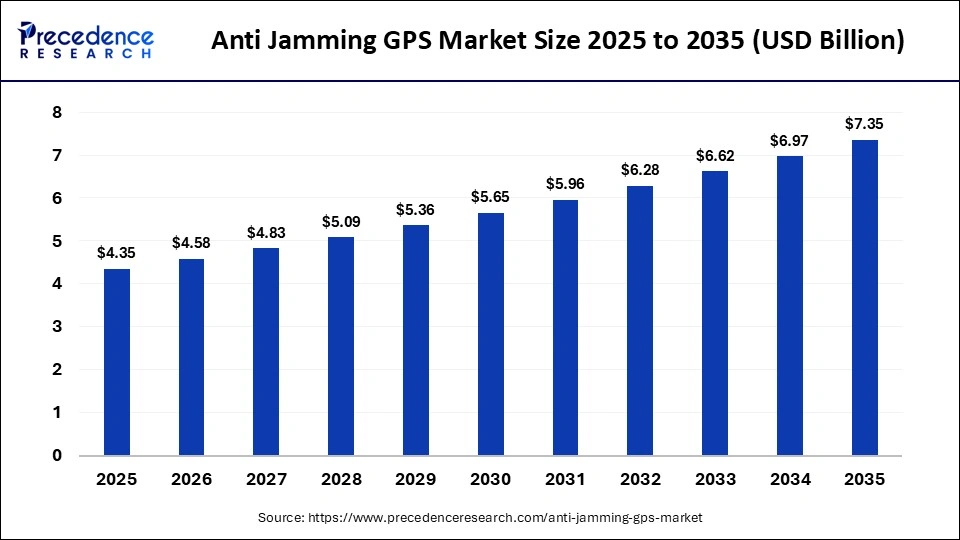
Key Takeaways
- North America dominated the global market with the largest market share in 2025.
- Asia Pacific is expected to grow at the fastest CAGR during the forecast period.
- By platform, the ground-based segment led the market in 2025.
- By platform, the airborne segment is expected to expand with the highest CAGR during the forecast period.
- By technology, the military-grade GPS segment held the largest share of the market in 2025.
- By technology, the software-based anti-jamming segment is expected to expand with the highest CAGR during the forecast period.
- By application, the military and defense segment dominated the market in 2025.
- By application, the civilian and commercial segment is expected to grow with the fastest CAGR during the forecast period.
- By end-user, the government agencies segment dominated the market in 2025.
- By end-user, the military forces segment is expected to grow with the fastest CAGR during the forecast period.
Market Overview
The anti jamming GPS market deals with the development, manufacture, and deployment of technologies to protect GNSS/GPS receivers from intentional jamming and deception spoofing. Anti-jamming GPS devices use advanced antennas, such as controlled reception pattern antennas, signal filtering, and beamforming, to suppress noise that is crucial for defense, maritime, aviation, and autonomous vehicles. It combines GNSS data with accelerometers and gyroscopes to maintain navigation when satellite signals are completely blocked. These devices use multiple satellite systems across different frequencies (L1/L2/L5) for delivering enhanced resilience.
The market is expected to grow at a significant rate in the coming years as rising electronic warfare threats, increasing GPS signal interference incidents, and expanding use of GPS‑dependent systems in defense and autonomous applications drive demand for resilient positioning solutions. Growing defense spending, adoption in civilian sectors such as autonomous vehicles and critical infrastructure, and technological advancements in anti‑jamming technologies are further accelerating market growth.
How is AI Impacting the Anti Jamming GPS Market?
AI plays a transformative role in the anti-jamming GPS industry. AI algorithms scan the radio frequency (RF) environment to protect legitimate signals from jamming or spoofing. AI also enhances controlled reception pattern antennas (CRPA) to adjust beamforming and steer nulls toward the source of interference by cancelling the deceptive signals. Moreover, AI models are highly deployed on the embedded systems of the GPS receivers, which allows instant decision-making without relying on cloud bandwidth.
- In June 2024, SandboxAQ launched an AI-based navigation system. This AI-enabled navigation system is designed to address GPS jamming and spoofing.
Anti Jamming GPS Market Trends
- Partnerships: Numerous defense companies are partnering with aircraft manufacturers to deliver anti-jamming GPS systems. For instance, in February 2026, Raytheon partnered with General Atomics Aeronautical Systems. Under this partnership, Raytheon will deliver around 140 Landshield Plus anti-jamming GPS antennas to General Atomics Aeronautical Systems.
- Innovations: Various aerospace component manufacturing companies are engaged in innovating a wide range of GPS anti-jamming components for the end-users. For instance, in February 2026, Valiant Communications launched an anti-jamming GPS server. This server is designed for the Indian Armed Forces.
- Surging Defense Expenditure: Governments of several countries, such as the U.S., China, Russia, and France, are investing rapidly in strengthening the defense sector. For instance, in January 2026, the government of the U.S. invested US$ 1.43 trillion. This investment is made to develop the military and defense sector of the U.S. region.
- Miniaturization and Lightweight Designs: There is a growing trend toward compact, lightweight anti jamming systems that can be deployed on mobile and unmanned platforms, meeting the needs of UAVs, autonomous systems, and portable defense equipment.
Market Scope
| Report Coverage | Details |
| Market Size in 2025 | USD 4.35 Billion |
| Market Size in 2026 | USD 4.58 Billion |
| Market Size by 2035 | USD 7.35 Billion |
| Market Growth Rate from 2026 to 2035 | CAGR of 5.38% |
| Dominating Region | North America |
| Fastest Growing Region | Asia Pacific |
| Base Year | 2025 |
| Forecast Period | 2026 to 2035 |
| Segments Covered | Platform, Technology, Application, End-User, and Region |
| Regions Covered | North America, Europe, Asia-Pacific, Latin America, and Middle East & Africa |
Segment Insights
Platform Insights
Why Did the Ground-Based Segment Dominate the Anti Jamming GPS Market?
The ground-based segment dominated the market with the largest share in 2025, owing to the rapid adoption of GPS technology in terrestrial applications, such as telecommunication, transportation, and logistics. Ground-based platforms are dependent on high-end anti-jamming GPS solutions to enhance fleet management, improve border security, and advance precision agriculture. Ground-based systems benefit from easier deployment, higher power availability, and integration with existing defense and industrial networks, making them ideal for safeguarding critical operations against GPS disruptions.
The airborne segment is expected to grow with the highest CAGR during the forecast period due to the increasing dependency of the aviation sector on accurate navigation solutions to reach proper locations. Increasing reliance on aircraft, UAVs, and drones for defense, surveillance, and commercial applications requires uninterrupted and precise navigation in GPS-denied or jamming-prone environments. The adoption is further driven by advancements in lightweight, compact anti-jamming solutions and the need for high-accuracy positioning in complex air operations, including military missions and autonomous aerial platforms.
Technology Insights
What Made Military-Grade GPS the Dominant Segment in the Anti Jamming GPS Market?
The military-grade GPS segment dominated the market in 2025. The dominance of the segment is attributed to the surging need for reliable and secure navigation solutions in the military and defense operations. Military organizations heavily rely on GPS technology for enhancing navigation, targeting, mission planning, and improving communication systems. However, the insurgent groups are increasingly adopting electronic warfare technologies such as GPS jamming and GPS spoofing. With the surging cases of these criminal activities, the demand for advanced military-grade GPS jamming systems has increased rapidly.
The software based anti-jamming segment is expected to grow with the highest CAGR during the forecast period, owing to its cost-effectiveness, flexibility, and adaptability in tough conditions. Software-based anti-jamming systems use advanced algorithms to detect and suppress outsider interference. These systems are also used to identify abnormal signal patterns initiated by GPS jammers in warfare zones. The growing cases of aircraft jamming and spoofing have increased the application of software-based anti-jamming solutions.
Application Insights
Why Did the Military and Defense Segment Lead the Anti Jamming GPS Market?
The military and defense segment led the market with a major share in 2025, owing to the increasing dependency of military organizations on reliable satellite navigation systems. Defense forces rely heavily on GPS for numerous applications, including missile guidance, troop navigation, reconnaissance, and unmanned vehicle systems, which increases the application of military-grade anti-jammers. Anti-jamming GPS systems are widely used in various platforms, including naval ships, fighter jets, naval ships and unmanned aerial vehicles.
The civilian and commercial segment is expected to grow with the fastest CAGR during the forecast period, due to the surging adoption of phased array antennas across several sectors, such as logistics, transportation, aviation, maritime, and telecommunication. Anti-jamming GPS systems are rapidly adopted across several industries, such as shipping, commercial aviation, and autonomous vehicles, to enhance operational efficiency and protect from threats.
End-User Insights
How Do Government Agencies Dominate the Anti Jamming GPS Market?
The government agencies segment dominated the market while holding the largest share in 2025. This is primarily due to the increasing investment by the government agencies in deploying advanced satellite navigation systems to enhance protection against international threats. In addition, partnerships among governmental organizations and aerospace companies to develop high-quality anti-jamming systems have contributed to the segment's leadership.
The military forces segment is expected to grow with the highest CAGR during the forecast period. This is due to the significant role of reliable GPS navigation solutions in the warfare zones. Military forces are relying on advanced anti-jamming GPS systems for numerous operations, such as missile guidance, unmanned aerial vehicle navigation, surveillance, and troop movement.
Regional Insights
Why Did North America Dominate the Anti Jamming GPS Market?
North America dominated the anti jamming GPS market in 2025 by holding the largest share. The dominance of the region in the market is attributed to growing concerns related to internal security, along with the rapid deployment of reliable navigation systems in border areas. The increasing expenditure on strengthening the military and defense infrastructure, as well as the rise in the number of defense startups, is significantly contributing to the industry. The presence of prominent aerospace component manufacturing companies, such as Northrop Grumman (U.S.), Raytheon Technologies (U.S.), and Lockheed Martin (U.S.), that are engaged in developing advanced anti-jamming GPS satellite systems, has driven the market growth.
- In January 2026, Lockheed Martin launched the GPS III space vehicle (SV09). SV09 is a GPS satellite that is equipped with improved anti-jamming capabilities.
U.S. Anti Jamming GPS Market Trends
The U.S. leads the North American market due to the surging threat of signal jamming from terrorist organizations, as well as a supportive regulatory framework to enhance rapid innovations in this field. Additionally, technological advancements in the aerospace industry, along with numerous government initiatives aimed at lowering terrorist activities, have driven the industrial expansion. Increasing reliance on GPS for critical civilian applications, such as aviation, transportation, telecommunications, autonomous systems, and infrastructure synchronization, is prompting both government and commercial entities to adopt anti‑jamming technologies to ensure reliable positioning, navigation, and timing across sectors.
Why is Asia Pacific Expanding with the Fastest Rate in the Market?
Asia Pacific is expected to expand with the fastest CAGR during the forecast period, owing to the increasing focus of fleet operators to deploy self-driving vehicles to lower the dependency on the manual workforce and enhance the safety of passengers. This, in turn, increases the demand for anti-jamming GPS systems. The rising disputes among neighboring countries such as Pakistan and India, coupled with the surging imports of advanced defense solutions from developed nations, have shaped the industry in a positive direction. Government organizations such as DRDO, JSDF, CMC, and MND are investing significantly to strengthen the defense sector, which is driving the market.
- In September 2025, Grab Holdings collaborated with WeRide. This collaboration is done to deploy autonomous vehicles for enhancing fleet operations in Singapore.
China Anti Jamming GPS Market Analysis
China leads the anti-jamming GPS industry in Asia-Pacific, owing to the growing adoption of high-quality surveillance systems in the military sector and the increasing demand for software-based anti-jamming solutions among naval forces. Additionally, rapid economic development and increased reliance on GPS for sectors such as transportation, logistics, telecommunications (including 5G), and autonomous systems are prompting both public and private investment in anti-jamming technologies to ensure uninterrupted navigation and communication. Government support, policies encouraging domestic innovation, and strategic collaboration between research institutions and companies are further accelerating market growth.
Anti-Jamming GPS Devices Market Value Chain Analysis
- Raw Materials Procurement
Raw materials used in the manufacturing of anti-jamming GPS devices comprise aluminum, silver, polydimethylsiloxane, and ceramics.
Key Companies: Arfin, MMP Industries, and Hydro.
- Quality Checks and Testing
The quality check (QC) and performance validation of anti-jamming GPS devices is operated through a combination of controlled laboratory simulations, anechoic chamber tests, and live field trials.
Key Companies: SGS, Element Materials Technology, Intertek, and Applus+ Laboratories.
- Distribution Channel
The distribution channel for anti-jamming GPS devices operates primarily through a business-to-government (B2G) and business-to-business (B2B) model, heavily reliant on direct sales, defense contracts, and specialized system integrators rather than open commercial markets.
Key Companies: BAE Systems, Raytheon (RTX), and L3Harris Technologies.
Anti Jamming GPS Market Companies
- Northrop Grumman
- Raytheon Technologies
- Lockheed Martin (US)
- Boeing (US)
- L3Harris Technologies (US)
- General Dynamics (US)
- Elbit Systems (IL)
- Thales Group (FR)
- Rockwell Collins (US)
Recent Developments
- In November 2025, infiniDome launched Aura. Aura is a new GNSS anti-jamming protection system designed to enhance navigation resilience with smarter algorithms and quicker interference response.(Source: https://www.gpsworld.com)
- In November 2025, Fokker launched a new range of GPS anti-jamming systems. These anti-jamming systems are designed to deliver active protection against threats to enhance navigation reliability and avionics.(Source: https://www.airport-technology.com)
- In October 2025, Honeywell launched a new range of software-based navigation platforms. This software platform is designed to counter GPS jamming and network spoofing activities. (Source: https://www.aerotime.aero)
- In June 2025, Calian GNSS launched an anti-jamming antenna. This antenna is designed to provide superior interference protection and real-time situational awareness across several sectors, including critical infrastructure, marine, and defense environments.(Source: https://www.gpsworld.com)
- In March 2025, Inertial Labs launched the M-AJ-QUATRO. M-AJ-QUATRO is an anti-jamming antenna system, designed to ensure assured navigation, positioning, and timing (A-PNT) in GNSS-challenged environments.(Source: https://www.gpsworld.com)
Segments Covered in the Report
By Platform
- Ground-Based
- Airborne
- Naval
- Space-Based
By Technology
- Military-Grade GPS
- Software-Based Anti-Jamming
- Phased Array Antennas
- Adaptive Filter Technology
By Application
- Military and Defense
- Civilian and Commercial
- Law Enforcement and Public Safety
- Critical Infrastructure Protection
By End-User
- Government Agencies
- Private Security Companies
- Military Forces
- Commercial Enterprises
By Region
- North America
- Latin America
- Europe
- Asia-pacific
- Middle and East Africa
For inquiries regarding discounts, bulk purchases, or customization requests, please contact us at sales@precedenceresearch.com
Frequently Asked Questions
Tags





Ask For Sample
No cookie-cutter, only authentic analysis – take the 1st step to become a Precedence Research client
 Get a Sample




 sales@precedenceresearch.com
 Schedule a Meeting
