



Field Programmable Gate Array Market Size, Key Companies, Company Market Share, Product Portfolio, Technology Adoption, Application Demand, Regional Analysis, Competitive Positioning, and Industry Outlook
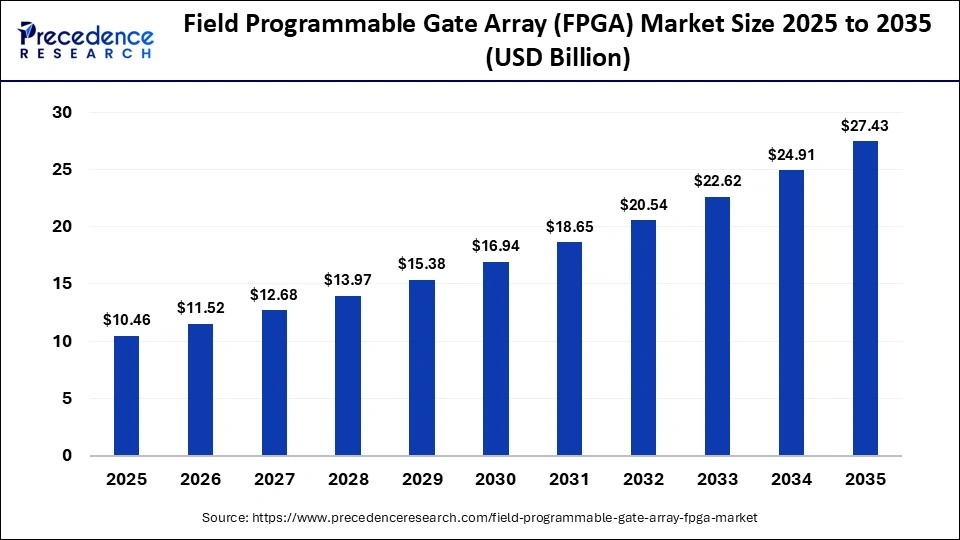
According to semiconductor and electronics specialist Laxminarayan, the field programmable gate array market is valued at USD 11.52 billion in 2026 and is forecast to reach USD 27.43 billion by 2035, reflecting a CAGR of 10.12%. Leading field programmable gate array market companies, including AMD (Xilinx), Intel, Achronix, are strengthening their presence across key segments such as by device type, by logic density, by application, by end-use industry.
Source: https://www.precedenceresearch.com/field-programmable-gate-array-market
 Get a Sample
 Table Of Content


What is the Field Programmable Gate Array Market Size?
The global field programmable gate array market size accounted for USD 10.46 billion in 2025 and is predicted to increase from USD 11.52 billion in 2026 to approximately USD 27.43 billion by 2035, expanding at a CAGR of 10.12% from 2026 to 2035. The field programmable gate array market is witnessing unprecedented growth, driven by the rising applications across key industries, including increasing applications in aerospace & defense, automotive (ADAS), and industrial automation.
Market Highlights
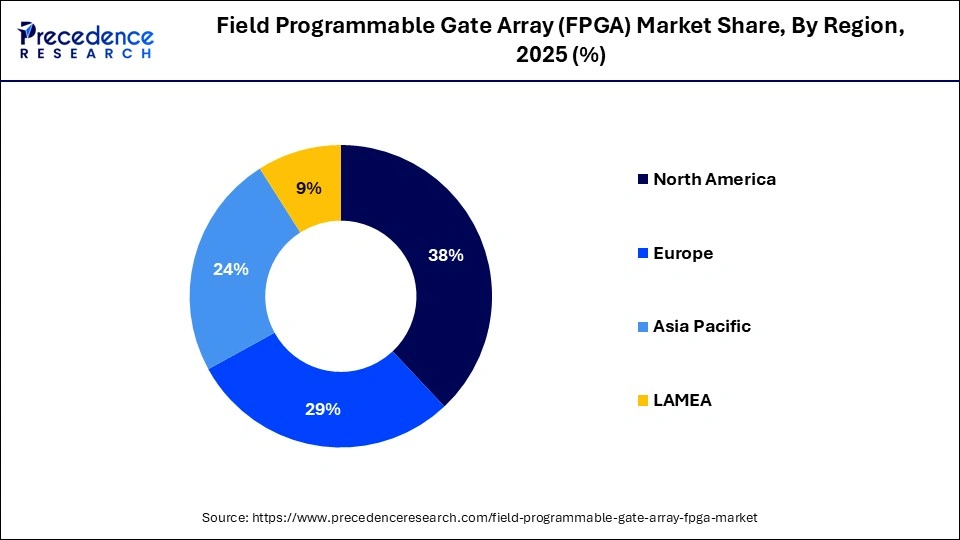
- North America dominated the market, holding the largest market share of 38% in 2025.
- The Asia-Pacific is expected to expand at the fastest CAGR of 18% between 2026 and 2035.
- By logic density, the medium logic density segment held the major market share of 38% in 2025.
- By logic density, the ultra-high logic density segment is poised to grow at a remarkable CAGR of 16% between 2026 and 2035.
- By application, the telecom & 5G infrastructure segment generated the biggest market share of 30% in 2025.
- By application, the AI/ML & edge computing segment is growing at a significant CAGR of 15% between 2026 and 2035.
- By end-user industry, the IT & Telecom segment captured the highest market share of 18% in 2025.
- By end-user industry, the Automotive (ADAS / EV / Autonomous) segment is set to grow at a notable CAGR of 17% between 2026 and 2035.
- By device type, the SRAM-based FPGA segment held the largest market share of 55% in 2025.
- By device type, the flash-based FPGAs segment is expected to expand at a remarkable CAGR of 14% between 2026 and 2035.
Market Overview
The global field programmable gate array (FPGA) market comprises programmable semiconductor devices that can be configured by designers after manufacturing to perform application-specific hardware functions. Unlike fixed-function ASICs, FPGAs allow post-deployment reconfiguration, enabling hardware-level customization, faster design iteration, and adaptability to evolving performance or protocol requirements.
FPGAs are widely deployed across digital signal processing, embedded systems, telecommunications, data centers, industrial automation, aerospace and defense, automotive electronics, and AI and machine learning acceleration. Their inherent flexibility, fine-grained parallel processing capability, and deterministic low-latency performance make them particularly well suited for workloads that require real-time processing, high throughput, and hardware-level optimization.
In communications and data center environments, FPGAs are used for network acceleration, packet processing, encryption, and protocol offloading. In industrial and automotive applications, they support motor control, sensor fusion, vision processing, and safety-critical systems where reliability and timing precision are essential. Aerospace and defense deployments rely on FPGAs for radar, electronic warfare, avionics, and secure communications, benefiting from their long lifecycle support and reprogrammability.
How Is AI Impacting the Growth of the Field Programmable Gate Array Market?
As AI technology continues to evolve, the integration of Artificial Intelligence (AI) is driving innovation and accelerating the growth of the field programmable gate array market, as FPGAs offer a blend of low latency, parallel processing power, and reconfigurability. From edge AI to real-time data processing, these characteristics make them ideal for various AI applications. FPGAs offer the flexibility required to meet the needs of tomorrow's breakthroughs. With the advancement in AI technology, FPGAs' role is expected to increase, spurring discoveries and paving the way to smarter, faster, and more effective AI solutions for a wide range of industries like healthcare (medical imaging and diagnostics), aerospace & defense (radar systems, avionics), and financial services.
AI applications are widely supported by FPGAs in data centers, cloud, and edge settings. FPGAs play a crucial role in complex tasks in data centers, like AI training and sorting data. They are fast at handling tasks with minimum time. Major technology companies like Microsoft (Project Brainwave) and AWS increasingly rely on FPGAs to accelerate specific AI workloads, such as recommendation engines, speech recognition, and natural language processing.
Field Programmable Gate Array Market Outlook
- Industry Growth Overview: Between 2025 and 2030, the industry is expected to experience accelerated growth. The growth of the market is driven by the rapid growth of Artificial Intelligence (AI), the deployment of 5G networks, the proliferation of IoT devices, and the growing demand for data centers. The increasing shift toward programmable hardware for AI inference, 5G infrastructure, high performance computing, and edge acceleration is driving adoption globally.
- Global Expansion: Several leading players in the field programmable gate array (FPGA) market are actively expanding their geographical presence through various strategic initiatives. For instance, companies like AMD (Xilinx), Intel (Altera), Microchip Technology, Lattice Semiconductor, and Achronix are leveraging targeted partnerships, product innovations, and government initiatives to grow their footprint.
- Major Investors: Several major companies and strategic investors are actively engaged in the Field Programmable Gate Array (FPGA) market, including Intel Corporation, Advanced Micro Devices (AMD), Lattice Semiconductor, Microchip Technology, and Achronix Semiconductor. The investment includes technology development, R&D, and acquisitions. For instance, in April 2025, Intel Corporation announced that it had entered into a definitive agreement to sell 51% of its Altera business to Silver Lake, a global leader in technology investing. The transaction, which values Altera at $8.75 billion, establishes Altera's operational independence and makes it the largest pure-play FPGA (field programmable gate array) semiconductor solutions company. Intel will own the remaining 49% of the Altera business, enabling it to participate in Altera's future success while focusing on its core business.
Market Scope
| Report Coverage | Details |
| Market Size in 2025 | USD 10.46 Billion |
| Market Size in 2026 | USD 11.52 Billion |
| Market Size by 2035 | USD 27.43 Billion |
| Market Growth Rate from 2026 to 2035 | CAGR of 10.12% |
| Dominating Region | North America |
| Fastest Growing Region | Asia Pacific |
| Base Year | 2025 |
| Forecast Period | 2026 to 2035 |
| Segments Covered | Device Type, Logic Density, Application, End-Use Industry, and Region |
| Regions Covered | North America, Europe, Asia-Pacific, Latin America, and Middle East & Africa |
Market Dynamics
Driver
Demand for Real-Time Data Processing
The growing demand for high-performance computing and real-time data processing is a key factor in the market. The high flexibility, low latency, and parallel processing power are making FPGAs increasingly attractive to industries like telecommunications, automotive, aerospace, defence, and data centers. The growth of 5G networks, AI workloads, and edge computing applications is driving FPGA adoption across the world even further. Also, the rising demand for customised semiconductor solutions that can fulfil the changing technological needs is making a major contribution to market growth.
Restraint
High Complexity and Upfront Costs
However, there is high development complexity and high implementation costs in the market, which restrain its development. FPGA development and programming can be a specialized process, potentially requiring specialized engineering skills and expertise that may not be available in smaller organizations with fewer technical resources. In some niche applications and AI applications, competition from application-specific integrated circuits (ASICs) and graphics processing units (GPUs) is also a challenge. Moreover, unpredictable semiconductor supply chains and growing power demands of high-performance FPGA products could be a constraint on penetration in the wider market.
Opportunity
Technological Advancements
As these technologies mature and gain widespread adoption, the industry is poised for significant growth as a key component of the future of AI, machine learning, and advanced analytics in various fields. With their programmable architecture and energy efficiency, FPGAs are now being used in a variety of applications, including autonomous vehicles, smart manufacturing systems, healthcare imaging devices, and next-generation communication networks. The emerging economies are undertaking significant investments in digital infrastructure modernisation, which will drive FPGA adoption in industrial and enterprise applications. In addition, the growing proliferation of FPGA acceleration services on the cloud and AI-powered edge devices will drive high future growth opportunities.
Segmental Insights
Device type Insights
What Has Led the SRAM-Based FPGAs Segment to Dominate the Field Programmable Gate Array Market?
SRAM-Based FPGAs: The segment is dominating the field programmable gate array market with a 55% share, driven by core advantages such as high flexibility, strong performance, and suitability for compute-intensive applications including 5G infrastructure, data centers, and AI workloads. SRAM-based FPGAs are particularly well suited to environments where protocols, algorithms, and standards evolve rapidly, as they allow frequent reconfiguration without hardware replacement. SRAM FPGAs offer real-time configurability, high logic density, and fast processing speeds, enabling low-latency and parallel execution of complex tasks. These characteristics are critical for applications such as network acceleration, baseband processing, inference acceleration, and workload offloading in hyperscale data centers.
Flash-Based FPGAs: The segment is a significant and rapidly growing segment with an expected CAGR between 14% in the field programmable gate array market. Several market players are increasingly focusing on upgrading their portfolios of FPGAs to cater to the evolving demand from the expanding application base. The rising popularity of flash-based FPGAs over SRAM-based FPGAs is mainly due to their lower power consumption. The power-saving feature is beneficial in portable electronics, battery powered devices, and energy-constrained applications, accelerating the segment's expansion in the coming years.
Logic Density Insights
What Causes the Medium Logic Density Segment to Dominate the Field Programmable Gate Array Market?
Medium Logic Density FPGAs: The medium logic density segment accounted for the majority of the market share in 2025. Mid-range FPGAs provide sufficient logic density and processing capabilities to handle complex tasks. They are extensively utilized in numerous high-volume and high-growth sectors, including automotive electronics, industrial automation, telecommunications, consumer electronics, and others.
On the other hand, the ultra-high logic density segment is expected to grow at a remarkable CAGR between 2026 and 2035. The growth of the segment is driven by the increasing demand for high-performance computing (HPC), the wide deployment of 5G network infrastructure, and the increasing adoption of artificial intelligence (AI) and machine learning (ML). Moreover, the surge in electric vehicles (EVs) and advanced driver-assistance systems (ADAS) is expected to spur the demand for high-performance FPGAs. They are extensively adopted in applications such as real-time sensor fusion (LiDAR and radar), image processing, and AI inference for autonomous driving.
Application Insights
Which Segment Is Dominated by Applications in the Field Programmable Gate Array Market?
Telecom & 5G Infrastructure: The segment is dominating the field programmable gate array market by holding a majority share of 30%. The widespread usage of field programmable gate arrays in the telecom sector is driven by the rapid expansion of 5G infrastructure, which requires FPGAs for numerous applications such as high-speed data transfer and bandwidth management, real-time signal processing and beamforming, and low-latency communication in base stations.
AI / ML & Edge Computing: The segment is the fastest-growing in the field programmable gate array market. The growth of the segment is primarily driven by the rising need for low-latency and real-time processing to handle complex AI models at the data source. FPGAs serve as powerful AI accelerators, enabling multiple tasks to be performed rapidly and simultaneously, which plays a crucial role in machine learning (ML) and deep learning workloads.
End-User Industry Insights
What Has Led the IT & Telecom Segment to Dominate the Field Programmable Gate Array Market?
IT & Telecom: The segment is dominating the field programmable gate array market. The growth of the segment is driven by the extensive deployment of 5G networks, requiring FPGAs for low-latency, high-bandwidth signal processing, and network virtualization. Field Programmable Gate Arrays (FPGAs) efficiently handle the complex processing for 5G base stations, Massive MIMO, and beamforming.
Automotive (ADAS / EV / Autonomous): This segment is the fastest-growing in the field programmable gate array market. FPGAs are crucial in modern cars for their flexibility, high-speed parallel processing, and low-latency performance, making them ideal for complex tasks in Advanced Driver-Assistance Systems (ADAS), vehicle-to-everything (V2X) communication, autonomous driving, and efficient power management/inverters in electric vehicles (EVs). In addition, the rising shift towards software defined vehicles and edge computing within cars significantly increases the demand for FPGAs.
Regional Insights
How Big is the North America field programmable gate array Market Size?
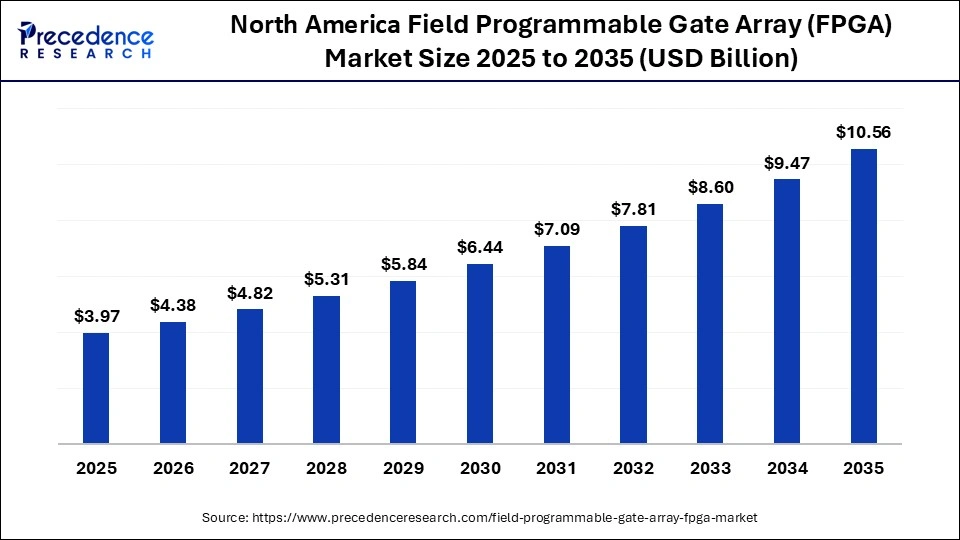
The North America field programmable gate array market size is estimated at USD 3.97 billion in 2025 and is projected to reach approximately USD 10.56 billion by 2035, with a 10.28% CAGR from 2026 to 2035.
What has led the North America region to dominate the field programmable gate array market?
North America dominates the field programmable gate array market, holding a 38% market share in 2025, supported by a strong and deeply embedded technology ecosystem, rapid expansion of 5G infrastructure, and sustained investment in advanced semiconductor development. The region benefits from early adoption of high-performance computing architectures and widespread use of FPGAs across communications, cloud, defense, and automotive applications.
The presence of large-scale cloud service providers, hyperscale data centers, and advanced networking infrastructure across the United States and Canada drives consistent demand for FPGAs used in network acceleration, workload offloading, encryption, and real-time data processing. FPGAs are increasingly deployed to support software-defined networking and 5G baseband processing, where flexibility and low latency are critical.
High-value defense, aerospace, and automotive sectors further reinforce regional dominance. North America has a strong concentration of defense and aerospace programs that rely on FPGAs for radar systems, secure communications, avionics, and electronic warfare due to their reprogrammability and long lifecycle support. At the same time, the region's accelerating push toward autonomous driving and advanced driver-assistance systems is creating substantial demand for FPGAs in sensor fusion, real-time perception, and safety-critical processing.
What is the Size of the U.S. field programmable gate array Market?
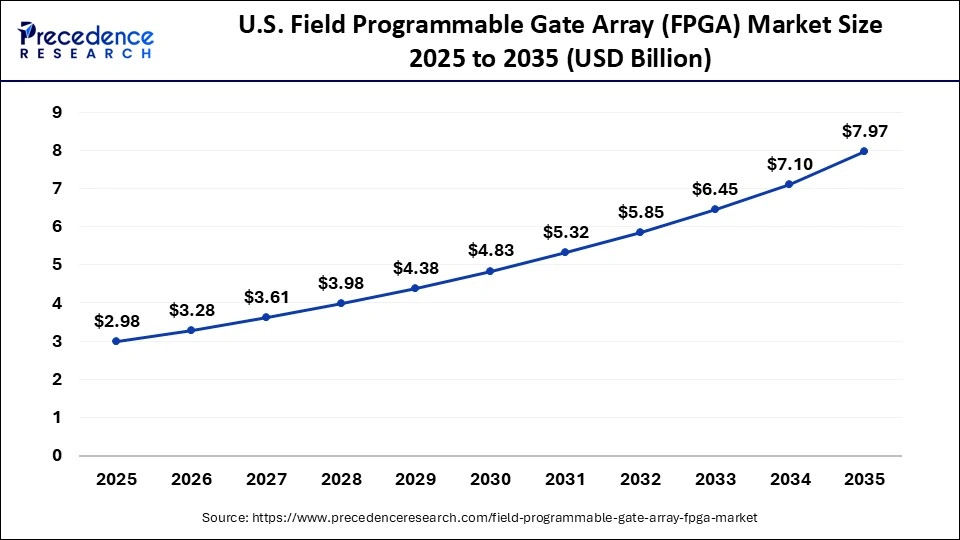
The U.S. field programmable gate array market size is calculated at USD 2.98 billion in 2025 and is expected to reach nearly USD 7.97 billion in 2035, accelerating at a strong CAGR of 10.34% between 2026 and 2035.
How Is the United States Transforming the Field Programmable Gate Array Market?
The United States is transforming the field programmable gate array market. The United States is a major contributor to the field programmable gate array market in the North American region. The country has a massive expansion of data centers for cloud computing, AI, and ML, which drives the demand for FPGAs for accelerating workloads and managing massive data. The country is a global leader in innovation and is home to major FPGA firms such as AMD/Xilinx, Microchip Technology, Lattice, Intel, and others. Moreover, increasing investments in data centers, aerospace, and defense, along with the increasing adoption of AI, autonomous vehicles (ADAS), and 5G technology, are anticipated to foster market growth during the forecast period.
How Is the Asia Pacific Region the Fastest-Growing in the Field Programmable Gate Array Market?
Asia Pacific is the fastest-growing region in the field programmable gate array market, holding an 18% market share, supported by a well-established and vertically integrated semiconductor ecosystem across multiple economies. Countries such as China, Japan, South Korea, India, and Taiwan have built strong capabilities spanning chip design, fabrication, assembly, and system integration, which facilitates large-scale FPGA deployment across electronics and communication systems.
Regional growth is strongly driven by the widespread rollout of 5G network infrastructure. Telecom operators and equipment manufacturers across Asia Pacific rely heavily on FPGAs for signal processing, baseband acceleration, fronthaul and backhaul optimization, and software-defined radio implementations. The ability of FPGAs to support evolving 5G standards and enable rapid reconfiguration makes them critical components in network densification and performance optimization initiatives.
Asia Pacific also serves as a global hub for consumer electronics manufacturing, encompassing smartphones, wearables, smart appliances, and connected devices. Rising production of IoT-enabled and advanced consumer electronics is increasing demand for power-efficient and compact FPGA solutions that can support real-time processing, sensor fusion, and connectivity without excessive energy consumption.
China Field Programmable Gate Array Market Analysis
China is experiencing significant growth in the field programmable gate array market, as the country has a well-established presence of prominent semiconductor companies. The country has a large production scale of consumer electronics, especially IoT & smart home devices, smartphones, drones, smart home devices, gaming consoles, TVs, and cameras (advanced image/video processing). The country's growth is supported by the robust digital infrastructure, rapid deployment of 5G networks, rising expansion of the automotive industry, supportive government initiatives, and high adoption of emerging technologies like AI, ML, and the Internet of Things (IoT).
Is the European Region Responsible for Growth in the Field Programmable Gate Array Market?
Europe holds a substantial share in the field programmable gate array market, supported by early adoption of advanced technologies such as 5G, artificial intelligence, and high-performance computing across multiple industries. Countries including Germany, France, and the United Kingdom are at the forefront of FPGA adoption due to strong industrial digitization, rising R&D expenditure, and coordinated government support for advanced semiconductor and electronics development.
The region's automotive sector is a major growth driver, particularly as Europe accelerates innovation in electric vehicles, autonomous driving, and advanced driver-assistance systems. FPGAs are increasingly used in automotive electronics for sensor fusion, real-time processing, powertrain control, and in-vehicle networking, where flexibility, low latency, and functional safety are critical requirements.
Europe also benefits from a strong aerospace and defense ecosystem, which is contributing to rising FPGA demand. Expansion in aerospace programs and defense modernization initiatives has increased the use of FPGAs in avionics, radar systems, electronic warfare, and secure communication platforms. Their reprogrammability, long lifecycle support, and reliability under harsh operating conditions make FPGAs well suited for mission-critical defense applications.
Germany Field Programmable Gate Array Market Analysis
The German field programmable gate array market is experiencing significant growth, driven primarily by the robust semiconductor infrastructure, widespread rollout of 5G network infrastructure, and rapid technological advancements such as AI, machine learning, and IoT.
The growth of the region is also largely driven by the growing demand in various industries such as automotive (ADAS, infotainment, autonomous driving, sensor fusion), 5G & telecommunications (high-speed 5G networks), consumer electronics (smartphones, cameras, TVs, and PCs), aerospace & defense (radar, signal processing, flight control, and UAVs), and industrial/IoT (industrial automation).
How is Latin America Growing in the Field Programmable Gate Array Market?
Latin America is expected to grow at a considerable CAGR in the upcoming period, driven by rising investments in telecommunications and industrial automation and rising digital transformation initiatives. Programmable semiconductor technologies are gaining popularity in the region, as companies seek to enhance network performance, manufacturing efficiency, and data processing capabilities. 5G infrastructure and the increasing adoption of smart industrial systems are also driving market growth. In addition, the pro-technology and digital infrastructure modernization policy of the government is also fostering market growth.
What Are the Significant Factors Driving the Growth of the Middle East & Africa Region in the Field Programmable Gate Array Market?
The field programmable gate array market is expected to grow at a notable rate in the Middle East & Africa region, supported by expanding digital infrastructure and rising investment in data center development. Governments and private sector stakeholders across the region are strengthening connectivity, cloud capacity, and computing infrastructure, creating new demand for programmable and high-performance semiconductor solutions.
Growth is further driven by increasing demand from the consumer electronics and automotive sectors, where FPGAs are used for real-time processing, control systems, and embedded applications. As vehicle electronics, advanced driver-assistance features, and connected devices gain traction, the need for flexible and reprogrammable hardware architectures continues to rise.
South Africa Field Programmable Gate Array Market Analysis
The country is experiencing remarkable growth. The country's growth is driven by the rise in digital transformation and infrastructure upgrades, especially in telecommunication and data processing. The emergence of 5G technology, growing demand for consumer electronics, increasing demand for high-performance computing, and a surge in government-backed funding are anticipated to drive the market's growth in the country. In addition, the rising incorporation of advanced technology, such as AI, cloud computing, autonomous vehicles (ADAS), and IoT, along with the significant growth in data centers, is expected to drive the expansion of the field programmable gate array market during the forecast period.
Key players in the Field Programmable Gate Array Market Analysis
- AMD (Xilinx)
- Intel (Altera)
- Microchip Technology (Microsemi)
- Lattice Semiconductor
- Achronix
- QuickLogic Corporation
- Efinix, Inc.
- Gowin Semiconductor Corp
- NVIDIA Corporation
- Teledyne e2v
- Flex Logix
- Renesas Electronics
Recent Developments
- In March 2024, AMD announced the AMD Spartan UltraScale FPGA family, the newest addition to the extensive portfolio of AMD cost-optimized FPGAs and adaptive SoCs. Delivering cost- and power-efficient performance for a wide range of I/O-intensive applications at the edge, Spartan UltraScale+ devices offer the industry's highest I/O-to-logic-cell ratio in FPGAs built in 28 nm and lower process technology, deliver up to 30 percent lower total power consumption versus the previous generation, and contain the most robust set of security features in the AMD Cost-Optimized Portfolio.(Source: https://www.amd.com)
- In December 2025, QuickLogic Corporation, a leading developer of embedded FPGA (eFPGA) Hard IP and User Tools, ruggedized FPGAs, and Endpoint AI/ML solutions, announces the scope of its Prime U.S. government contract for the development of Strategic Radiation Hardened (SRH), high reliability Field Programmable Gate Array (FPGA) technology to support identified and future Department of Defense (DoD) strategic and space system requirements has been increased to include GlobalFoundries 12LP fabrication process.(Source: https://www.prnewswire.com)
Segment Covered in the Report
By Device Type
- SRAM-Based FPGAs
- Flash-Based FPGAs
- Anti-Fuse FPGAs
- Others (non-volatile FPGA variants)
By Logic Density
- Low Logic Density FPGAs
- Medium Logic Density FPGAs
- High Logic Density FPGAs
- Ultra-High Logic Density FPGAs
By Application
- Data Centers & Cloud Computing
- Telecom & 5G Infrastructure
- Automotive & ADAS
- Consumer Electronics
- Aerospace & Defense
- Industrial Automation & Robotics
- Healthcare & Medical Devices
- AI/ML & Edge Computing
By End-Use Industry
- IT & Telecom
- Automotive
- Aerospace & Defense
- Consumer Electronics
- Healthcare & Medical
- Industrial
- Others (Energy, Utilities)
By Region
- North America
- Europe
- Asia-Pacific
- Latin America
- Middle East and Africa
For inquiries regarding discounts, bulk purchases, or customization requests, please contact us at sales@precedenceresearch.com
Frequently Asked Questions





Ask For Sample
No cookie-cutter, only authentic analysis – take the 1st step to become a Precedence Research client
 Get a Sample




 sales@precedenceresearch.com
 Schedule a Meeting
