






 Request Consultation
The next generation of automotive AI agents empowers smart vehicles with autonomous decision-making, predictive maintenance, and enhanced customer interactions. From manufacturing to in-car personalization, AI agents leverage real-time data, sensors, and advanced algorithms to improve efficiency, safety, and overall vehicle intelligence
What are AI Agents?
Artificial Intelligence agents are basically autonomous software systems that recognize the environment, reason, build logic, and take actions based on the data they collect. Using various tools, they achieve targets without extensive human interference. These agents are rapidly gaining traction to address challenges such as the shortage of skilled AI professionals, human biases, error-prone operations, and the rising threats of data breaches.
AI agents function independently, much like digital workers, and can execute multi-step workflows. Key components that enable their functionality include Large Language Models (LLMs) for reasoning, context retention, and tool integration. One major benefit of AI agents is their adaptability; they can learn from new environments and interact with external applications, such as APIs, search engines, and databases. This allows them to break down complex goals into simple, actionable steps.
Crucial Components of AI Agents in Automotive
Some of the crucial components of AI agents in automotive applications include perception systems with sensors such as cameras and LiDAR, Large Language Models (LLMs) and Learning and Reasoning Models (LRMs) for reasoning and planning model development, and actuators for executing action modules. These components work together to enable vehicles to interpret their environment, develop skills like high-precision mapping, and ensure safer navigation to avoid collisions. These capabilities are often supported by embedded systems powered by platforms like NVIDIA DRIVE, which provide the processing power required for real-time decision-making and action execution.
How are AI Agents Reshaping the Automotive Industry?
AI agents are significantly transforming the automotive industry by going beyond simple automation to AI-powered autonomous systems, along with proactive decision-making for the entire value chain, from research and development to manufacturing, sales, and marketing. Instead of reacting only to commands, AI agents can work intelligently, offer new approaches to resolve issues, and suggest various optimizations, such as adjusting routes based on traffic, suggesting rest points, and managing EV battery consumption for the long run.
AI agents can further learn from driver preferences for music, climate control, and other crucial choices to enhance the in-vehicle experience with customized settings. AI agents work as the brain in advanced driver-assistance systems, analyzing sensor data in real time for pedestrian safety and navigating complex and unknown environments efficiently.
Accelerated R&D, automated quality control, and the adoption of predictive maintenance are some of the main reasons supporting the expansion of AI agents in the automotive industry. Predictive maintenance is essential for monitoring manufacturing equipment and sensors to predict the probability of failure before it occurs. This saves the additional cost associated with machinery breakdowns, repairs, and maintenance, extends machinery life, and enhances uptime by 25–30%.
AI agents can function as active inspectors on assembly lines, detecting smaller and less noticeable defects in parts with greater accuracy, making them highly valuable for efficient manufacturing and high ROI. According to sources, nearly a 37% increase in lead conversion has been registered for some automaker dealers who have implemented AI agents for customer queries, providing prompt replies and guiding consumers through their models, financing options, and scheduling.
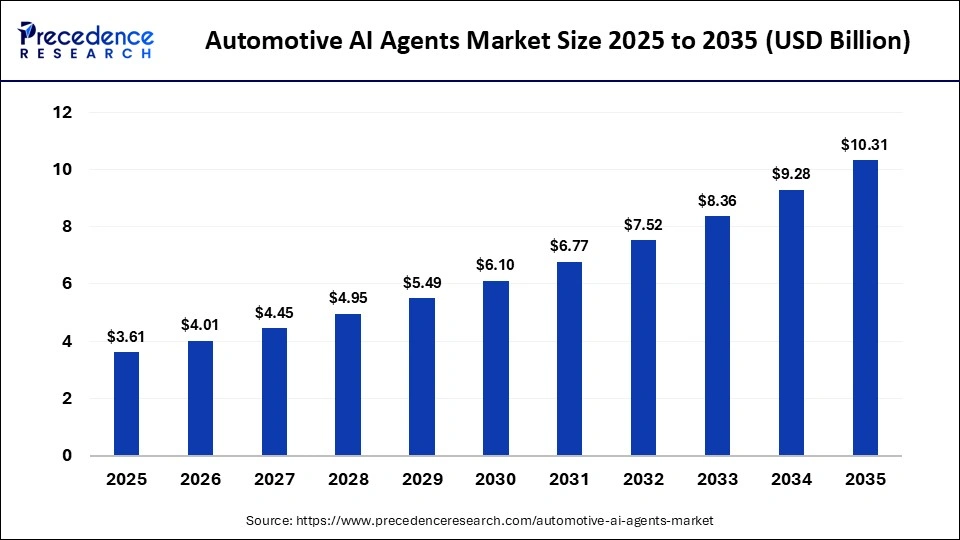
What is the Automotive AI Agents Market Size in 2026?
The global automotive AI agents market size was calculated at USD 3.61 billion in 2025 and is predicted to increase from USD 4.01 billion in 2026 to approximately USD 10.31 billion by 2035, expanding at a CAGR of 11.06% from 2026 to 2035.
Expert Views
According to our industry experts, AI agents are rapidly becoming a cornerstone of innovation and operational efficiency in the automotive industry. Beyond traditional automation, these agents enable intelligent decision-making across the entire value chain, from research and development and manufacturing to sales, marketing, and after-sales service. By leveraging real-time data from vehicles, sensors, IoT devices, and traffic systems, AI agents can optimize production schedules, monitor predictive maintenance, and enhance supply chain efficiency, significantly reducing operational costs.
For customer-facing operations, AI agents provide 24/7 support, offering context-aware, unscripted responses to inquiries, scheduling services, and managing leads without human intervention, which improves customer satisfaction and loyalty. Moreover, integration with advanced driver-assistance systems and vehicle-to-everything (V2X) communication enhances safety, route optimization, and energy efficiency, providing a competitive edge in a rapidly evolving market.
However, businesses must carefully address challenges such as data quality, integration costs, and workforce training. Companies that strategically invest in AI platforms, robust data management, and skill development will not only maximize ROI but also position themselves as leaders in the AI-driven automotive revolution.
What are the Key Applications of AI Agents in the Automotive Industry?
Some of the key applications of AI agents are as follows:
- In-vehicle personalization: AI assistance offers voice-based navigation, climate control, and infotainment, and learns drivers' preferences and behavior patterns over time to convert it into the best possible suggestions for a rich in-vehicle experience.
- Electrical Vehicle Management: AI agents are highly supportive of effective battery usage in EVs, which is a crucial aspect of EVs for longevity by managing charge rates, predicting battery life and health while optimizing charging ways based on traffic and temperature.
- Autonomous and Assisted Driving: AI agents can manage planning, perception, and control in real-time and handle edge cases better than conventional methods to resolve issues and suggest the best options. AI agents can support features like adaptive cruise control and traffic sign recognition.
- Predictive Maintenance: AI agents can analyze sensor data to find potential issues and predict component failure a long time before it occurs, and schedule services for it, which reduces downtime further without much human interference.
- Remote Vehicle Management: AI agents enable users to interact with vehicles remotely and control them for safety by using automatic locking doors, starting the engine, and maintaining the cabin environment.
Top Use Cases of AI Agents in the Automotive Industry
- Vehicle’s Service Status
AI agents can offer clarity on vehicle status by providing real-time answers to build consumer trust. They can collect vehicle data, schedule services, monitor component availability, and provide real-time updates, proactively notifying users of genuine delays in vehicle maintenance. This further helps achieve maximum ROI through fewer cancellations and missed service appointments, enhanced efficiency, and improved productivity with clear and proactive updates.
- Services, Orders and Cancellation
Cancellation of services is one of the most crucial aspects of automotive services, and if handled inconsistently, it may negatively affect a brand’s reputation. AI agents can assist in such cases by validating refund requests, providing details about the cancellation policy and its eligibility criteria, and offering alternative options before escalation occurs.
- Escalations and Complaints
Complaints regarding improper service or delays are common in automotive services, but they can have a significant impact if not handled sensitively, potentially damaging customer loyalty and increasing the risk of regulatory penalties. AI agents can quickly capture the full history of a complaint, assess its context and severity, guide consistent resolution pathways, and escalate to human experts if the issue is highly sensitive and requires human intervention.
- Customer Services with Chatbots
Customer service is a critical aspect of the automotive industry for building consumer trust. AI agents are highly effective in handling consumer queries by providing unscripted, context-aware responses and remaining available 24/7, unlike humans. They can schedule test drives, provide detailed vehicle information, and manage leads that do not require human intervention, allowing human staff to focus on core tasks.
- V2X Communication
AI agents can support vehicle-to-everything (V2X) communication by analyzing data from traffic, various sensors, IoT devices, and cameras, enabling smart infrastructure interactions, such as optimizing traffic lights to reduce energy consumption.
What are the Challenges in the Adoption of Automotive AI Agents?
Despite the numerous benefits of AI agents in the automotive industry, several challenges remain that must be addressed to achieve better outcomes and seamless integration with existing automotive fleets. These challenges include data integration and quality issues, resistance to AI adoption by some automotive marketers due to insufficient knowledge, high costs of AI implementation, and ethical concerns affecting consumer trust.
AI technology is highly complex and requires proper guidance and significant investment, which may limit its adoption by small-scale industries. Successful AI implementation depends on clean, unbiased data to ensure accurate and reliable results. Many companies face siloed data sources, and poor data quality is a major hurdle that can prevent AI systems from functioning effectively.
These challenges can be addressed by investing in a robust data management strategy to ensure proper data processing. Companies also need to carefully evaluate ROI before investing in AI agents for automotive applications and consider establishing partnerships with AI vendors or leveraging cost-effective cloud-based AI solutions. As technology continues to evolve, these barriers can be overcome.
Future Potential of Automotive AI Agents
As the rapid adoption of self-driving cars becomes indispensable, the integration of AI technologies and AI agents in the automotive industry is also inevitable in the foreseeable future. Experts predict that autonomous vehicles powered by AI agents will soon dominate the automotive sector with new launches and enhanced features. Nearly 80–90% of cars are expected to be equipped with AI-driven systems by the end of this decade.
It is no exaggeration to claim that the automotive sector is on the verge of an AI-driven technological revolution, as automakers aggressively invest in smart vehicle development, demonstrating that the future of AI in automotive is nonnegotiable.
AI-Directed Automation Era for Vehicles
It is clear that AI agents are not merely an addition to automotive systems but a driving force behind the evolution of vehicles, bringing intelligence with minimal human interference. Therefore, adopting AI agents is essential for automotive companies that wish to thrive in the future. This requires a strategic approach, including investing in AI platforms, training the workforce to handle AI systems, and supporting complex automotive engineering challenges.
AI agents are setting new standards in the automotive industry in terms of efficiency, quality, and innovation. Their impact is expected to be revolutionary, and embracing this shift is a crucial strategy for automakers worldwide. The potential for positive transformation through AI agents in automotive is undeniable.
Closing Remarks
In a nutshell, the expansion of AI has reached the automotive industry and is set to penetrate the global landscape even more significantly. The adoption of AI agents is profoundly transforming how vehicles and automotive operations will function in the future, from vehicle design and supply chain management to customer service, road safety, and traffic optimization, leveraging AI technologies such as predictive maintenance. While AI agents present challenges such as integration costs, data quality, and ethical concerns, their potential benefits, ranging from smarter manufacturing and predictive maintenance to enhanced customer experiences, far outweigh the risks. Automotive companies that approach AI adoption strategically, with investment, training, and ethical safeguards, will unlock transformational value and secure a competitive advantage in the evolving mobility landscape.
About the Authors

Aditi Shivarkar
Aditi, Vice President at Precedence Research, brings over 15 years of expertise at the intersection of technology, innovation, and strategic market intelligence. A visionary leader, she excels in transforming complex data into actionable insights that empower businesses to thrive in dynamic markets. Her leadership combines analytical precision with forward-thinking strategy, driving measurable growth, competitive advantage, and lasting impact across industries.



Aman Singh
Aman Singh with over 13 years of progressive expertise at the intersection of technology, innovation, and strategic market intelligence, Aman Singh stands as a leading authority in global research and consulting. Renowned for his ability to decode complex technological transformations, he provides forward-looking insights that drive strategic decision-making. At Precedence Research, Aman leads a global team of analysts, fostering a culture of research excellence, analytical precision, and visionary thinking.

Piyush Pawar
Piyush Pawar brings over a decade of experience as Senior Manager, Sales & Business Growth, acting as the essential liaison between clients and our research authors. He translates sophisticated insights into practical strategies, ensuring client objectives are met with precision. Piyush’s expertise in market dynamics, relationship management, and strategic execution enables organizations to leverage intelligence effectively, achieving operational excellence, innovation, and sustained growth.