



Automotive AI Agents Market Size, Companies, Share, Vehicle Production Volume, Sales Performance, Export & Import Analysis, Technology Adoption, Competitive Positioning, and Demand Trends
Automotive AI Agents Market (By Agent Type: Conversational AI Agents, Autonomous Driving AI Agents, Predictive Maintenance AI Agents, Fleet Management AI Agents, Customer Support & Sales AI Agents; By Vehicle Type: Passenger Vehicles, Commercial Vehicles, Electric Vehicles (EVs), Autonomous Vehicles; By Application: Driver Assistance & Safety, In-Vehicle Virtual Assistants, Predictive Maintenance, Fleet & Logistics Managemet, Infotainment Personalization; By Deployment Type: Cloud-Based AI Agents Edge/On-Board AI Agents, Hybrid Deployment) - Global Industry Analysis, Size, Trends, Leading Companies, Regional Outlook, and Forecast 2026 to 2035
Source: https://www.precedenceresearch.com/automotive-ai-agents-market
 Get a Sample
 Table Of Content


What is the Automotive AI Agents Market Size in 2026?
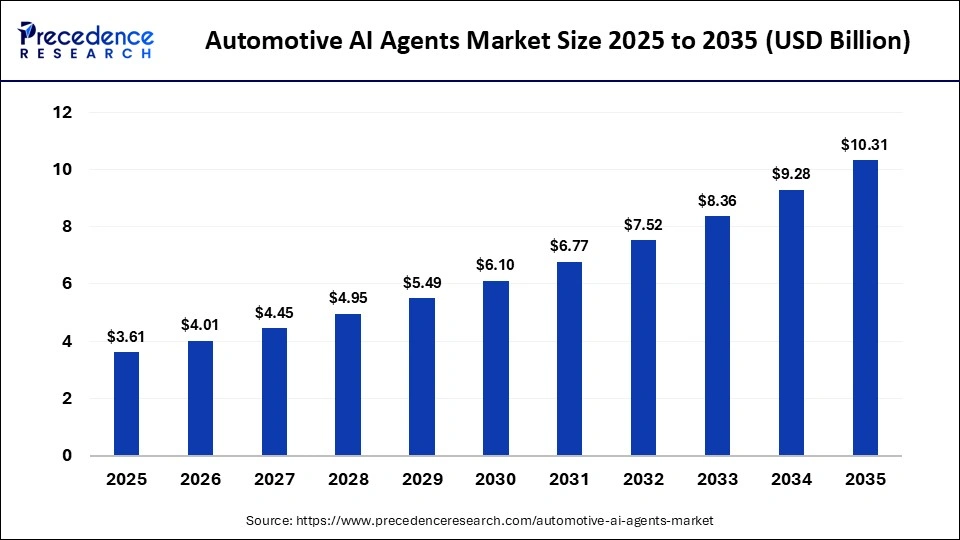
The global automotive AI agents market size accounted for USD 3.61 billion in 2025 and is predicted to increase from USD 4.01 billion in 2026 to approximately USD 10.31 billion by 2035, expanding at a CAGR of 11.06% from 2026 to 2035. The market growth is driven by the increasing demand for AI-powered safety features in vehicles. The rise of agentic AI and a rapid shift toward proactive virtual agents and autonomous systems to enhance user experience and safety are also contributing to the market growth.
Key Takeaways
- North America held the largest market share in 2025.
- Asia Pacific is expected to witness the fastest growth during the foreseeable period.
- By agent type, the conversational AI agents segment held the largest market share in 2025.
- By agent type, the autonomous driving AI agents segment is projected to grow at the fastest CAGR during the forecast period.
- By vehicle type, the passenger vehicles segment held the largest market share in 2025.
- By vehicle type, the electric vehicles segment is projected to grow at the fastest CAGR during the projection period.
- By application, the driver assistance and safety segment held the largest market share in 2025.
- By application, the in-vehicle virtual assistants segment is projected to grow at the fastest CAGR during the foreseeable period.
- By deployment type, the cloud-based AI agents segment held the largest market share of 42% in 2025.
- By deployment type, the edge/on-board AI agents segment is projected to grow at the fastest CAGR during the foreseeable period.
Market Overview
Automotive AI agents refer to intelligent and software-based programs that perform autonomous operations like complex automotive tasks, make instant decisions, and improve efficiency across the entire automotive value chain. Agentic AI helps in planning, reasoning, and executing several steps within a workflow without the intense support of humans. These agents monitor data from sensors, inventory, and consumer behavior to fulfill needs like predicting component failure before it occurs. Automotive AI agents offer several benefits, such as improved operational efficiency, increased revenue, and conversion, along with an excellent customer experience. The market is expanding rapidly as vehicle manufacturers integrate intelligent software systems for autonomous driving, advanced driver assistance, predictive maintenance, and enhanced in-car user experiences.
Automotive AI Agents Market Trends
- The automotive industry is increasingly adopting autonomous AI agents that go beyond simple pre-programmed assistants, enabling vehicles and systems to make real-time decisions without requiring continuous human intervention.
- There is a growing emphasis on integrating generative AI to enhance in-car interactions, allowing AI agents to act as digital companions that understand context, recognize driver moods, and facilitate engaging, natural conversations.
- The use of digital twins is expanding in R&D and autonomous driving validation, reducing reliance on physical prototypes, accelerating vehicle testing, and improving overall development efficiency.
- Automotive maintenance is evolving from reactive to proactive approaches, leveraging real-time vehicle sensor data to detect potential system failures early and alert drivers before issues escalate, enhancing safety and reducing downtime.
Market Scope
| Report Coverage | Details |
| Market Size in 2025 | USD 3.61 Billion |
| Market Size in 2026 | USD 4.01 Billion |
| Market Size by 2035 | USD 10.31 Billion |
| Market Growth Rate from 2026 to 2035 | CAGR of 11.06% |
| Dominating Region | North America |
| Fastest Growing Region | Asia Pacific |
| Base Year | 2025 |
| Forecast Period | 2026 to 2035 |
| Segments Covered | Agent Type, Vehicle Type, Application, Deployment Type, and Region |
| Regions Covered | North America, Europe, Asia-Pacific, Latin America, and Middle East & Africa |
Segment Insights
Agent Type Insighs
Why Did the Conversational AI Agents Segment Dominate the Market?
The conversational AI agents segment dominated the automotive AI agents market with the largest share in 2025. This is mainly due to their ability to handle consumer queries efficiently, provide 24/7 service, and deliver personalized, human-like interactions. Automotive dealerships are increasingly leveraging conversational AI to engage potential customers, capture leads, and drive sales through customized interactions. These agents offer voice assistants, hands-free control over navigation, entertainment, and communication systems that enhance user experience. Also, AI agents handle repetitive tasks like scheduling maintenance and answering FAQs that lead to streamlined operations.
The autonomous driving AI agents segment is projected to grow at the fastest CAGR during the foreseeable period due to the increasing demand for improved safety features, growing adoption of advanced driver assistance systems, and demand for vehicle autonomy by reducing human errors that may turn into fatal accidents. Autonomous driving AI agents can manage tasks like traffic optimization, ride sharing, real-time decisions, and fleet management. Moreover, leading automakers are heavily investing in self-driving technologies, which significantly support segmental growth.
Vehicle Type Insights
What Made Passenger Vehicles the Leading Segment in the Automotive AI Agents Market?
The passenger vehicles segment led the market with the largest share in 2025, as many consumers prioritize advanced safety features like adaptive cruise control, lane keeping assistance, and automated emergency braking. The rapid shift toward software-defined vehicles has further enabled the integration of intelligent infotainment systems, voice-based controls, and highly personalized in-car experiences, making driving more intuitive and interactive. Additionally, government regulations mandating enhanced vehicle safety have encouraged automotive OEMs to adopt AI-powered solutions, further supporting the growth of the segment.
The electric vehicles segment is projected to grow at the fastest CAGR during the foreseeable period, as automotive AI agents are capable of resolving general pain points of EVs like monitoring energy consumption in real-time and predicting the most efficient routes by analyzing environmental conditions. Moreover, AI agents enhance vehicle efficiency by optimizing regenerative braking, recommending energy-saving routes, and providing guidance to maximize driving range. This capability to improve performance, reduce energy losses, and enhance the EV user experience is fueling the rapid adoption of AI agents in electric vehicles.
Application Inisghts
Why Did the Driver Assistance and Safety Segment Lead the Automotive AI Agents Market?
The driver assistance and safety segment led the market in 2025 due to stringent regulations regarding vehicle safety, growing consumer demand for crash prevention systems, and the rapid integration of AI-driven technologies in new vehicle models. AI agents enhance ADAS functionality by processing high-resolution data from cameras, LiDAR, and radar in real time, enabling rapid decision-making without human intervention. This has prompted automakers to increasingly adopt AI-driven ADAS across all vehicle types, significantly boosting the deployment and volume of AI agents in the automotive sector.
The in-vehicle virtual assistants segment is projected to grow at the fastest CAGR during the foreseeable period due to the increasing demand for advanced infotainment systems, growing demand for hands-free convenience, and AI-enabled personalization that enhances both safety and user experience. Studies indicate that nearly 60% of consumers expect AI agents to optimize navigation, enable predictive maintenance, and detect vehicle issues in real time, making these features a key differentiator for automakers. Major automotive players, including BMW and Hyundai, have already integrated voice-enabled infotainment systems, supporting seamless interaction with in-car AI agents. The adoption of such technologies is driving the rapid growth of the segment as consumers increasingly seek intelligent, personalized, and connected driving experiences.
Deployment Type Insights
How Does the Cloud-based AI Agents Segment Dominate the Automotive AI Agents Market?
The cloud-based AI agents segment held the largest market share in 2025 due to their superior processing power for handling complex tasks and the ability to provide over-the-air (OTA) updates for connected vehicles. Cloud infrastructure enables centralized data management, seamless integration of advanced AI features across vehicle fleets, and easy customization, making it highly attractive for automakers. Cloud-based AI agents allow manufacturers to deploy software updates that fix bugs, improve performance, and enhance user experience without requiring physical service visits. Additionally, leveraging large language models (LLMs), these agents deliver sophisticated conversational capabilities and context-aware information that go beyond navigation and voice control, offering a highly personalized and intelligent in-car experience, which is a critical requirement in modern automotive systems.
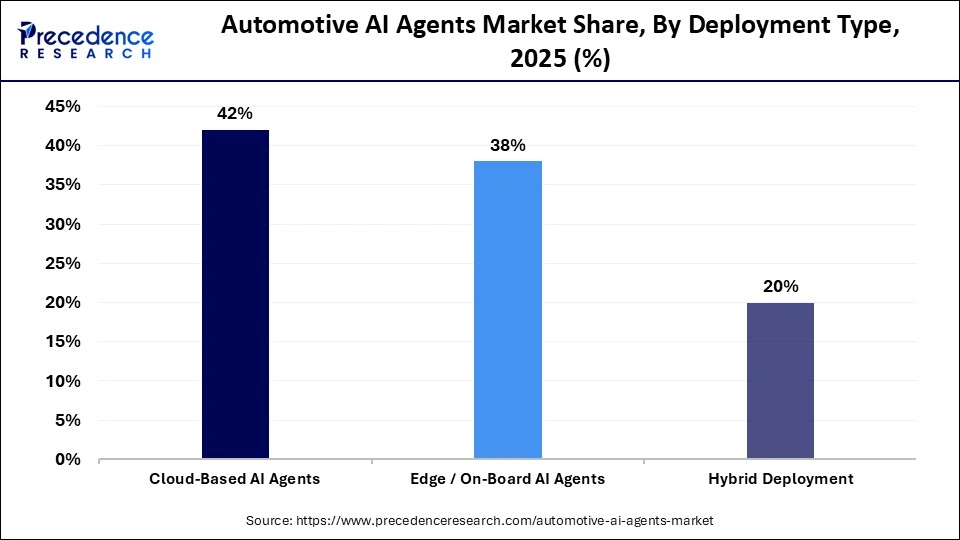
The edge/on-board AI agents segment is projected to grow at the fastest CAGR during the foreseeable period, as edge AI processes sensor data locally within milliseconds, which is crucial for ADAS systems. Emergency braking or hindrance avoidance cannot afford even a 200-500ms delay by cloud communication. Navigating unpredictable information within an unstable environment is highly crucial, which is directly executed on the vehicle's brain, called the system-on-chip. Moreover, edge AI/on-board AI agents offer privacy by design and offline transparency, advanced in-cabin personalization, and bandwidth savings with cost-effective scalability, boosting the segment's growth.
Regional Insights
What Made North America a Leader in the Automotive AI Agents Market?
North America led the automotive AI agents market with the largest share in 2025 due to the presence of leading technology and automotive companies such as NVIDIA and Tesla, favorable regulations, and the rapid adoption of ADAS technologies. Significant investments in R&D and advanced 5G infrastructure have further strengthened the region's position as a leader in automotive AI integration. The widespread use of AI agents in robotics, predictive analytics, and simulation enhances vehicle performance, operational efficiency, and safety, reinforcing North America's dominance in the market. The region's technological ecosystem and proactive innovation culture continue to drive market growth.
The region serves as a global hub for AI innovators and semiconductor manufacturers such as NVIDIA, Alphabet, and Tesla, which are actively developing AI-powered software-defined vehicles. The increasing consumer demand for road safety and regulatory mandates have forced automakers to incorporate features like adaptive cruise control, lane-keeping navigation, and automated vehicle parking that have standardized ADAS systems in several vehicle structures.
U.S. Automotive AI Agents Market Analysis
The U.S. is the major contributor to the automotive AI agents market within North America, due to the increasing adoption of AI-powered vehicles equipped with ADAS systems, predictive maintenance, in-car customization, and autonomous driving capabilities. Automotive AI is reshaping the U.S. transportation ecosystem by enhancing safety, efficiency, user experience, and technological innovation. Major automakers and technology companies are making substantial investments in self-driving technologies, which rely on AI-driven systems, machine learning algorithms, and sensor fusion, further supporting the region's market growth and leadership.
Why is Asia Pacific Rapidly Expanding in the Automotive AI Agents Market?
Asia Pacific is expected to witness the fastest growth during the foreseeable period due to the rising automobile production in emerging economies, significant government investment in smart mobility, and growing consumer demand for high-tech, safety-compliant vehicles. Increasing road safety concerns and high incidences of fatal accidents have prompted automakers to integrate AI-driven ADAS features such as lane-keeping assistance, automatic emergency braking, and adaptive cruise control. Regulatory bodies in the region are developing standardized frameworks for testing and certifying AI-powered automotive technologies, while governments are providing incentives, subsidies, and other support programs to accelerate the adoption of AI in the automotive sector.
Japan Automotive AI Agents Market Analysis
The market in Japan is rapidly growing due to a combination of factors, including strong government support and evolving regulations that encourage AI adoption in the automotive sector. The country is also witnessing a significant shift toward software-defined vehicles and increased focus on EV battery optimization, which is driving demand for AI-powered solutions. Over 60% of Japanese automakers are leveraging AI-powered robotics in production systems, enabling cost-effective manufacturing of highly complex vehicles while integrating advanced AI functionalities efficiently. This strategic adoption of AI across production and vehicle technologies is fueling the growth of the market for automotive AI agents in Japan.
Automotive AI Agents Market Companies
- NVIDIA Corporation
- Alphabet Inc. (Waymo)
- Tesla Inc.
- Intel Corporation (Mobileye)
- Qualcomm Technologies
- Microsoft Corporation
- Amazon Web Services (AWS)
- IBM Corporation
- Bosch
- Continental AG
Recent Developments
- In January 2026, the world's leading auto parts supplier, Bosch, signed an agreement with tech giant Microsoft and autonomous truck technology developer Kodiak AI to bolster the use of AI in manufacturing and accelerate the deployment of self-driving cars backed with AI technologies.(Source: https://www.autonews.com)
- In March 2026, a leading player in AI for dealership customer operations announced its strategic integration with Tekion, AI native platform innovator serving the entire automotive retail ecosystem. This partnership supports Numa's AI appointment agent with Tekion's ARC service module and assists an open ecosystem approach beneficial for both enterprises.(Source: https://www.prnewswire.com)
Segments Covered in the Report
By Agent Type
- Conversational AI Agents
- Autonomous Driving AI Agents
- Predictive Maintenance AI Agents
- Fleet Management AI Agents
- Customer Support & Sales AI Agents
By Vehicle Type
- Passenger Vehicles
- Commercial Vehicles
- Electric Vehicles (EVs)
- Autonomous Vehicles
By Application
- Driver Assistance & Safety
- In-Vehicle Virtual Assistants
- Predictive Maintenance
- Fleet & Logistics Management
- Infotainment Personalization
By Deployment Type
- Cloud-Based AI Agents
- Edge / On-Board AI Agents
- Hybrid Deployment
By Region
- North America
- Latin America
- Europe
- Asia-pacific
- Middle and East Africa
For inquiries regarding discounts, bulk purchases, or customization requests, please contact us at sales@precedenceresearch.com
Frequently Asked Questions
Tags





Ask For Sample
No cookie-cutter, only authentic analysis – take the 1st step to become a Precedence Research client
 Get a Sample




 sales@precedenceresearch.com
 Schedule a Meeting
