






 Request Consultation
Discover the rise of digital health technologies like AI, telemedicine, EHR, and wearables improving patient care, access, and healthcare efficiency.
Healthcare is rapidly changing nowadays in different ways that would have been difficult to imagine just a decade ago. Digital technologies are becoming an everyday part of healthcare services. Digital health refers to the use of technology, data, and connected systems to improve healthcare delivery, enhance patient outcomes, and make medical services more accessible. Tools such as telemedicine platforms, wearable devices, artificial intelligence, data-driven diagnostic systems, and electronic health records are reshaping the way patients interact with healthcare providers.
The growing population volume, the increase in the ageing population and the rise in healthcare costs are encouraging the shift towards digital health. People prefer convenience over spending hours waiting in hospitals if a simple consultation can be done at home. The growing use of technology has made it easier to collect and understand health data in real time, helping doctors make better decisions faster.
During the COVID-19 pandemic, hospitals and clinics adopted remote consultation and virtual monitoring systems to continue treatment while reducing physical contact. Many countries adopted digital health systems during the COVID-19 pandemic. Onwards, digital health is not optional but has become an essential tool in healthcare. Digital health is not only improving patient care but also empowering healthcare systems to operate more efficiently and respond faster to medical challenges.
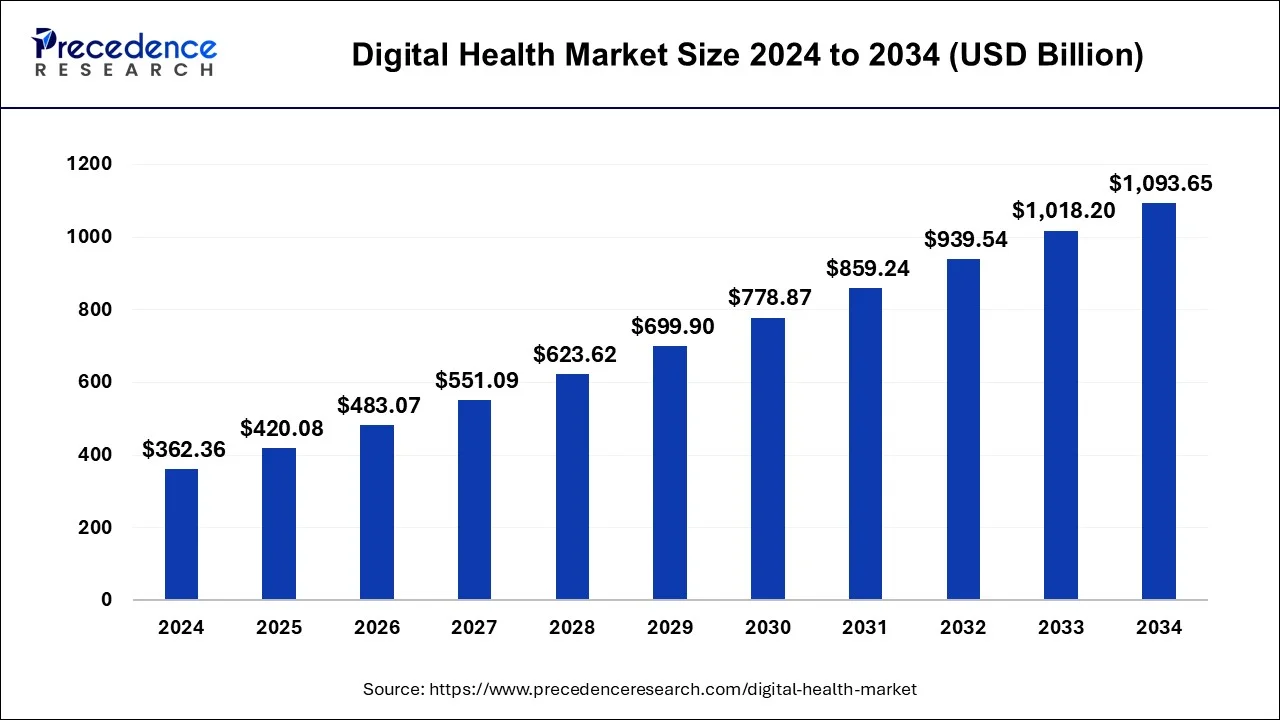
What is the Digital Health Market Size?
The global digital health market size is accounted for USD 420.08 billion in 2025 and predicted to increase from USD 483.07 billion in 2026 to approximately USD 1,171.24 billion by 2035, representing a CAGR of 10.8% from 2026 to 2035.
Limitations of Traditional Healthcare Systems
Before digital health came into the picture, most healthcare systems heavily relied on manual work and paper-based records. These traditional methods worked well, but often created inefficiencies in maintaining records and slowed down the process of sharing information with healthcare professionals. Hospitals create huge amounts of data daily, and managing this data is difficult manually. The paper medical records are difficult to manage and retrieve when patients visit multiple hospitals. The important data of a patient is scattered across different hospitals or clinics, making it difficult for doctors to access the complete medical history during consultation. The management of huge data, along with administrative work like appointment scheduling, medical documentation, and billing, consumes significant time of healthcare providers. To address this problem, a strong technological solution is needed to streamline the healthcare processes. This will help doctors to focus on a large number of patients while maintaining high standards of care.
Benefits of Digital Health Integration in Healthcare
Digital health technologies provide practical solutions that help healthcare providers improve efficiency, expand access to patient information, and allow healthcare professionals to make informed medical decisions.
Improving Access to Healthcare -
Digital health technologies are supporting the expansion of healthcare access for people living in rural and remote areas, where services are not easily available. Telemedicine and virtual platforms like e-sanjeevani in India allow patients to consult with healthcare professionals remotely using smartphones and computers. This reduces the need to travel to hospitals and clinics. mHealth Apps and wearables provide real-time patient data, which helps in patients with chronic conditions, enabling remote monitoring. Virtual healthcare services useful for follow-up consultations and prescription guidance without visiting hospitals and clinics physically.
Enhancing Patient Engagement -
Digital health tools like mobile applications and wearable devices allow individuals to track various healthcare metrics such as heart rate, physical activity, sleep patterns, and blood glucose levels. The continuous monitoring of human vitals in real-time helps in understanding patterns and allows early detection of health issues. This also helps in monitoring lifestyle habits of individuals, which enhances patient engagement.
Supporting Evidence-based Healthcare decisions –
Another digital health technology called electronic health records (EHR) stores patients' medical information digitally. Authorised hospitals and clinics can use these electronic health records to study treatment outcomes, monitor disease patterns, and improve treatment strategies. The access to patients' complete information in one place allows doctors to make informed decisions for treatment.
Digital Health Technologies
Digital health technologies are combined to improve patient care.
Telemedicine and virtual care – In the COVID-19 era and post-COVID-19 era, telemedicine and virtual care are being adopted globally. In telemedicine, patients can consult doctors through video call or even a chat platform, without physically visiting hospitals. This is useful in follow-ups, minor illnesses, or mental health support. This also helps people in remote areas to take consultation from specialist doctors who are not available nearby.
- Wearable health devices – wearable devices such as smartwatches are monitoring not only steps but also track heart rate, oxygen levels, sleep, and even detect irregular patterns. This is helpful for patients with chronic conditions as it will keep track of daily health without hospital visits. Popular wearables among the athletes and health enthusiasts are WHOOP, Apple Watch, Garmin, Fitbit, Oura ring, etc.
- Electronic Health Records (EHR) – electronic health records store patient information, including demographics, progress notes, problems, medications, vital signs, past medical history, laboratory data, and radiology reports digitally, which makes it easy for healthcare providers to access records when needed. This easy availability of patient data helps doctors to make better decisions and provide better care.
Applications
Artificial Intelligence in Digital Health
Artificial intelligence is becoming a strong support in healthcare. AI can handle numerical and perceptual data by using machine learning (ML) and natural language processing (NLP). AI can help in analysing complex data and spot patterns that might require extra attention. Machine learning has the ability to learn from data and improve its performance over time. A prediction algorithm in an ML model can be used to recommend personalised treatment options. ML plays an important role in analysing and recognising medical images, video, voice, and texts.
- Image recognition is analysing medical images like X-rays to assist radiologists in diagnosing various diseases and health conditions.
- Video recognition helps with patient monitoring, behaviour tracking, and sends quick alerts to medical staff in hospitals.
- Voice recognition is used to transcribe medical dictations, which reduces the risk of error in patient records.
- Text recognition is helpful for analysing EMR, such as prescription information, and identifying potential drug interactions.
AI is also being used to predict patient outcomes by analysing historical health data. WHO generative AI promoters and other platforms provide health information to support patient engagement.
Remote Monitoring
Remote monitoring is one of the most promising applications of healthcare technologies. Healthcare providers can track patient health data in real time through connected medical devices, without the patient need remain in hospitals or clinics. The devices, such as blood glucose monitoring, blood pressure monitoring, and cardiac monitoring systems, can transmit patients' data directly to healthcare providers. This remote continuous monitoring allows doctors to identify potential issues and modify the treatment plans. This system is particularly helpful for patients with chronic diseases and elderly patients who require regular medical supervision. This reduces frequent hospital visits and allows patients to receive care at home.
Challenges in the Usage of Digital Health
Digital health technologies have various advantages, such as the ability to facilitate remote monitoring, provide personalised treatment and improve disease management. The technologies it includes are telemedicine, electronic health records, mobile health apps, and wearable devices. This technology stores patients' medical information and lifestyle habits. As technology is advancing rapidly, it also raises challenges and ethical considerations. The devices with patients' sensitive information can be accessed by third parties, leading to privacy exploitation and data breaches. To overcome such issues, strict guidelines should be established on billing, privacy, security, and documentation. The healthcare providers practising digital health must adhere to the Health Insurance Portability and Accountability Act (HIPAA).
Also, the integration of artificial intelligence in digital health technologies is transforming healthcare services. But in healthcare sectors, relying on these complex algorithm based technologies requires quality evidence. To address this issue, regulatory bodies must develop clear frameworks and guidelines for using high-quality technologies.
Real - World Innovations in Digital Health
- The government of El Salvador launched DoctorSV, a healthcare project to transform the national system and make medical care available to the entire population, which helps in reducing waiting times and the need to travel to hospitals. This system is based on data and advanced analytics, which improve decision-making and reduce errors. It allows each stage of the process, diagnosis, treatment, and follow-up to be integrated and traceable.
- Lupin Digital Health launched VITALYFE – an AI-powered cardiometabolic wellness platform. This platform uses artificial intelligence, behavioural science, and computer-vision technology to detect early risks and provide personalised, non-medicated interventions that address the main cause of heart ageing.
- Nephroplus, Asia’s leading dialysis provider, launched its mobile application called Guest App in the Philippines. This app is a fully digital platform that helps NephroPlus patients to manage their treatment journey.
- Union Minister for Health and Family Welfare launched two digital health initiatives – SAHI (Strategy for Artificial Intelligence in Healthcare for India) and BODH (Benchmarking Open Data Platform for Health AI). This will help in safe, ethical and evidence based deployment of artificial intelligence in India’s healthcare ecosystem.
Conclusion
Digital health is changing healthcare in a way that feels more practical and patient-focused. Digital health makes patient medical information easier to access through electronic health records, which helps doctors make better decisions. Telemedicine platforms, wearable devices, remote monitoring systems, and the integration of artificial intelligence in digital health are helping healthcare providers to deliver better care to patients. These technologies are making medical services more accessible, efficient, and data driven. As technology continues to grow, healthcare will become even more connected and efficient. The continuous adoption of digital health technologies will reshape the way healthcare is delivered to patient care. The system that adapts to these changes will be better equipped to handle future challenges and provide quality care. In the end, digital health is not just about technology - it is making healthcare work better for everyone.
About the Authors

Aditi Shivarkar
Aditi, Vice President at Precedence Research, brings over 15 years of expertise at the intersection of technology, innovation, and strategic market intelligence. A visionary leader, she excels in transforming complex data into actionable insights that empower businesses to thrive in dynamic markets. Her leadership combines analytical precision with forward-thinking strategy, driving measurable growth, competitive advantage, and lasting impact across industries.



Aman Singh
Aman Singh with over 13 years of progressive expertise at the intersection of technology, innovation, and strategic market intelligence, Aman Singh stands as a leading authority in global research and consulting. Renowned for his ability to decode complex technological transformations, he provides forward-looking insights that drive strategic decision-making. At Precedence Research, Aman leads a global team of analysts, fostering a culture of research excellence, analytical precision, and visionary thinking.

Piyush Pawar
Piyush Pawar brings over a decade of experience as Senior Manager, Sales & Business Growth, acting as the essential liaison between clients and our research authors. He translates sophisticated insights into practical strategies, ensuring client objectives are met with precision. Piyush’s expertise in market dynamics, relationship management, and strategic execution enables organizations to leverage intelligence effectively, achieving operational excellence, innovation, and sustained growth.