






 Request Consultation
Drylab photo printing is revolutionizing photography by delivering fast, high-quality prints without the use of chemicals. It offers a cost-effective, eco-friendly solution widely adopted by professional studios and photo labs.
The Rise of Drylab Photo Printing
Drylab photo printing has revolutionized the world of photography by combining speed, precision, and unmatched image quality. Unlike traditional darkroom processes, drylab technology eliminates the need for chemical development while producing vibrant, high-resolution prints. This innovation has made professional-quality photo printing more accessible, efficient, and environmentally friendly.
From professional photographers to hobbyists, drylab photo printing ensures every image captures its true colors and intricate details. With faster turnaround times and consistent results, it has become the preferred choice for studios, labs, and online photo services. As digital photography continues to dominate, drylab technology bridges the gap between digital convenience and tangible, gallery-quality prints.
The drylab photo printing revolves around a revolutionary trend of using specialized inkjet technology to offer precise and high-quality photographs for professional, retail, and on-demand photo services. The drylab systems are software based solutions that are eco-friendly and provide tools for color correction, cropping, and print management. Drylab printing requires lower maintenance, low wastage, lower operational costs, no chemicals, and cost-effective solutions. The leading industrial players in this industry are Seiko Epson Corporation, FUJIFILM Corporation, Canon Inc., Noritsu Koki Co., Ltd., Sinfonia Technology Co., Ltd., and HP Development Company.
Technological Advancements in Drylab Photo Printing
- High-Resolution Printheads: The leading printhead technologies are Epson PrecisionCore MicroTFP, Fujifilm SAMBA & Printbar Systems, which are two primary high-resolution architectures. DE1024 Digital Embellishment Printbar and 42X Printbar System of Fujifilm are designed to deliver high-resolution performance across commercial and personal photo applications.
- Augmented Reality (AR): AR is becoming a standard feature for high-end products like wall art, calendars, and photo books. Users can view or hide the videos and animations by scanning a printed image with a smartphone. Augmented reality (AR) is integrated into in-store or retail tasks to allow customers to preview their photos.
Major Impulse of the Drylab Photo Printing
- Environmental & Sustainability Mandates: Regional regulatory authorities, like the European Union, European Commission, the Environmental Protection Agency (EPA), the U.S. Food and Drug Administration, the Asian Development Bank (ADB), and many others, aim to set a promising regulatory framework for the sustainable production and commercialization of photo printing products. They aim to maintain efficiency, durability, energy efficiency, and repairability across the industry.
- Consumer Demand for Customized Products: A surging trend of digital photography and a rapid shift toward personalized items over standard prints drives the expansive reach of customized products. A drylab technology is widely preferred by customers to create customized photo albums, bespoke wall decor, and high-quality canvas prints.
What is the Drylab Photo Printing Market Size in 2026?
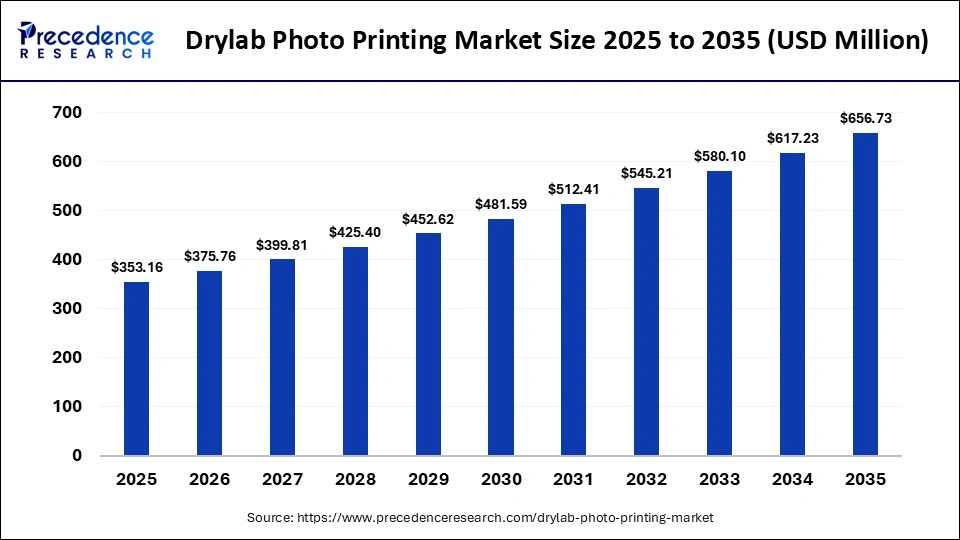
The global drylab photo printing market was valued at USD 353.16 million in 2025 and is projected to grow from USD 375.76 million in 2026 to approximately USD 656.73 million by 2035, registering a CAGR of 6.40% during the forecast period from 2026 to 2035. The market growth is driven by the increasing demand for eco-friendly, on-demand, and high-quality printing solutions, along with advancements in inkjet technology and the rising adoption of drylab photo printing in retail and professional photography.
Top Trends Shaping the Drylab Photo Printing Industry
- Compact & Modular Designs of Printers: The highly compact, modular, and stackable designs of drylab photo printers offer scalable solutions for businesses such as event photography, retail, and small labs by allowing multiple units to be added as needed. These modular systems enable the integration of optional duplex feeders for efficient double-sided printing. Additionally, multiple units can be combined into a software-managed fleet, providing streamlined operations and centralized control for high-volume printing environments.
- High-Resolution Output: Modern drylab systems deliver exceptional high-resolution performance, offering standard professional output, premium quality, and gallery-level prints. A resolution of 300 DPI is widely regarded as the benchmark for high-quality retail photos and brochures. For applications requiring ultra-fine detail, such as weddings, fine art, and exhibition prints, resolutions between 600 DPI and 1200 DPI provide smooth gradients and razor-sharp detail, ensuring every image looks stunning.
The Next Frontier: Opportunities in Drylab Photo Printing
- Growing Demand for Personalized and On-Demand Products: Leading companies, such as Fujifilm, have introduced a range of photo specialty solutions, including narrow-format duplex media and the FUJIFILM CX 3240 creative duplex printer. In addition, many businesses are offering digital lab solutions, personalized photo products, wide-format inkjet systems, paper and lab products, and photographic chemicals. These innovations provide a broad spectrum of products and services that help businesses expand and meet the growing demand for customized photo printing.
- Rising Popularity of Subscription-Based Models: With the widespread use of smartphones and mobile applications, users increasingly prefer a mobile-first approach to ordering prints through easy subscription sign-ups. Modern drylab software and cloud services are rapidly adopting subscription models for print management and photo editing, offering the added benefits of remote monitoring and predictive maintenance. These developments not only enhance convenience for customers but also streamline operations for photo labs and printing businesses.
Government Initiatives Supporting the Drylab Photo Printing Industry
In March 2024, the New Energy and Industrial Technology Development Organization (NEDO) accelerated the R&D project of the enhanced infrastructures for post-5 G information and communication systems. In this latest innovation, Dai Nippon Printing (DNP) will contribute as a subcontractor and offer the latest technology to Tokyo-based Rapidus Corporation. DNP aims to boost the development of the photomask manufacturing process for 2nm generation EUV lithography.
In September 2025, Canon India collaborated with Future Schoolz to introduce a new and India’s first digital press certification program for digital printing professionals. Canon is committed to advancing the digital printing ecosystem, and this collaboration aims to upskill supervisors, managers, and digital press operators by resolving the gaps in the Indian print industry.
Top Companies Operating in the Drylab Photo Printing Industry and Their Offerings
- Seiko Epson Corporation: Epson SureLab SL-D1000 Series, Epson SureLab SL-D500 Series, variants like SL-D1000 (simplex) and SL-D1030.
- FUJIFILM Corporation: FUJIFILM Frontier DX400W, FUJIFILM Frontier DE100-XD, inkjet printbar systems, ApeosPro C810/C650 for Photo.
- Canon Inc.: Canon DreamLabo 5000, Canon imagePROGRAF PRO-1100, imagePROGRAF PRO-2600/4600/6600, imagePROGRAF GP Series, etc.
- Noritsu Koki Co., Ltd.: Noritsu QSS Green IV, Noritsu QSS Green III, Noritsu QSS Green R, consumables, Noritsu 931-BL, EZ controller.
- Dai Nippon Printing: DP-DS820DX, DNP DS-RX1HS Dye Sublimation Printer Kit with WCM Plus, DNP QW410 Dye Sublimation Printer, DNP DS620A Dye Sub Professional Photo Printer.
Exploring Opportunities in North America for the Drylab Photo Printing Industry
North American retailers and leading photo printing services, such as Nations Photo Lab, Mpix, Bay Photo Lab, Fujifilm, Whitewall, and Artisan HD, are increasingly shifting from traditional chemical wet-lab systems to modern, cloud-based drylab photo printing solutions. These businesses are adopting eco-friendly, cost-effective, and highly efficient software solutions to streamline operations, improve manufacturing efficiency, and meet growing consumer demand for high-quality prints.
Major players like Fujifilm provide a wide range of photofinishing products in the U.S., including thermal photo printers, digital minilabs, film and paper chemicals, professional photo papers, and silver halide prints. Canon U.S.A., a leader in digital imaging and printing, is also driving innovation with production inkjet systems, digital presses, wide-format printers, workflow solutions, and professional services.
Significant investments by Canon, focused on automation, productivity, revenue growth, and client expansion, highlight the industry’s push toward efficiency and scalability. Industry collaborations, such as the Printing United Alliance, bring together companies like Ricoh, Fujifilm, and Canon to advance research, product development, and industry growth. This shift marks a major transformation in North America’s photo printing landscape, combining sustainability, speed, and high-quality output.
Expert Opinion
As per our industry experts, drylab photo printing represents a major advancement in the imaging and photography industry, offering companies a competitive edge through speed, quality, and cost efficiency. Unlike traditional wet-lab processes that rely on chemical development, drylab systems utilize inkjet or dye-sublimation technologies to produce high-resolution, vibrant, and durable prints without harmful chemicals. This not only reduces operational costs and environmental impact but also accelerates turnaround times, enabling businesses to meet growing customer demands for fast, high-quality photo products.
Retailers, professional photo studios, and online print services are increasingly adopting drylab systems to scale operations, manage high-volume orders, and offer personalized and on-demand printing solutions. The modular and software-integrated designs of modern drylab printers allow businesses to expand capacity seamlessly while maintaining consistent print quality. Additionally, cloud-enabled and subscription-based solutions support remote monitoring, predictive maintenance, and streamlined workflow management, improving operational efficiency and customer satisfaction.
From a revenue standpoint, drylab technology enables service providers to diversify offerings, from retail prints and photo books to professional gallery-quality and event photography, while reducing production costs. Companies investing in drylab systems gain a strategic advantage by combining sustainability, automation, and premium output, positioning themselves for long-term growth in a highly competitive and evolving photo printing industry.
Wrapping Up
In summary, drylab photo printing is transforming the photography industry with innovative features such as high-speed, chemical-free prints that maintain professional-quality results. Advanced inkjet and dye-sublimation technologies deliver precision, accuracy, and operational efficiency while offering vibrant, durable prints at lower costs compared to traditional wet-lab methods. These solutions are widely adopted in retail, photo studios, and professional labs, enabling rapid turnaround times without compromising quality.
Drylab printers continue to lead globally due to their superior color accuracy, enhanced resolution, and eco-friendly appeal. Photo studios and retail providers prioritize drylab technology for its reliability, speed, and ability to handle high-volume outputs efficiently, all without the use of wet chemicals. With these advantages, drylab photo printing represents a sustainable, cost-effective, and high-quality solution for modern photography
About the Authors

Aditi Shivarkar
Aditi, Vice President at Precedence Research, brings over 15 years of expertise at the intersection of technology, innovation, and strategic market intelligence. A visionary leader, she excels in transforming complex data into actionable insights that empower businesses to thrive in dynamic markets. Her leadership combines analytical precision with forward-thinking strategy, driving measurable growth, competitive advantage, and lasting impact across industries.



Aman Singh
Aman Singh with over 13 years of progressive expertise at the intersection of technology, innovation, and strategic market intelligence, Aman Singh stands as a leading authority in global research and consulting. Renowned for his ability to decode complex technological transformations, he provides forward-looking insights that drive strategic decision-making. At Precedence Research, Aman leads a global team of analysts, fostering a culture of research excellence, analytical precision, and visionary thinking.

Piyush Pawar
Piyush Pawar brings over a decade of experience as Senior Manager, Sales & Business Growth, acting as the essential liaison between clients and our research authors. He translates sophisticated insights into practical strategies, ensuring client objectives are met with precision. Piyush’s expertise in market dynamics, relationship management, and strategic execution enables organizations to leverage intelligence effectively, achieving operational excellence, innovation, and sustained growth.