






 Request Consultation
8K technology is redefining visual intelligence beyond traditional displays with ultra-high precision and data capabilities. This blog highlights its role across industries like healthcare, defense, and industrial design. It also covers global investments, key technologies, and future growth opportunities.
8K technology is often positioned as the next step in display evolution, but this framing significantly understates its strategic importance. Beyond sharper screens, 8K represents a data-intensive visual infrastructure layer that intersects with AI, edge computing, advanced semiconductors, and high-bandwidth connectivity. The real story is not just adoption. It is about who is investing, why they are investing, and where value will be created.
Reframing 8K: Beyond Display Technology
To understand the significance of 8K, it is essential to move beyond the traditional lens of consumer electronics. While larger televisions and premium viewing experiences have driven early awareness, the core advantage of 8K lies in its ability to enhance data density and interpretability.
This level of resolution allows for highly precise visualization, enabling users to zoom, analyze, and interpret visual data without loss of detail. In sectors such as medical imaging, this translates into more accurate diagnostics and improved surgical outcomes. In defense and surveillance, it enhances situational awareness by capturing finer details across wide areas. In industrial design and engineering, it supports complex simulations and digital twin environments where precision is critical.
What is the 8k Technology Market Size in 2026?
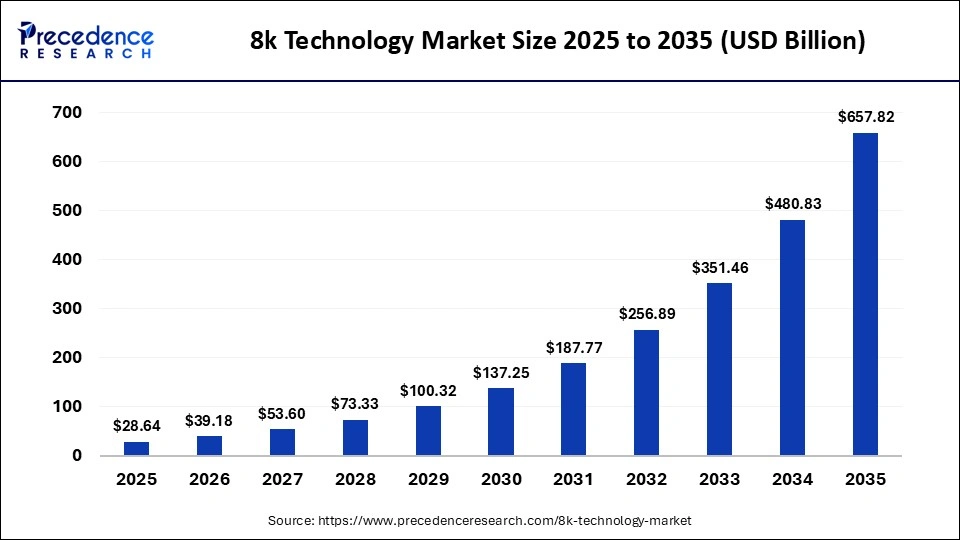
The global 8K technology market size was valued at USD 28.64 billion in 2025 and is expected to grow from USD 39.18 billion in 2026 to approximately USD 657.82 billion by 2035, registering a CAGR of 36.81% from 2026 to 2035. The growth is driven by the increasing demand for ultra-high-definition displays.
Get a Free Sample Report with Key Market Trends: https://www.precedenceresearch.com/sample/8233
Global Investment Landscape
The development of the 8K ecosystem is being shaped by distinct regional strategies, each reflecting different economic priorities and technological strengths.
Asia-Pacific has emerged as the dominant force in 8K development, driven by a combination of manufacturing scale, government support, and technological leadership. Japan has played a pioneering role in 8K broadcasting, setting early benchmarks for adoption. South Korea continues to lead in display innovation, particularly in advanced panel technologies. China, meanwhile, is aggressively expanding its capabilities through state-backed investments, focusing on supply chain localization and large-scale production. This coordinated approach positions the region as the global hub for 8K hardware and infrastructure.
In contrast, North America is focusing less on display manufacturing and more on the underlying compute ecosystem. Investments are concentrated in high-performance GPUs, artificial intelligence, and cloud infrastructure. These capabilities are essential for processing and transmitting 8K content, particularly in enterprise and simulation-based applications. The region’s strategic focus is on controlling the intelligence and processing layers that enable 8K functionality.
Where 8K Creates Real Value
A critical distinction in understanding the 8K landscape is recognizing where value is actually being created. While consumer electronics often dominate the narrative, the most significant impact is emerging in enterprise and institutional applications.
In medical imaging, 8K enables a level of detail that enhances diagnostic accuracy and supports advanced surgical procedures. In defense and surveillance, it provides improved clarity across large-scale environments, enabling better monitoring and faster decision-making. Industrial design and simulation benefit from the ability to model complex systems with high precision, reducing errors and improving efficiency. Broadcasting and media represent a transitional segment, where 8K is used to differentiate premium content offerings, although widespread adoption remains limited.
Consumer electronics, despite being the most visible application, currently represent a relatively lower value segment in terms of strategic impact. The incremental improvement in viewing experience does not yet justify the broader infrastructure investment required for mass adoption. This imbalance highlights a key insight: enterprise use cases will drive the initial return on investment, while consumer adoption will follow over time.
Europe is taking a more targeted approach, emphasizing precision-driven applications. Investments are directed toward sectors such as healthcare, automotive engineering, and industrial systems, where the benefits of ultra-high resolution can be directly translated into operational efficiency and innovation. Rather than pursuing mass consumer adoption, Europe is leveraging 8K where it creates measurable value.
Technology Stack and Enablers
The scalability of 8K technology depends on a complex and interdependent technology stack. At the foundation lies semiconductor capability, as processing 8K content requires advanced GPUs and AI accelerators capable of handling extremely high data volumes. Without sufficient processing power, the benefits of 8K cannot be fully realized.
Equally important is the data infrastructure required to transmit and manage such large amounts of information. High-speed connectivity through fiber networks and 5G plays a critical role, along with edge computing solutions that reduce latency and improve performance. Efficient compression technologies are also essential, as they enable the transmission of high-resolution content without overwhelming network capacity.
On the materials and hardware side, innovations in display technologies such as OLED and MicroLED are central to delivering true 8K performance. These advancements must be complemented by improvements in thermal management and substrate efficiency to ensure reliability and scalability.
Leading Companies Shaping the 8K Technology Ecosystem
| Company | Core Strength in 8K | Strategic Positioning | Key Focus Area |
| Samsung Electronics | Leadership in 8K displays and AI upscaling technologies | Dominant player in premium 8K segment and ecosystem development | Consumer electronics, display panels, AI processing |
| LG Electronics/LG Display | Advanced OLED panel innovation with high color accuracy | Strong in professional and high-end display applications | OLED technology, medical and professional displays |
| BOE Technology Group | Large-scale manufacturing and cost-efficient panel production | Driving affordability and scaling of 8K displays globally | Mass-market displays, smart devices, IoT integration |
| Sharp Corporation | Early pioneer in 8K development and commercialization | Focus on niche industrial and broadcast ecosystems | 8K broadcasting, industrial displays, “8K + 5G” integration |
| Sony Corporation | Expertise in imaging, cameras, and content production | Strong presence in content creation and professional imaging | 8K cameras, media production, imaging systems |
| Innolux Corporation | Specialized display solutions with strong vertical integration | Focus on automotive and industrial applications | Automotive displays, industrial panels |
| AU Optronics (AUO) | Continued manufacturing of high-resolution panels | Remaining key supplier in shrinking 8K panel ecosystem | Display manufacturing and supply chain |
| Canon Inc | Advanced imaging and optical technologies | Key player in 8K content capture ecosystem | 8K cameras, broadcast equipment |
| Panasonic Corporation | Selective participation in high-end display and broadcast tech | Niche involvement in premium and professional segments | Broadcast systems, professional displays |
Strategic Implications
For industry participants, the emergence of 8K presents both opportunities and strategic decisions. Manufacturers must move beyond standalone display products and focus on integrated solutions that combine hardware, processing, and software capabilities. Telecom and infrastructure providers have an opportunity to position 8K as a driver for premium connectivity services, leveraging the demand for high bandwidth.
Enterprises can benefit by adopting 8K in applications where precision and data quality are critical, such as simulation, diagnostics, and advanced analytics. Investors, meanwhile, should focus on enabling technologies, including semiconductors, compression algorithms, and edge computing platforms, rather than limiting their attention to end-user devices.
Expert Opinion
According to our industry experts, 8K technology represents a transformative opportunity across consumer electronics, commercial displays, and content creation industries. The ultra-high-definition resolution not only enhances visual experiences but also drives premium product adoption, allowing manufacturers and retailers to command higher margins in competitive markets. For content providers and streaming platforms, 8K presents both a challenge and an opportunity: the need for optimized content delivery and storage solutions is balanced by the ability to offer immersive, next-generation viewing experiences that differentiate their offerings.
In commercial settings such as digital signage, healthcare imaging, and professional design, 8K displays enhance precision, clarity, and customer engagement, directly impacting business performance. Companies investing in 8K technology gain a competitive advantage through innovation, positioning themselves as market leaders. As adoption accelerates globally, driven by consumer demand and enterprise applications, 8K is poised to become a strategic growth driver for the electronics and visualization markets.
About the Authors

Aditi Shivarkar
Aditi, Vice President at Precedence Research, brings over 15 years of expertise at the intersection of technology, innovation, and strategic market intelligence. A visionary leader, she excels in transforming complex data into actionable insights that empower businesses to thrive in dynamic markets. Her leadership combines analytical precision with forward-thinking strategy, driving measurable growth, competitive advantage, and lasting impact across industries.



Aman Singh
Aman Singh with over 13 years of progressive expertise at the intersection of technology, innovation, and strategic market intelligence, Aman Singh stands as a leading authority in global research and consulting. Renowned for his ability to decode complex technological transformations, he provides forward-looking insights that drive strategic decision-making. At Precedence Research, Aman leads a global team of analysts, fostering a culture of research excellence, analytical precision, and visionary thinking.

Piyush Pawar
Piyush Pawar brings over a decade of experience as Senior Manager, Sales & Business Growth, acting as the essential liaison between clients and our research authors. He translates sophisticated insights into practical strategies, ensuring client objectives are met with precision. Piyush’s expertise in market dynamics, relationship management, and strategic execution enables organizations to leverage intelligence effectively, achieving operational excellence, innovation, and sustained growth.