






 Request Consultation
Iris recognition technology is emerging as a powerful tool in modern digital security, offering precise and reliable biometric authentication. Its integration with AI, cloud platforms, and smart devices is enabling seamless identity verification, reducing fraud, and supporting secure digital ecosystems worldwide.
In an era where digital security and identity verification have become critical, iris recognition technology is emerging as one of the most reliable and advanced biometric solutions. Unlike passwords or ID cards, which can be lost, stolen, or duplicated, iris recognition relies on unique biological patterns that remain stable throughout a person’s lifetime. This inherent reliability has positioned the industry at the forefront of next-generation authentication systems.
From airports and banking systems to smartphones and national identity programs, iris recognition is rapidly transitioning from a niche security tool to a mainstream technology. Its growth is not only driven by technological advancements but also by increasing global concerns around fraud, cybersecurity, and identity management.
Integration with Digital Ecosystems
Iris recognition is increasingly being integrated into broader digital ecosystems, where it functions as a key component of identity verification frameworks. It works alongside other technologies such as mobile applications, cloud platforms, and enterprise software systems.
This integration enables:
- Secure login across multiple platforms
- Unified identity management systems
- Enhanced data protection across digital services
As organizations continue to digitize operations, the role of iris recognition as a foundational authentication layer becomes more prominent.
What is the Iris Recognition Market Size in 2026?
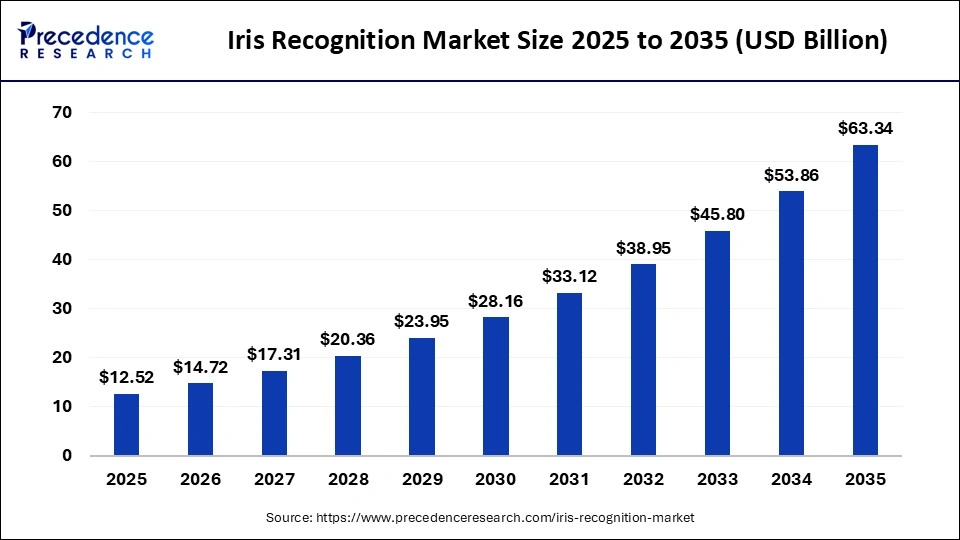
The global iris recognition market was valued at USD 12.52 billion in 2025 and is projected to grow from USD 14.72 billion in 2026 to approximately USD 63.34 billion by 2035, registering a CAGR of 17.60% from 2026 to 2035. This growth is primarily driven by the rising demand for secure biometric authentication across government, banking, and mobile device applications.
Get a Free Sample Report with Key Market Trends: https://www.precedenceresearch.com/sample/8218
Understanding Iris Recognition Technology
Iris recognition works by capturing high-resolution images of the colored ring surrounding the pupil and converting its unique patterns into a digital template. These patterns are highly distinctive and remain largely unchanged over time, making iris recognition one of the most accurate biometric identification methods available.
The technology is contactless, fast, and capable of operating at a distance, which adds to its appeal in environments requiring high throughput and minimal physical interaction. Compared to other biometric systems, such as fingerprint or facial recognition, iris recognition offers lower error rates and higher reliability, especially in high-security applications.
Expanding Applications of Iris Recognition Across Key Industries
| Industry | Application of Iris Recognition | Key Benefit |
| Banking and Finance | Secure transactions and identity verification | Enhances fraud prevention and ensures secure access |
| Healthcare | Patient identification and data protection | Improves accuracy in patient records and safeguards sensitive data |
| Airports and Border Control | Passenger identity verification and processing | Speeds up security checks and reduces waiting time |
| Consumer Electronics | Device authentication (smartphones, laptops) | Provides convenient and secure user access |
Shift Toward Contactless Authentication
The global shift toward contactless technologies has also played a major role in boosting the adoption of iris recognition. Unlike fingerprint systems, iris scanning does not require physical contact, making it more hygienic and suitable for public environments. This feature has gained even more importance as organizations prioritize safety, speed, and efficiency in high-traffic areas such as airports, offices, and healthcare facilities.
IriTech IriAegis-BK: Advancing Binocular Iris Scanning for High-Throughput Identity Systems
IriTech’s introduction of the IriAegis-BK marks a notable evolution in iris recognition hardware, building upon the proven foundation of its earlier device, the IriShield-USB BK2121U. While the BK2121U established itself as a compact, USB-powered dual iris scanner widely used in enrollment and authentication systems, the IriAegis-BK represents a next-generation binocular solution designed for higher throughput, improved usability, and enhanced security features.
Unlike earlier single or sequential capture systems, the IriAegis-BK is designed to capture both irises simultaneously in under three seconds. This binocular approach significantly improves enrollment efficiency, particularly in environments that require rapid processing of large populations. The simultaneous capture reduces user repositioning and minimizes errors caused by movement or misalignment, resulting in smoother and faster workflows.
How Iris Recognition is Transforming Multiple Sectors?
Iris recognition technology is redefining security, authentication, and operational efficiency across a wide range of industries. Its ability to deliver fast, contactless, and highly accurate identification makes it a critical tool for modern enterprises and institutions.
- Government & Defense: Iris recognition plays a key role in national security, border control, and military access management. By providing precise verification for secure facilities, it prevents unauthorized entry and strengthens the overall security framework for defense personnel and sensitive locations.
- Banking & Finance: Financial institutions are leveraging iris recognition for secure customer authentication in ATMs, mobile banking, and high-value transactions. The technology minimizes fraud, ensures compliance with KYC regulations, and enhances both the speed and reliability of customer verification.
- Consumer Electronics: Smartphones, laptops, and other smart devices are increasingly incorporating iris recognition for secure device unlocking and user authentication. This contactless solution safeguards personal data and digital transactions while offering a seamless user experience.
- Healthcare: Hospitals and clinics use iris recognition to verify patient identity, prevent medical errors, and secure access to health records. It streamlines patient check-ins, supports compliance with data privacy regulations, and improves overall operational efficiency.
Role of Governments in Driving Adoption
- National Identity Programs: Governments around the world are playing a crucial role in the expansion of iris recognition technology. Many countries are incorporating biometric identification systems into national ID programs to improve governance, reduce fraud, and enhance service delivery. Large-scale biometric databases are being used to support public welfare systems, financial inclusion, and digital identity frameworks, enabling secure and efficient citizen authentication.
- Border Security and Immigration: Iris recognition is increasingly being deployed in border control and immigration systems. Governments are using biometric solutions to strengthen national security while improving the speed and accuracy of identity verification processes. These systems help reduce waiting times, prevent identity fraud, and enhance overall travel efficiency.
- Law Enforcement and Public Safety: Law enforcement agencies are adopting iris recognition for criminal identification and surveillance purposes. By integrating biometric data into centralized systems, authorities can improve investigation processes and ensure accurate identification. Such initiatives highlight the growing importance of iris recognition in maintaining public safety and national security.
Contribution of Private Companies
Innovation and Technology Development
Private companies are at the forefront of advancing iris recognition technology. Leading firms are investing in research and development to improve system accuracy, speed, and scalability. Their efforts focus on enhancing image capture technologies, refining recognition algorithms, and integrating advanced analytics to deliver more efficient solutions.
Expansion into Consumer Devices
Technology companies are also driving adoption by incorporating iris recognition into everyday devices such as smartphones and laptops. This has significantly increased user exposure to the technology, making it more accessible and widely accepted.
As consumers become more comfortable with biometric authentication, demand for iris recognition is expected to grow further.
Product Evolution: From Specialized Systems to Everyday Integration
Iris recognition technology has evolved significantly from bulky, high-cost security systems to compact, highly efficient solutions embedded in everyday devices. Early implementations were largely confined to government and defense applications, where accuracy outweighed cost and convenience. Today, advancements in miniaturization and software optimization have enabled seamless integration into smartphones, access control systems, and enterprise security platforms.
Modern iris recognition products are designed with user experience in mind, offering rapid authentication, minimal latency, and intuitive interfaces. The shift toward lightweight, scalable solutions has made deployment easier for organizations across various operational environments, from corporate offices to high-security zones.
Customization and Scalability in Deployment
One of the defining strengths of modern iris recognition solutions is their ability to adapt to diverse operational needs. Vendors now offer highly customizable systems that can be tailored to specific use cases, whether it is securing a small office or managing identity verification across large populations. Scalable deployment models allow organizations to start with a limited implementation and expand as requirements grow. Cloud-based architectures further enhance scalability by enabling centralized data management and remote accessibility.
The iris recognition industry is experiencing strong growth, driven by increasing demand for secure, contactless, and reliable authentication solutions. Its applications are expanding across industries, supported by technological advancements and growing awareness of biometric security.
While challenges such as privacy concerns and costs remain, continuous innovation and collaboration are expected to address these issues. As the world becomes more digitally connected, iris recognition is set to play a vital role in shaping the future of identity verification and security systems.
How Advances are Empowering Iris Recognition Technology?
Recent technological advances are driving the widespread adoption and effectiveness of iris recognition across industries. AI and machine learning have significantly improved pattern recognition, enabling faster and more accurate identification even under challenging conditions such as low light or partial occlusion.
Enhanced sensors and imaging technology now allow high-resolution, contactless scanning, increasing convenience and hygiene while reducing errors. Integration with cloud computing and digital identity platforms enables seamless cross-platform authentication and real-time data processing, which is especially valuable in banking, healthcare, and government applications.
Additionally, improvements in cybersecurity and encryption ensure that sensitive biometric data is protected, addressing privacy concerns and regulatory compliance. Together, these innovations make iris recognition more reliable, scalable, and adaptable, positioning it as a leading solution for secure identification and authentication in the digital era.
About the Authors

Aditi Shivarkar
Aditi, Vice President at Precedence Research, brings over 15 years of expertise at the intersection of technology, innovation, and strategic market intelligence. A visionary leader, she excels in transforming complex data into actionable insights that empower businesses to thrive in dynamic markets. Her leadership combines analytical precision with forward-thinking strategy, driving measurable growth, competitive advantage, and lasting impact across industries.



Aman Singh
Aman Singh with over 13 years of progressive expertise at the intersection of technology, innovation, and strategic market intelligence, Aman Singh stands as a leading authority in global research and consulting. Renowned for his ability to decode complex technological transformations, he provides forward-looking insights that drive strategic decision-making. At Precedence Research, Aman leads a global team of analysts, fostering a culture of research excellence, analytical precision, and visionary thinking.

Piyush Pawar
Piyush Pawar brings over a decade of experience as Senior Manager, Sales & Business Growth, acting as the essential liaison between clients and our research authors. He translates sophisticated insights into practical strategies, ensuring client objectives are met with precision. Piyush’s expertise in market dynamics, relationship management, and strategic execution enables organizations to leverage intelligence effectively, achieving operational excellence, innovation, and sustained growth.