






 Request Consultation
Introduction to the Global Digital Advertising Ecosystem
The digital advertising ecosystem evolved from manual ad sales into an automated, programmatic network as manual negotiations could not keep pace with billions of web pages, apps, along with real-time user auctions. To manage this scale, distinct software layers emerged to buy, sell, measure, combine, and optimize ads instantly. Digital advertising between 2026 and 2027 is undergoing a structural evolution propelled by agentic AI, stricter privacy rules, and commerce convergence. These forces are changing budgets toward Retail Media Networks and Connected TV (CTV), then turning passive media impressions into automated, outcome-engineered actions.
Leading publicly traded ad tech firms drive innovation across the advertising stack by deploying AI-driven automation, cookieless determination frameworks, and omnichannel real-time measurement. Major players such as The Trade Desk, Magnite, and Criteo use these core capabilities to redefine programmatic workflows along with performance. Supply-side and data collaboration platforms activate secure data clean rooms to match user profiles safely and anonymously.
Understanding the Modern Digital Advertising Value Chain
Digital advertising operates via an end-to-end lifecycle that transforms business goals into market actions. The core process spans campaign planning, media buying, creative development, audience targeting, ongoing optimization, attribution, and even analytics. Technology providers collaborate in the adtech and martech ecosystems, utilizing interoperable data layers, privacy-safe clean rooms, along with automated execution engines to maximize return on advertising spend (ROAS) and also efficiency. This cooperation connects fragmented signals across the customer journey without exposing raw consumer data.
Google DV360, along with independent exchanges, automates real-time bidding, matching advertiser budgets with publisher inventory in milliseconds. Multi-touch and incrementality attribution tools merge performance metrics from social, search, and even connected TV (CTV) to show true conversion drivers rather than siloed last-click results.
Evolution from Traditional Advertising to AI-Powered Marketing
Transitioning from conventional digital advertising to an AI-based framework requires consolidating data inputs, changing from manual rule sets to goal-based architectures, and redefining the marketer's role as a strategic director rather than a manual executor. This evolution spans five practical phases of operational change. Moreover, generative AI and automated systems transform marketing by accelerating asset creation from weeks to minutes and continuously optimizing ad delivery for better audience response. This pairing enables teams to scale targeted messaging without increasing manual workloads.
Platforms adjust text and visuals automatically to fit individual user behavior along with preferences. Automated budget and even bid allocation tools route spending to the highest-performing creative variations instantly.
Why Data, Privacy, and Measurement Are Becoming Strategic Priorities
Generative AI transforms creative production, along with automation elevates campaign performance by accelerating asset creation, allowing hyper-personalization, and optimizing real-time delivery. Together, they shrink launch windows from weeks to days while scaling output without increasing team size. Moreover, automated platforms continuously test various creative assets against live user data, pushing the highest-performing versions forward. Further, systems match creative variations to individual customer behavior and traits, driving higher engagement and conversion rates.
Key Technology Trends Defining the 2026–2027 Advertising Market
The tightening privacy landscape is reshaping advertising technology investments by shifting budgets toward first-party data infrastructure, data clean rooms, and even alternative identity solutions. Ad tech spending now prioritizes privacy-by-design tools that allow targeting and measurement without exposing individual user data. Safe collaboration spaces such as Snowflake or LiveRamp are seeing rapid enterprise adoption. They enable brands, publishers, and retailers to match datasets and analyze campaign performance utilizing encryption and differential privacy without sharing raw personal data.
Digital Advertising Market Size and Forcast 2026 to 2035
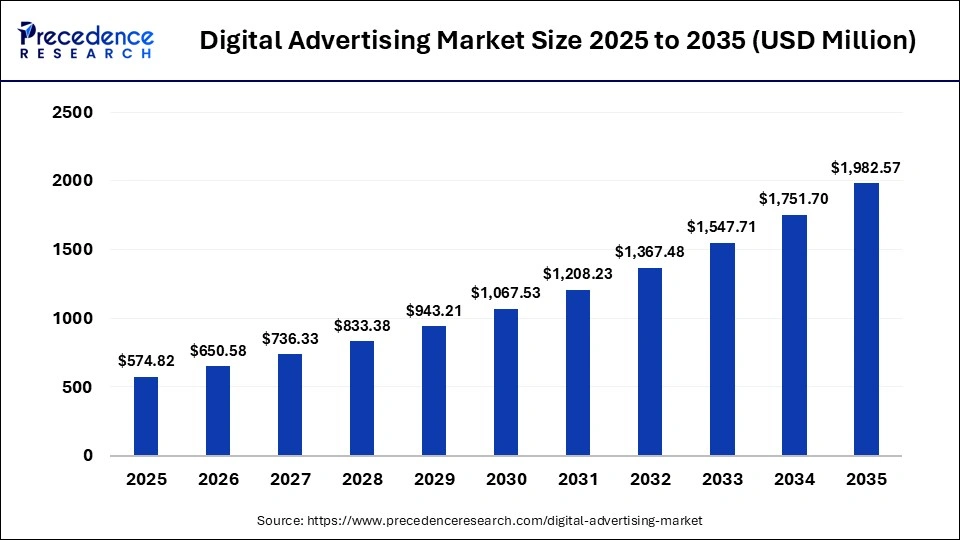
The global digital advertising market size was valued at USD 574.82 million in 2025 and is projected to grow from USD 650.58 million in 2026 to approximately USD 1,982.57 million by 2035, registering a CAGR of 13.18% during the forecast period from 2026 to 2035.The market is experiencing significant growth due to the rising adoption of smartphone-based advertising and increasing investments by manufacturing companies in digital marketing campaigns. Additionally, the expanding use of social media advertising by ed-tech companies to enhance customer engagement, coupled with the growing implementation of digital advertising solutions across the entertainment industry, is further driving market expansion.
Get a Free Sample Report with Key Market Trends: https://www.precedenceresearch.com/sample/7381
Leading Public Companies Shaping the Digital Advertising Ecosystem
Major publicly traded companies are driving innovation across digital advertising infrastructure to capture high-margin revenue streams, leverage artificial intelligence, and even adapt to privacy changes. Key drivers involve maximizing shareholder returns, scaling programmatic automation, and also monetizing first-party data ecosystems. Publicly traded platforms such as The Trade Desk maintain high gross margins by automating ad transactions at a massive scale. Machine learning models improve real-time bidding, automated copywriting, and personalized video generation instantly.
Organizations collectively support modern marketing via privacy-safe infrastructure, automated workflows, and shared data networks while simultaneously competing on algorithmic sophistication along with proprietary asset ownership. This dual reality of collaboration and rivalry operates across core operational pillars. Media buying functions through interconnected Demand-Side Platforms (DSPs) and Supply-Side Platforms (SSPs) that execute real-time auctions and even leverage offsite commerce data for precise reach. Unified intelligence dashboards ingest continuous multi-touch attribution along with log-level data to evaluate performance, replacing lagged human reporting with autonomous optimization.
Alphabet Inc. (Google)
Google supports global marketers by integrating enterprise media tools, AI-based automation, and deep data infrastructure across its ecosystem. This leadership unifies cross-channel execution, bidding optimization, along with precision measurement. Google integrates Google AI models to dynamically optimize bids, customize creatives, and even surface near-real-time trend insights. Links first-party signals through Google Analytics and BigQuery to improve attribution accuracy and conversion lift.
Meta Platforms
Meta's advertising ecosystem is a unified, AI-based platform that connects businesses with billions of users across Instagram, Facebook, WhatsApp, and Threads, utilizing automated tools like Advantage+, real-time creative optimization, and even advanced measurement. An end-to-end automation suite, which includes Shopping and Leads, that replaces manual audience filtering with AI-driven discovery. Real-time changing of funds to high-probability conversion pathways rather than static ad sets.
Amazon
Amazon Ads is an omnichannel retail media powerhouse allowing brands to target audiences, automate campaigns, and measure outcomes utilizing first-party shopping insights. Key components include sponsored advertising, retail media leadership, and the Amazon DSP. Secure clean rooms such as Amazon Marketing Cloud (AMC) and self-service third-party studies enable closed-loop reporting, which connects top-of-funnel ad exposure to real-world sales.
Microsoft
Microsoft Advertising is an end-to-end digital marketing platform which leverages the Bing advertising platform search ecosystem, exclusive LinkedIn Ads profile integration, along with Copilot-powered advertising tools to deliver AI-driven enterprise marketing and even deep measurement solutions.
The Trade Desk
The Trade Desk is a leading independent demand-side platform offering omnichannel media buying, connected TV leadership, and even privacy-safe identity solutions. It empowers enterprise advertising via transparent, AI-driven campaign optimization.
Criteo
Criteo's commerce media platform is a unified advertising tool that utilizes first-party data and AI to run retail and omnichannel campaigns. It assists brands and retailers in targeting shoppers, showing product suggestions, and tracking sales.
DoubleVerify Holdings
DoubleVerify offers software tools that ensure digital ads are real, safe, and even effective, focusing on verification, fraud detection, and performance analytics. It evaluates viewability, geo-compliance, and even technical quality to confirm that an ad had the opportunity to be seen by a real human.
Integral Ad Science (IAS)
Integral Ad Science offers digital ad verification, viewability metrics, and AI-driven campaign optimization. Its core features include media quality measurement, ad verification, contextual targeting, fraud prevention, viewability tracking, brand suitability, and AI automation.
PubMatic
PubMatic functions as an advanced, independent sell-side and even omnichannel advertising infrastructure. It connects publishers, app developers, along with streamers directly with global agencies and demand-side platforms through real-time auctions and private marketplaces.
Magnite
Magnite operates the world's largest independent sell-side advertising platform, offering modular software that assists content creators and media owners in monetizing audio, display, and video across all screens. It optimizes digital advertising via connected TV (CTV) infrastructure, unified programmatic ad decisioning, and even major streaming partnerships.
LiveRamp
LiveRamp offers a privacy-first data collaboration and identity resolution platform centered around its durable person-based identifier, RampID. It allows brands, publishers, and platforms to connect first-party data, run secure data clean rooms, and also execute omnichannel activation and measurement without exposing underlying raw user identities.
Adobe Inc.
Adobe Experience Cloud is an enterprise suite combining data analytics, content management, along with campaign tools. Major features include Adobe Journey Optimizer for real-time orchestration, Adobe GenStudio for AI asset creation, and even Adobe Analytics for digital intelligence.
Salesforce
Salesforce Marketing Cloud is an omnichannel digital marketing platform that assists brands in orchestrating journeys, managing data, along with engage customers. It integrates deeply with Salesforce Data Cloud and even the core CRM to drive automated, hyper-personalized, and AI-managed campaigns.
HubSpot
HubSpot is an all-in-one growth platform built on the inbound methodology of attracting, engaging, along with delighting customers. It combines an intuitive Smart CRM, robust marketing automation, and even AI-driven tools tailored for small-to-medium businesses.
Oracle Corporation
Oracle's data-driven ecosystem revolves around the Oracle Unity Customer Data Platform (CDP), customer intelligence, and even enterprise marketing cloud capabilities designed to unify disparate data along with personalize customer journeys across channels.
Companies Leading Creative Platforms and Content Automation
Platforms such as Adobe GenStudio, Smartly.io, and even AdCreative.ai streamline creative production by unifying AI-assisted design, generative asset creation, along with workflow automation into a single pipeline. These tools reduce production timelines from weeks to minutes, scale hyper-personalization, and even optimize real-time campaign performance.
Adobe's AI-Powered Creative Ecosystem
Adobe integrates creative software with enterprise artificial intelligence via Adobe Firefly and Adobe GenStudio. These platforms automate content workflows, handle brand assets, and scale AI-generated advertising. Adobe GenStudio connects asset creation, campaign planning, and performance insights into a single platform.
Canva's Public Market Influence
Canva is a privately held firm and has not been publicly traded. Addressing its market role had it been public highlights key functions like collaborative tools, democratizing design, and AI-powered workflows that drive its multi-billion-dollar valuation.
AI Creative Automation Across Enterprise Marketing
Generative AI allows rapid advertising production by automating ideation, scaling hyper-personalized messaging, generating synthetic video, translating regional contexts, and running continuous multivariate performance tests. Platforms such as Creatify and StackAdapt collapse traditional multi-week studio timelines into minutes.
Companies Driving Programmatic Advertising and Media Buying
Leading demand-side and supply-side technology providers automate modern digital advertising utilizing artificial intelligence to manage media buying, real-time bidding, and cross-channel optimization. Key industry leaders include The Trade Desk, Google Marketing Platform (DV360), along with Magnite. These platforms streamline fragmented ecosystems through unified machine learning architecture.
Enterprise suite offering deep integration with Google’s data ecosystem, automated budget allocation, along with real-time optimization across YouTube and external exchanges. Cloud-scale infrastructure provider aiming at supply path optimization (SPO), header bidding technology, and transparent publisher analytics.
Demand-Side Platform (DSP) Leaders
Major demand-side platforms such as The Trade Desk, Google DV360, and Amazon DSP differ fundamentally across AI, reach, and inventory. Moreover, the Trade Desk leads the open internet with independent omnichannel reach along with Unified ID 2.0; Google DV360 dominates through native access to YouTube and Google ecosystem data; and Amazon DSP wins with exclusive bottom-funnel retail purchase data.
Supply-Side Platform (SSP) Leaders
Platforms such as PubMatic and Magnite operate as major sell-side platforms (SSPs) that maximize digital ad revenue across connected TV (CTV), digital publishers, streaming, and retail media through automated programmatic marketplaces. They utilize unified auctions, header bidding wrappers, and even real-time yield optimization to boost web and in-app revenue.
Retail Media Network Expansion
Retail media networks operated by giants such as Amazon, Walmart, Kroger, Target, and Instacart are revolutionizing digital advertising. By leveraging deterministic first-party commerce data along with AI-powered automation, these platforms deliver full-funnel targeting, automated bidding, and also verified closed-loop attribution right at the point of purchase. Networks extend their reach to connected TV (CTV) and social platforms via partnerships, like Walmart via The Trade Desk and Vizio, or Instacart via TikTok, enabling brands to target specific buyer audiences outside the retailer's native app.
Companies Transforming Advertising Measurement and Analytics
The rising focus on advanced ad analytics is propelled by privacy changes, fragmented digital channels, and pressure from corporate finance to prove real financial returns. Traditional tracking has broken down, thus forcing brands to adopt a multi-layered measurement toolkit. Consumers split time across streaming TV, retail networks, social media, and offline spaces, complicating tracking. Advertisers now prioritize trusted measurement, privacy-compliant attribution, along with omnichannel performance by shifting away from outdated user-level tracking toward integrated methods such as modernized Marketing Mix Modeling (MMM), privacy-safe data clean rooms, and even continuous incrementality testing.
Blending platform-specific signals with cross-channel metrics to evaluate full-funnel impact across online and even offline touchpoints. Transitioning from individual cookies and device IDs to aggregated, anonymized data models as well as secure collaboration environments.
DoubleVerify and Media Quality Measurement
Digital advertising quality depends upon an interconnected ecosystem of systems and protocols: verification technologies act as the underlying software layer, fraud prevention filters out non-human traffic, and viewability analysis measures pixel exposure, brand safety solutions restrict unsuitable placements, and even attention metrics quantify genuine user engagement. Algorithms determine network behaviors, device fingerprints, and traffic patterns to detect and block invalid traffic (IVT) like botnets, ad stacking, and pixel stuffing.
Integral Ad Science and Campaign Verification
Modern digital advertising depends on an integrated framework of campaign verification, contextual intelligence, and even media quality analytics to ensure brand safety, eliminate fraud, and maximize return on investment via AI-driven optimization. Scores content adjacency against specific brand values, ensuring placements work with an organization's unique risk tolerances rather than rigid exclusions. Unifies verification metrics, viewability data, and cost insights into centralized dashboards, like platforms offered by Integral Ad Science or DoubleVerify, to prove true campaign effectiveness.
LiveRamp and Identity-Based Measurement
Modern marketing depends on an integrated framework of identity resolution, privacy-first attribution, clean room collaboration, first-party data activation, and even omnichannel measurement capabilities. These tools work together by connecting fragmented user signals into a single profile, securing data partnerships, along with tracking results across platforms without breaking user privacy. It offers a safe, locked digital space where two firms can match and study shared customer data without exposing raw files.
Adobe Analytics and Enterprise Marketing Intelligence
Using customer journey analytics, cross-channel performance analysis, marketing attribution, AI-powered insights, and enterprise reporting together is necessary because they transform fragmented data into a unified and actionable growth engine. They replace guesswork with a complete view of buyer behavior, accurate budget distribution, and even clear executive oversight. Moreover, it assigns precise financial credit to the exact ads, emails, or content pieces that motivate a purchase.
Competitive Landscape of the Digital Advertising Technology Industry
Comparing leading advertising technology firms helps marketers, investors, and publishers navigate complex ecosystems across Google Marketing Platform, The Trade Desk, and Amazon Advertising. Key drivers include AI-based automation, first-party data liquidity, and cross-channel programmatic reach. Algorithms manage real-time bidding, predictive budgeting, and dynamic creative optimization (DCO) backed by massive cloud frameworks such as GCP, AWS, and Azure.
Comparison Based on AI Innovation
Investments in generative AI, campaign automation, intelligent optimization, predictive analytics, AI-powered creative production, and autonomous marketing platforms drive massive efficiency gains, lower customer acquisition costs, along with lift marketing ROI. These tools shift marketing from manual, reactive tasks to high-speed, automated execution. It automates copywriting, image generation, as well as video versioning, slashing asset creation time and allowing real-time content localization.
Comparison Based on Advertising Platform Integration
Companies build unified marketing ecosystems by establishing a Customer Data Platform (CDP) as the central brain, connecting data pipelines via APIs, and even synchronizing workflows across tools. This integration connects customer data, analytics, media buying, creative assets, along with marketing automation into a single feedback loop. Links design and creative management tools with performance data so teams can swap out low-performing ad variations automatically based on real-time feedback.
Comparison Based on Enterprise Customer Adoption
Digital marketing and AI adoption vary broadly across the ecosystem: global organizations deploy proprietary AI studios, retailers monetize first-party data, agencies leverage programmatic suites, and SMBs rely on low-cost self-serve tools.
Growth Strategies Adopted by Industry Leaders (2026-2027)
Leading public firms strengthen market leadership by executing compounding expansion strategies across multiple digital and operational vectors: acquisitions to absorb emerging technologies and talent, AI and cloud investments to lock in high-margin enterprise switching costs, and retail media collaborations to monetize first-party consumer data. Scale infrastructure, storage, and hybrid computing capacity to raise enterprise dependency and raise customer switching barriers, and even cultivate unified toolkits and application programming interfaces (APIs) to anchor third-party builders into proprietary technical stacks.
Artificial Intelligence Driving Marketing Automation
Investments in artificial intelligence are shifting marketing from manual tasks to unified, data-driven ecosystems. Key investment areas involve generative content tools, predictive media models, and autonomous agent workflows that improve performance in real time. AI evaluates historical data, market signals, and even consumer behavior patterns to forecast campaign performance and budget allocation before launch. Agentic AI automates multi-step customer journeys, cross-channel orchestration, along with routine operational adjustments with minimal human intervention.
Strategic Acquisitions Expanding Platform Capabilities
Acquisitions strengthen marketing capabilities by thus, securing durable first-party data, integrating automated workflows, and even unifying closed-loop attribution. Companies consolidate around measurement and determine to combat signal loss, scale commerce media, and also deploy predictive AI. Buying transaction-connected networks links offsite media directly to real-time in-store or online sales.
Global Expansion Through Cloud and Enterprise Partnerships
Collaborating with cloud providers, retailers, agencies, publishers, enterprise software companies, and technology partners is important to expand advertising capabilities by unlocking proprietary first-party data, allowing secure, privacy-compliant data clean rooms, scaling omnichannel reach, and even streamlining campaign measurement. Partnering with retailers and publishers bridges the gap left by fading third-party cookies by connecting high-intent browsing and shopping signals directly to ad campaigns.
Industry Applications Driving Digital Advertising Growth
Organizations leverage digital advertising technologies, like programmatic buying, artificial intelligence, customer data platforms, and real-time analytics, to target audiences, personalize user journeys, and even maximize investment returns. These tools enable precise customer acquisition, automated engagement, along with data-driven optimization at scale. It uses machine learning on existing customer data to find and target new prospects who share similar behavioral traits and high lifetime value.
Retail and E-Commerce
Personalized commerce connects advertising, product recommendations, retail media, customer acquisition, and omnichannel shopping by utilizing unified first-party data and artificial intelligence to deliver relevant, real-time experiences across both digital and physical touchpoints. AI determines past purchases, browsing habits, and real-time context to suggest matching items on websites, apps, and in-store kiosks. Moreover, it connects data across channels and assists brands in targeting high-value prospects efficiently, lowering overall acquisition costs.
Financial Services and Banking
Modern digital marketing connects digital customer acquisition, AI-based personalization, fraud-aware advertising, compliance-focused marketing, and even customer lifecycle management into a single loop. Brands utilize data and smart rules to find new buyers, keep them happy, and then follow the law while stopping ad waste.
Healthcare and Life Sciences
Modern digital initiatives blend patient engagement, tailored pharma outreach, along with strict data protection. Companies utilize smart data tools, clear educational content, and even safe online channels to reach people without breaking privacy laws. They share clear tips on disease prevention, wellness, along with healthy habits instead of pushing specific products.
Media, Entertainment, and Streaming
Connected TV (CTV) advertising, digital subscriptions, streaming monetization, audience engagement, and cross-platform content promotion merge precision digital marketing with big-screen living room viewing. This change changes how brands reach consumers and how media networks generate revenue. Modern campaigns feature QR codes, pause ads, and also shoppable overlays that connect the TV screen directly to mobile actions.
Challenges Reshaping the Digital Advertising Ecosystem
The digital advertising and technology sectors face severe pressures from tightening privacy mandates (GDPR, CCPA), fragmented user signals across devices, along with rising AI-driven fraud. Companies navigate these hurdles by investing heavily in artificial intelligence governance, deterministic identity graphs, data clean rooms, and durable media mix modeling. Safari and even Firefox block third-party cookies, while browsers and privacy frameworks alter legacy behavioral tracking signals. Moreover, cross-platform attribution is harder than ever, and saturated digital markets make brand differentiation tough.
Privacy Regulations and Identity Transformation
First-party data strategies, identity resolution, along with privacy-enhancing technologies form a connected framework for secure consumer data use. Together with data clean rooms, consent management platforms, and even strict regulatory compliance, they enable brands to personalize marketing while protecting user privacy. They employ advanced cryptographic methods such as homomorphic encryption and trusted execution environments, along with federated learning to process data without exposing raw values.
Building Trusted Measurement Across Channels
Measuring cross-channel campaign performance consistently while protecting user privacy is hindered by signal loss from cookie deprecation, walled-garden data silos, and incompatible metrics across search, social, streaming, mobile, retail media, and Connected TV (CTV). Platforms such as social networks, search engines, and major retail media networks operate independent tracking systems that restrict raw data access and also inflate their own performance credit.
Future Outlook for the Digital Advertising Ecosystem (2026-2027)
Digital advertising is changing from manual media buying to an autonomous, intelligence-driven ecosystem. This change is defined by AI-native platforms, commerce data integration, and strict privacy standards. Platforms utilize machine learning as their base operating system rather than an add-on layer, budget pacing, managing bidding, and placement automatically. Generative tools build and resize hundreds of dynamic ad variations simultaneously, thus matching visual and text elements to live user context.
AI Will Become the Core of Advertising Operations
Artificial intelligence transforms digital advertising workflows by changing operations from manual, siloed tasks to fast, integrated, and adaptive systems. Generative AI, intelligent optimization, predictive modeling, autonomous execution, and AI-powered creative production work together to maximize performance, compress launch timelines, and manage micro-decisions and multi-step campaign deployment across platforms, enabling marketing systems to act as adaptive agents rather than static rules. Conversational AI and agentic workflows are transforming advertising platforms by automating campaign creation, allowing autonomous multi-step execution, and personalizing user interactions at scale. Key developments involve autonomous ad agents, generative creative optimization, and even conversational commerce integration.
Measurement and Identity Will Define Competitive Leadership
Companies that combine trusted identity resolution, real-time attribution, privacy-first data collaboration, advanced measurement, and AI-driven analytics gain sustainable competitive advantages by eliminating signal loss, maximizing media efficiency, along with scaling hyper-personalization safely. This powerful integration allows a closed-loop ecosystem where accurate user identification feeds clean rooms, fueling precise attribution and even proactive AI optimization. It operates cleanly in a cookieless environment via consented first-party graphs and decentralized IDs.
About the Authors

Aditi Shivarkar
Aditi, Vice President at Precedence Research, brings over 15 years of expertise at the intersection of technology, innovation, and strategic market intelligence. A visionary leader, she excels in transforming complex data into actionable insights that empower businesses to thrive in dynamic markets. Her leadership combines analytical precision with forward-thinking strategy, driving measurable growth, competitive advantage, and lasting impact across industries.



Aman Singh
Aman Singh with over 13 years of progressive expertise at the intersection of technology, innovation, and strategic market intelligence, Aman Singh stands as a leading authority in global research and consulting. Renowned for his ability to decode complex technological transformations, he provides forward-looking insights that drive strategic decision-making. At Precedence Research, Aman leads a global team of analysts, fostering a culture of research excellence, analytical precision, and visionary thinking.

Piyush Pawar
Piyush Pawar brings over a decade of experience as Senior Manager, Sales & Business Growth, acting as the essential liaison between clients and our research authors. He translates sophisticated insights into practical strategies, ensuring client objectives are met with precision. Piyush’s expertise in market dynamics, relationship management, and strategic execution enables organizations to leverage intelligence effectively, achieving operational excellence, innovation, and sustained growth.