






 Request Consultation
Laser technologies are transforming modern manufacturing by enabling high-precision cutting, marking, and micromachining across industries like aerospace, electronics, and medical devices. With reduced material waste, improved energy efficiency, and minimal environmental impact, laser systems support sustainable and smart production. Integration with AI and robotics enhances automation, process optimization, and quality control, positioning laser technology as a cornerstone of next-generation industrial operations.
Laser technology has steadily evolved into one of the most transformative tools, driving progress in modern industry, scientific research, and medicine. From enabling high precision manufacturing to supporting contactless and ultrafast data transmission, lasers now power a wide range of advanced processes that were once considered impossible.
The scientific foundation of this technology dates to the work of Albert Einstein, whose theory of stimulated emission laid the groundwork for laser development. Building on this principle, the first functioning laser was demonstrated in 1960 by Theodore Maiman using a ruby crystal. Since then, continuous technological progress has led to the development of multiple laser systems designed for industrial, medical, and scientific applications.
Today, lasers are used in an extraordinary range of fields. In advanced manufacturing, laser micromachining enables extremely precise shaping and processing of metals and other materials required in sectors such as electronics, aerospace, and medical device production. In scientific research, lasers play an equally critical role. Quantum computing research uses lasers to manipulate quantum states in a highly targeted manner, while plasma physics relies on high power laser systems to explore the possibility of controlled nuclear fusion.
Optical tweezers, another remarkable innovation, use laser light to move and examine microscopic particles, cells, and even DNA structures without physical contact. Beyond enabling precision and scientific discovery, laser systems are also transforming production efficiency. Their unmatched accuracy in cutting, marking, and quality control allows manufacturers to minimize material loss and improve process reliability, an advantage that is increasingly important as industries search for more sustainable and resource efficient production methods.
What is the Laser Technologies in Manufacturing Market Size in 2026?
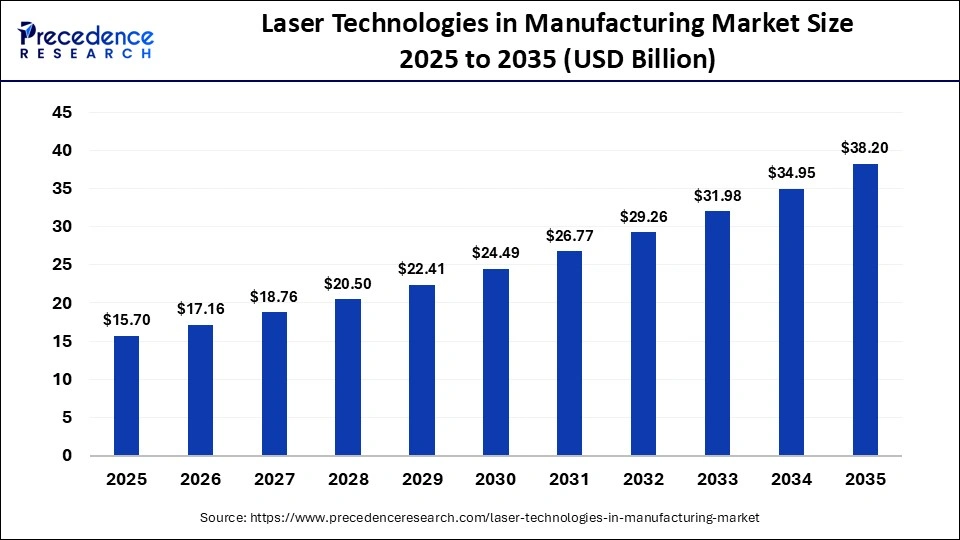
The global laser technologies in manufacturing market size was calculated at USD 15.70 billion in 2025 and is predicted to increase from USD 17.16 billion in 2026 to approximately USD 38.20 billion by 2035, expanding at a CAGR of 9.30% from 2026 to 2035
Key Insights
- Asia Pacific dominates the laser technology in the manufacturing industry and is projected to remain the fastest‑growing region, with China and Japan leading the sector.
- Laser innovation is expanding into micromachining, quantum computing, plasma physics, and optical tweezer research.
- Industrial manufacturing faces major challenges from pollutant emissions and inefficient material utilization.
- Laser processing enables cleaner production by reducing waste through high precision cutting and marking.
- Next generation laser systems are accelerating smarter, more efficient, and more sustainable manufacturing worldwide.
Understanding Waste Challenges in Modern Production Environments
Traditional methods such as milling, drilling, grinding, and polishing, though long relied on in manufacturing, generate significant byproducts that affect both the production environment and worker health. These byproducts typically include metal chips, fine dust particles, coolant liquids, oil mist, polishing residues, and chemical vapors, many of which accumulate during routine machining operations.
In automotive and industrial machinery manufacturing, where heavy metal components are frequently cut, drilled, and shaped, one of the most common wastes is metal chips and machining swarf. These fragments are produced when cutting tools physically remove material from metal surfaces. Over time, large volumes of these chips accumulate on the production floor and require continuous removal.
Alongside these solid wastes, machining operations often depend on coolant fluids and lubricating oils to control friction and heat. When exposed to high temperatures, these fluids can generate oil mist and vapors, which may circulate within the workspace.
In electronics and semiconductor manufacturing, the challenges are slightly different. Producing microscale circuits and delicate electronic components often involves chemical etching processes and fine polishing steps. These methods can generate chemical residues, microparticles, and vapor emissions, which are particularly problematic in environments where even tiny contaminants can interfere with sensitive electronic structures.
Similarly, medical device manufacturing, which produces surgical instruments, implants, and precision components, requires extremely controlled production environments. However, traditional machining of metal parts can release fine metallic dust, polishing particles, and microscopic debris. These particles can complicate contamination control in facilities that aim to maintain highly clean manufacturing conditions.
In industries such as defense and aerospace manufacturing, the machining of large and complex components often produces significant amounts of scrap metal, grinding dust, and tool wear debris. Grinding and finishing processes used to refine these components can also release airborne particulate matter, which may remain suspended in the surrounding environment.
Even in more specialized sectors such as diamond and jewelry processing, conventional grinding and polishing techniques generate diamond dust, abrasive particles, and slurry residues. These byproducts not only represent material loss but also contribute to airborne dust within workshops.
Sustainability Advantages of Laser-Based Manufacturing
Laser-based manufacturing is gaining traction as industries seek cleaner, resource-efficient processes. Studies suggest laser systems can reduce material waste and energy consumption by up to 90%, depending on the application. This technology is versatile, applicable in producing microscale electronic components, industrial laser heads, automotive panels, and packaging materials, prompting an analysis of its environmental impact across various sectors.
- Industrial marking and product identification clearly show the benefits of laser-based manufacturing. Traditional marking uses ink, solvents, and cleaners that create chemical waste and require special disposal. Laser marking eliminates these consumables by engraving directly with focused light, producing no VOC emissions and no hazardous waste during operation.
- Laser systems are reshaping packaging design and material efficiency. Their high positional accuracy allows tighter tolerances while preserving durability, enabling manufacturers to use less raw material without compromising performance and significantly reducing packaging waste in large-scale production.
- Energy performance is a key advantage of laser-based manufacturing. Modern laser cutters can convert over 90% of electrical energy into a usable laser beam, often outperforming traditional mechanical or plasma methods. This high efficiency reduces overall energy consumption during continuous, large-scale production.
- Material utilization improves with the precision of laser processing. Laser cutting can create complex geometries and fine details with minimal spacing between cuts, allowing optimized sheet layouts that use more of the raw material and significantly reduce scrap and corner waste.
- Environmental benefits also appear in reduced airborne emissions and particles. Compared with many traditional cutting methods, laser cutting generates less gas and dust. Modern systems often include exhaust and filtration units to capture remaining emissions, helping manufacturers meet environmental regulations and maintain cleaner production environments.
- Laser cutting also improves the acoustic environment in manufacturing facilities. By using focused energy instead of mechanical friction or impact, it generates significantly less noise than conventional cutting systems, enhancing operator comfort and overall noise control.
Taken together, these capabilities illustrate how laser-based manufacturing technologies are increasingly being integrated into industrial workflows as part of broader efforts to improve material efficiency, energy performance, and environmental management within modern production systems.
Global Landscape of Laser Manufacturing
Across the global manufacturing landscape, laser technology is rapidly evolving through continuous innovation, strategic investment, and expanding industrial applications. A recent example is the Tescan Group’s acquisition of FemtoInnovations, a leading innovator in ultrafast laser technology, along with the creation of a dedicated laser technology business unit headquartered at the University of Connecticut Tech Park.
At the same time, advancements in materials and processes are expanding the scope of laser-enabled manufacturing. In 3D printing, material and process innovations such as polyamide 12 bioplastics and micro-level sintering are improving component strength while significantly reducing the weight of 3D-printed parts. Supporting this progress, modern fiber lasers are becoming increasingly efficient, achieving conversion rates of up to 45% and lowering operating costs compared with older COâ‚‚ models.
Laser technology is also moving beyond conventional industrial use into more experimental scientific applications. For example, a research project conducted under the supervision of the UAE Research Program for Rain Enhancement Science has achieved a scientific breakthrough, confirming the feasibility of laser-induced water vapor condensation. The project is now preparing for field trials in collaboration with international partners.
At a broader market level, the Asia-Pacific region dominated the laser technologies market in 2025, generating the highest revenue, and is expected to remain the fastest-growing region during the forecast period. This growth is largely supported by the shift toward energy efficient fiber and solid state lasers, rapid advances in laser technology, increasing industrial automation, and rising investment in research and development. Countries such as Japan, China, South Korea, and India are heavily investing in laser research to develop new materials, advanced laser systems, and innovative applications.
Key players such as Han's Laser Technology Industry Group, AMADA Co., Ltd., EO Technics Co., Ltd., and Sahajanand Laser Technology Ltd. are strengthening their R&D capabilities and infrastructure in their respective countries. Beyond heavy industry, lasers are also transforming more specialized sectors. One of the significantly growing applications is the use of laser systems in jewelry manufacturing as an alternative to traditional methods of welding, engraving, and cutting metals. By enabling greater precision and control, laser technology is transforming jewelry artistry and craftsmanship, and Laser Tech USA has been working closely with the jewelry industry to support this transformation.
Expert Advise
Our experts at Precedence Research suggest that as industries pursue efficiency, automation, and sustainability, laser technology is emerging as a central pillar of the next-generation manufacturing system. Manufacturers increasingly adapt to Industry 4.0 standards and prefer smart factory solutions to enhance productivity and reduce downtime. They must focus on strategic integration rather than standalone installation by combining with AI tools and robotics. They must also continue to invest in skilled workforce training, system calibration, and preventive maintenance programs. Thus, the shifting trend toward a cleaner and smarter manufacturing potentiate the demand and use of laser technologies.
About the Authors

Aditi Shivarkar
Aditi, Vice President at Precedence Research, brings over 15 years of expertise at the intersection of technology, innovation, and strategic market intelligence. A visionary leader, she excels in transforming complex data into actionable insights that empower businesses to thrive in dynamic markets. Her leadership combines analytical precision with forward-thinking strategy, driving measurable growth, competitive advantage, and lasting impact across industries.



Aman Singh
Aman Singh with over 13 years of progressive expertise at the intersection of technology, innovation, and strategic market intelligence, Aman Singh stands as a leading authority in global research and consulting. Renowned for his ability to decode complex technological transformations, he provides forward-looking insights that drive strategic decision-making. At Precedence Research, Aman leads a global team of analysts, fostering a culture of research excellence, analytical precision, and visionary thinking.

Piyush Pawar
Piyush Pawar brings over a decade of experience as Senior Manager, Sales & Business Growth, acting as the essential liaison between clients and our research authors. He translates sophisticated insights into practical strategies, ensuring client objectives are met with precision. Piyush’s expertise in market dynamics, relationship management, and strategic execution enables organizations to leverage intelligence effectively, achieving operational excellence, innovation, and sustained growth.