



Laser Technologies in Manufacturing Market Trends, Companies, Revenue / Sales Performance, Manufacturing Yield, Fab Capacity, Export & Import Dynamics, Supply Chain Analysis, Competitive Landscape, and Growth Forecast
Laser Technologies in Manufacturing Market (By Laser Type: Fiber Lasers, COâ‚‚ Lasers, Solid-State Lasers, Diode Lasers, Ultrafast Lasers; By Application: Laser Cutting, Laser Welding, Laser Marking and Engraving, Laser Drilling, Laser Surface Treatment; By End-Use Industry: Automotive, Aerospace and Defense, Electronics and Semiconductors, Industrial Machinery, Medical Device Manufacturing, Others; By System Type: Laser Processing Systems, Laser Machines, Laser Components) - Global Industry Analysis, Size, Trends, Leading Companies, Regional Outlook, and Forecast 2026 to 2035
Source: https://www.precedenceresearch.com/laser-technologies-in-manufacturing-market
 Get a Sample
 Table Of Content


What is the Laser Technologies in Manufacturing Market Size in 2026?
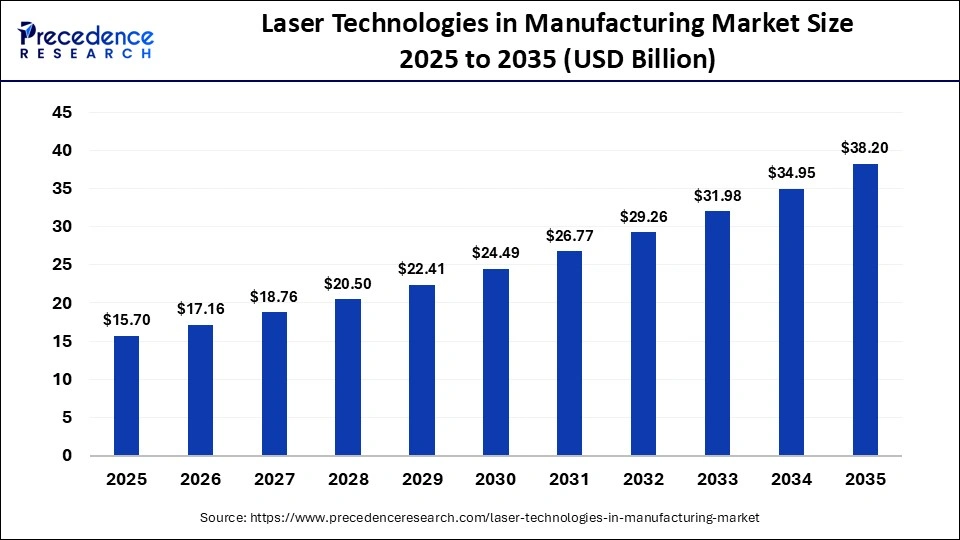
The global laser technologies in manufacturing market size accounted for USD 15.70 billion in 2025 and is predicted to increase from USD 17.16 billion in 2026 to approximately USD 38.20 billion by 2035, expanding at a CAGR of 9.30% from 2026 to 2035. Rapid advancements in laser technology and growing industrial automation are driving growth in the market.
Key Takeaways
- Asia Pacific led the laser technologies in manufacturing market in 2025 and is expected to be the fastest-growing region in the forecasted period.
- By laser type, the fiber lasers segment dominated the market in 2025.
- By laser type, the ultrafast lasers segment is expected to be the fastest-growing segment in the foreseen period.
- By application, the laser cutting segment led the global market in 2025.
- By application, the laser welding segment is expected to be the fastest-growing segment in the forecast period.
- By end-use industry, the automotive segment dominated the global market in 2025.
- By end-use industry, the electronics and semiconductors segment is expected to be the fastest growing in the foreseeable period.
- By system type, the laser processing systems segment led the market in 2025.
- By system type, the laser machines segment is expected to be the fastest-growing in the coming years.
Laser Technologies in Manufacturing Market Overview
The laser is a device that generates a distinct type of light. Lasers are utilized for cutting, marking, welding, and various other high-precision tasks in the manufacturing field. The market growth is being propelled by the transition towards energy-efficient fiber and solid-state lasers, swift advancements in laser technology, increasing industrial automation, and heightened investments in research and development.
However, the use of lasers poses considerable health hazards, particularly to the eyes and skin. Despite these dangers, the advantages of lasers continue to foster market growth. Ongoing innovation, coupled with adequate safety training, is anticipated to mitigate these risks and further promote the use of laser technologies.
Impact of Artificial Intelligence on the Laser Technologies in Manufacturing Market
The rising use of artificial intelligence (AI) is unlocking new possibilities in laser-enabled manufacturing. AI is increasingly being utilized to gain a deeper understanding of the intricate physics that dictate how lasers cut, weld, or drill materials. Machine learning plays a crucial role in enabling systems to learn and execute tasks by recognizing patterns within data. Algorithms such as Support Vector Machines (SVMs), k-Nearest Neighbors (KNN), decision trees, random forests, and neural networks are trained on continuous datasets to forecast specific results. Furthermore, neural networks, celebrated for their capacity to model complex nonlinear relationships, have demonstrated significant potential in laser applications. This data-driven methodology improves precision and efficiency, aiding in the resolution of the constraints posed by conventional theoretical models in laser technologies in manufacturing.
Laser Technologies in Manufacturing Market Trends
- Environmental Sustainability: Sustainability trends in manufacturing are encouraging wider use of eco-friendly laser solutions as industries increasingly move away from conventional mechanical processing methods.
- Superior Advantages over Conventional Methods: Laser technology continues to gain prominence in manufacturing, enabling highly precise results, intricate micro-level detailing, and cleaner processing with minimal debris generation. Laser technology is increasingly enabling accurate fabrication and patterning of nanoscale devices in advanced manufacturing.
- High Versatility: Laser technologies can be used on different materials, including glass, plastics, ceramics, and metals, as they have adjustable wavelengths. This helps reduce manufacturing costs as laser tools can use similar machines for a variety of purposes.
Market Scope
| Report Coverage | Details |
| Market Size in 2025 | USD 15.70 Billion |
| Market Size in 2026 | USD 17.16 Billion |
| Market Size by 2035 | USD 38.20 Billion |
| Market Growth Rate from 2026 to 2035 | CAGR of 9.30% |
| Dominating Region | Asia Pacific |
| Base Year | 2025 |
| Forecast Period | 2026 to 2035 |
| Segments Covered | Laser Type, Application, End-Use Industry, System Type, and Region |
| Regions Covered | North America, Europe, Asia-Pacific, Latin America, and Middle East & Africa |
Segmental Insights
Laser Type Insights
How the Fiber Lasers Segment Dominated the Laser Technologies in Manufacturing Market?
The fiber lasers segment held a dominant market share in 2025, as these lasers are favored by numerous industries for their precision, efficiency, and adaptability. Over the last two decades, high-power fiber lasers have become essential instruments in the automotive manufacturing sector. They are utilized across a variety of applications, ranging from cutting to cleaning, owing to their outstanding performance and cost-effectiveness.
Additionally, two significant technologies have surfaced to address the changing demands of the industry, i.e., single-mode, dual-beam fiber lasers, while the second comprises real-time, in-process laser weld measurement and verification tools, both of which are facilitating further market growth.
The ultrafast lasers segment is expected to show the fastest growth over the forecast period, as they enable superior operational performance in micro- and nano-fabrication of materials, supported by their ease of use, robustness, and reliability. They have opened entirely new and exciting opportunities across a wide range of scientific and industrial fields, including high-energy physics, materials science, medical diagnostics, surgery, manufacturing, and more.
Besides, the use of ultrafast lasers in additive manufacturing offers significant potential for next-generation production techniques for hard-to-process materials, transparent materials, and micro- and nano-scale manufacturing, further expanding the future adoption of ultrafast laser technologies.
Application Insights
Why Did the Laser Cutting Segment Dominate the Laser Technologies in Manufacturing Market?
The laser cutting segment held the largest market share in 2025, driven by its precision and versatility, which have transformed various industries. Laser cutting is a process that removes material by heating and cutting along a defined trajectory. It uses a high-power laser directed through optics and controlled by computer numerical control (CNC) systems to guide the beam or the material. From creating intricate jewelry to manufacturing critical components in the aerospace and automotive sectors, this technology plays a crucial role in driving market adoption of laser cutting.
The laser welding segment is expected to gain the highest market share between 2026 and 2035, driven by its high precision across many industries. It is suitable for materials and components that need to be welded at high speed with a narrow weld seam and minimal thermal distortion. Laser welding is a fusion process that joins metals or thermoplastics using a focused laser beam.
It is widely used in industries such as aerospace, medical equipment, and fine jewelry, and reduces damage or contamination by eliminating physical contact between the tool and materials. It is particularly valuable in industries where delicate components and strict cleanliness standards are required, such as medical device manufacturing, thereby supporting market expansion in the high-precision industries.
End-Use Industry Insights
What Made the Automotive Segment Dominate the Laser Technologies in Manufacturing Market?
The automotive segment contributed the biggest market share in 2025, driven by the need for high precision, efficiency, and the ability to manufacture both complex and delicate components. Laser technologies enable precision cutting of body panels to enhance both aesthetics and aerodynamics, as well as the shaping of engine components with exceptional accuracy. Compared with traditional metal fabrication methods such as die cutting or plasma cutting, laser-based processes are significantly more efficient. This has streamlined vehicle manufacturing, reduced waste, and improved overall production quality in the automotive industry.
The electronics and semiconductors segment is expected to witness the fastest growth in the market over the forecast period. Laser technology is frequently used in semiconductor manufacturing due to the laser's thin, precise, versatile, and powerful beam. It plays a pivotal role in the electronics industry, particularly in the miniaturization of electronic devices. It enables the cutting of intricate components for electronics and printed circuit boards (PCBs), where precision is paramount. Moreover, laser engraving and cutting of silicon wafer, a crucial step in semiconductor manufacturing, is further encouraging the adoption of laser technology in the industry.
System Type Insights
Which System Type Segment Led the Laser Technologies in Manufacturing Market?
The laser processing systems segment led the market in 2025, due to the growing adoption of laser processing as a non-contact, abrasion-free technique that can efficiently handle a wide variety of materials. Laser processing systems leverage the laser's unique ability to deliver a high concentration of energy to a microscopic spot, enabling precise and controlled thermal interactions. These capabilities make laser processing systems highly versatile and valuable across multiple manufacturing applications, reinforcing their leading position in the market.
The laser machines segment is expected to expand rapidly in the market in the coming years due to their exceptional speed, accuracy, and versatility, making them ideal for extensive cutting and engraving tasks. These machines include both 2D and 3D processing systems, which excel in performance and adaptability. They utilize a combination of a laser source, optics, and mechanisms to direct the laser beam or move the workpiece, facilitating a wide range of applications such as creating complex embossing tools, automotive dashboards, and processing components like jet turbine blades and combustion chambers. Laser machines can perform intricate technical surface structures, press stamps, engravings, labels, and drilling operations on workpieces, maintaining the high precision necessary for machining diamond tools.
Regional Insights
Which Factors Drive the Laser Technologies in Manufacturing Market in Asia-Pacific?
Asia-Pacific held a major market share in 2025 and is expected to host the fastest-growing market in the coming years, driven by the shift towards energy-efficient fiber and solid-state lasers, rapid advancements in laser technology, growing industrial automation, and rising investments in research and development. Laser technologies are being increasingly adopted across the region for industrial automation, precision manufacturing, medical devices, telecommunications, and defense. With the rise of automation and smart manufacturing, the use of lasers in processes such as cutting, welding, engraving, and marking has gained significant traction.
Country-Level Analysis
Countries in the Asia-Pacific region, particularly Japan, China, South Korea, and India, are heavily investing in laser research to develop new materials, enhanced laser systems, and innovative applications. Key players such as Han's Laser Technology Industry Group, AMADA Co., Ltd., EO Technics Co., Ltd., and Sahajanand Laser Technology Ltd. are strengthening R&D capabilities and infrastructure in their respective countries. In China and Japan, companies are focusing on high-power and ultrafast lasers for a wide range of uses, from telecommunications to medical treatments.
Japanese manufacturers have introduced new fiber laser systems that offer higher efficiency and precision for industrial applications. In India, laser technologies are increasingly being integrated into medical and dental equipment, with companies launching laser systems for non-invasive procedures, particularly in ophthalmology and dermatology. These developments are expected to support regional growth in the coming years, accelerate the adoption of new technologies, and foster continued innovation.
Will North America Grow in the Laser Technologies in Manufacturing Market?
North America is expected to grow at a notable CAGR in the foreseeable future. The rising adoption of advanced technologies, the burgeoning manufacturing sector, and favorable government support drive the market. The region is also home to key players that provide laser tools for a variety of applications. Companies shift toward automation, potentiating the demand for laser technologies. Government organizations make constant efforts to strengthen the manufacturing sector by promoting indigenous manufacturing and reducing reliance on imports.
Country-Level Analysis
The U.S. leads the market in North America, owing to the presence of major players, such as Laser Technologies, Inc., Zebra Technologies Corp., and Full Spectrum Laser. In Q3 2025, over $2.95 trillion accounted for by manufacturing in the U.S., representing 9.5% of the GDP. Stringent regulatory frameworks related to trade from other countries have encouraged numerous manufacturers to establish their factories in the U.S.
Canada's market is driven by the increasing use of AI technologies and the growing adoption of Industry 4.0 standards. Key technologies, such as fiber lasers, robot-based laser cells, and additive manufacturing, are tailored for automotive, aerospace, and specialized industrial sectors.
Laser Technologies in Manufacturing Market Companies
- TRUMPF SE + Co. KG
- Coherent Corp.
- Han's Laser Technology Industry Group
- IPG Photonics Corporation
- AMADA Co., Ltd.
- Bystronic Group
- Jenoptik AG
- Mitsubishi Electric Corporation
- Raycus Fiber Laser Technologies
- Mazak Optonics Corporation
- Lumentum Holdings Inc.
- nLIGHT, Inc.
- MKS Instruments (Spectra-Physics)
- HGTECH (Huagong Laser)
- Sahajanand Laser Technology Ltd. (SLTL Group)
Recent Developments
- In March 2026, Web Industries announced a strategic capacity expansion at its Denton, TX facility by adding next-generation laser technology, reinforcing its broader capability growth initiatives. The new laser technology aims to process flexible and composite materials requiring precision laser cutting, significantly increasing productivity and throughput.
- In November 2025, Tescan Group acquired FemtoInnovations, a prominent innovator in ultrafast laser technologies. A specialized Laser Technology Business Unit (LT BU) was established, with its headquarters located at the University of Connecticut (UConn) Tech Park. This new unit expands Tescan's portfolio in correlative and multimodal technologies across the semiconductor, biomedical device manufacturing, and advanced research sectors.(Source: https://www.azom.com)
- In September 2025, Meltio, a producer of wire-laser metal additive manufacturing solutions, together with Virginia-based Fastech, a provider of advanced metal additive manufacturing and machining services, announced the launch of Meltio's Blue Laser wire-metal 3D printing technology. The new technology offers improved performance, reliability, and scalability, supporting the development of future reference centers worldwide.(Source: https://www.engineering.com)
Segments Covered in the Report
By Laser Type
- Fiber Lasers
- COâ‚‚ Lasers
- Solid-State Lasers
- Diode Lasers
- Ultrafast Lasers
By Application
- Laser Cutting
- Laser Welding
- Laser Marking and Engraving
- Laser Drilling
Laser Surface Treatment
By End-Use Industry
- Automotive
- Aerospace and Defense
- Electronics and Semiconductors
- Industrial Machinery
- Medical Device Manufacturing
- Others
By System Type
- Laser Processing Systems
- Laser Machines
- Laser Components
By Region
- North America
- Latin America
- Europe
- Asia-pacific
- Middle and East Africa
For inquiries regarding discounts, bulk purchases, or customization requests, please contact us at sales@precedenceresearch.com
Frequently Asked Questions





Ask For Sample
No cookie-cutter, only authentic analysis – take the 1st step to become a Precedence Research client
 Get a Sample




 sales@precedenceresearch.com
 Schedule a Meeting
