






 Request Consultation
Particulate matter monitoring uses smart sensors, IoT, and AI to track air pollution in real time. Learn how hyperlocal monitoring, data analytics, and smart city integration are improving environmental governance and public health.
One of the most significant environmental and public health issues of the twenty-first century is air pollution. In many parts of the world, the concentration of dangerous airborne particles has considerably increased due to rapid urbanization, industrial growth, transportation emissions, and construction activities. Among these pollutants, coarse particles like PM 1 and fine particulate matter like PM 2.5 pose major threats to both environmental stability and human health.
These microscopic particles are small enough to penetrate deep into the respiratory system and bloodstream, contributing to respiratory diseases, cardiovascular problems, reduced lung function, and premature mortality. Long-term exposure to high levels of particulate pollution dramatically raises healthcare costs and lowers overall quality of life, according to global health studies. As a result, governments, environmental organizations, and urban planners are looking for more sophisticated ways to monitor and control air quality as worries about air pollution continue to grow.
For many years, traditional air monitoring infrastructure has offered insightful data, but the demand for real-time, highly localized, and economical monitoring solutions is growing. With particulate matter monitoring technology, urban authorities can identify pollution sources more accurately, track changes in particulate levels, and analyze pollution patterns over time. The data collected allows for proactive measures, such as targeted emission controls, policy interventions, and community awareness programs, ultimately improving public health and environmental outcomes.
This blog explains how smart sensors are transforming particulate matter monitoring, the technological innovations driving this shift, and the role these systems will play in building healthier and more resilient urban environments.
Why Has Air Quality Monitoring Become a Global Priority?
Air quality monitoring has evolved beyond regulatory compliance and environmental reporting; it is now a vital component of urban planning, public health, and sustainability strategies in modern cities. Continuous, accurate monitoring of particulate matter provides governments and organizations with critical insights into pollution levels, sources, and trends.
This real-time data enables informed decision-making for pollution control measures, urban development, and community health initiatives. By integrating air quality monitoring into broader environmental and public health strategies, cities can proactively reduce exposure to harmful pollutants, improve the quality of life, and support sustainable growth.
In short, air quality monitoring is no longer optional; it has become a global priority for building healthier, more resilient urban environments.
From Data to Action: The Advantages of PM Monitoring
- Protecting Public Health Asthma, lung cancer, cardiovascular disorders, and respiratory ailments have all been closely associated with high particulate matter exposure. Polluted air especially affects vulnerable groups like children, the elderly, and those with pre-existing medical conditions.Authorities can identify abrupt spikes in pollution levels and promptly issue health advisories thanks to ongoing air quality monitoring. Communities can implement temporary traffic restrictions or limit outdoor activities during pollution peaks thanks to real-time data.
- Supporting Evidence-Based Environmental Policies Data on air quality is crucial in forming regulatory frameworks and environmental policies. To assess pollution sources, gauge adherence to emission regulations, and monitor progress toward environmental goals, governments depend on precise monitoring systems. By analyzing long-term monitoring data, policymakers can identify pollution trends and design targeted interventions to reduce emissions from industries, transportation systems, and urban development activities.
- Enhancing Urban Planning Strategies Air quality is influenced by the interplay of traffic congestion, industrial activity, and population density in modern cities, which are becoming more complex ecosystems. Urban planners can identify pollution hotspots and implement mitigation strategies like green corridors, better traffic management systems, and more stringent industrial zoning regulations with the help of detailed particulate matter monitoring.
- Strengthening Environmental Transparency Data on air quality is increasingly being made available to the public as part of environmental governance. Through digital dashboards and mobile applications, many cities now offer real-time air quality updates, enabling residents to stay up-to-date on pollution levels in their local communities. Increased public awareness and community involvement in environmental protection programs are fostering this openness.
What is the Particulate Matter Monitoring Market Size in 2026?
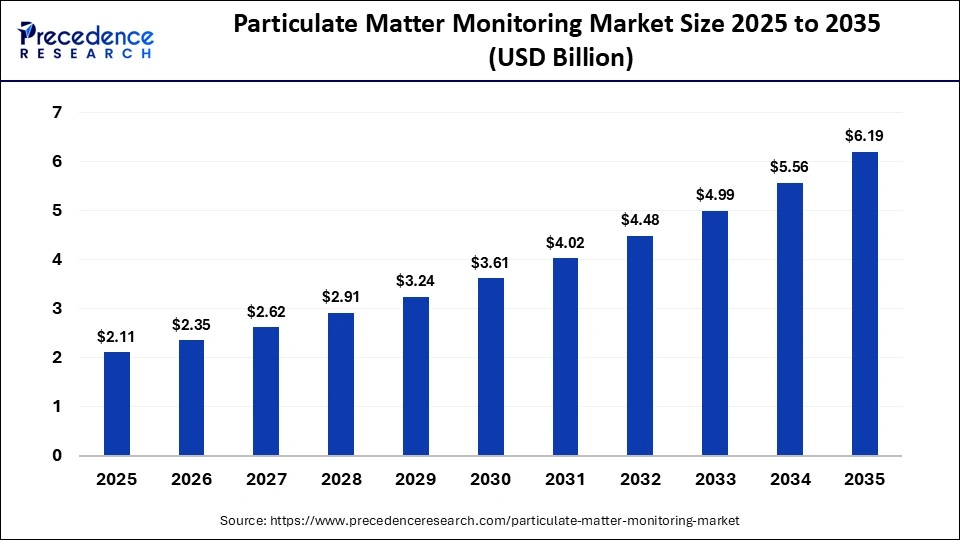
The global particulate matter monitoring market size accounted for USD 2.11 billion in 2025 and is predicted to increase from USD 2.35 billion in 2026 to approximately USD 6.19 billion by 2035, expanding at a CAGR of 11.36% from 2026 to 2035.
Limitations of Traditional Air Quality Monitoring Systems
For decades, stationary monitoring stations with advanced analytical equipment have been the foundation of air quality monitoring. These systems can accurately measure a wide range of pollutants, making them essential for environmental networks. However, traditional stations come with several limitations. They have restricted spatial coverage, high installation and maintenance costs, and sometimes provide delayed data reporting. Because stations are typically spaced far apart, it can be difficult to detect pollution variations at the neighborhood level or identify localized emission sources.
To overcome these challenges, many cities are now adopting distributed monitoring systems that combine traditional infrastructure with smart sensor networks. This hybrid approach maintains the accuracy of conventional stations while adding real-time, hyperlocal monitoring capabilities, enabling more precise pollution tracking and better-informed environmental interventions.
Smart Sensors: Revolutionizing Particulate Matter Monitoring
One of the biggest technological developments in environmental monitoring is smart sensors. These small devices use cutting-edge optical sensing technologies to identify particulate matter concentrations. Smart sensors, in contrast to conventional monitoring stations, can be placed widely throughout cities to form dense monitoring networks that record variations in pollution at a far finer scale.
Most particulate sensors use laser-based optical detection systems that measure how airborne particles scatter light when they pass through a sensing chamber. This scattering pattern allows the device to determine particle size and concentration.
The collected data is then transmitted to centralized monitoring platforms, where it can be analyzed and visualized in real time.
Key Focus Areas in Smart Air Quality Monitoring
Several infrastructure and technological domains are becoming essential parts of contemporary particulate matter monitoring systems as environmental monitoring technologies advance.
|
Monitoring Technology Area |
Strategic Importance in the Current Environment |
Long-Term Environmental Impact |
|
Smart Sensor Networks |
Enable distributed and hyperlocal pollution monitoring |
Detailed city-level pollution mapping |
|
IoT-Enabled Monitoring Systems |
Allow real-time remote monitoring and data transmission |
Faster regulatory responses |
|
AI-Based Pollution Analytics |
Improve forecasting and pollution source identification |
Proactive environmental management |
|
Mobile Monitoring Platforms |
Sensors mounted on vehicles or drones expand monitoring coverage |
Enhanced geographic data collection |
|
Cloud Data Platforms |
Centralized environmental data storage and analysis |
Improved decision-making and policy design |
These technologies allow environmental agencies to monitor air quality more accurately while responding quickly to pollution incidents.
The Rise of Hyperlocal Air Quality Monitoring
One of the most revolutionary benefits of smart sensor technology is its ability to enable hyperlocal air quality monitoring. Unlike traditional monitoring systems that rely on a few widely spaced stations, hyperlocal networks use hundreds of sensors to gather detailed data at the neighborhood level. This granular approach allows authorities and environmental organizations to pinpoint pollution hotspots and tackle specific sources of emissions with precision
For example, sensors near construction sites can track dust emissions in real time, while those along busy highways can monitor traffic-related particulate pollution. By analyzing this hyperlocal data, cities can design targeted interventions, such as localized traffic management, dust mitigation measures, or green buffer zones, that directly improve air quality.
Hyperlocal monitoring not only provides a clearer picture of pollution patterns but also empowers city planners, policymakers, and communities to take actionable, data-driven steps toward cleaner, healthier urban environments.
Smart Cities and Integrated Environmental Monitoring
Smart cities are increasingly leveraging smart sensors to create integrated environmental monitoring systems. Air quality monitoring is now being connected with digital platforms such as traffic management systems, urban data hubs, and weather monitoring networks across cities worldwide.
This integration allows environmental data to be analyzed alongside other urban indicators, providing a comprehensive view of city operations and environmental conditions. By correlating air quality trends with traffic patterns, industrial activity, and weather changes, city authorities can make data-driven decisions to improve urban living, optimize infrastructure, and implement targeted interventions for cleaner, healthier environments.
Integrated monitoring not only enhances the efficiency of urban management but also helps citizens stay informed about local air quality, fostering smarter, more sustainable cities.
Key Applications in Smart Cities
- Real-time monitoring of construction dust emissions
- Traffic emission monitoring near busy road intersections
- Industrial emission monitoring in manufacturing zones
- Public air quality dashboards and mobile applications
These integrated monitoring systems help cities shift from reactive pollution control toward proactive environmental management.
AI and Data Analytics in Air Monitoring
Massive amounts of environmental data are being produced by the quick expansion of sensor networks. Advanced analytics and artificial intelligence are essential in turning this data into insights that can be used. To predict air quality levels, machine learning models can examine past weather and pollution trends. AI systems are also capable of locating sources of pollution and spotting odd environmental occurrences like dust storms or industrial leaks. Automated analytics systems can produce reports on environmental compliance for regulatory bodies and offer suggestions for pollution control tactics in real time.
These capabilities enable governments to shift from reactive pollution management toward predictive environmental planning.
Emerging Innovations in Particulate Monitoring Technology
The field of air quality monitoring is changing quickly as new technologies increase the efficiency, durability, and accuracy of sensors. Sensors with edge computing capabilities that evaluate data locally before sending it to cloud platforms are examples of recent innovations. Additionally, multi-identifiers, which identify multiple airborne pollutants at once, are becoming more widely used. Cities can now gather environmental data over wide geographic areas thanks to mobile monitoring platforms that use drones and vehicles with sensors.
Opportunities for the Environmental Monitoring Industry and Technology Providers
Technology firms, sensor manufacturers, and environmental service providers are seeing tremendous opportunities due to the increasing demand for sophisticated environmental monitoring solutions. Smart monitoring technologies are being adopted by industries like manufacturing, construction, energy, and transportation to improve sustainability performance and adhere to environmental regulations.
As part of larger plans to combat climate change, governments and international organizations are also making significant investments in environmental monitoring infrastructure in the upcoming years. It is anticipated that these investments will accelerate the production and adoption of sophisticated particulate matter monitoring solutions.
Building a Smarter and Cleaner Future
Although air pollution is still a complicated worldwide problem, technological advancements are offering effective solutions. Smart sensors are revolutionizing particulate matter monitoring by improving the accessibility, detail, and actionability of air quality data. These technologies enabled real-time monitoring and hyperlocal pollution analysis, which enabled cities to swiftly identify sources of pollution and put targeted mitigation strategies into place. The future of environmental monitoring will be significantly shaped by the integration of sensor networks, artificial intelligence, and digital infrastructure as smart city initiatives spread globally.
Governments, industries, and communities that invest in advanced monitoring technologies today will be better equipped to tackle air pollution challenges tomorrow.
Widespread use of smart particulate monitoring systems will eventually lead to more sustainable urban environments, healthier populations, and cleaner air. Smart sensors will be a key component of contemporary environmental governance as technology advances, assisting the world's shift to more resilient and environmentally friendly cities.
About the Authors

Aditi Shivarkar
Aditi, Vice President at Precedence Research, brings over 15 years of expertise at the intersection of technology, innovation, and strategic market intelligence. A visionary leader, she excels in transforming complex data into actionable insights that empower businesses to thrive in dynamic markets. Her leadership combines analytical precision with forward-thinking strategy, driving measurable growth, competitive advantage, and lasting impact across industries.



Aman Singh
Aman Singh with over 13 years of progressive expertise at the intersection of technology, innovation, and strategic market intelligence, Aman Singh stands as a leading authority in global research and consulting. Renowned for his ability to decode complex technological transformations, he provides forward-looking insights that drive strategic decision-making. At Precedence Research, Aman leads a global team of analysts, fostering a culture of research excellence, analytical precision, and visionary thinking.

Piyush Pawar
Piyush Pawar brings over a decade of experience as Senior Manager, Sales & Business Growth, acting as the essential liaison between clients and our research authors. He translates sophisticated insights into practical strategies, ensuring client objectives are met with precision. Piyush’s expertise in market dynamics, relationship management, and strategic execution enables organizations to leverage intelligence effectively, achieving operational excellence, innovation, and sustained growth.