



Particulate Matter Monitoring Market Trends, Companies, Revenue / Sales Performance, Manufacturing Yield, Fab Capacity, Export & Import Dynamics, Supply Chain Analysis, Competitive Landscape, and Growth Forecast
Particulate Matter Monitoring Market (By Type: Indoor Monitoring, Outdoor Monitoring; By Technology: Light Scattering, Beta-Attenuation, Gravimetric, Opacity, Others; By Application: Process Industries, Ambient Air Monitoring, Indoor Air Monitoring, Healthcare, Others; By Particle Size: PM1, PM2.5, PM5, PM10) - Global Industry Analysis, Size, Trends, Leading Companies, Regional Outlook, and Forecast 2026 to 2035
Source: https://www.precedenceresearch.com/particulate-matter-monitoring-market
 Get a Sample
 Table Of Content


What is the Particulate Matter Monitoring Market Size in 2026?
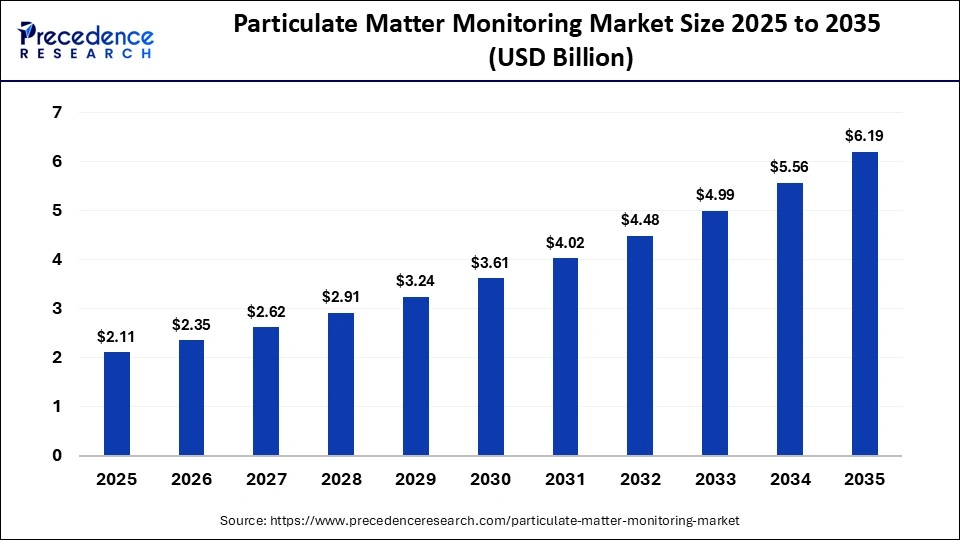
The global particulate matter monitoring market size was calculated at USD 2.11 billion in 2025 and is predicted to increase from USD 2.35 billion in 2026 to approximately USD 6.19 billion by 2035, expanding at a CAGR of 11.36% from 2026 to 2035. The market is driven by increasing air pollution levels, stricter environmental regulations, and rising awareness about the health risks associated with particulate emissions.
Key Takeaways
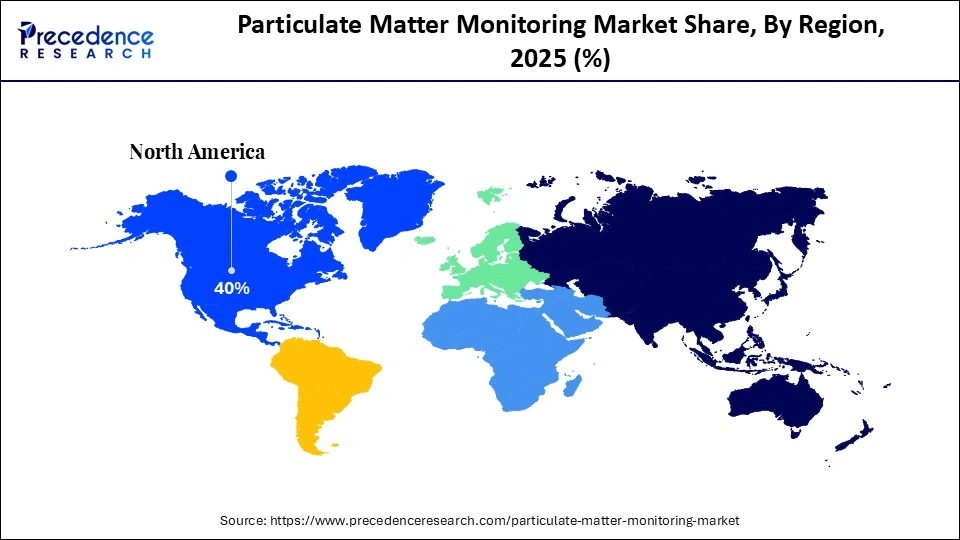
- North America dominated the global particulate matter monitoring market with the largest market share of 40% in 2025.
- Asia Pacific is expected to grow at the fastest CAGR between 2026 and 2035.
- By type, the indoor monitoring segment held the largest market share in 2025.
- By type, the outdoor monitoring segment is expected to expand at the fastest CAGR between 2026 and 2035.
- By technology, the light scattering segment contributed to the highest market share in 2025.
- By technology, the beta attenuation segment is expected to grow at a strong CAGR between 2026 and 2035.
- By application, the ambient air monitoring segment held a major market share in 2025.
- By application, the indoor air monitoring segment is expected to expand at the fastest CAGR from 2026 to 2035.
- By particle size, the PM2.5 segment held the biggest market share in 2025.
- By particle size, the PM1 segment is expected to expand at the fastest CAGR between 2026 and 2035.
Why is the Particulate Matter Monitoring Market Growing?
The particulate matter monitoring market is experiencing steady growth because of growing concerns about air pollution and its effects on the environment and human health. The adoption of advanced monitoring technologies by governments and environmental agencies is being promoted by the increasing levels of particulate emissions from the vehicle industries and construction activities. Furthermore, industries are being forced to implement dependable monitoring systems to track particulate matter levels like PM 2.5 and PM 1.0 due to stringent environmental regulations and air quality standards. Smart sensors, IoT-enabled monitoring systems, and real-time air quality analytics are examples of technological innovations that are helping market growth. In the upcoming years, it is anticipated that demand for effective particulate matter monitoring systems will continue to rise as global awareness of air pollution rises.
Future Market Overview
- Increasing Investments in Smart City Projects: Smart city initiatives worldwide are creating strong demand for advanced air quality monitoring networks to improve urban environmental management.
- Expansion of Indoor Air Quality Monitoring: The growing focus on indoor air quality in offices, schools, hospitals, and residential buildings is creating new opportunities for particulate monitoring solutions.
- Growth in Emerging Economies: Rapid industrialization and urbanization in developing countries are increasing the need for effective pollution monitoring systems.
- Adoption in Industrial Emission Monitoring: Industries are increasingly deploying particulate matter monitoring systems to comply with environmental regulations and reduce emission levels.
- Advancements in Sensor Technologies: Continuous innovations in sensor technologies are opening new opportunities for more accurate, compact, and affordable monitoring devices.
Government Initiatives Supporting the Particulate Matter Monitoring Market
| Region | Initiatives/Program | Key Objective |
| India | National Clean Air Program | This program focuses on reducing air pollution levels across major cities by expanding air quality monitoring stations and implementing pollution control measures. |
| India | National Air Quality Index Program | The initiative provides real-time air quality data through a network of monitoring stations, helping authorities track particulate pollution levels and inform the public. |
| United States | AirNow Program | This program offers real-time air quality information and encourages community participation in monitoring air pollution levels. |
| European Union | EU Clean Air Policy Package | The initiative aims to improve air quality standards across European countries by strengthening monitoring systems and reducing harmful emissions. |
| Global | Climate and Clean Air Coalition | This global partnership works with governments and organizations to reduce short-lived climate pollutants, including particulate matter, through improved monitoring and policy implementation. |
How is AI Transforming the Particulate Matter Monitoring Market?
Artificial intelligence plays an important role in improving the efficiency of particulate matter monitoring systems. Large amounts of air quality data gathered from sensors and monitoring stations can be analyzed by AI-powered systems to identify pollution levels and forecast variations in particulate matter levels. Real-time monitoring, quicker data processing, and early warning about increasing pollution levels are all made possible by these systems. Government businesses and environmental organizations can therefore manage air pollution and enhance overall air quality management more quickly.
Key Trends in the Particulate Matter Monitoring Market
- Growing Adoption of Smart Air Quality Monitoring Systems: Cities and industries are increasingly adopting smart monitoring systems that provide real-time air quality data. These systems help authorities track pollution levels and implement effective environmental management strategies.
- Integration of IoT in Monitoring Devices: IoT-enabled sensors are improving the efficiency of particulate matter monitoring by enabling continuous data collection and remote monitoring. These connected devices help create large air quality monitoring networks across cities.
- Rising Demand for Portable Monitoring Devices: Portable and handheld particulate matter monitoring devices are gaining popularity due to their flexibility and ease of use. These devices are widely used in construction sites, industrial areas, and research activities.
- Increasing Government Regulations on Air Quality: Governments across the world are introducing strict air pollution control regulations. These policies encourage industries and municipalities to install advanced particulate monitoring systems.
- Expansion of Urban Air Monitoring Networks: Many cities are expanding their air quality monitoring infrastructure to better track pollution levels. Large-scale monitoring networks are helping authorities develop effective pollution control measures.
- Growing Use of AI and Data Analytics: Artificial intelligence and advanced analytics are improving the accuracy of pollution monitoring systems. These technologies help analyze large datasets and predict pollution trends more effectively.
- Rising Awareness About Health Impacts of Air Pollution: Increasing awareness about the health risks of particulate matter exposure is encouraging organizations and governments to invest in monitoring technologies.
- Development of Low-Cost Air Quality Sensors: Manufacturers are focusing on developing cost-effective sensors to make particulate matter monitoring more accessible for cities, industries, and residential applications.
Market Scope
| Report Coverage | Details |
| Market Size in 2025 | USD 2.11 Billion |
| Market Size in 2026 | USD 2.35 Billion |
| Market Size by 2035 | USD 6.19 Billion |
| Market Growth Rate from 2026 to 2035 | CAGR of 11.36% |
| Dominating Region | North America |
| Fastest Growing Region | Asia Pacific |
| Base Year | 2025 |
| Forecast Period | 2026 to 2035 |
| Segments Covered | Type, Technology, Application, Particle Size , and region |
| Regions Covered | North America, Europe, Asia-Pacific, Latin America, and Middle East & Africa |
Segment Insights
Type Insights
What Made Indoor Monitoring the Dominant Segment in the Particulate Matter Monitoring Market?
The indoor monitoring segment dominated the market with the largest share in 2025 because people are becoming more conscious of indoor air quality and its effects on human health. The need for continuous air quality monitoring solutions has grown as people spend more time indoors in residential, commercial, and institutional settings. The use of indoor monitoring devices has increased because of governments' and health organizations' emphasis on indoor pollution control in workplaces, hospitals, and educational institutions.
The outdoor monitoring segment is expected to grow at the fastest CAGR in the coming years due to growing government efforts to monitor urban air pollution and implement environmental laws. Advanced outdoor monitoring solutions are becoming increasingly necessary in urban areas due to increased industrialization and vehicle emissions. Municipalities are being encouraged to install sophisticated air quality monitoring stations through smart city initiatives and environmental monitoring programs.
Technology Insights
Why Did the Light Scattering Segment Dominate the Particulate Matter Monitoring Market?
The light scattering segment dominated the market in 2025 because of its ability to measure airborne particles in real time and has a high sensitivity. Due to its widespread use of inexpensive portable monitoring devices, this technology is appropriate for both home and commercial settings. Its adoption in environmental monitoring systems has increased due to its capability to quickly detect a wide range of particle sizes. Additionally, the use of light scattering techniques in contemporary air quality monitoring devices has been reinforced by developments in optical sensors and miniaturization technologies.
The beta attenuation segment is expected to grow at the fastest CAGR in the coming years because it offers particulate measurements that are both highly accurate and of regulatory quality. For long-term evaluations of air quality, this technology is widely utilized in government monitoring stations and environmental research facilities. The deployment of dependable and certified monitoring technologies is being encouraged by the increasing enforcement of stringent environmental regulations across the globe. Automated beta attenuation monitor advancements are also improving measurement accuracy and lowering maintenance needs.
Application Insights
What Made Ambient Air Monitoring the Leading Segment in the Particulate Matter Monitoring Market?
The ambient air monitoring segment dominated the market in 2025 because of growing worries about urban air pollution and its effects on the environment. Ambient monitoring systems are widely used by governments and environmental organizations to monitor pollution levels in urban areas and industrial areas. Public health programs, pollution control regulations, and regulatory compliance are all supported by the data produced by these systems. Additionally, the installation of ambient air monitoring stations has increased dramatically due to the growth of smart city initiatives and environmental monitoring programs.
The indoor air monitoring segment is expected to grow at the fastest CAGR in the coming years because people are becoming more conscious of indoor pollution and how it affects productivity and health. The need for indoor air quality monitoring systems is rising due to factors like inadequate ventilation and chemical emissions from building materials and domestic activities. The use of indoor monitoring systems is also being accelerated by the adoption of smart home technologies and connected air quality sensors. To maintain healthy indoor environments, monitoring systems are also being installed more frequently in commercial spaces like offices, hospitals, and educational institutions.
Particle Size Insights
Why Did the PM2.5 Segment Dominate the Particulate Matter Monitoring Market?
The PM2.5 segment dominated the market in 2025 because of the serious health risks that fine particulate matter poses. PM 2.5 particles can cause respiratory and cardiovascular disorders by deeply penetrating the lungs and bloodstream. Because of this, monitoring PM 2.5 levels in urban areas is a top priority for environmental monitoring organizations and regulatory bodies. The need for monitoring systems that can accurately detect PM 2.5 concentrations has increased dramatically due to stricter air quality regulations and growing public awareness.
The PM 1 segment is expected to grow at the fastest CAGR in the coming years because these ultrafine particles, being smaller than PM2.5, can penetrate deeper into the respiratory system, increasing health risks. Rising awareness among health researchers and regulators about the dangers of PM1 has driven demand for precise monitoring. Advances in detection technology and the focus on comprehensive urban air quality analysis are further boosting the adoption of PM1 monitoring solutions.
Regional Analysis
North America Particulate Matter Monitoring Market Size and Growth 2026 to 2035
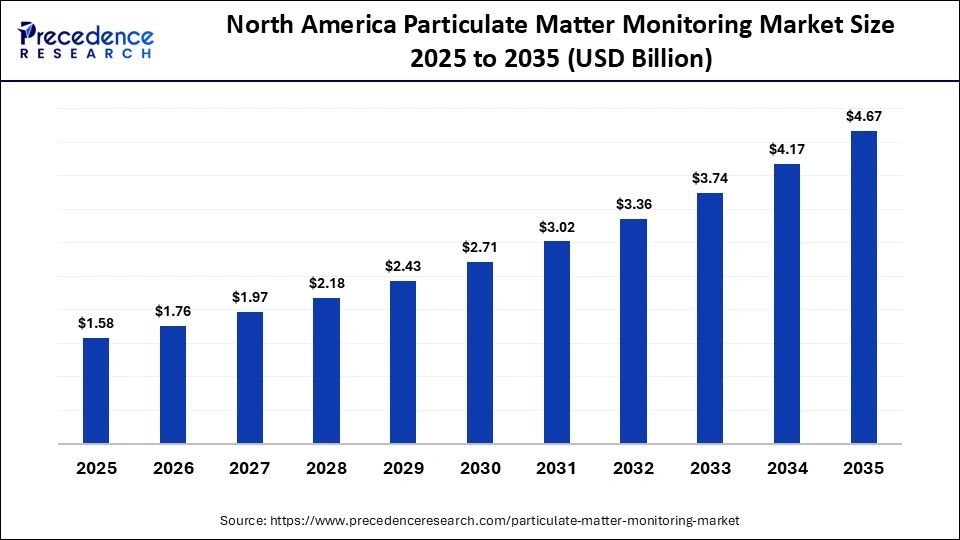
The North America particulate matter monitoring market size is estimated at USD 1.58 billion in 2025 and is projected to reach approximately USD 4.67 billion by 2035, with a 11.45% CAGR from 2026 to 2035.
What Made North America the Dominant Region in the Particulate Matter Monitoring Market?
North America dominated the particulate matter monitoring market while holding a major share in 2025. This is because of the government's efforts to monitor air pollution and stringent environmental laws. Comprehensive air quality standards have been put in place by regulatory organizations like the US Environmental Protection Agency, which promotes widespread use of cutting-edge monitoring technologies. Leading environmental monitoring firms and significant R&D expenditures also contribute to the region's market expansion. Particulate monitoring system adoption has also been bolstered by the growing deployment of smart environmental monitoring networks throughout cities.
U.S. Particulate Matter Monitoring Market Size and Growth 2026 to 2035
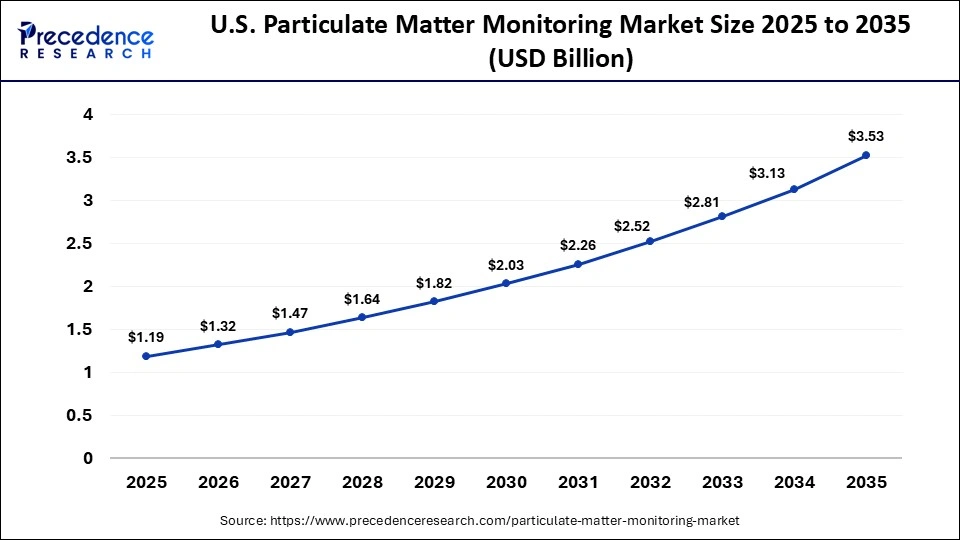
The U.S. particulate matter monitoring market size is calculated at USD 1.19 billion in 2025 and is expected to reach nearly USD 3.53 billion in 2035, accelerating at a strong CAGR of 11.49% between 2026 and 2035.
U.S. Particulate Matter Monitoring Market Analysis
The U.S. is a major contributor to the market within North America, driven by the growing adoption of real-time air quality monitoring systems across urban and industrial areas. The implementation of sophisticated monitoring solutions across the country is being aided by government programs aimed at reducing pollution as well as growing investments in smart city infrastructure. The effectiveness of air quality monitoring systems is increasing thanks to technological developments in cloud-based data platforms and IoT-enabled sensors.
Additionally, the use of particulate matter monitoring devices is being encouraged by growing public awareness of air pollution and its negative health effects.
How is the Opportunistic Rise of Asia Pacific in the Market?
Asia Pacific is expected to grow at the fastest CAGR in the coming years because of the rapid urbanization, industrialization, and growing air pollution in large cities. To reduce environmental pollution, governments around the region are implementing several initiatives, prompting the adoption of air quality monitoring solutions. The use of cutting-edge monitoring technologies is also being fueled by increased environmental consciousness and more stringent emissions regulations. Particulate matter monitoring system deployment is also accelerating due to the growth of smart cities projects and environmental sustainability initiatives.
India Particulate Matter Monitoring Market Analysis
The market in India is largely driven by the rising demand for air quality monitoring systems due to high pollution levels in major cities. Government initiatives such as the National Clean Air Program aim to reduce particulate pollution and strengthen nationwide air quality monitoring networks, further supporting market growth. Rapid urbanization, increased construction activities, rising vehicle emissions, and the deployment of low-cost sensors and real-time monitoring stations are also expanding the country's air quality monitoring infrastructure.
Particulate Matter Monitoring Market Companies
- Thermo Fisher Scientific Inc.
- Siemens AG
- Honeywell International Inc.
- Teledyne Technologies Incorporated (including Teledyne API)
- TSI Incorporated
- Horiba, Ltd.
- 3M Company
- ABB Ltd.
- AMETEK, Inc. (including AMETEK Land)
- Emerson Electric Co.
- Aeroqual Ltd.
- Vaisala Oyj
- Palas GmbH
- GRIMM Aerosol Technik
- Kanomax USA Inc.
- Opsis AB
- Testo SE & Co. KGaA
- PerkinElmer Inc.
- Sick AG
Recent Developments
- In January 2026, Butterfly Air announced the launch of its Spiro outdoor air quality sensor, designed to monitor particulate matter and other pollutants in outdoor environments and support environmental monitoring networks.(Source: https://airqualitynews.com).
- In April 2025, Axis Communications announced the launch of AXIS D6210 and AXIS D6310 environmental sensors, capable of monitoring particulate matter along with gases, humidity, and temperature for indoor air quality management (Source: https://newsroom.axis.com).
- In 2025, Bosch Sensortec and PurpleAir announced the PurpleAir PIXEL portable air quality monitor, powered by Bosch's BMV080 particulate matter sensor to deliver compact, real-time pollution monitoring.(Source: https://www.bosch-sensortec.com).
- In 2025, Oizom Instruments launched AQBot, an industrial air quality monitoring device designed to track specific pollutants and particulate matter for industrial emission monitoring applications.(Source: https://www.envirotech-online.com).
Segments Covered in the Report
By Type
- Indoor Monitoring
- Outdoor Monitoring
By Technology
- Light Scattering
- Beta-Attenuation
- Gravimetric
- Opacity
- Others
By Application
- Process Industries
- Ambient Air Monitoring
- Indoor Air Monitoring
- Healthcare
- Others
By Particle Size
- PM1
- PM2.5
- PM5
- PM10
By Region
- North America
- Latin America
- Europe
- Asia-pacific
- Middle and East Africa
For inquiries regarding discounts, bulk purchases, or customization requests, please contact us at sales@precedenceresearch.com
Frequently Asked Questions





Ask For Sample
No cookie-cutter, only authentic analysis – take the 1st step to become a Precedence Research client
 Get a Sample




 sales@precedenceresearch.com
 Schedule a Meeting
