






 Request Consultation
Rugged servers enable reliable computing in extreme environments where traditional systems fail. They support mission-critical operations, edge computing, and real-time data processing across industries. Their growing adoption is driven by advancements in AI, automation, and industrial digitalization.
In today’s digital era, organizations across industries rely heavily on computing systems to process, store, and transmit critical data. Reliable computing has become the backbone of modern technological ecosystems, from transportation networks and energy infrastructure to defense operations and industrial automation. However, the controlled conditions of office data centers are often absent in many operational environments, where extreme conditions can challenge conventional IT systems.
Traditional servers are designed for stable, indoor environments and can struggle to perform reliably under extreme temperatures, dust, vibrations, humidity, or erratic power supply. This can lead to data loss, operational downtime, and increased maintenance costs. In scenarios where conventional equipment cannot ensure dependable computing, rugged servers are essential.
Rugged servers are specifically engineered to withstand harsh environmental conditions. They feature reinforced components, specialized cooling systems, shock-resistant structures, and sealed enclosures, enabling reliable operation in extreme settings, unlike standard servers optimized for controlled indoor spaces. As industries expand digital operations into remote locations, mobile platforms, and mission-critical environments, rugged servers are becoming increasingly vital. They support mission-critical communications, edge computing, and real-time data processing, ensuring operational continuity even in the most challenging environments.
This blog explores the growing adoption of rugged servers across industries, the sectors driving their demand, and the technological advancements shaping resilient computing infrastructure for the future.
What is the Rugged Servers Market Size?
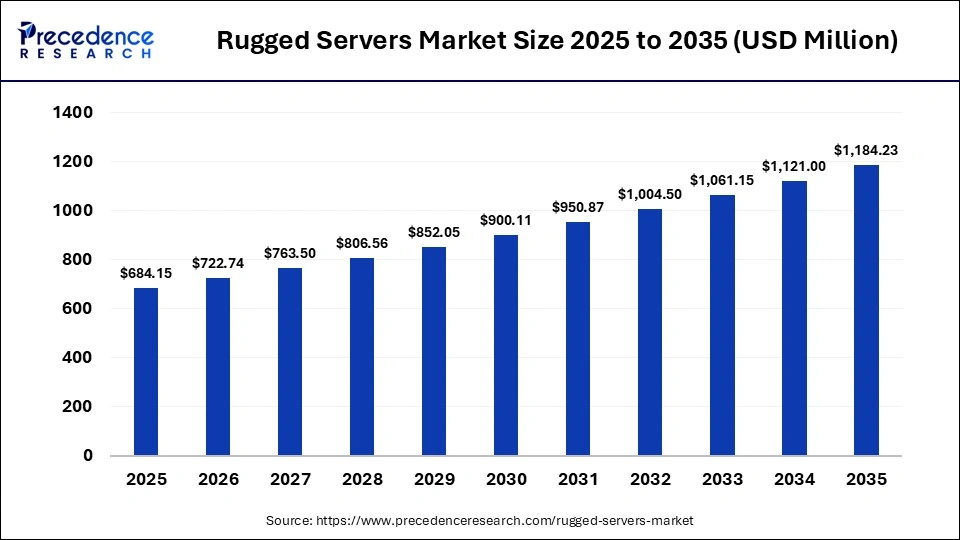
The rugged servers market was valued at USD 684.15 million in 2025 and is projected to grow from USD 722.74 million in 2026 to around USD 1,184.23 million by 2035, registering a CAGR of 5.64% during the forecast period from 2026 to 2035. This growth is driven by rising demand for reliable computing solutions in harsh environments, including military, industrial, and remote operations.
Why Reliable Computing Infrastructure Matters Today?
In the digital age, modern businesses generate vast volumes of data and rely heavily on constant connectivity to manage daily operations effectively. Uninterrupted computing performance is critical to support mission-critical activities such as defense operations, logistics management, and monitoring industrial machinery. Reliable computing infrastructure ensures that systems continue to operate smoothly, even in unpredictable and challenging environments. This is where rugged servers come into play, offering the durability and resilience necessary to maintain operational continuity under extreme conditions.
Here’s why they matter:
Supporting Mission-Critical Operations
In many industries, system failures can have disastrous consequences. For sectors like defense, emergency response, and transportation control, continuous data processing and communication are non-negotiable. Rugged servers are specifically designed to endure vibrations, harsh weather, and irregular power sources, ensuring the uninterrupted continuation of mission-critical operations. This makes them indispensable for environments where performance reliability can mean the difference between success and failure.
Enabling Remote and Edge Computing
Computing systems are being placed at the network edge more frequently as digital technologies spread beyond centralized data centers. By processing data closer to the source, edge computing lowers latency and speeds up reaction times. For edge environments like mining sites, oil fields, offshore platforms, and distant industrial facilities, rugged servers are perfect. They can function effectively in places where traditional IT infrastructure cannot dependably operate because of their durability.
Improving Operational Efficiency
System outages and equipment malfunctions can lead to substantial financial losses and operational disruptions. Rugged servers, by offering dependable performance in harsh environments, reduce the need for frequent maintenance and increase overall system uptime. By minimizing hardware failures and guaranteeing continuous data processing, rugged servers help businesses maintain productivity and improve operational efficiency, especially in industries where downtime is costly.
Enhancing Data Security and System Stability
In environments where data integrity and system stability are paramount, reliable computing infrastructure is crucial. Rugged servers, equipped with capabilities like encryption, secure communications, and real-time monitoring, are often deployed in secure settings to protect sensitive data. These servers ensure data security by operating reliably in extreme conditions, thus reducing the risk of data loss and enhancing overall system reliability.
Why Traditional Server Infrastructure Struggles in Harsh Environments?
Conventional enterprise servers are usually made for controlled spaces like centralized data centers or office buildings. These systems require low humidity, consistent temperatures, and few physical disruptions. However, it is impossible to guarantee such conditions in many industries. Computing equipment is subjected to continuous vibrations, dust, and temperature changes in manufacturing facilities, military vehicles, construction sites, and offshore platforms.
These circumstances have the potential to rapidly deteriorate traditional servers, resulting in overheating, hardware malfunctions, or interruptions in connectivity. Furthermore, dusty or hot conditions may make it difficult for conventional cooling systems to operate efficiently. Organizations are increasingly using rugged computing solutions, which are designed to endure challenging operating environments, as a result of these constraints.
How are Rugged Servers Transforming Industrial and Mission-Critical Computing?
An important advancement in resilient computing technology is the rise of rugged servers, which are specifically designed to operate in the most challenging environments. Unlike traditional servers, rugged servers are built with reinforced chassis, vibration-resistant components, and advanced thermal management systems, allowing them to maintain high performance under extreme conditions.
Rugged servers undergo extensive testing to meet industrial and military standards for durability, making them capable of withstanding electromagnetic interference, shock, humidity, and both extremely high and low temperatures without compromising functionality. Additionally, many rugged servers support modular designs, allowing businesses to customize the configuration based on specific operational requirements. This flexibility, combined with their exceptional durability, makes rugged servers an essential component of modern digital infrastructure, particularly in industries where reliability and long-term performance are critical, such as defense, aerospace, oil & gas, and manufacturing.
| Rugged Server Technology Area | Strategic Importance in Modern Infrastructure | Long-Term Industry Impact |
| Reinforced Hardware Architecture | Protects servers from shock, vibration, and environmental stress | Increased equipment lifespan |
| Edge Computing Integration | Enables data processing closer to operational sites | Faster decision-making |
| Advanced Thermal Management | Maintains performance in extreme temperature conditions | Improved system stability |
| Secure Communication Systems | Supports encrypted data transmission in mission-critical operations | Enhanced cybersecurity |
| Modular and Compact Designs | Allows flexible deployment in limited spaces | Greater operational adaptability |
Rugged servers can now support a wide range of industrial and mission-critical applications thanks to these technological developments.
How is Edge Computing Driving the Usage of Rugged Servers?
The rapid expansion of edge computing is one of the most important factors propelling the adoption of rugged servers. Data can be processed locally at or close to the source, thanks to edge computing as opposed to being sent to centralized cloud servers. With this method, latency is greatly decreased, and real-time decision-making is enhanced because it can function in harsh or remote settings where traditional data center infrastructure cannot be installed. Rugged servers are perfect for edge computing deployment.
For instance, a lot of operational data is produced by industrial sensors placed in manufacturing facilities. This data can be processed in real time by the facility's rugged servers, enabling operators to quickly identify equipment problems and improve production procedures. As industries embrace automation, predictive maintenance, and smart manufacturing, this capability is becoming increasingly crucial.
Applications of Rugged Servers Across Industries
Nowadays, rugged servers are being widely used in a variety of industries that need dependable computer infrastructure in difficult settings.
- Defense and Military Operations: Military environments often involve extreme weather conditions, vibrations from vehicles, and remote deployments. Rugged servers provide reliable computing capabilities for battlefield communication systems, intelligence processing, and mission planning.
- Energy and Utilities: Power plants, renewable energy installations, and oil and gas facilities often operate in harsh or remote areas. In these settings, rugged servers facilitate grid management, equipment diagnostics, and monitoring systems.
- Transportation and Logistics: Continuous monitoring and communication are necessary for maritime operations, aviation systems, and railway networks. Transportation management programs, cargo tracking platforms, and real-time navigation systems are all supported by robust servers.
- Industrial Automation: Manufacturing plants rely heavily on automated systems, robotics, and sensor networks. Rugged servers enable real-time data processing for production monitoring, predictive maintenance, and quality control.
AI and Data Analytics: Revolutionizing Rugged Computing for Harsh Environments
The capabilities of rugged server infrastructure are greatly improved by the integration of advanced analytics and artificial intelligence. Large datasets produced by industrial sensors, cameras, and Internet of Things devices can be processed by modern rugged servers. This data can be analyzed by AI algorithms to find trends, forecast equipment failures, and improve operational efficiency. Predictive maintenance strategies that avert expensive equipment failures are made possible by machine learning models operating on rugged edge servers that can identify anomalies in industrial systems. Proactive and data-driven operational management is replacing reactive maintenance strategies in organizations thanks to these capabilities.
Emerging Innovations in Rugged Server Technology
As new technological advancements boost system performance, energy efficiency, and connectivity, the rugged computing sector keeps changing quickly. Recent developments include servers with edge AI acceleration capabilities that allow for remote real-time data analytics. Rugged servers can now function effectively in extremely hot conditions thanks to improved thermal management systems. Furthermore, mobile applications like drones, autonomous cars, and military platforms are increasingly using small, lightweight, rugged servers. Rugged servers are anticipated to be even more important in supporting distributed computing architecture as 5G networks and industrial IoT ecosystems grow.
Opportunities for Industry and Technology Providers
The increasing demand for resilient computing infrastructure is creating significant opportunities for technology companies and system integrators. Industries like manufacturing, transportation, energy, and defense are making significant investments in digital transformation projects that call for dependable computer systems in demanding settings. The need for rugged server solutions is also being accelerated by government investments in critical communication networks, smart infrastructure initiatives, and cutting-edge defense technologies. Rugged servers are anticipated to play a major role in next-generation digital infrastructure as edge computing, AI, and industrial automation continue to grow.
Building a Resilient Digital Future
Reliable computing infrastructure that can function outside of traditional data center settings is essential to modern technological ecosystems. Resilient and long-lasting computing systems are becoming more necessary as industries extend their operations into harsh and remote areas. The deployment and management of computing infrastructure in harsh environments is being revolutionized by rugged servers. They are crucial for missions and critical applications in many different industries because of their capacity to provide dependable performance in challenging circumstances.
Rugged servers assist businesses in creating more robust and effective operational systems by facilitating edge computing, supporting AI-driven analytics, and guaranteeing continuous system performance. Rugged computing solutions will be essential in assisting the global digital transformation of industries as technology develops.
Businesses that make today's investments in rugged server infrastructure will be better equipped to handle intricate operations, enhance system dependability, and accommodate upcoming technological developments. In the end, more robust digital infrastructure and more dependable technology ecosystems will result from the widespread use of rugged servers.
About the Authors

Aditi Shivarkar
Aditi, Vice President at Precedence Research, brings over 15 years of expertise at the intersection of technology, innovation, and strategic market intelligence. A visionary leader, she excels in transforming complex data into actionable insights that empower businesses to thrive in dynamic markets. Her leadership combines analytical precision with forward-thinking strategy, driving measurable growth, competitive advantage, and lasting impact across industries.



Aman Singh
Aman Singh with over 13 years of progressive expertise at the intersection of technology, innovation, and strategic market intelligence, Aman Singh stands as a leading authority in global research and consulting. Renowned for his ability to decode complex technological transformations, he provides forward-looking insights that drive strategic decision-making. At Precedence Research, Aman leads a global team of analysts, fostering a culture of research excellence, analytical precision, and visionary thinking.

Piyush Pawar
Piyush Pawar brings over a decade of experience as Senior Manager, Sales & Business Growth, acting as the essential liaison between clients and our research authors. He translates sophisticated insights into practical strategies, ensuring client objectives are met with precision. Piyush’s expertise in market dynamics, relationship management, and strategic execution enables organizations to leverage intelligence effectively, achieving operational excellence, innovation, and sustained growth.