



Intracranial Pressure Monitor Market Size, Companies, Share, Patient Volume, Treatment Adoption Rates, Pricing Analysis, Regulatory Landscape, Competitive Positioning, and Demand Forecast
Intracranial Pressure Monitor Market (By Product Type: Invasive ICP Monitoring Devices (External Ventricular Drain, Intraparenchymal Sensors, Subdural Screws), Non-invasive ICP Monitoring Devices (Transcranial Doppler, Optic Nerve Sheath Diameter Systems, Tympanic Membrane Displacement Devices); By Technology: Fiber Optic Sensors, Strain Gauge Sensors, Microelectromechanical Systems (MEMS), Telemetric ICP Monitoring Systems; By Application: Traumatic Brain Injury (TBI) Monitoring, Intracerebral Hemorrhage Monitoring, Hydrocephalus Management, Stroke Monitoring, Other Neurological Disorders; By End-Use: Hospitals, Neurosurgery Centers, Ambulatory Surgical Centers (ASCs), Trauma Centers, Research & Academic Institutes) - Global Industry Analysis, Size, Trends, Leading Companies, Regional Outlook, and Forecast 2026 to 2035
Source: https://www.precedenceresearch.com/intracranial-pressure-monitor-market
 Get a Sample
 Table Of Content


What is the Intracranial Pressure Monitor Market Size in 2026?
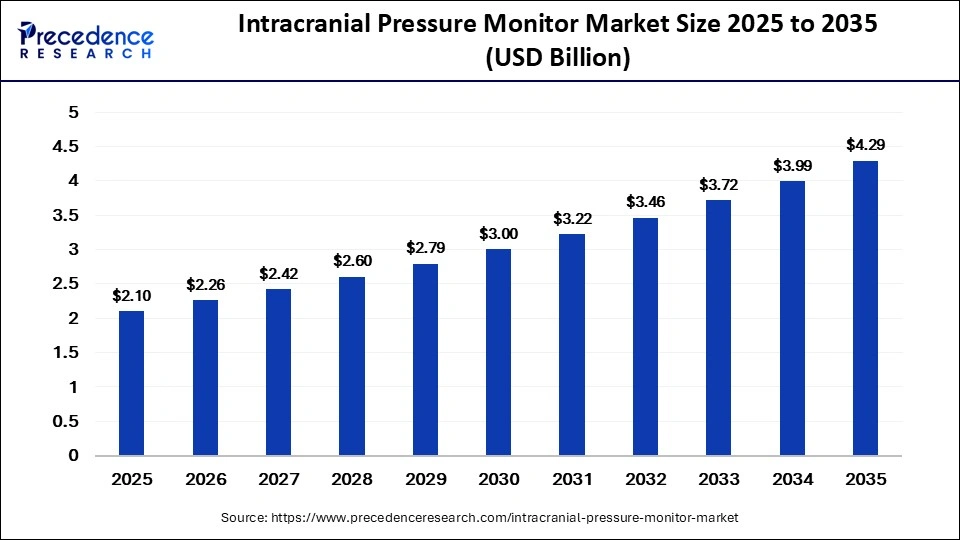
The global intracranial pressure monitor market size accounted for USD 2.10 billion in 2025 and is predicted to increase from USD 2.26 billion in 2026 to approximately USD 4.29 billion by 2035, expanding at a CAGR of 7.40% from 2026 to 2035. The market growth is attributed to the rising burden of neurological disorders and increasing adoption of advanced real-time intracranial pressure monitoring technologies in critical care settings.
Key Takeaways
- North America dominated the market with a 40% share in 2025.
- Asia Pacific is expected to grow at the highest CAGR of 10.5% between 2026 and 2035.
- By product type, the invasive ICP monitoring devices segment held the highest market share of 70% in 2025.
- By product type, the non-invasive ICP monitoring devices segment held a 30% share of the market in 2025 and is expected to grow at the fastest CAGR of 10.5% in between 2026 and 2035.
- By technology, the fiber optic sensors segment held a major market share of 35% in 2025.
- By technology, the telemetric ICP monitoring systems segment is expected to grow at a 10.5% CAGR during the forecast period.
- By application, the traumatic brain injury (TBI) monitoring segment contributed the highest market share of 35% in 2025.
- By application, the intracerebral hemorrhage monitoring segment held the second-largest market share of 20% in 2025 and is estimated to grow at a strong CAGR of 6.5% over the projected period.
- By end-use, the hospitals segment contributed the highest market share of 60% in 2025.
- By end-use, the neurosurgery centers segment held a 15% share of the market in 2025 and is expected to grow at a significant CAGR of 8% between 2026 and 2035.
Market Overview
The rising global burden of neurological disorders is a major driver accelerating growth in the intracranial pressure monitor market. The World Health Organization states that more than 3 billion people have neurological conditions, making it one of the primary causes of disability in the world. Intracranial pressure monitoring technology is very crucial as it measures pressure within the skull by using invasive and non-invasive sensors.
Such systems assist clinicians in treating traumatic brain injuries, hydrocephalus, and brain edema with real-time, continuous monitoring in intensive care units. The increasing burden of neurological conditions and growing healthcare expenditure are expected to drive the market in the coming years.
Impact of Artificial Intelligence on the Intracranial Pressure Monitor Market
Artificial intelligence is influencing the intracranial pressure monitor market by enabling more accurate and intelligent neurological monitoring in critical care settings. AI-based algorithms can process and interpret continuous ICP waveform signals and illuminate early indicators of intracranial hypertension. Furthermore, medical device manufacturers are integrating AI into the next-generation ICP devices, enhancing their usability and predictive functionality for medical workers.
Major Market Trends
- Expansion of Neurosurgical Procedures: Increasing volume of complex brain surgeries is fueling the demand for accurate intraoperative and postoperative pressure monitoring.
- Growing Focus on Patient Safety and Outcome Optimization: Emphasis on reducing mortality and complications in neurological cases is boosting adoption of continuous ICP monitoring solutions.
- Shift Toward Home-Based and Remote ICP Monitoring: The demand for remote patient monitoring is growing, which necessitates portable ICP and home-compatible devices. The use of wearable and non-invasive ICP devices allows monitoring around the clock, enhancing the management of neurological care.
Market Scope
| Report Coverage | Details |
| Market Size in 2025 | USD 2.10 Billion |
| Market Size in 2026 | USD 2.26 Billion |
| Market Size by 2035 | USD 4.29 Billion |
| Market Growth Rate from 2026 to 2035 | CAGR of 7.40% |
| Dominating Region | North America |
| Fastest Growing Region | Asia Pacific |
| Base Year | 2025 |
| Forecast Period | 2026 to 2035 |
| Segments Covered | Product Type, Technology, Application, End-Use, and Region |
| Regions Covered | North America, Europe, Asia-Pacific, Latin America, and Middle East & Africa |
Market Dynamics
Drivers
Growing Aging Population and Neurodegenerative Disease Burden
The growing aging population and the rising burden of neurodegenerative diseases are expected to drive the demand for neurological monitoring solutions. Dementia, stroke, and normal pressure hydrocephalus are some of the conditions that increase in prevalence as a result of aging demographics. Increased hospitalizations of geriatric groups reinforce the need to acquire complex monitoring devices in the ICUs. Furthermore, the increasing incidence of traumatic brain injuries and neurological emergencies is expected to fuel the intracranial pressure monitor market.
Restraint
High Cost of Devices and Procedures
High costs of ICP monitoring systems and neurosurgical procedures are expected to restrain market growth. Budget constraints in low- and middle-income regions limit hospitals' ability to invest in advanced neuromonitoring equipment. Additionally, healthcare facilities often prioritize essential medical devices, delaying the adoption of specialized neurological monitoring systems.
Opportunity
Advancements in Sensor-Based and Fiber-Optic Monitoring Technologies
Ongoing advancements in sensor-based and fiber-optic technologies create immense opportunities in the intracranial pressure monitor market. Fiber-optic technologies are low-invasive in nature, enhancing safety and clinical effectiveness for patients. Additionally, the high healthcare expenditure and hospital investment in advanced medical technologies are expected to strengthen market growth in the coming years.
Segment Insights
Product Type Insights
Intracranial Pressure Monitor Market Share, By Product Type, 2025-2035 (%)
| Product Type | 2025 | 2035 | CAGR (%) |
| Invasive ICP Monitoring Devices | 70.00% | 66.00% | 6.50% |
| Non-invasive ICP Monitoring Devices | 30.00% | 34.00% | 10.50% |
The Invasive ICP Monitoring Devices Segment Held a 70% Market Share in 2025
The invasive ICP monitoring devices segment dominated the intracranial pressure monitor market with the largest share of 70% in 2025. This is mainly due to their high adoption in clinical settings for their accuracy. These devices are critical in neuro-ICUs, where even minor pressure variations directly influence treatment and surgical decisions. Their dominance is further supported by the gold-standard status of external ventricular drainage systems in neurosurgical practice.
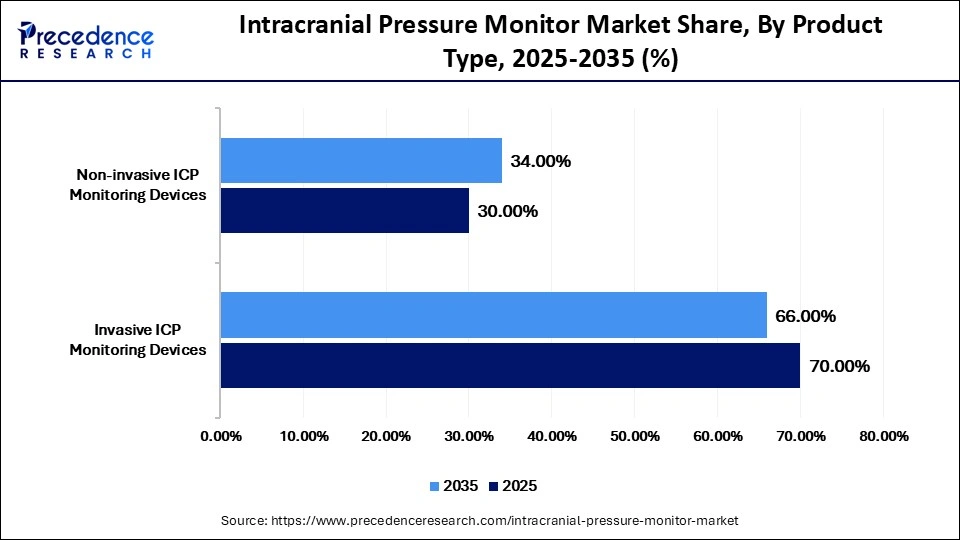
The non-invasive ICP monitoring devices segment held a 30% share of the market in 2025 and is expected to grow at the highest CAGR of 10.5% between 2026 and 2035, driven by demand for safer and more accessible monitoring solutions. Moreover, the adoption of these devices in emergency care and remote settings is further accelerating due to growing preference for non-invasive technologies.
Technology Insights
Intracranial Pressure Monitor Market Share, By Technology, 2025-2035 (%)
| Technology | 2025 | 2035 | CAGR (%) |
| Fiber Optic Sensors | 35.00% | 33.00% | 6.50% |
| Strain Gauge Sensors | 25.00% | 23.00% | 5.50% |
| Microelectromechanical Systems (MEMS) | 20.00% | 22.00% | 9.50% |
| Telemetric ICP Monitoring Systems | 20.00% | 22.00% | 10.50% |
The Fiber Optic Sensors Segment Dominated the Market in 2025
The fiber optic sensors segment dominated the intracranial pressure monitor market with a share of 35% in 2025, due to their established performance standards and widespread use in advanced neuromonitoring systems. These sensors provide very precise and consistent intracranial pressure measurements, making them necessary in the treatment of complex neurological cases. Furthermore, ongoing improvements in durability and calibration stability are enhancing long-term performance.
The strain gauge sensors segment held a 25% share of the market in 2025 and is expected to grow at a 5.5% CAGR between 2026 and 2035, owing to their simplicity and widespread use in clinical practice. Hospitals in developing countries use strain gauge systems to extend the coverage to ICP monitoring without capital-intensive investment.
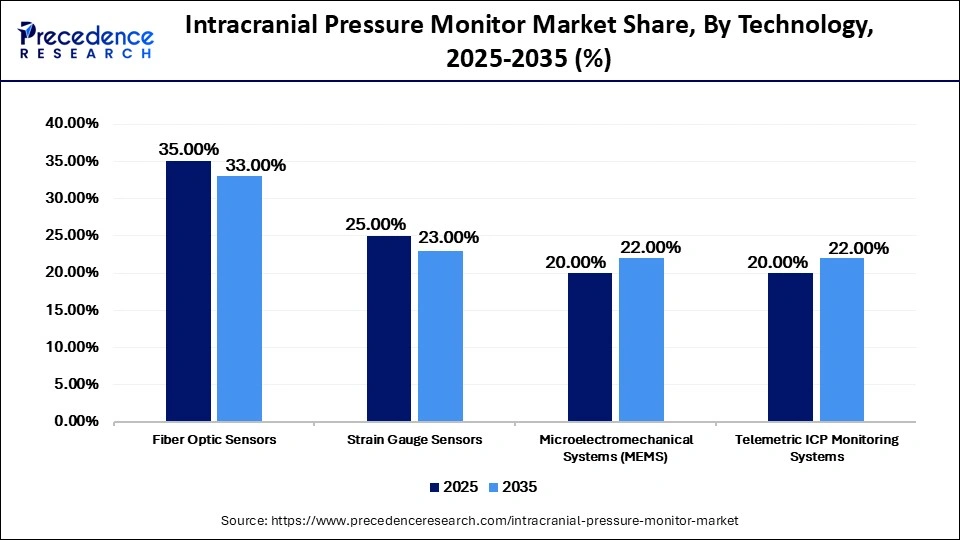
The microelectromechanical systems (MEMS) segment held a 20% market share in 2025 and is expected to grow at a strong CAGR of 9.5% over the projected period. The growth of the segment is driven by the need for small yet effective neuromonitoring systems in contemporary healthcare systems. These systems are miniaturized and have high performance, enhancing patient comfort.
The telemetric ICP monitoring systems segment held a 20% share of the market in 2025 and is expected to grow at a significant CAGR of 10.5% between 2026 and 2035. Due to the need to have long-term and remote monitoring features. This growth is driven by increasing demand for long-term and remote monitoring, as these systems enable continuous, wireless intracranial pressure tracking without physical connections.
Application Insights
The Traumatic Brain Injury (TBI) Monitoring Segment Held a 35% Market Share in 2025
The traumatic brain injury (TBI) monitoring segment dominated the intracranial pressure monitoring market with a share of 35% in 2025. This is mainly due to the key role of TBI monitoring in emergencies and trauma care settings. With the increased frequency of road accidents, falls, and head injuries, the need for continuous ICP monitoring has increased.
As per the World Federation of Neurosurgical Societies, traumatic brain injury pertains to more than 69 million individuals every year, further creating a necessity to monitor acute care in real-time. Furthermore, the clinicians in TBI give high importance to ICP monitoring to avoid secondary damage to the brain as well as to control cerebral perfusion.
Intracranial Pressure Monitor Market Share, By Application, 2025-2035 (%)
| Application | 2025 | 2035 | CAGR (%) |
| Traumatic Brain Injury (TBI) Monitoring | 35.00% | 34.00% | 7.00% |
| Intracerebral Hemorrhage Monitoring | 20.00% | 19.00% | 6.50% |
| Hydrocephalus Management | 20.00% | 21.00% | 8.00% |
| Stroke Monitoring | 15.00% | 16.00% | 7.50% |
| Other Neurological Disorders | 10.00% | 10.00% | 6.00% |
The intracerebral hemorrhage monitoring segment held the second-largest market share of 20% in 2025 and is expected to grow at a 6.5% CAGR during the projection period. This is mainly due to the rising cases of hypertension-related brain hemorrhage across aging populations. According to the American Heart Association, intracerebral hemorrhage represents nearly 10-15% of all stroke cases in 2025. This emphasizes the need for continuous ICP monitoring.
The hydrocephalus management segment held a 20% share of the market in 2025 and is estimated to grow at a strong CAGR of 8% over the projected period. The growth of the segment is driven by rising cases of both congenital and age-related incidences of hydrocephalus, which are precipitating the need for long-term intracranial pressure monitoring solutions. According to the Hydrocephalus Association, hydrocephalus affects nearly 1 in 770 births globally in 2025. These factors increase long-term monitoring needs, further propelling the segment.
The stroke monitoring segment held a 15% share of the market in 2025 and is expected to grow at a CAGR of 7.5% between 2026 and 2035. This is mainly due to the growing application of monitoring technologies in acute stroke management guidelines. The rising rates of strokes worldwide promote the need for continuous control of the intracranial pressure and brain movement.
End-Use Insights
Hospitals Held a 60% Share of the Market in 2025
The hospitals segment dominated the intracranial pressure monitor market with a share of 60% in 2025 due to their central role in delivering advanced neurocritical care services. Massive inflow of patients, particularly the emergency and trauma cases, enhances the need to constantly monitor intracranial pressure.
The neurosurgery centers segment held a 15% market share in 2025 and is expected to grow at a 8% CAGR during the forecast period. This is primarily due to these centers' focus exclusively on complex brain and spinal procedures, increasing demand for precise intracranial pressure monitoring systems. Furthermore, the segment growth is fueled by the increased complexity of the procedures and the emphasis on precision-focused neurosurgery.
Intracranial Pressure Monitor Market Share, By End-Use, 2025-2035 (%)
| End-Use | 2025 | 2035 | CAGR (%) |
| Hospitals | 60.00% | 58.00% | 6.50% |
| Neurosurgery Centers | 15.00% | 16.00% | 8.00% |
| Ambulatory Surgical Centers (ASCs) | 10.00% | 10.50% | 7.50% |
| Trauma Centers | 10.00% | 10.50% | 8.50% |
| Research & Academic Institutes | 5.00% | 5.00% | 7.00% |
The ambulatory surgical centers (ASCs) segment held a 10% share of the market in 2025 and is estimated to grow at a strong CAGR of 7.5% over the projected period. The growth of the segment is driven by rising demand for more economical and time-saving surgical services. These facilities are attuned to minimally invasive surgery, and there is a growing use of small and effective ICP monitors.
The trauma centers segment held a 10% share of the market in 2025 and is expected to grow at a significant CAGR of 8.5% between 2026 and 2035. This is mainly due to the increasing incidence of road accidents and severe injuries, which is boosting the need for intracranial pressure monitors in these settings.
The research & academic institutes segment held a 5% market share in 2025 and is expected to register a 7% CAGR during 2026 and 2035. This is due to the continuous research in neurological disorders and critical care technologies. Additionally, the funding for neuroscience research supports the development of advanced monitoring solutions, thus facilitating segmental growth.
Regional Insights
North America Intracranial Pressure Monitor Market Size and Growth 2026 to 2035
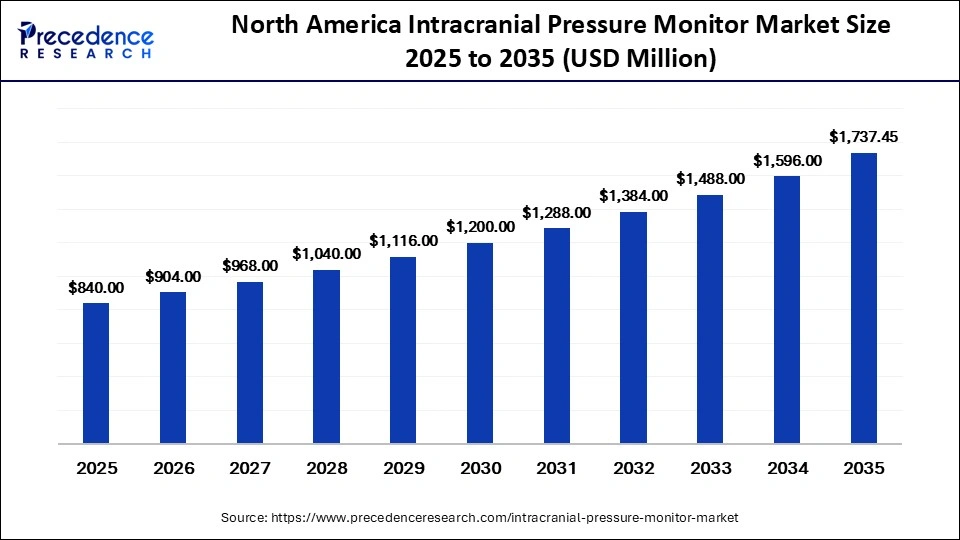
The North America intracranial pressure monitor market size is estimated at USD 840.00 million in 2025 and is projected to reach approximately USD 1,737.45 million by 2035, with a 7.54% CAGR from 2026 to 2035.
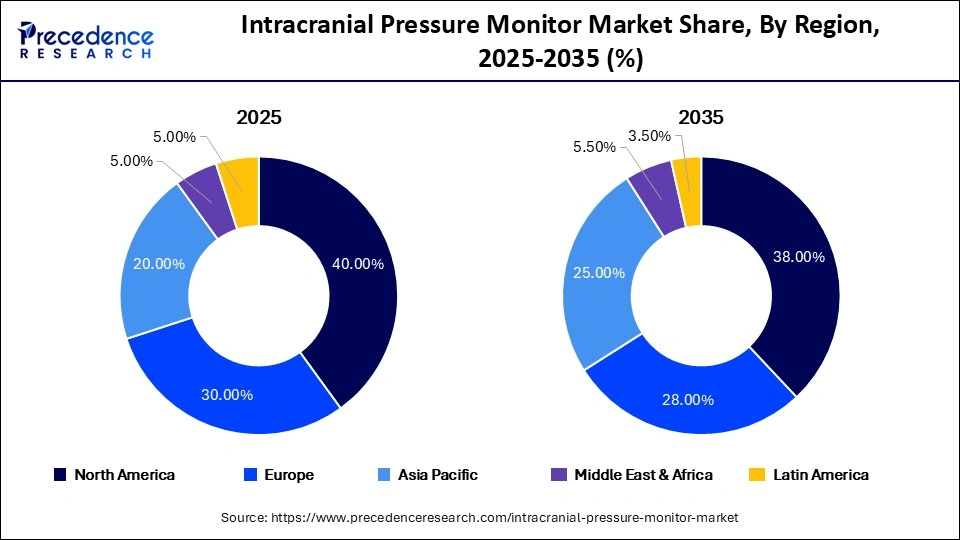
North America Led the Market With a 40% Share in 2025
North America led the intracranial pressure monitor market, capturing the largest revenue share of 40% in 2025. This is mainly due to its advanced neurocritical care infrastructure and widespread integration of ICP systems in intensive care units. High healthcare spending and continuous adoption of innovative neuromonitoring technologies further support regional growth. The presence of well-established clinical systems enables effective management of complex neurological disorders.
U.S. Intracranial Pressure Monitor Market Size and Growth 2026 to 2035
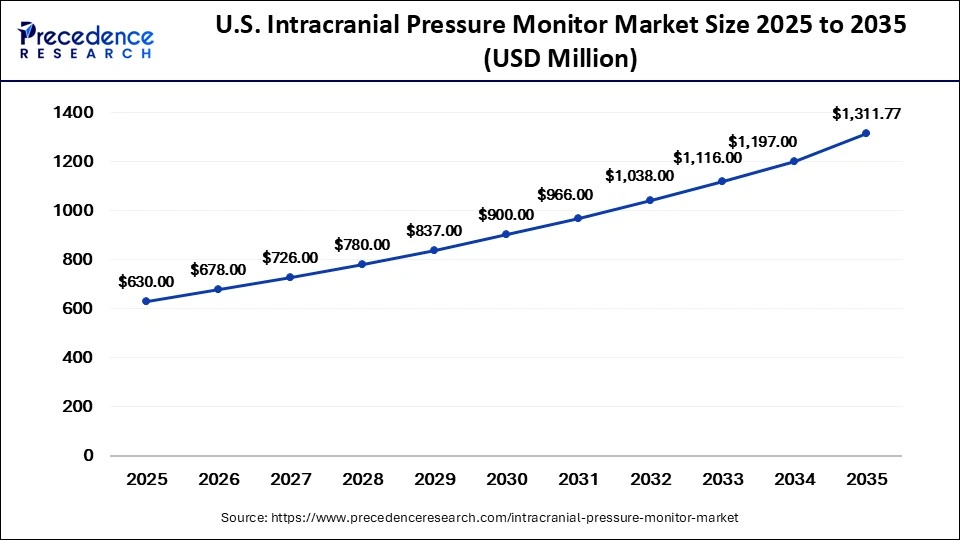
The U.S. intracranial pressure monitor market size is calculated at USD 630.00 million in 2025 and is expected to reach nearly USD 1,311.77 million in 2035, accelerating at a strong CAGR of 7.61% between 2026 and 2035.
U.S. Intracranial Pressure Monitor Market Analysis
The U.S. leads the market due to the high incidence of traumatic brain injuries (TBI), which drives demand for ICP monitoring technologies. According to the Centers for Disease Control and Prevention (CDC), over 2.87 million TBI-related emergency visits were reported in 2025, highlighting a significant clinical need. Additionally, the presence of leading medical device manufacturers supports ongoing innovation and rapid adoption of advanced monitoring systems.
Europe: The Second-Largest Market
Europe held the second-largest market share of 30% to the market in 2025 and is estimated to grow at a strong CAGR rate of 7% over the projected period. This growth is driven by increasing healthcare investments and expanding adoption of ICP monitoring technologies. Well-established healthcare infrastructure and rising focus on neurological disease management are driving steady market expansion.
Germany Intracranial Pressure Monitor Market Analysis
Germany is a key contributor to the European market, supported by strong healthcare infrastructure and high investment in advanced medical technologies. Hospitals are increasingly integrating ICP monitoring systems into specialized neurology and intensive care units to manage complex cases effectively.
Asia Pacific: The Fastest-Growing Region
Asia Pacific held a 20% share of the intracranial pressure monitor market in 2025 and is expected to grow at the highest CAGR of 10.5% between 2026 and 2035, owing to the rapid expansion of healthcare facilities. The increase in population and the burden of neurological disorders are fueling the need for advanced technologies to monitor conditions. There is an expansion of healthcare systems in countries, including China and India. The rise in awareness of neurological disorders and the increasing adoption of modernized medical technologies are also driving the growth of the market.
India Intracranial Pressure Monitor Market Analysis
India's market is growing due to rising patient volumes and ongoing improvements in healthcare delivery systems. Increasing prevalence of neurological disorders and expansion of trauma centers and neurocritical care units are driving demand for ICP monitoring technologies. Greater awareness and improved access to advanced medical devices are further supporting market growth.
Intracranial Pressure Monitor Market Value Chain Analysis
- Raw Material Sourcing
Biocompatible materials such as medical-grade polymers, silicone, and electronic components are sourced under strict quality and safety standards.
Key Players: DuPont, 3M, BASF.
- Component Fabrication
These materials are converted into precision components, including sensors, fiber-optic probes, and microelectronic circuits used in ICP devices.
Key Players: TE Connectivity, Honeywell, STMicroelectronics.
- Device Manufacturing & Regulatory Approval
Components are assembled into ICP monitoring systems and undergo clinical validation and regulatory approvals to ensure safety and performance.
Key Players: Medtronic, Integra LifeSciences, U.S. Food and Drug Administration.
- Distribution & End-User Utilization
Approved devices are distributed to hospitals and utilized in neurosurgical and ICU settings with ongoing technical support and maintenance.
Key Players: McKesson Corporation, Cardinal Health, Mayo Clinic.
Intracranial Pressure Monitor Market Companies
- Ad-Tech Medical Instrument Corporation
- Biometrix Ltd.
- Codman Neuro (Johnson & Johnson)
- Gaeltec Devices Ltd.
- GE Healthcare
- Integra LifeSciences Corporation
- Medtronic plc
- Natus Medical Incorporated
- Neuromedex GmbH
- Neurovent (Raumedic Group)
- Philips Healthcare
- Raumedic AG
- Smiths Medical (ICU Medical Inc.)
- Sophysa SA
- Spiegelberg GmbH & Co. KG
Recent Developments
- In April 2026, Zeto, Inc. announced that it secured 510(k) clearance from the U.S. Food and Drug Administration for its Zeto New Wave EEG system, designed for both outpatient clinics and home-based care settings. The company focuses on advancing brain health monitoring by positioning EEG as a routine vital sign, enabling faster and more accessible neurological assessments outside traditional hospital environments.(Source: https://www.prnewswire.com)
- In January 2026, the U.S. Food and Drug Administration granted 510(k) clearance to Intellidrop, an automated brain fluid management system developed by BrainSpace. The system supports cerebrospinal fluid drainage and intracranial pressure monitoring through integrated hardware and software, delivering continuous pressure measurement alongside automated, gravity-driven fluid management tailored to patient-specific targets.(Source: https://practicalneurology.com)
Segments Covered in the Report
By Product Type
- Invasive ICP Monitoring Devices (External Ventricular Drain, Intraparenchymal Sensors, Subdural Screws)
- Non-invasive ICP Monitoring Devices (Transcranial Doppler, Optic Nerve Sheath Diameter Systems, Tympanic Membrane Displacement Devices)
By Technology
- Fiber Optic Sensors
- Strain Gauge Sensors
- Microelectromechanical Systems (MEMS)
- Telemetric ICP Monitoring Systems
By Application
- Traumatic Brain Injury (TBI) Monitoring
- Intracerebral Hemorrhage Monitoring
- Hydrocephalus Management
- Stroke Monitoring
- Other Neurological Disorders
By End-Use
- Hospitals
- Neurosurgery Centers
- Ambulatory Surgical Centers (ASCs)
- Trauma Centers
- Research & Academic Institutes
By Region
- North America
- Latin America
- Europe
- Asia-pacific
- Middle and East Africa
For inquiries regarding discounts, bulk purchases, or customization requests, please contact us at sales@precedenceresearch.com
Frequently Asked Questions





Ask For Sample
No cookie-cutter, only authentic analysis – take the 1st step to become a Precedence Research client
 Get a Sample




 sales@precedenceresearch.com
 Schedule a Meeting
