



Legal Technology Market Revenue, Leading Companies, Company Technology / Innovation, Service Utilization, Infrastructure Capacity, Sales Performance, Pricing Metrics, Competitive Positioning, and Growth Opportunities
Legal Technology Market (By Offering Type: Solutions (Software & Intellectual Property), Services (Professional & Labor-Based); By Function / Utility: Practice & Business Operations, Document & Contract Lifecycle, Litigation & Dispute Support, Knowledge & Research Intelligence; By End-User: Law Firms, Corporate Legal Departments, Government & Public Sector, Consumers & Small Business (B2C/B2B), Alternative Legal Service Providers (ALSPs)) – Global Industry Analysis, Size, Trends, Leading Companies, Regional Outlook, and Forecast 2026 to 2035
Source: https://www.precedenceresearch.com/legal-technology-market
 Get a Sample
 Table Of Content


What is the Legal Technology Market Size?
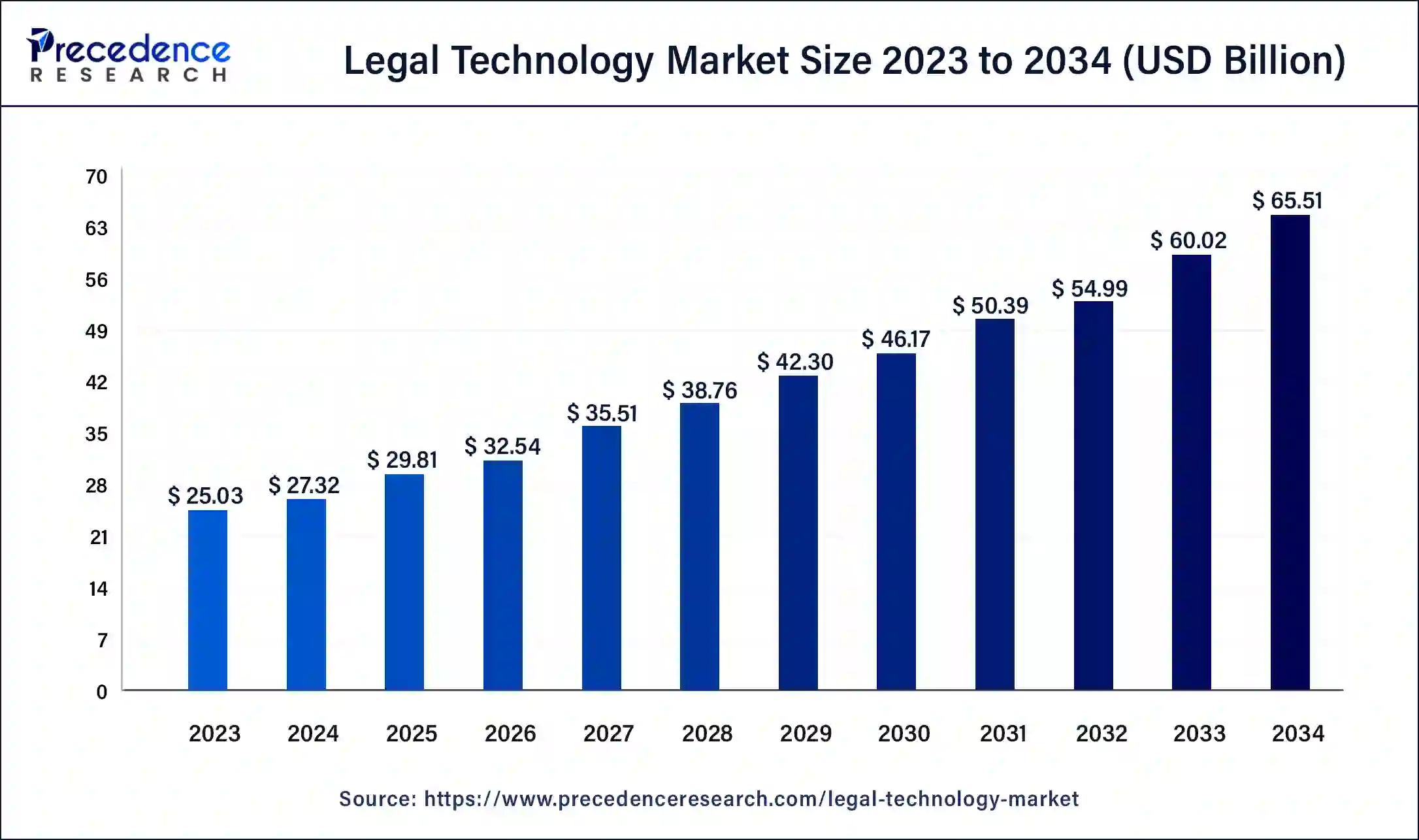
The global legal technology market size is calculated at USD 29.81 billion in 2025 and is predicted to increase from USD 32.53 billion in 2026 to approximately USD 73.32 billion by 2035. The market is expanding at a solid CAGR of 9.42% over the forecast period 2026 to 2035. The market is driven by increasing adoption of AI-powered tools, automation, and digital solutions that improve efficiency, compliance, and legal service delivery.
Key Takeaways
- The global legal technology market was valued at USD 29.81 billion in 2025.
- It is projected to reach USD 73.32 billion by 2035.
- The market is expected to grow at a CAGR of 9.42% from 2026 to 2035.
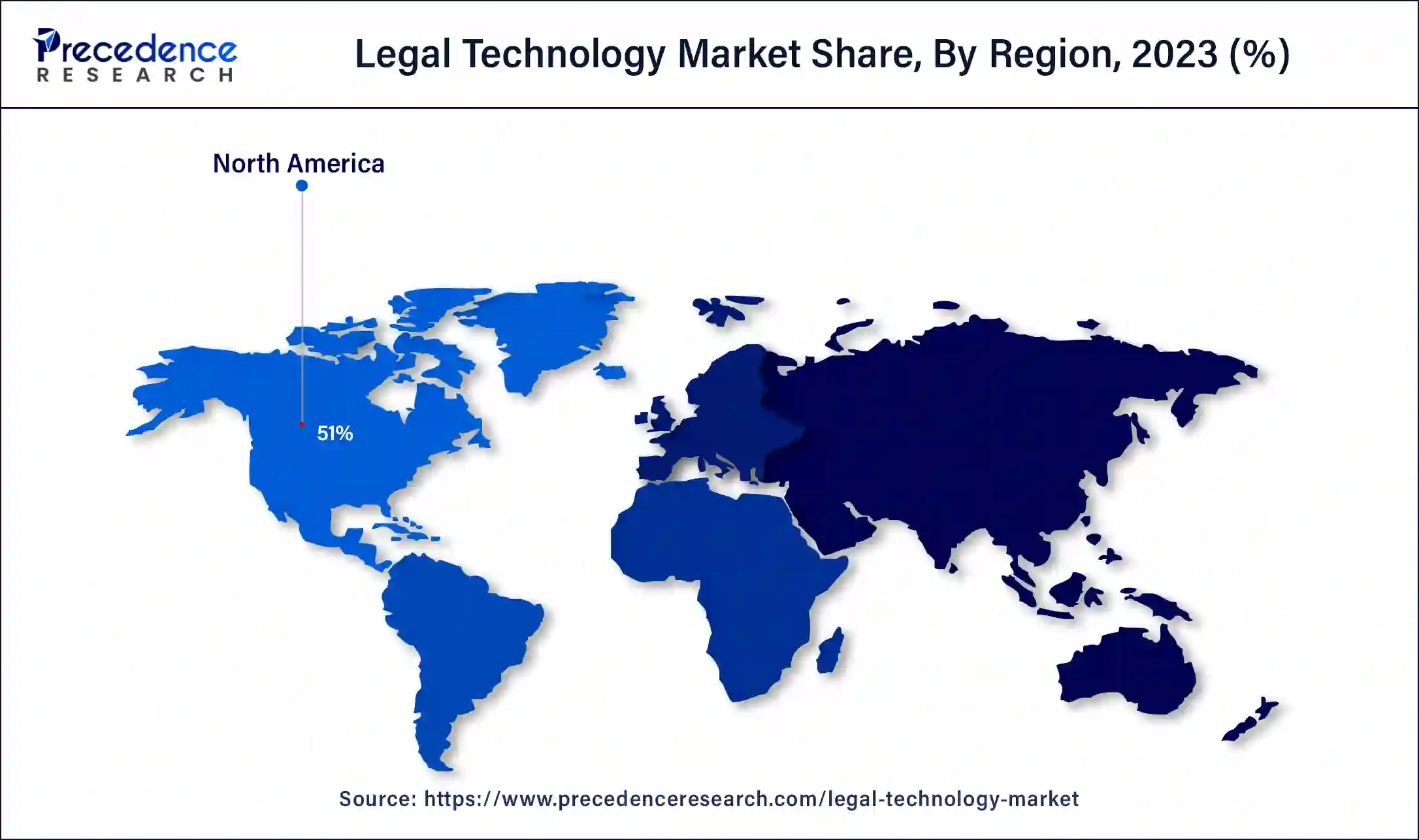
- North America led the legal technology market with the largest revenue share of 54% in 2025.
- Asia Pacific is observed to grow at the fastest rate during the forecast period.
- By offering type, the solutions (software & intellectual property) segment has generated the biggest revenue share of 78% in 2025.
- By function / utility, the practice & business operations segment has contributed more than 25% of revenue share in 2025.
- By end-user, the law firms segment has recorded the highest revenue share of 60% in 2025.
- By end-user, the corporate law departments segment is observed to grow at the fastest rate during the forecast period.
Market Overview
Legal technologies include a wide range of instruments and software applications that aim to eliminate or simplify any aspect of the field of law. These include the case management system, Electronic Discovery Software, Contract Management platforms, Legal Research tools, Document automation software, and Virtual law firms. The benefit of legal technology is to increase efficiency, cost reduction, and improve accuracy. The global market for legal technology is expected to grow at an encouraging rate over the coming years, due to which there will be increasing productivity among administrative staff and increased efficiency within law agencies.
The emerging concept in the legal technology market is smart contracts, blockchain technology, and artificial intelligence (AI), which has enabled law firms and legal departments to store records safely. Furthermore, the legal industry is undergoing rapid changes as Artificial Intelligence speeds up, and law technology companies are developing a broad range of AI-powered solutions.
Additionally, Legal tech solutions to help lawyers with a wide range of tasks, such as legal research, document review, and contract analysis, can be provided by artificial intelligence or machine learning technologies. The adoption of cloud platforms is increasing the development of the global legal technology market, which allows lawyers to access legal software and data from anywhere and make it easier for lawyers to collaborate with their clients.
Legal Technology Market Growth Factors
- Due to the exponential growth of digital data, there has been a growing amount of electronic evidence that requires advanced instruments and software for efficiently managing and analyzing large amounts of information.
- To protect individuals and organizations from cybercrime and data theft, there is an increased need for Forensic Investigation and legal action.
- Advances in AI and machine learning have enabled lawyers to take advantage of predictive analytics and data-derived insights that allow them to anticipate potential litigation risks and make critical business decisions. This has led to increased demand in the legal technology market for litigation and investigation solutions.
- The need to resolve large cases, comply with regulations, and facilitate Alternative Dispute Resolution and the handling of evidence electronically is also driving demand for legal technology solutions in litigation and investigations.
Major Market Trends
- Growing Adoption of Generative AI and Legal Automation: Generative AI is transforming legal workflows by automating tasks such as contract drafting, legal research, document review, and case summarization. Law firms and corporate legal departments are adopting AI-powered tools to improve efficiency, reduce manual effort, and accelerate decision-making.
- Expansion of Cloud-Based Legal Platforms: Cloud-based legal solutions are gaining popularity due to their scalability, accessibility, and lower infrastructure costs. These platforms enable secure document management, remote collaboration, and real-time access to legal information, supporting the growing trend toward hybrid and remote work environments.
- Increased Focus on Compliance and Regulatory Technology (RegTech): Organizations are investing in legal technology solutions that help manage regulatory compliance, risk assessment, and policy monitoring. Automated compliance tools reduce the complexity of navigating evolving regulations while improving accuracy and minimizing legal risks.
How is AI Impacting the Legal Technology Market?
Artificial intelligence is significantly transforming the legal technology market by automating time-intensive tasks such as contract review, legal research, document drafting, and compliance monitoring. AI-powered platforms can analyze vast volumes of legal data within seconds, helping law firms and corporate legal departments improve accuracy, reduce operational costs, and increase productivity. Advanced technologies such as natural language processing (NLP) and generative AI enable faster case analysis, risk assessment, and predictive insights, supporting better legal decision-making. As organizations seek greater efficiency and regulatory compliance, AI-driven legal solutions are becoming an essential tool for modern legal operations and digital transformation.
Market Scope
| Report Coverage | Details |
| Market Size by 2035 | USD 73.32 Billion |
| Market Size in 2025 | USD 29.81 Billion |
| Market Size in 2026 | USD 32.53 Billion |
| Market Growth Rate from 2026 to 2035 | CAGR of 9.42% |
| Largest Market | North America |
| Base Year | 2025 |
| Forecast Period | 2026 to 2035 |
| Segments Covered | Offering Type, Function / Utility, End-user, and Regions |
| Regions Covered | North America, Europe, Asia-Pacific, Latin America, and Middle East & Africa |
Market Dynamics
Driver
Increasing Adoption of Cloud-based Technologies
Cloud technologies are becoming more widespread, and they have a significant influence on the law technology market. There are a variety of benefits to cloud-based legal technology, such as scalability, flexibility, and cost-effectiveness compared with existing Premises solutions.
Cloud technology enables a large amount of data to be stored safely in the cloud for law firms and lawyers. This means that the need for physical servers is no longer necessary, providing users with a simple and accessible way to access court records, case files, contracts, or other pertinent information via Internet-connected devices at any time. It makes it easier for users to find specific documents and ensures the proper management of their document lifecycle by grouping files, using metadata, applying version controls, or performing advanced searches. By using cloud technology, legal firms can focus on their core competencies, reduce administrative burdens, and enhance their overall productivity and client service.
Additionally, cloud technology has been widely adopted in the legal technology market, which has changed the way law firms and legal professionals operate. Moreover, Cloud-based solutions offer several benefits, which include greater flexibility, scale, and cost-effectiveness. Furthermore, law firms can securely store and access a wide range of data and collaborate with clients and colleagues in ways that facilitate their business processes by using cloud technology.
Restraints
High Cost of Legal Technology
The high cost of legal technology is a major restraint in the legal technology market. The high costs of legal technology can be attributed to several factors. This is because of the cost of development, limited market size, and lack of standardization. As a result of the growing market, and as more companies learn how to use these technologies, the cost of legal technology is likely to decrease. However, for some time to come, the high costs of law enforcement technology will continue to be an obstacle on the market.
Cyberattacks on legal technology
Cyberattacks on legal technology, such as data breaches, unauthorized access to client information, and disruption of judicial proceedings, pose a serious risk. Due to the sensitive and valuable data they possess, law firms and legal organizations are attractive targets for hackers. To gain unauthorized access to sensitive information, cybercriminals use a range of techniques, such as phishing, ransomware attacks, and data breaches.
Nevertheless, these attacks not only affect the client data but also have an impact on operations, which leads to a loss of revenue and reputational damage. For Instance, the law firm Campbell Conroy & O'Neil P.C. was subject to a data breach on February 27, 2021. The ransomware attack prevented Campbell Conroy & O'Neil P.C. from accessing critical files in its system.
Opportunity
Artificial intelligence (AI) segment in legal technology Market
The AI segment in the legal technology market is growing rapidly as lawyers and legal professionals look for ways to use artificial intelligence to improve their efficiency and productivity. AI solutions for legal technology are being used in various areas, including contract review and analysis. Legal research. E-discovery. Fraud detection. In addition, artificial intelligence can automagically perform some of the everyday tasks, freeing up legal professionals' time for more important work. Artificial intelligence is transforming the legal landscape by increasing productivity, simplifying processes and workflows, and providing more efficient services through its capacity to handle complicated and data-heavy tasks.
The legal sector can be transformed into a more efficient and productive one by artificial intelligence. The development of law firms is being positively impacted by the application of artificial intelligence in the legal technology market. This growth can be expected to continue in the future as AI technology develops.
Segment Insights
Offering Type Insights
What made solutions the dominant segment in the legal technology market?
The solutions segment dominated the market with the largest share in 2025 because AI-powered legal research solutions, e-discovery tools, contract lifecycle management platforms, and legal practice management software have become widely used. A growing number of law firms and corporate legal departments are investing in software platforms that lower operating costs, improve document management, increase compliance, and streamline workflows. The industry's need for legal technology solutions is further strengthened by the expanding integration of cloud-based technologies, artificial intelligence, and machine learning.
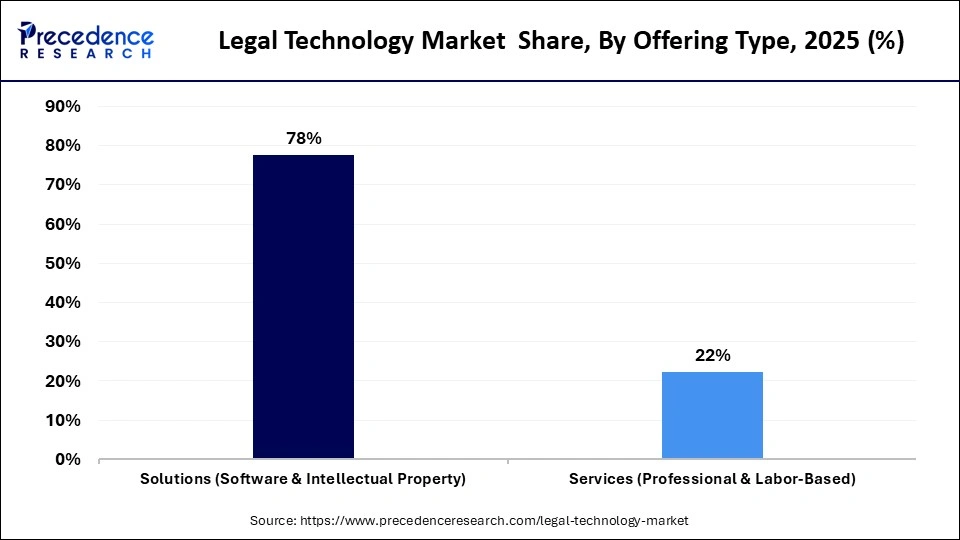
This segment's dominance is also driven by widespread adoption of enterprise-grade SaaS solutions for contract management, legal analytics, and e-discovery that deliver scalable automation, real-time collaboration, and enhanced compliance. Law firms, corporate legal teams, and ALSPs are increasingly investing in integrated software solutions to streamline workflows, reduce manual workloads, and derive actionable insights from large volumes of legal data.
The services segment is expected to witness the fastest growth during the forecast period due to the rising need for managed services, training implementation, integration, and consulting. To implement and optimize cutting-edge legal technology platforms while maintaining data security and regulatory compliance, organizations need specialized expertise. Global demand for expert legal technology services is being driven by the increasing complexity of digital transformation initiatives.
Function / Utility Insights
The practice & business operations segment dominated the market in 2025
The practice & business operations segment dominated the legal technology market in 2025 due to the increasing need for law firms and corporate legal departments to improve operational efficiency, streamline workflows, and reduce administrative burdens. Legal organizations are adopting practice management software to automate essential functions such as case management, time tracking, billing, document management, scheduling, client communication, and workflow coordination. These solutions help legal professionals optimize resource utilization, enhance productivity, and maintain compliance while managing growing caseloads and complex legal matters.
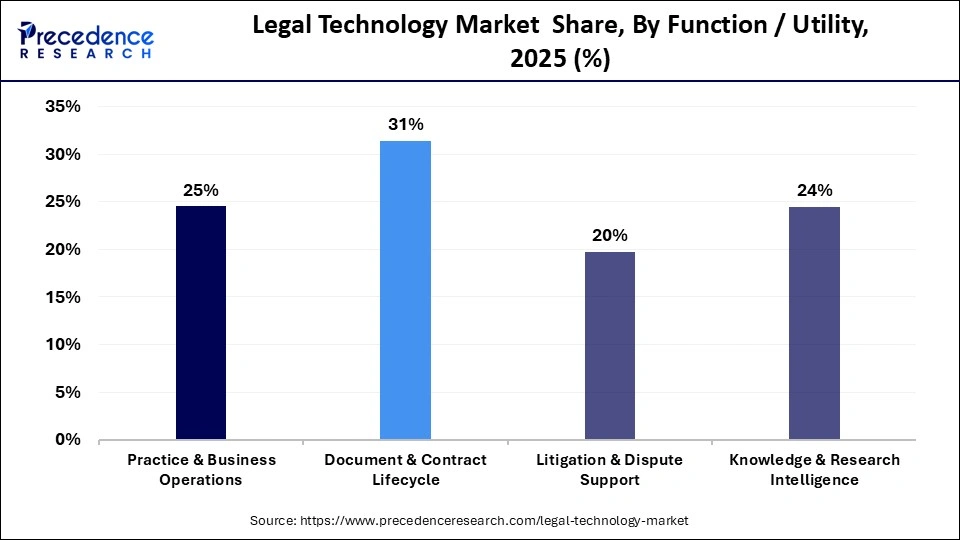
The document & contract lifecycle segment held a considerable share of the market in 2025 because it is vital to create, review, approve, store, and monitor contracts in an efficient manner. To cut down on manual labor, lower legal risks, and boost operational effectiveness, businesses are increasingly implementing automated contract management systems. Contract lifecycle management technology adoption is still fueled by the increasing number of business agreements and legal requirements.
The knowledge & intelligence segment is projected to grow at the fastest rate because AI-driven legal research platforms and analytics tools are becoming increasingly popular. To access case laws, rules, and legal precedents more quickly and accurately, legal professionals are utilizing cutting-edge technologies. Predictive analytics and generative AI are being used more frequently, which is speeding up this market's expansion.
End-user Insights
Why did the law firms segment dominate the legal technology market?
Law firms accounted for the largest share of the legal technology market because they make extensive use of document automation platforms for e-discovery tools, case management systems, and legal research software. Increasing client demands for quicker and more affordable legal services are pushing businesses to spend money on digital solutions that boost output, teamwork, and service quality. Law firms of all sizes are also actively adopting AI-powered legal tools.
Corporate law departments are anticipated to register the fastest growth during the forecast period as businesses concentrate more on handling compliance risk and automating legal processes. To increase productivity and lessen dependency on outside legal counsel, businesses are implementing contract management, legal analytics, and governance
solutions. Internal legal teams' adoption of technology is being driven by the need for real-time legal insights and the growing complexity of regulations.
Legal Technology Market Size, By End-User 2022 to 2024 (USD Billion)
| End-User | 2022 | 2023 | 2024 |
| Law Firms | 14.4 | 15.5 | 16.7 |
| Corporate Legal Departments | 4.4 | 4.9 | 5.5 |
| Government & Public Sector | 2.0 | 2.2 | 2.4 |
| Consumers & Small Business (B2C/B2B) | 1.3 | 1.4 | 1.5 |
| Alternative Legal Service Providers (ALSPs) | 1.1 | 1.2 | 1.3 |
Regional Insights
What is the U.S. Legal Technology Market Size?
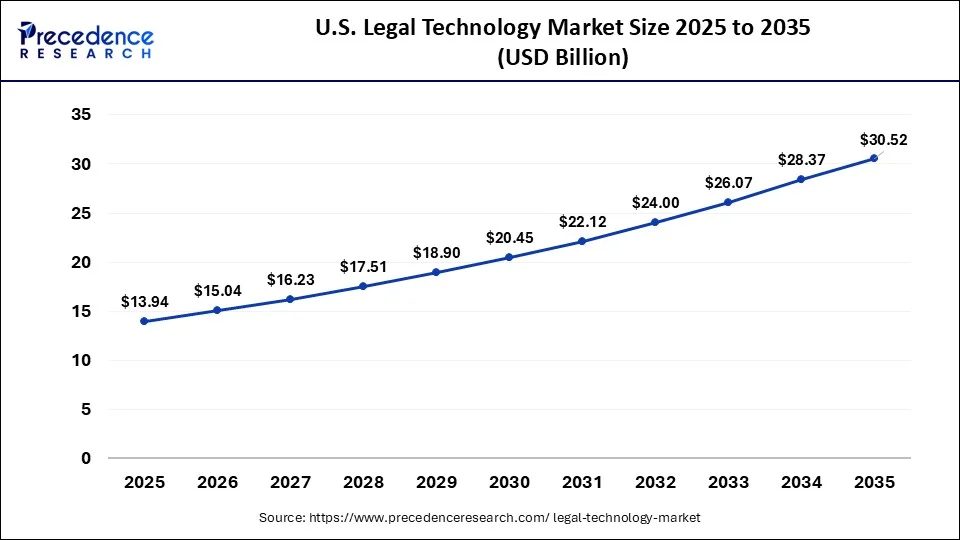
The U.S. legal technology market size is exhibited at USD 13.94 billion in 2025 and is projected to be worth around USD 30.52 billion by 2035, poised to grow at a CAGR of 8.15% from 2026 to 2035.
Why did North America dominate the legal technology market?
North America dominated the legal technology market by holding the largest share in 2025, owing to the widespread use of AI-powered legal solutions for sophisticated digital infrastructure and the robust presence of top legal technology providers. The region also benefits from significant investments in legal innovation, rising automation demand, and a thriving legal services sector because so many American law firms and corporate legal departments are adopting digital transformation.
U.S. Market Trends
The U.S. represents the largest legal technology market globally, driven by the existence of prominent legal technology vendors, corporate legal departments, and large law firms. To increase productivity and cut expenses, businesses are quickly implementing AI-powered legal research and contract management compliance solutions. Growing expenditure on legal innovation and digital transformation are sustaining the nation's market expansion.
What Makes Asia Pacific the Fastest-Growing Region in the Market?
Asia Pacific is expected to expand at the fastest CAGR during the forecast period because of the quickening pace of digitalization, the growth of the legal services sector, and the rising use of cloud-based legal technologies. To increase productivity and regulatory compliance, nations are making significant investments in legal modernization programs. Regulation of market expansion is also being aided by the growing number of startups in the legal technology ecosystem and the increased awareness of AI-driven legal solutions.
India Market Trends
India is emerging as one of the fastest-growing legal technology markets due to the growing demand for reasonably priced legal solutions and the increasing digitalization of legal services. Cloud-based platforms, document automation tools, and AI-driven legal research systems are being used more by law firms, businesses, and legal startups. Market expansion is being further accelerated by government programs that support judicial modernization and digital governance.
Why is the Latin American Legal Technology Market Gaining Momentum?
The Latin American market is experiencing steady growth owing to rising awareness of legal process automation and increased use of digital legal platforms. To increase operational efficiency, companies and law firms are investing in case management, contract management, and compliance monitoring systems. Legal technology innovation and adoption are also being aided by the growing startup ecosystem in the area.
Brazil Market Trends
Brazil is leading the legal technology market in Latin America, driven by the growing need for operational efficiency and the expanding digital transformation of legal services. To simplify legal procedures and lessen administrative burdens, law firms, corporate legal departments, and government organizations are implementing legal research platforms, contract management software, and compliance solutions. The nation's sizable legal services industry and growing technology ecosystem are fostering an environment that is conducive to market expansion. Additionally, growing investments in cloud-based legal platforms, automation, and artificial intelligence are improving the efficiency and accessibility of legal services.
How is the Opportunistic Rise of Europe in the Legal Technology Market?
Europe held a significant share of the market in 2025 and is expected to grow at a significant rate over the projection period, due to sophisticated legal software solutions being widely used and robust regulatory frameworks being in place. Businesses in the area are putting legal technology platforms into place to enhance contract administration data security and compliance management. The market is expanding as artificial intelligence and analytics tools are used more frequently. The need for advanced legal technologies is increasing due to the growing focus on GDPR compliance and international legal operations. Additionally, the region is seeing an increase in funding for legal innovation and digital transformation initiatives.
Germany Market Trends
Germany is one of the leading contributors to the European legal technology market, backed by its robust enterprise sector and sophisticated digital infrastructure. AI-based solutions for document management of legal research and regulatory compliance are being adopted by law firms and corporate legal departments at an increasing rate. Growing investments in automation technologies and legal innovation support the nation's market expansion.
What Drives the Market Within the Middle East & Africa?
The legal technology market within the Middle East & Africa (MEA) is driven by the modernization of legal systems and the growth of digital transformation initiatives. Legal technology solutions are being adopted by businesses and governments to increase legal process efficiency, regulatory compliance, and transparency. New prospects for market expansion throughout the region are being created by the increased emphasis on smart governance and digital services. Technology adoption is being aided by increasing investments in cloud infrastructure and digital legal services. The need for effective legal and compliance management solutions is also being driven by an increase in international business activities.
UAE Market Trends
The UAE is emerging as a key legal technology hub in the MEA, driven by quick digitalization and robust government support for innovation. To improve efficiency and service quality, legal firms are increasingly implementing AI-powered legal research, contract lifecycle management, and compliance solutions. The nation's emphasis on cutting-edge digital infrastructure and smart government initiatives is anticipated to support market expansion. The need for cutting-edge legal technologies is growing as free economic zones and international business operations expand. Furthermore, the UAE is becoming a regional leader in legal innovation thanks to continuous investments in AI and digital transformation initiatives.
Competitive Landscape
The legal technology market is highly competitive, with companies focusing on artificial intelligence (AI), legal research, contract lifecycle management (CLM), e-discovery, compliance solutions, legal automation, and cloud-based platforms to strengthen their market positions. Market participants are increasingly investing in product innovation, strategic partnerships, mergers and acquisitions, and generative AI capabilities to enhance legal workflows, improve productivity, and deliver greater value to law firms, corporate legal departments, and government agencies.
Leading players are developing advanced AI-powered solutions that automate legal research, contract analysis, document review, case management, and compliance monitoring. The growing adoption of cloud-based legal platforms is also driving competition, as organizations seek scalable, secure, and collaborative solutions that support remote and hybrid work environments. Companies are differentiating themselves through integrated platforms that combine workflow automation, analytics, e-discovery, and contract management capabilities.
Key companies operating in the market include Thomson Reuters, LexisNexis, Wolters Kluwer, Clio, Relativity, Luminance, DISCO, Everlaw, Ironclad, Filevine, MyCase, and PracticePanther. These companies continue to expand their AI-driven capabilities and cloud offerings to address the evolving requirements of the global legal services industry.
Legal Technology Market Companies
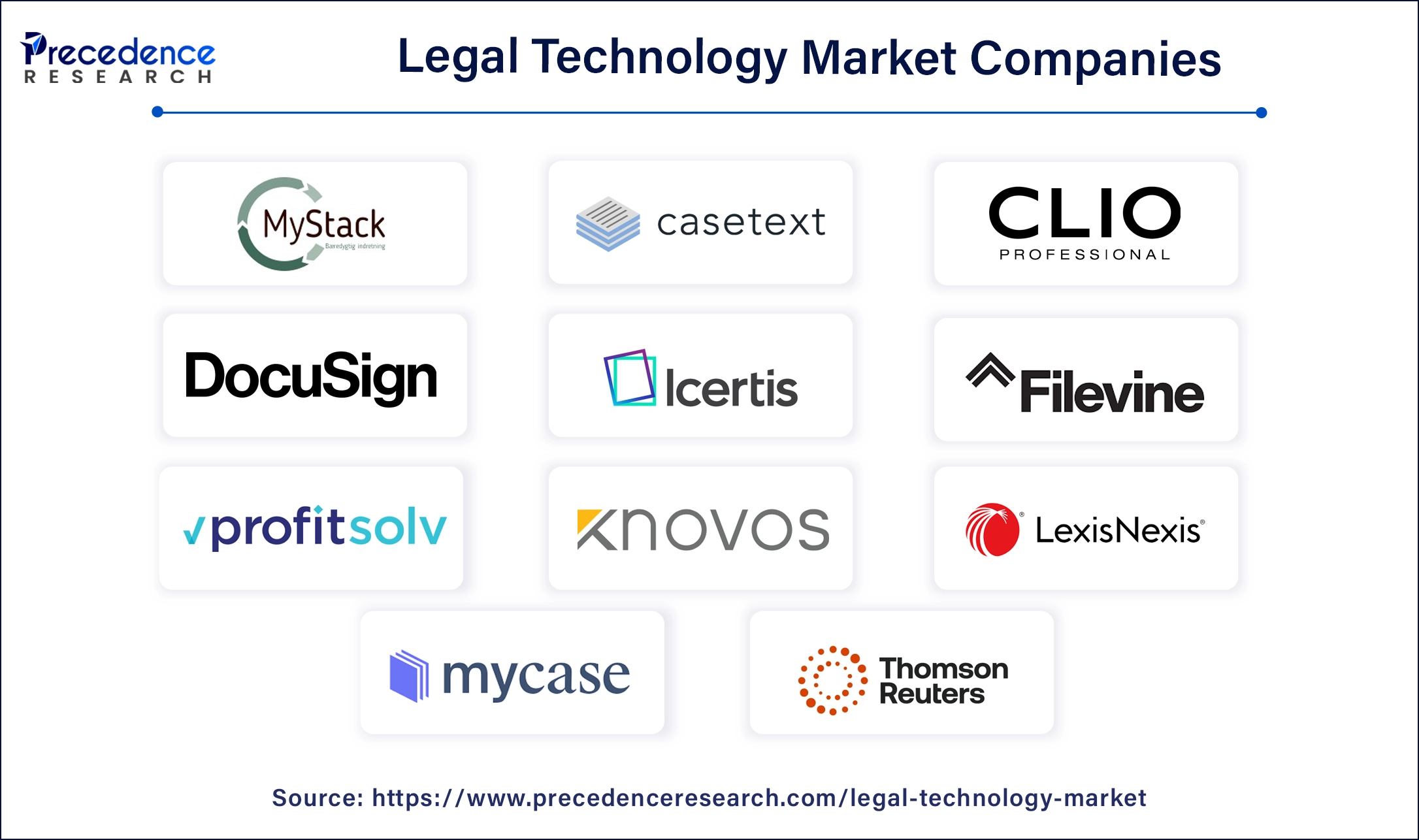
- LexisNexis Legal & Professional Company
- Clio
- My Case
- Thomson Reuters
- Icertis, Inc.
- Filevine Inc.
- DocuSign, Inc.
- Casetext Inc.
- ProfitSolv, LLC
- Knovos, LLC
- Mystacks, Inc.
Recent Government Initiatives Supporting the Legal Technology Market
- In June 2026, the UK Government launched the AI Growth Labs initiative to accelerate innovation in legal technology (LawTech). The program provides secure testing environments where legal technology companies can develop, test, and deploy AI-powered legal solutions while receiving regulatory guidance. The initiative aims to modernize legal services, improve access to justice, and promote responsible AI adoption across the legal sector.
- In April 2025, the UK Government initiated the next phase of AI Growth Zones, creating dedicated innovation hubs to accelerate AI development and adoption. While spanning multiple industries, the initiative supports legal technology innovation by providing infrastructure, investment opportunities, and a favorable environment for AI-driven legal solutions. The program is expected to strengthen the country's digital legal ecosystem.
- In March 2026, the Karnataka Government launched a pilot project aimed at creating paperless courts through digital filing, electronic records management, and technology-enabled judicial proceedings. The initiative seeks to improve efficiency, transparency, and accessibility within the judicial system while supporting broader adoption of legal technology solutions in court administration
Recent Development
- In October 2025, Clio introduced the Intelligent Legal Work Platform, an AI-powered legal technology solution that integrates legal practice management, legal intelligence, and business operations into a single ecosystem. The platform is designed to enhance productivity, automate workflows, and support law firms with advanced AI capabilities across legal processes. The launch reflects the growing demand for unified legal technology platforms that improve efficiency and client service delivery.
- In July 2025, LexisNexis launched Protégé, a personalized AI legal assistant designed to help legal professionals accelerate legal research, document drafting, summarization, and client advisory tasks. The solution incorporates agentic AI capabilities and advanced legal intelligence features, enabling lawyers to improve productivity while maintaining accuracy and compliance. The launch strengthens LexisNexis' position in the rapidly evolving legal AI market.
- In April 2025, Anytime AI launched its 5th Generation Legal AI Platform, providing end-to-end automation and AI-powered workflow management for legal professionals. The platform offers enhanced collaboration tools, intelligent case management capabilities, and productivity features that help legal teams streamline operations and improve case outcomes. The launch highlights the increasing role of generative AI in legal practice modernization.
- In March 2025, Reveal announced the release of GenAI Review, an advanced document review solution that combines generative AI with attorney-centric workflows. The platform helps legal teams conduct faster, more accurate, and cost-effective document reviews while maintaining transparency and legal defensibility. The solution is aimed at transforming e-discovery and legal investigation processes through AI-driven automation.
- In August 2025, Reveal launched its new AI-powered review platform, "aji," designed to enhance legal document review through patent-pending AI guidance, calibration tools, and hybrid review capabilities. The platform enables legal professionals to leverage advanced generative AI technologies while maintaining control over legal workflows and review processes. The initiative reflects the industry's growing focus on AI-assisted legal operations and workflow optimization.
- In July 2024, UK-based data protection advisory company 2twenty4 Consulting released an AI GDPR assessment tool in order to offer firms an idea of compliant AI projects. The toll can help in minimizing the risk of personal data processed by AI system.
- In July 2204, US-based startup, Paxton AI announced the launch of its new AI Citator to help legal professionals in saving time for detailed legal context. Paxton AI created this citation service with an advanced efficiecny and accuracy.
- In July 2024, Clio announced the launch of accounting solutions for law firms. The company will offer comprehensive platform tailored to the needs of legal professionals.
Segment Covered in the Report
By Offering Type
- Solutions (Software & Intellectual Property)
- SaaS & Cloud-Based Platforms
- On-Premise & Private Cloud Software
- Agentic AI (Autonomous AI Associates)
- Mobile-First Legal Applications
- API & Integration Middleware
- Services (Professional & Labor-Based)
- Implementation & Data Migration
- Managed Legal Services (LPO/ALSPs)
- Strategic Legal Ops Consulting
- AI Governance & Prompt Engineering Advisory
- Cyber-Forensics & Incident Response
- Technical Support & Maintenance
By Function / Utility
- Practice & Business Operations
- Document & Contract Lifecycle
- Litigation & Dispute Support
- Knowledge & Research Intelligence
By End-User
- Law Firms
- Corporate Legal Departments
- Government & Public Sector
- Consumers & Small Business (B2C/B2B)
- Alternative Legal Service Providers (ALSPs)
By Geography
- North America
- Asia Pacific
- Europe
- Latin America
- Middle East & Africa
For inquiries regarding discounts, bulk purchases, or customization requests, please contact us at sales@precedenceresearch.com
Frequently Asked Questions
Tags





Ask For Sample
No cookie-cutter, only authentic analysis – take the 1st step to become a Precedence Research client
 Get a Sample




 sales@precedenceresearch.com
 Schedule a Meeting
