



M-Commerce Market Size, Share and Trends 2026 to 2035
M-Commerce Market (By Transaction Type: M-Retailing, M-Ticketing/Booking, M-Billing, Other Transaction Types; By Payment Mode: Mobile Web Payments, Near-Field Communication (NFC), Premium SMS, Wireless Application Protocol (WAP), Direct Carrier Billing, Other Payment Modes; By Device Type: Smartphones, Tablets, Wearables (Smartwatches/Bands), Other Connected Devices; By End-User Application: Retail and E-commerce Applications, Banking and Financial Services, Travel and Hospitality, Media and Entertainment) - Global Industry Analysis, Size, Trends, Leading Companies, Regional Outlook, and Forecast 2026 to 2035
Source: https://www.precedenceresearch.com/m-commerce-market
 Get a Sample
 Table Of Content


What is the M-Commerce Market Size?
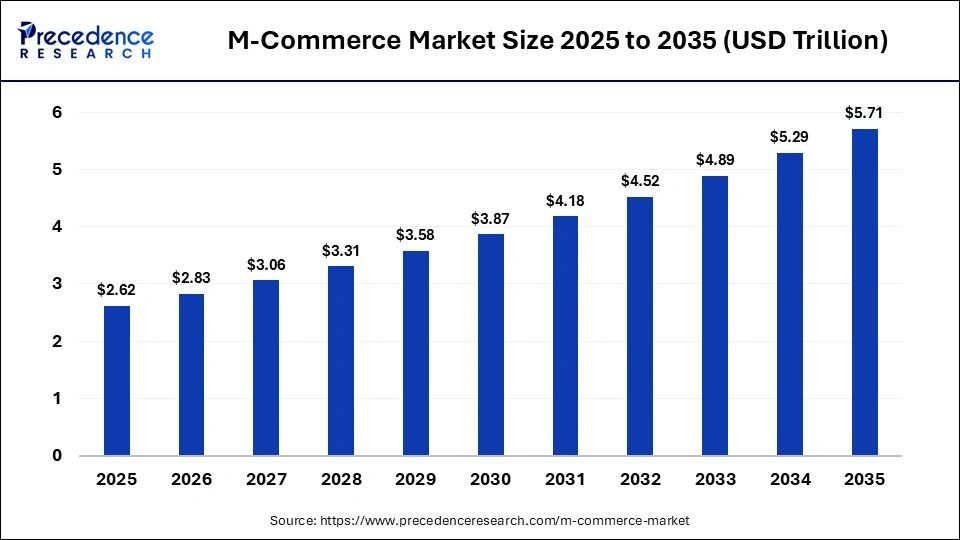
The global M-commerce market size was estimated at USD 2.62 trillion in 2025 and is predicted to increase from USD 2.83 trillion in 2026 to approximately USD 5.71 trillion by 2035, expanding at a CAGR of 8.11% from 2026 to 2035. The improved functionality of mobile applications for e-commerce offers loyalty, discount codes, allows for simple tracking of deliveries and returns, and holds potential for higher personalization.
Market Highlights
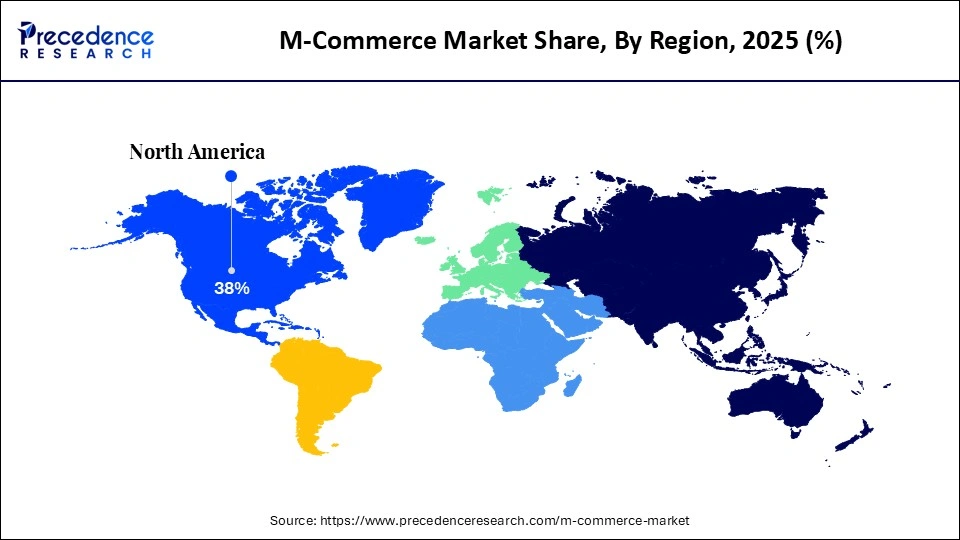
- North America dominated the market with the largest market share of 38% in 2025.
- Asia Pacific is expected to grow at the fastest CAGR in the market during the forecast period.
- By transaction type, the M-retailing segment dominated the market in 2025.
- By transaction type, the M-billing segment in the market is expected to grow at the fastest CAGR in the market during the forecast period.
- By payment mode, the mobile web payments segment dominated the market in 2025.
- By payment mode, the Near-Field Communication (NFC) segment is expected to grow at a notable rate in the M-commerce market in 2025.
- By device type, the smartphones segment dominated the market in 2025.
- By device type, the wearables segment is expected to grow at the fastest CAGR in the market during the forecast period.
- By end-user application, the retail and e-commerce applications segment dominated the market in 2025.
- By end-user application, the media and entertainment segment is expected to grow at the fastest CAGR in the market during the forecast period.
M Commerce: Advanced Search Features and Functionality
The M-commerce market is of utmost importance among the global population due to its associated convenience and the high trend of social media to purchase from e-commerce stores. The mobile applications are crucial for consumers to get personalized recommendations and information, and experience optimized UX and design. The end-users prefer transactions on smartphones and tablets through mobile-optimized websites or applications. Remarkable sales of e-commerce stores are driven by the integration of shopping features in social media platforms.
M-commerce is gaining traction with the inclusion of progressive web applications, augmented reality, mobile payments, digital wallets, livestream shopping, voice commerce, mobile UX reality, and social commerce. There is an increased focus on preventing mobile fraud by implementing multi-factor authentication with biometric verification and using AI-powered fraud detection and risk scoring. These efforts are also backed by deploying tokenization for payment data protection and conducting regular security audits and vulnerability assessments.
How does AI transform the M-Commerce Market?
AI-driven revolutionary changes are reshaping retail and changing the ways in which companies engage their clients. Amazon's AI-powered recommendation system analyzes previous purchases and purchasing patterns of consumers to make the best product recommendations. Alibaba is a renowned M-commerce platform in China, which has included AI into its M-commerce solutions to give its clients tailored product suggestions. A well-known cosmetics company named Sephora uses AI in its mobile application to offer virtual try-on experiences, while EBay uses AI to enhance search results and improve pricing tactics. AI and ML platforms greatly contribute to the expansion of the M-commerce market by playing an integral role in cybersecurity. They assist in detecting, stopping, and preventing any cyber-attacks.
M Commerce Market Trends
- Social Commerce Platforms: It is a comprehensive approach to social media marketing through different platforms like TikTok, Instagram, and Facebook. It includes the integration of shopping features directly into your social media presence and investing in platform-specific content. This content is related to TikTok videos, Instagram reels, and Facebook shop. These new ways target younger people with social-first shopping experiences that are also scaling up the M-commerce market. They also prefer partnerships with social commerce platforms for an expanded reach.
- Mobile Payments and Digital Wallets: These are becoming the standard due to the increased preference of consumers for contactless and secure payment methods. The consumers get many benefits in terms of security and convenience, which include faster transaction processing and better user experience across devices. The essential mobile payment features are tokenization, Near-field communication (NFC), real-time fraud detection, and streamlined checkout flow.
Market Scope
| Report Coverage | Details |
| Market Size in 2025 | USD 2.62 Trillion |
| Market Size in 2026 | USD 2.83 Trillion |
| Market Size by 2035 | USD 5.71 Trillion |
| Market Growth Rate from 2026 to 2035 | CAGR of 8.11% |
| Dominating Region | North America |
| Fastest Growing Region | Asia Pacific |
| Base Year | 2025 |
| Forecast Period | 2026 to 2035 |
| Segments Covered | Transaction Type, Payment Mode, Device Type, End-User Application, and Region |
| Regions Covered | North America, Europe, Asia-Pacific, Latin America, and Middle East & Africa |
Market Dynamics
Driver
The Rise of Digital Payment Systems
The increasing popularity of smartphones and increased access to faster internet connections have resulted in an upsurge in mobile commerce. Convenient digital payment gateways such as Apple Pay and Google Pay facilitate speedy and secure payment processes. The ability to conveniently shop on the go, coupled with the provision of personalized offers, has fueled its popularity amongst consumers. Furthermore, the ability to purchase goods directly through social media applications is making mobile commerce a more interactive and readily available shopping experience.
Restraint
Data Privacy
The threat of data theft, fraud, and phishing remains a persistent hurdle for mobile commerce. Mobile application design and slow load times have been a critical setback and consequently result in abandoned purchases. Limited screen real estate proves to be a bottleneck in comparing goods and easy browsing, consequently limiting the overall utility of mobile commerce platforms.
Opportunity
Augmented Reality
With rapidly increasing rates of mobile phone adoption in the market, m-commerce is projected for strong growth. A growing adoption of newer technology, such as AI and augmented reality, is providing a more intuitive and responsive shopping experience. Features like virtual try-ons and intelligent recommendations aid consumer purchasing decisions. The emergence of voice-commerce also provides quick and easy options to shop.
Segmental Insights
Transaction Type Insights
How did the M-Retailing Segment Dominate the M-Commerce Market in 2025?
The M-retailing segment dominated the market in 2025, owing to the key role of mobile technology in transforming retail by enhancing customer experience, streamlining operations, and ensuring a seamless omnichannel retailing. In this, key innovations include mobile payments, mobile point-of-sale systems, augmented reality, virtual reality, IoT-enabled smart shelves, and inventory management. The future trends in mobile retail technology that enhance connectivity, data processing, and security include 5G technology, blockchain in retail, and edge computing.
The M-billing segment is expected to grow at the fastest CAGR in the M-commerce market during the forecast period due to the increased use of mobile wallets by young consumers and efforts of companies to integrate mobile wallets into their bill payment platforms. The bills and payments are shaping the services and capabilities of the payment industry. The companies are exploring new opportunities to introduce flexible payment options.
Payment Mode Insights
What made Mobile Web Payments the Dominant Segment in the Market in 2025?
The mobile web payments segment dominated the M-commerce market in 2025, owing to the integration with emerging technologies such as voice assistants, virtual reality, and augmented reality, which create new opportunities for e commerce business and enhance the shopping experience. Mobile payments result in increased sales and revenue for e-commerce businesses due to their speed and convenience. E-commerce is widely accessible to a wider audience due to mobile payments, which allows businesses increase their sales and reach more customers.
The Near-Field Communication (NFC) segment is estimated to grow at the fastest rate in the M-commerce market during the predicted timeframe due to safe transmission for payments and maintenance of consumer trust. NFC enables users to make faster payment transactions, and NFC contactless payments require less time per transaction. Mobile wallets using NFC are the rising trend, while NFC-enabled cards provide the same functionality.
Device Type Insights
How did the Smartphones Segment Dominate the M-Commerce Market in 2025?
The smartphones segment dominated the market in 2025, owing to the advantages of M-commerce in lowering shopping process times, creating specific offers for mobile users, and lowering operational costs. E-commerce stores directly interact with specific users and gather customers' essential data through mobile devices. There is a wide use of Android smartphones and iPads for e-commerce transactions.
The wearables segment is anticipated to grow at the fastest rate in the M-commerce market during the upcoming period due to the core benefits of wearable devices, such as device compatibility, user interaction, functionality, interface design, cross-platform support, connectivity, and personalization. They give real-time notifications and alerts, flexible payment solutions, and recommendations. The wearable app development services for e-commerce businesses are beneficial for enhanced customer engagement, improved accessibility, real-time data collection, and insights.
End-User Application Insights
Why did the Retail and E-commerce Applications Segment dominate the M-Commerce Market in 2025?
The retail and e-commerce applications segment dominated the market in 2025, owing to the offered tools such as biometric security, push notifications, and location-based marketing that allow businesses to reach customers anytime. M-commerce supports the integration of features like in-store inventory checks and Click and Collect through smartphones. Mobile applications heavily use hardware features like fingerprint scanning and face ID to secure transactions more efficiently.
The media and entertainment segment is predicted to grow at a rapid rate in the m-commerce market during the studied period due to the rising trends of streaming services and gaming. A rapid shift towards different streaming platforms like Spotify, Netflix, and YouTube allows mobile applications to stream audio and video content. Mobile gaming apps offer casual puzzles, complex multiplayer experiences, and more.
Regional Insights
How Big is the North America M-Commerce Market Size?
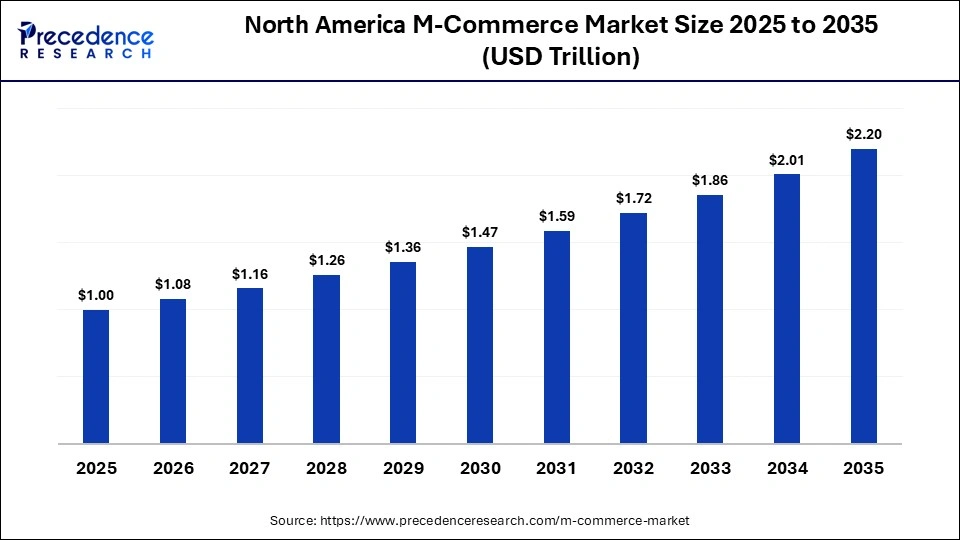
The North America M-commerce market size is estimated at USD 1.00 trillion in 2025 and is projected to reach approximately USD 2.20 trillion by 2035, with a 8.20% CAGR from 2026 to 2035.
How did North America dominate the M-Commerce Market in 2025?
North America dominated the market in 2025, owing to enhanced shopping experiences through social commerce integration and personalization with AI, and an improved retail and logistics ecosystem. Research suggests that North America accounts for 319 million mobile internet users across this region, and about $1.6 trillion was contributed to the North American economy by mobile in 2024. It is expected that 89% of mobile connections in North America will be 5G by 2030.
What is the Size of the U.S. M-Commerce Market?
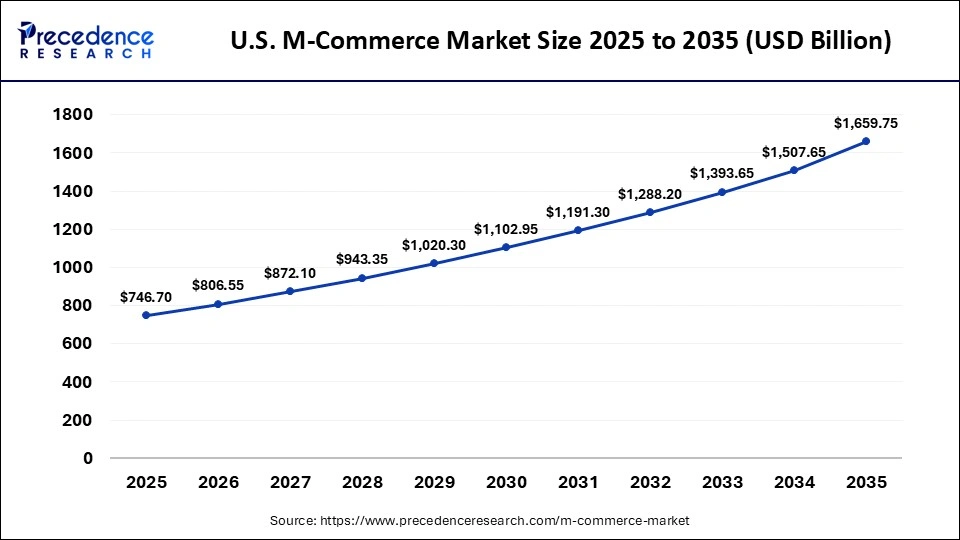
The U.S. M-commerce market size is calculated at USD 746.70 billion in 2025 and is expected to reach nearly USD 1,659.75 billion in 2035, accelerating at a strong CAGR of 8.32% between 2026 and 2035.
U.S. M Commerce Market Analysis
The U.S. industry experiences a demand for ultra-fast delivery for groceries and other essential items through popular platforms like Uber Eats, DoorDash, and Instacart, and more reliable and faster 5G networks. Operators in the U.S. and Canada are moving towards 5G-advanced to transform mobile technology, expand the M-commerce market, create opportunities in the enterprise sector, and launch networks in these countries.
What is the Potential of the M Commerce Market in the Asia Pacific?
Asia Pacific is expected to grow at the fastest CAGR in the M-commerce market during the forecast period due to the expansion of 5G networks, the rapid adoption of affordable smartphones, expanded mobile connectivity into rural areas, and cashless transactions promoted by the Digital India initiative. Asia Pacific holds the presence of the world's most advanced 5G markets, and it is estimated that 5G will reach for 50% of the region's mobile connections by 2030.
According to the Global System for Mobile Communications Association (GSMA), the Asia Pacific accounts for 1.5 billion mobile internet users in 2024, which is expected to grow to 1.8 billion by 2030. Research suggests that about $950 billion was contributed to the regional economy by mobile technologies and services in 2024. It is estimated that 91% of mobile connections will be developed with 5G in the Asia Pacific by 2030.
India M-Commerce Market Trends
The India market is growing due to streamlined logistics, improved connectivity, and expanded digital access through government initiatives like the National Logistics Policy and Digital India. The Union budget 2025-26 promotes global capability and electronics manufacturing to strengthen e-commerce supply chains.
What Factors Drive Europe's Notable Lead in the M-Commerce Market?
Europe is expected to grow at a notable rate in the market, owing to simplified payment ecosystems, increased focus on hyper-personalized product recommendations, and effective e-commerce transactions through smartphones. According to the European Digital Commerce Association, European companies highly prefer to sell their goods and services online to consumers in Europe, further driving the market. E-commerce Europe is a potential platform to exchange best practices and stay informed. It has stated that there was a 7% increase in the total B2C European e-commerce turnover in 2024, which is increasing from €784 billion† to 842 billion.
Germany M-Commerce Market Analysis
Germany leads in seamless transitions between physical stores and mobile apps, and retailers prefer to implement augmented reality and AI-driven personalization for virtual try-on options. Germany focuses on investments to strengthen its digital infrastructure, modernize public services, and stay competitive, and reduce the burden on businesses and the public.
What is the Major Footprint of Latin America in the M-Commerce Market?
Latin America is expected to grow at a significant rate in the market due to heavy investments in mobile-optimized tracking, same-day delivery, and consumer trust building for improved mobile shopping and logistics. In January 2026, Pomelo, the leading payments infrastructure platform focused on Latin America, announced the funding of US$55 million to manage payment products by targeting large corporates, banks, and rapidly growing FinTechs across Latin America. The other major driving forces shaping the future of this region are 5G momentum, climate action, public policy, and the region's connectivity ecosystem.
Brazil M-Commerce Market Trends
The rapid adoption of instant payment systems, new features for mobile transactions, and heavy investments in logistics and infrastructure drive the expansion of the Brazilian market. Research reported that omnichannel payment methods offer flexibility and control to Brazilian shoppers.
How does the Middle East and Africa progress in the M-Commerce Market?
The Middle East and Africa are expected to grow at a lucrative rate in the market, owing to significant investments in AI-driven route optimization, smart warehousing, and automated fulfillment centers. In November 2025, the UAE launched an economic program to boost Emirati exports and attract 1,000 global trade companies.
Saudi Arabia Market Trends
The rate of growth in the region is tremendous, with growing mobile commerce driven by high levels of smartphone usage and various supporting government initiatives. Mobile payment platforms like STC pay are becoming commonplace, and users are becoming more comfortable with digital payments. Quick commerce platforms like InstaShop are increasing in popularity in the region. Mobile usage has significantly reduced transaction times, making mobile commerce increasingly accessible.
Competitive Landscape
The global M-commerce market is highly competitive and moderately consolidated. Major technology companies, digital payment providers, online retailers, and social commerce platforms are continuously competing for consumer attention. Industry leaders such as Amazon, Alibaba, PayPal, Apple, and Shopify are dominating through strong mobile ecosystems, advanced payment solutions, and personalized shopping experiences. The emerging startups are focusing on niche services and AI-driven innovations.
Technologies, such as AI-powered recommendations, livestream shopping, and secure mobile payments, are accelerating market growth. However, the strong entry barriers to new market players include strict data privacy regulations, cybersecurity concerns, and high technology investment requirements.
Who are the Major Players in the Global M-Commerce Market?
The major players in the M-commerce market include Amazon, Alibaba Group, Walmart, JD.com, Shopify, Meta, TikTok, PayPal, Google Pay, Apple Pay, and Tencent.
Recent Developments
- In April 2026, the Indian Ministry of Commerce and Industry launched a new integrated website for the Department of Commerce (DoC) to improve service delivery and provide seamless access to trade-related information for exporters, importers, and stakeholders. (Source: https://knnindia.co.in)
- In November 2025, FNB Zambia and Airtel Mobile Commerce Ltd. introduced the Mobile Money on POS solution, enabling Airtel Money users to make direct payments at FNB POS terminals. This groundbreaking partnership enhances interoperability between banking and mobile money, promoting seamless and secure cashless transactions. (Source: https://techafricanews.com )
- In June 2025, Glance, supported by Google, introduced Glance AI, an integrated lock screen AI commerce platform for Samsung users in the U.S. This partnership grants exclusive access to AI shopping, styling experiences, and content discovery. Launching earlier this month, Glance AI transforms shopping by enabling instant visualization of AI-curated looks for easy purchasing with a tap. (Source: https://www.citybiz.co )
- In November 2024, Alibaba Group integrated e-commerce platforms into a single business unit named the Alibaba E-Commerce Business Group.(Source: https://economictimes.indiatimes.com)
- In August 2024, Amazon planned to launch its quick commerce offering in India, for which Amazon's Indian unit had hired a senior executive to lead the development of its quick commerce initiative.(Source: https://www.business-standard.com)
Segments Covered in the Report
By Transaction Type
- M-Retailing
- M-Ticketing/Booking
- M-Billing
Other Transaction Types
By Payment Mode
- Mobile Web Payments
- Near-Field Communication (NFC)
- Premium SMS
- Wireless Application Protocol (WAP)
- Direct Carrier Billing
- Other Payment Modes
By Device Type
- Smartphones
- Tablets
- Wearables (Smartwatches/Bands)
- Other Connected Devices
By End-User Application
- Retail and E-commerce Applications
- Banking and Financial Services
- Travel and Hospitality
- Media and Entertainment
By Region
- North America
- Europe
- Asia-Pacific
- Latin America
- Middle East & Africa
For inquiries regarding discounts, bulk purchases, or customization requests, please contact us at sales@precedenceresearch.com
Frequently Asked Questions
Tags





Ask For Sample
No cookie-cutter, only authentic analysis – take the 1st step to become a Precedence Research client
 Get a Sample




 sales@precedenceresearch.com
 Schedule a Meeting
