



Marketing Automation Software Market Trends, Companies, Revenue / Sales Performance, Subscriber Growth, Pricing Strategies, Cloud Adoption, Infrastructure Expansion, Competitive Landscape, and Industry Outlook
Marketing Automation Software Market (By Component: Software Platforms (Campaign Management, Lead Scoring, Email Automation, Analytics), Services (Consulting, Integration, Support & Maintenance); By Deployment Mode: Cloud-based Solutions, On-premise Solutions, Hybrid Solutions; By Organization Size: Large Enterprises, Small & Medium Enterprises; By Application: Lead Management & Nurturing, Email Marketing Automation, Social Media Marketing Automation, Customer Journey Orchestration, Marketing Analytics & Reporting; By End-Use Industry: Retail & E-commerce, Banking, Financial Services, and Insurance, IT & Telecommunications, Healthcare & Life Sciences, Media & Entertainment, Manufacturing, Others) - Global Industry Analysis, Size, Trends, Leading Companies, Regional Outlook, and Forecast 2026 to 2035
Source: https://www.precedenceresearch.com/marketing-automation-software-market
 Get a Sample
 Table Of Content


What is the Marketing Automation Software Market Size in 2026?
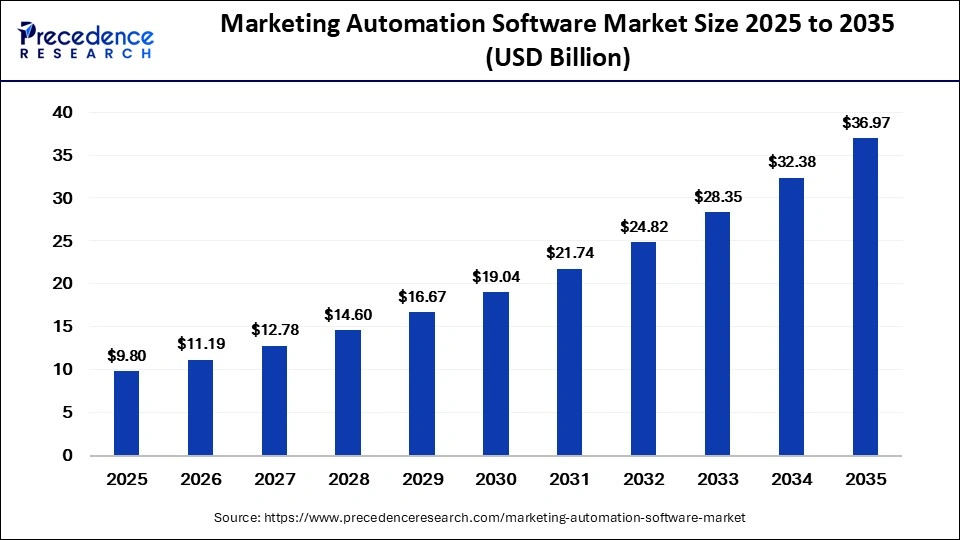
The global marketing automation software market size was calculated at USD 9.80 billion in 2025 and is predicted to increase from USD 11.19 billion in 2026 to approximately USD 36.97 billion by 2035, expanding at a CAGR of 14.20% from 2026 to 2035. The market is driven by growing demand for personalized customer experiences and advances in AI algorithms & tools.
Key Takeaways
- North America led the market with a 38.00% share in 2025.
- Asia Pacific held a 25.00% market share in 2025 and is expected to grow at a 17.5% CAGR in the coming years.
- By component, the software platforms segment held a share of 72.00% in the market in 2025.
- By component, the services segment held the second-largest market share of 28.00% in 2025 and is expected to grow at a 11.5% CAGR in the studied years.
- By deployment mode, the cloud-based solutions segment held a 75.00% share of the market in 2025.
- By deployment mode, the on-premise solutions segment accounted for the second-largest share of 15.00% in 2025 and is expected to grow at a 7.5% CAGR in the coming years.
- By organization size, the large enterprises segment dominated the market with a 60.00% share in 2025.
- By organization size, the small & medium enterprises (SMEs) segment held the second-largest market share of 40.00% in 2025 and is expected to grow rapidly at 17.0% CAGR during the forecast period.
- By application, the lead management & nurturing segment led the market with a 25.00% share in 2025.
- By application, the customer journey orchestration segment is expected to grow at an 18.5% CAGR in the coming years.
- By end-use industry, the retail & e-commerce segment dominated the market with a 30.00% share in 2025.
- By end-use industry, the IT & telecommunications segment captured the second-largest share of 20.00% in 2025 and is expected to expand at a 13.0% CAGR during 2026-2035.
Market Overview
The marketing automation software market is defined as the use of technology that simplifies, automates, & measures marketing tasks & workflows across various channels, like email, social media, & websites. The global market progression is impacted by several prominent growth factors, such as advancing AI-enabled customization, growing digital marketing investments, & the wider adoption of omnichannel strategies to boost customer involvement.
Marketing Automation Software Market Trends
- Gradually, the globe is fostering AI applications by leveraging behavioral signals, purchase history, & real-time intent to achieve messaging dynamically.
- Alongside, the market has been transitioning toward generative AI as a copilot, which assists in the analysis, planning, & creation of content for campaigns, coupled with improved send times & suggestions for channel strategies.
- Ongoing breakthroughs in AI algorithms are supporting predicting customers' requirements, & furthering lead scoring to find the highest-value prospects.
Market Scope
| Report Coverage | Details |
| Market Size in 2025 | USD 9.80 Billion |
| Market Size in 2026 | USD 11.19 Billion |
| Market Size by 2035 | USD 36.97 Billion |
| Market Growth Rate from 2026 to 2035 | CAGR of 14.20% |
| Dominating Region | North America |
| Fastest Growing Region | Asia Pacific |
| Base Year | 2025 |
| Forecast Period | 2026 to 2035 |
| Segments Covered | Component, Deployment Mode, Organization Size, Application, End-Use Industry, and Region |
| Regions Covered | North America, Europe, Asia-Pacific, Latin America, and Middle East & Africa |
Market Dynamics
Drivers
Surging Focus on Personalization Demands
The marketing automation software market is driven by the broader use of gen AI, which is enabling automated content generation, hyper-personalization, behavioral scoring, & predictive, real-time insights. Also, the market expansion is propelled by escalating need for customized customer experience (CX), which is related to involvement across email, social media, and mobile channels. Moreover, omni-channel marketing is demanding, orchestrating constant experiences across different platforms, which fulfils the need for combined automation platforms.
Restraints
Higher Initial Spending & Unification Difficulties
A key challenge involved in market growth is the expense of comprehensive platforms, including increased licensing, personalization, & maintenance fees, leading to 65% of SMEs hesitating to adopt. Somehow, several firms are facing hurdles in the integration of smart automation tools with legacy systems & existing CRM software, resulting in data silos.
Opportunities
Development of Advanced Tools
The marketing automation software market presents strong opportunities with the development of advanced tools that predict customer behavior and Customer Lifetime Value (CLV), enabling brands to optimize marketing spend and deliver personalized experiences. Additionally, the integration of AI-powered chatbots with platforms like WhatsApp is enhancing real-time, two-way customer engagement across web, mobile, and social channels, driving more consistent and automated interactions.
Segmental Insights
Component Insights
Marketing Automation Software Market Share, By Component, 2025-2035 (%)
| Component | 2025 | 2035 | CAGR (%) |
| Software Platforms | 72.00% | 75.00% | 15.0% |
| Services | 28.00% | 25.00% | 11.5% |
The Software Platforms Segment Led the Market in 2025
The software platforms segment dominated the marketing automation software market with a 72.00% share in 2025. This dominance is driven by automation of repetitive tasks, including email campaigns & social media scheduling, which finally enhances productivity. These platforms offer deeper insights into campaign performance, allowing data-driven & planned decision-making.
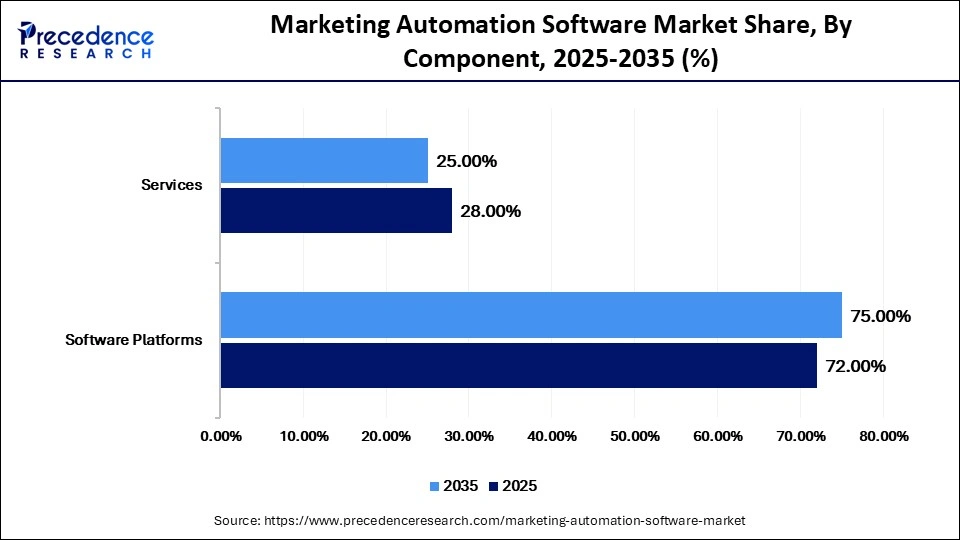
However, the services segment held the second-largest market share of 28.00% in 2025 and is expected to expand at a 11.5% CAGR in the coming years. This is mainly due to the increasing demand for support and implementation services. These services raise ROI by enhancing cross-channel campaigns, lowering manual errors, & speeding up sales cycles. Services support implementation, integration with CRM/CDP systems, and optimization of marketing workflows.
Deployment Mode Insights
Marketing Automation Software Market Share, By Deployment Mode, 2025-2035 (%)
| Deployment Mode | 2025 | 2035 | CAGR (%) |
| Cloud-based Solutions | 75.00% | 80.00% | 16.5% |
| On-premise Solutions | 15.00% | 10.00% | 7.5% |
| Hybrid Solutions | 10.00% | 10.00% | 12.5% |
The Cloud-Based Solutions Segment Dominated the Market in 2025
In 2025, the cloud-based solutions segment led the marketing automation software market with a 75.00% share. The segmental dominance is driven by the elimination of higher initial capital expenditure for infrastructure, facilitating subscription-based, scalable pricing models that are favorable for both SMEs & large enterprises. These solutions are in high demand, especially among SMEs, due to their low costs.
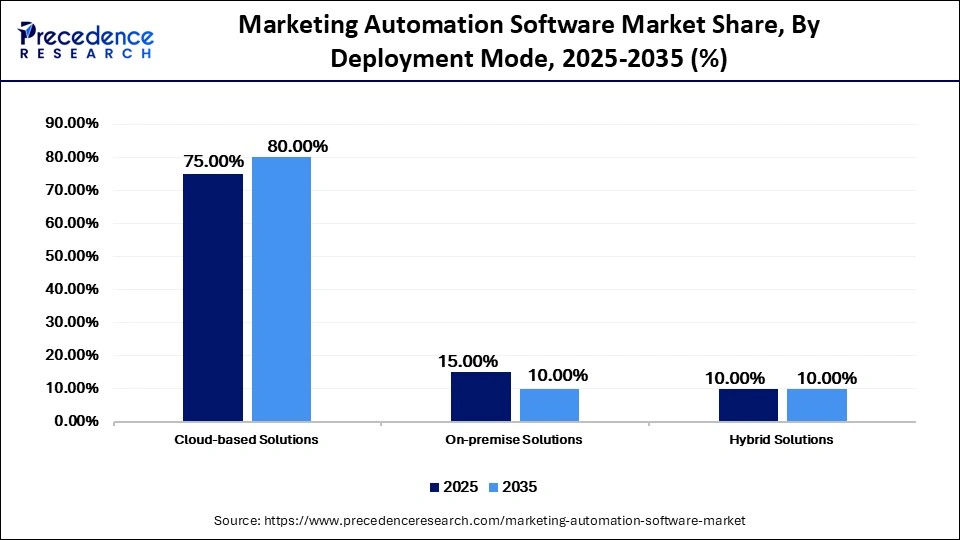
The on-premise solutions segment held the second-largest share of 15.00% in 2025 and is expected to expand at a 7.5% CAGR between 2026 and 2035. This is mainly due to the growing concerns over data security. These solutions highly provide rigorous data security, full control over system configurations, and perfect integration with internal, legacy systems.
The hybrid solutions segment held a 10.00% market share in 2025, due to the increasing demand for on-premises security with cloud agility, which enables businesses to handle sensitive data locally while using cloud-based AI solutions. Leading companies are employing sophisticated, secure, site-to-site VPN connections, enabling the cloud environment to align with the local environment in real time, & allow tailored engagement.
Organization Size Insights
Marketing Automation Software Market Share, By Organization Size, 2025-2035 (%)
| Organization Size | 2025 | 2035 | CAGR (%) |
| Large Enterprises | 60.00% | 55.00% | 12.5% |
| Small & Medium Enterprises (SMEs) | 40.00% | 45.00% | 17.0% |
The Large Enterprises Segment Was Dominant in the Market in 2025
The large enterprises segment captured a major share of 60.00% of the marketing automation software market in 2025. The dominance is driven by their wider utilization of AI & ML for predictive analytics, dynamic classification, & real-time content customization, which allows precision customer involvement across emails, web, & mobile. These enterprises invest heavily in automation tools because of their large customer base.
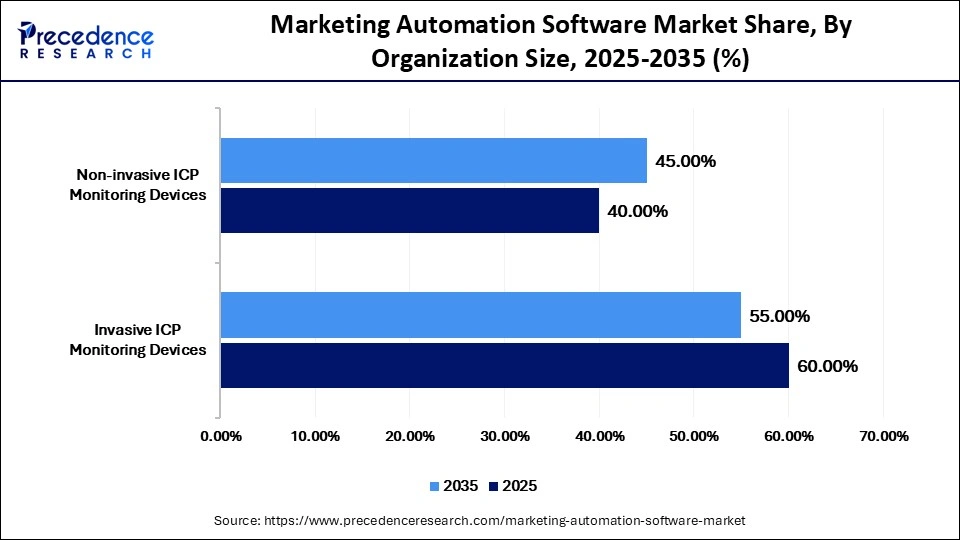
The small & medium enterprises (SMEs) segment accounted for a 40.00% share in 2025 and is anticipated to expand at the fastest CAGR of 17.0% in the coming years. To overcome manpower limitations, these enterprises are adopting smart, cloud-based, subscription-based (SaaS) marketing tools that provide scalability without major upfront capital investment. They are increasingly executing cost-effective, AI-enabled, & omnichannel solutions that unify email, SMS, & CRM functionalities to propel revenue.
Application Insights
The Lead Management & Nurturing Segment Led the Market in 2025
In 2025, the lead management & nurturing segment held a dominant share of 25.00% in the marketing automation software market. This is because increasing customer expectations across the buying journey are driving the need for personalized, automated engagement at scale. Businesses are rapidly adopting automation tools to manage large volumes of leads and identify sales-ready opportunities more efficiently.
Marketing Automation Software Market Share, By Application, 2025-2035 (%)
| Application | 2025 | 2035 | CAGR (%) |
| Lead Management & Nurturing | 25.00% | 23.00% | 13.0% |
| Email Marketing Automation | 20.00% | 18.00% | 11.5% |
| Social Media Marketing Automation | 15.00% | 16.00% | 14.5% |
| Customer Journey Orchestration | 20.00% | 25.00% | 18.5% |
| Marketing Analytics & Reporting | 20.00% | 18.00% | 13.5% |
The customer journey orchestration segment held a share of 20.00% in 2025 and is projected to expand at a 18.5% CAGR between 2026 and 2035. This growth is driven by rising demand for hyper-personalization, real-time data activation, and seamless omnichannel experiences. Advanced tools now integrate physical and digital interactions, enabling use cases such as personalized in-app offers triggered by in-store visits.
The email marketing automation segment captured a 20.00% share in 2025, supported by its cost-effectiveness and high return on investment. Modern platforms enable dynamic content features such as live product listings, cart updates, and countdown timers, enhancing engagement and conversion rates.
End-Use Industry Insights
The Retail & E-commerce Segment Dominated the Market in 2025
The retail & e-commerce segment held a 30.00% share of the marketing automation software market in 2025. This is mainly due to high customer interaction, personalization needs, and omnichannel marketing strategies. The segment dominance is also driven by use cases such as cart recovery, loyalty programs, and personalized marketing across digital channels. Increasing adoption of AI-driven automation is enabling features like click-and-collect and real-time, behavior-based in-store engagement.
Marketing Automation Software Market Share, By End-Use Industry, 2025-2035 (%)
| End-Use Industry | 2025 | 2035 | CAGR (%) |
| Retail & E-commerce | 30.00% | 32.00% | 15.5% |
| IT & Telecommunications | 20.00% | 18.00% | 13.0% |
| Banking, Financial Services, and Insurance (BFSI) | 15.00% | 14.00% | 12.5% |
| Healthcare & Life Sciences | 10.00% | 11.00% | 14.0% |
| Media & Entertainment | 10.00% | 11.00% | 15.0% |
| Manufacturing | 10.00% | 9.00% | 12.0% |
| Others | 5.00% | 5.00% | 12.5% |
Meanwhile, the IT & telecommunications segment held the second-largest share of 20.00% in 2025 and is estimated to grow at a 13.0% CAGR over the forecast period. The segmental expansion is driven by a higher user base, surging AI & machine adoption, & wider demand for constant omnichannel customer involvement. Automated systems are supporting simplifying the onboarding process for novel tech services & offering upselling/cross-selling chances personalized to existing customer behavior.
The banking, financial services, and insurance (BFSI) segment captured a 15.00% share in 2025. This is mainly due to the increasing demand for regulatory compliance, secure communication, and auditability. Institutions are leveraging AI-powered chatbots and virtual financial assistants to deliver 24/7 personalized support while managing high interaction volumes.
Regional Insights
North America Marketing Automation Software Market Size and Growth 2026 to 2035
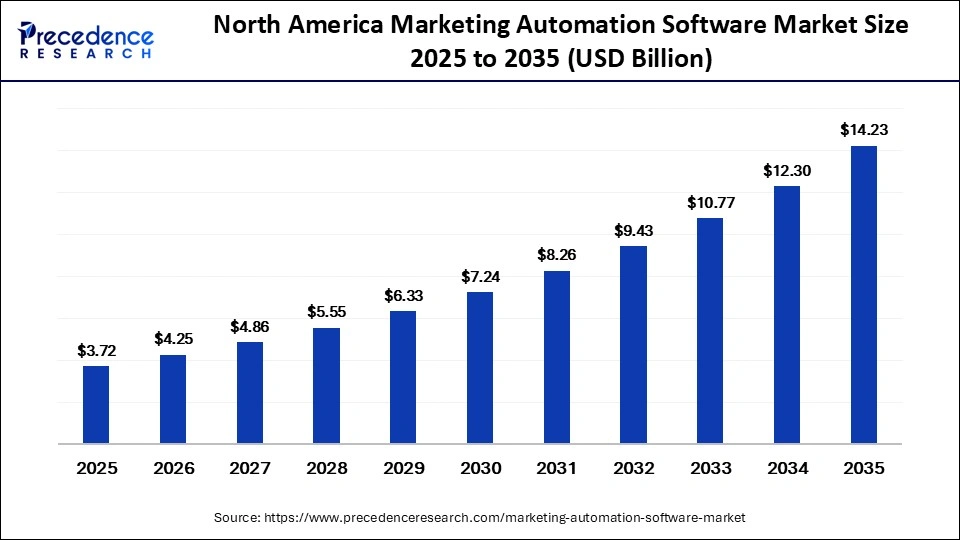
The North America marketing automation software market size is estimated at USD 3.72 billion in 2025 and is projected to reach approximately USD 14.23 billion by 2035, with a 14.36% CAGR from 2026 to 2035.
What Made North America the Dominant Region in the Market in 2025?
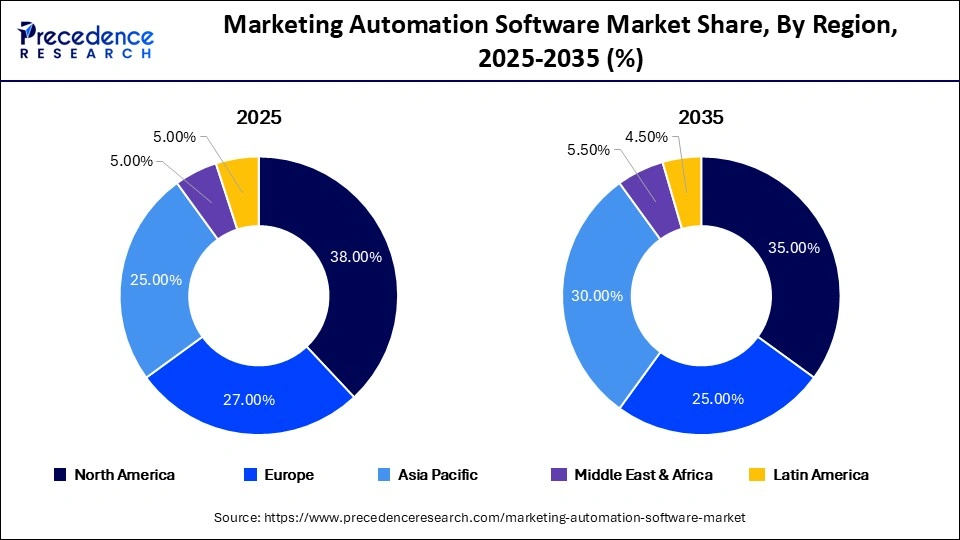
In 2025, North America registered dominance in the marketing automation software market by holding a 38% share. The regional dominance is fueled by early adoption of digital marketing technologies, strong presence of vendors, and high investments in marketing solutions. Ongoing digitization is driving the adoption of SaaS-based platforms and cloud computing. The region also benefits from a well-established digital infrastructure to simplify marketing operations.
U.S. Marketing Automation Software Market Size and Growth 2026 to 2035
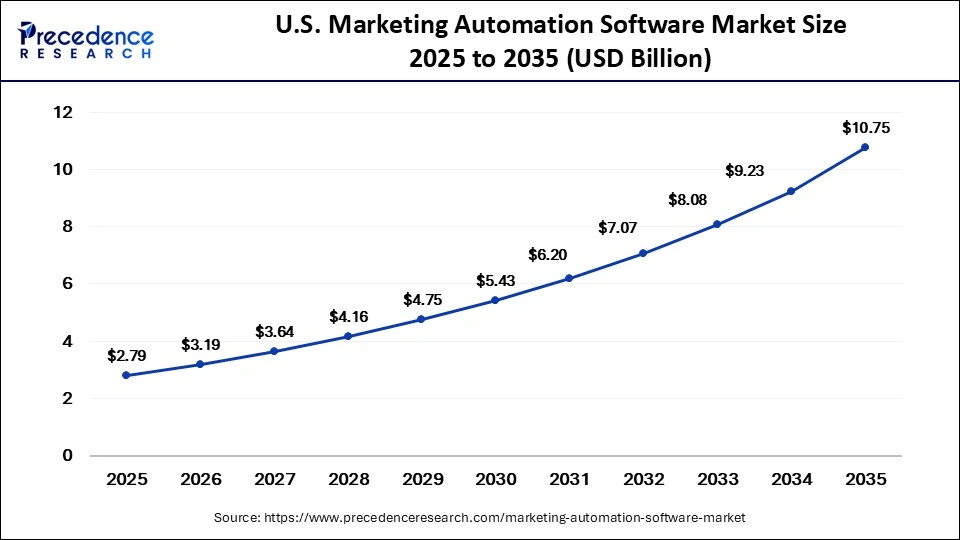
The U.S. marketing automation software market size is calculated at USD 2.79 billion in 2025 and is expected to reach nearly USD 10.75 billion in 2035, accelerating at a strong CAGR of 14.44% between 2026 and 2035.
U.S. Market Analysis
The marketing automation software market in the U.S. is driven by increasingly adopting AI agents that enable autonomous decision-making, such as reallocating ad budgets and optimizing personalized content without human intervention. Additionally, advancements in automation tools are enhancing integration with voice assistants and AI-powered visual search, supporting the growth of hands-free and more intuitive shopping experiences across digital platforms.
Asia Pacific: The Fastest-Growing Region
Asia Pacific is anticipated to grow at a 17.5% CAGR in the upcoming years due to rapid digital transformation, increasing internet and smartphone penetration, and the expansion of e-commerce across countries such as China, India, and Southeast Asia. Businesses in the region are rapidly adopting AI-driven marketing tools to manage large customer bases, improve personalization, and enhance omnichannel engagement at scale. Additionally, growing investments in cloud infrastructure, rising startup activity, and the increasing need for cost-effective customer engagement solutions are further accelerating market adoption across the region.
China Market Analysis
The marketing automation software market in China is growing due to the rapid expansion of e-commerce platforms, high mobile internet penetration, and strong adoption of digital payment ecosystems that generate large volumes of consumer data. Chinese businesses are increasingly leveraging AI-driven marketing tools to enable hyper-personalization, real-time customer engagement, and efficient handling of massive user bases across platforms like social media and super-app ecosystems. Additionally, strong government support for digitalization, rising investment in cloud and AI technologies, and intense competition among online retailers are further accelerating market growth in the country.
Marketing Automation Software Market Companies
- Oracle
- Act-On Marketing Automation
- IBM Corporation
- Microsoft
- Cognizant
- Brevo
- Adobe Systems Inc.
- HubSpot, Inc.
- ActiveCampaign
- Keap
Recent Developments
- In April 2026, LiveBy Local rolled out an automated hyperlocal marketing platform for real estate agents to deliver precision, hyperlocal market updates to every contact in an agent's database.(Source: https://www.businesswire.com)
- In April 2026, Adobe Inc. unveiled its novel suite of artificial intelligence tools called CX Enterprise, focused on automating & tailoring digital marketing for enterprise clients.(Source: https://www.gurufocus.com)
- In April 2026, Wonestop strengthened its WhatsApp automation solutions to support businesses in enhancing customer communication, developing leads, & automating repetitive workflows.(Source: https://www.issuewire.com)
- In January 2026, Treasure Data today introduced Marketing Super Agent, a category-defining AI marketer designed directly into Treasure Data's AI Marketing Cloud.(Source: https://www.businesswire.com)
Segments Covered in the Report
By Component
- Software Platforms (Campaign Management, Lead Scoring, Email Automation, Analytics)
- Services (Consulting, Integration, Support & Maintenance)
By Deployment Mode
- Cloud-based Solutions
- On-premise Solutions
- Hybrid Solutions
By Organization Size
- Large Enterprises
- Small & Medium Enterprises (SMEs)
By Application
- Lead Management & Nurturing
- Email Marketing Automation
- Social Media Marketing Automation
- Customer Journey Orchestration
- Marketing Analytics & Reporting
By End-Use Industry
- Retail & E-commerce
- Banking, Financial Services, and Insurance (BFSI)
- IT & Telecommunications
- Healthcare & Life Sciences
- Media & Entertainment
- Manufacturing
- Others
By Region
- North America
- Latin America
- Europe
- Asia-pacific
- Middle and East Africa
For inquiries regarding discounts, bulk purchases, or customization requests, please contact us at sales@precedenceresearch.com
Frequently Asked Questions





Ask For Sample
No cookie-cutter, only authentic analysis – take the 1st step to become a Precedence Research client
 Get a Sample




 sales@precedenceresearch.com
 Schedule a Meeting
