



Medical Adhesive-Related Skin Injury (MARSI) Treatment Market Size, Companies, Share, Patient Volume, Treatment Adoption Rates, Pricing Analysis, Regulatory Landscape, Competitive Positioning, and Demand Forecast
Medical Adhesive-Related Skin Injury (MARSI) Treatment Market (By Product Type: Barrier films & sprays, Adhesive removers & cleansers, Protective dressings, Topical therapeutics; By Application: Prevention in hospitals, Treatment of MARSI, Homecare prevention, Long-term care; By End User: Hospitals & wound clinics, Long-term care facilities, Retail pharmacies, Homecare) - Global Industry Analysis, Size, Trends, Leading Companies, Regional Outlook, and Forecast 2026 to 2035
Source: https://www.precedenceresearch.com/medical-adhesive-related-skin-injury-treatment-market
 Get a Sample
 Table Of Content


What is Medical Adhesive-Related Skin Injury (MARSI) Treatment Market Size in 2026?
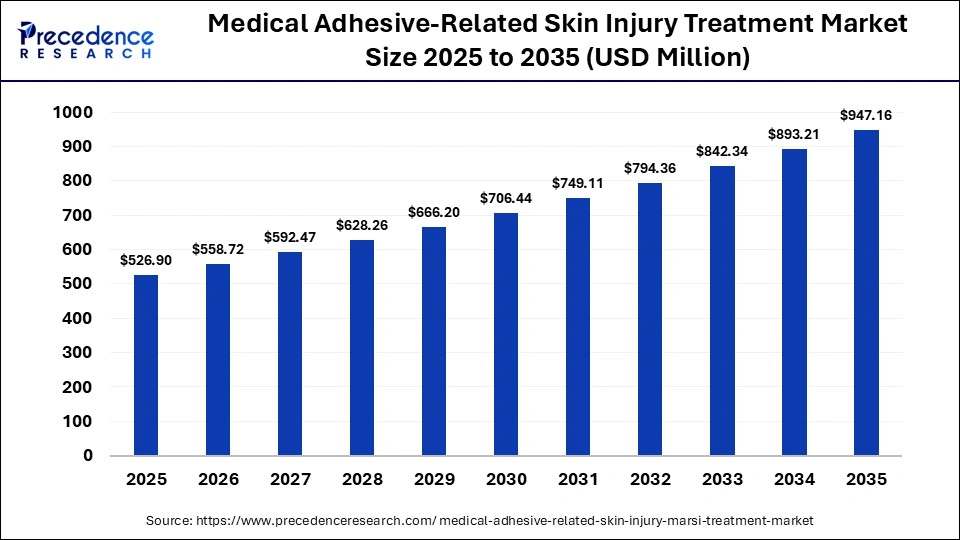
The global medical adhesive-related skin injury (MARSI) treatment market size accounted for USD 526.90 million in 2025 and is predicted to increase from USD 558.72 million in 2026 to approximately USD 947.16 million by 2035, expanding at a CAGR of 6.04% from 2026 to 2035. The market is driven by the rising incidence of adhesive-related skin damage and the increasing focus on advanced wound care management.
Key Takeaways
- By region, North America accounted for the largest share of the market in 2025.
- By region, Asia Pacific is expected to experience the fastest growth over the forecast period.
- By product type, the barrier films & sprays segment held a significant share of the market in 2025.
- By product type, the adhesive removers & cleansers segment is expected to grow at a significant rate in the market over the forecast period.
- By application, the prevention in hospitals segment led the market in 2025.
- By application, the homecare prevention segment is expected to grow at a considerable rate in the market over the forecast period.
- By end user, the hospitals & wound clinics segment dominated the market in 2025.
- By end user, the long-term care facilities segment is expected to grow at a significant CAGR in the market over the forecast period.
Market Overview
The medical adhesive-related skin injury (MARSI) treatment market is a branch of the healthcare sector that focuses on products and treatments to prevent, control, and treat skin injuries caused by medical adhesives. The condition MARSI develops when stripping, blistering, or irritation of the skin or catheter, monitoring device, or ostomy appliances are stripped off, leaving tears. Such injuries especially occur in elderly patients, neonates, and people with weak skin. The increasing awareness regarding patient safety and the growing geriatric population, who are vulnerable to weakened skin conditions, are major factors fueling the demand for special MARSI treatment products. Additionally, product utilization is rising due to the growing demand for chronic disease management, long-term care services, and post-surgical wound care, driving sustained market growth.
How is AI Influencing the Medical Adhesive-Related Skin Injury (MARSI) Treatment Market?
Artificial Intelligence is positively impacting the medical adhesive-related skin injury (MARSI) treatment market by altering the prevention, diagnosis, and patient-specific care plan. AI-driven imaging tools are being implemented in hospitals and wound care centers to inspect the skin condition and identify early-stage irritation, as well as to categorize injuries caused by adhesives with greater accuracy. Such systems minimize the use of subjective visual examination, and clinical intervention speeds up to a minimum of complications. AI is also enhancing supply chain efficiency by forecasting demand and automatically managing the stock of wound care supplies.
Medical Adhesive-Related Skin Injury (MARSI) Treatment Market Trends
- Shift to Silicone-Based and Atraumatic Adhesives: The growing adoption of silicone-based and atraumatic adhesive products is reducing skin stripping and irritation, particularly in elderly and neonatal patients, advancing dressing technologies that prioritize skin integrity and patient comfort.
- Focus on Preventive Skin Care: Increased awareness and clinical guidelines for preventing adhesive-related skin injuries are prompting healthcare organizations to implement standardized skin assessments and invest in barrier films and protective solutions.
- Chronic Disease Management Driving Product Use: Rising prevalence of chronic conditions requiring long-term devices, such as diabetes and cardiovascular disorders, is boosting demand for advanced wound care products designed to withstand repetitive adhesive use and removal.
- Growth in Home and Outpatient Care: Expansion of home healthcare and outpatient services is fueling demand for skin-friendly adhesive removal sprays, protective wipes, and self-application wound care products that minimize complications outside hospital settings.
Market Scope
| Report Coverage | Details |
| Market Size in 2025 | USD 526.90 Million |
| Market Size in 2026 | USD 558.72 Million |
| Market Size by 2035 | USD 947.16 Million |
| Market Growth Rate from 2026 to 2035 | CAGR of 6.04% |
| Dominating Region | North America |
| Fastest Growing Region | Asia Pacific |
| Base Year | 2025 |
| Forecast Period | 2026 to 2035 |
| Segments Covered | Product Type, Application, End User and Region |
| Regions Covered | North America, Europe, Asia-Pacific, Latin America, and Middle East & Africa |
Segment Insights
Product Type Insights
Why Did the Barrier Films & Sprays Segment Dominate the Market?
The barrier films & sprays segment dominated the medical adhesive-related skin injury (MARSI) treatment market with a major revenue share in 2025 and is expected to sustain its position throughout the projected period. This is primarily due to the growing interest in preventive skin protection measures within the clinical environment. These products form a protective breathable layer on the skin, which reduces friction, skin damage, and trauma of the skin. Their widespread use in pre-dressing, pre-taping, pre-ostomy appliance, and pre-securement device applications significantly reduces instances of skin stripping and irritation. Also, barrier films and sprays are simple to use and dry quickly, and can be used with most adhesives, which increases the efficiency of workflow in high-traffic hospital environments.
The adhesive removers & cleansers segment is expected to grow at a significant rate in the upcoming period, owing to growing demand for safe methods of removing adhesives and the prevalence of frail skin among aging and chronically ill patients. Repeat dressing, ostomy, and prolonged use of devices often cause skin trauma during adhesive removal, leading to the demand for soft, silicone, and alcohol-free removal solutions. Also, the growth of the home healthcare industry and an increase in awareness of self-care among people are boosting the use of easy-to-use adhesive removers that can be safely used by caregivers and patients. The growing focus on decreasing rates of hospital-acquired skin injuries and enhancing the quality of care is further boosting product usage.
Application Insights
Why Did the Prevention in Hospitals Segment Lead the Market?
The prevention in hospitals segment led the medical adhesive-related skin injury (MARSI) treatment market in 2025, driven by the high volume of surgical procedures, intensive care, and long-term device placements in hospital settings. Acute care patients frequently require multiple adhesive-based products, such as wound dressings, IV adhesives, monitoring electrodes, and surgical covers, placing them at higher risk of skin injury. Hospitals have implemented strict skin assessment protocols and preventive measures to reduce complications, shorten patient stays, and lower treatment costs. Additionally, payment models and performance-based healthcare systems incentivize the prevention of avoidable skin damage, further supporting the adoption of MARSI prevention strategies.
The homecare prevention segment is expected to grow at a significant CAGR over the forecast period, driven by the expansion of home-based healthcare services. Older patients are increasingly opting for at-home care, and this is generating a long-term need for preventive skin care products outside the hospital. This segment is also fueled by the development of convenient barrier products, adhesive removers, and training programs that enable caregivers to be able to effectively manage skin health at home. Growing awareness of the importance of skin integrity management, combined with the rise of telehealth support, is driving the adoption of MARSI prevention products and practices in the homecare setting.
End User Insights
Why Did the Hospitals & Wound Clinics Segment Contribute the Most Revenue in the Market?
The hospitals & wound clinics segment held the largest share of the medical adhesive-related skin injury (MARSI) treatment market in 2025 and is expected to sustain its dominance throughout the projected period. This is mainly due to the fact that hospitals have well-established procurement processes, trained medical staff, and structured skin injury prevention protocols, enabling the implementation of advanced protection measures. Such facilities frequently handle complex surgeries, trauma care, chronic wound management, and intensive monitoring, all of which involve routine adhesive use and debridement. Ongoing research into preventive skin care technologies is essential, supported by increasing awareness of healthcare-associated complication prevention and the goal of improving patient outcomes.
The long-term care facilities segment is expected to grow at a significant CAGR in the market because of the growing geriatric population, as well as the rise in the rate of chronic disease prevalence, where patients require constant medical attention. The growth in this segment is due to the increased demand for skin care prevention measures aimed at minimizing the cases of complications like skin tears and pressure injuries. Also, long-term care settings are increasingly focusing on quality-of-care indicators by the regulatory bodies and are advocating the use of protective barrier products and soft adhesive solutions. A further boost to the product demand is the staffing and more intensive training in skin integrity management.
Regional Insights
Why Did North America Lead the Medical Adhesive-Related Skin Injury (MARSI) Treatment Market?
North America led the medical adhesive-related skin injury (MARSI) treatment market with the largest share in 2025. This is due to high healthcare standards, significant public and private healthcare expenditure, and strong clinical awareness of patient safety. The region benefits from advanced hospital facilities, widespread adoption of evidence-based wound care guidelines, and early implementation of skin-friendly adhesive systems. Additionally, the aging population in the U.S. and Canada has increased the need to prevent and manage fragile skin conditions, driving demand for both therapeutic and preventive MARSI solutions. Market leadership is further strengthened by the presence of major wound care product companies and their ongoing R&D efforts in clinical settings.
Why is Asia Pacific Experiencing the Fastest Growth in the Market?
Asia Pacific is expected to grow at the fastest CAGR in the market during the forecast period, driven by expanding healthcare coverage and high population growth. Increasing government investments in healthcare facilities, particularly in developing countries like China and India, are enhancing hospital capacity and the quality of patient care. Rising awareness of wound management and infection prevention is encouraging healthcare providers to adopt advanced skin-protective adhesive products. Additionally, the growing burden of chronic illnesses, surgical procedures, and prolonged device use is accelerating demand for MARSI treatment solutions. The region's medical tourism growth and the expansion of healthcare infrastructure in Southeast Asia further support market growth.
Why is the European Medical Adhesive-Related Skin Injury (MARSI) Treatment Market Growing?
The market in Europe is expected to grow at a notable rate in the upcoming period, owing to high regulatory standards and focus on patient-centric care. The healthcare system in the region is highly developed, with high awareness of the prevention of hospital-acquired complications, including adhesive-related skin injuries. The growing aging population in countries including Germany, France, and Italy is increasing the demand for skin-protective medical products. Moreover, the growth in home healthcare and chronic disease management programs is leading to a rise in the use of adhesive-based medical devices and thus generating the need to find preventive treatment solutions. Constant product innovation is also contributing to regional market growth.
Top Companies Operating in the Market
- 3M Health Care
- Nbz Healthcare LLP
- M D Enterprises
- M A Surgical Distributors
- Ish International
- J Enterprise
- Kingfa India
- Sav Chemicals Pvt Ltd
- Gujarat Orthofix
- Wellcare Pharma & Surgical
- Alec Meditech Pvt Ltd
- G Tech Pharma Solutions
- Joshi Furniture (Medical Division)
- SAP Medicals Pvt Ltd
- Adba Healthcare Pvt Ltd
Recent Developments
- In September 2024, Solentum introduced its first V.A.C. Peel and Place Dressing, which has an all-in-one dressing and drape design that streamlines the application process and minimizes time and effort, as well as training needs. There is an inbuilt perforated layer that is not adherent to aid in the prevention of tissue ingrowth, making it easier to remove the dressing from a patient and less painful. (Source: https://www.prnewswire.com)
- In April 2024, Elkem presented Silbionetm RT Gel 4660, a high-performance silicone soft skin gel adhesive, and easy to process for medical use. The goal of the innovation is to optimize the efficiency of dressing manufacturing and improve the comfort of patients and overall wound care outcomes. (Source: https://www.specialchem.com)
Segments Covered in the Report
By Product Type
- Barrier films & sprays
- Adhesive removers & cleansers
- Protective dressings
- Topical therapeutics
- Education & training
By Application
- Prevention in hospitals
- Treatment of MARSI
- Homecare prevention
- Long-term care
By End User
- Hospitals & wound clinics
- Long-term care facilities
- Retail pharmacies
- Homecare
By Region
- North America
- Asia Pacific
- Europe
- Latin America
- Middle East & Africa
For inquiries regarding discounts, bulk purchases, or customization requests, please contact us at sales@precedenceresearch.com
Frequently Asked Questions





Ask For Sample
No cookie-cutter, only authentic analysis – take the 1st step to become a Precedence Research client
 Get a Sample
.webp)



 sales@precedenceresearch.com
 Schedule a Meeting
