



Military Rotorcraft Market Trends, Companies, Contract Wins / Project Pipeline, Defense Contracts, Procurement Volume, Government Spending, Production Capacity, Competitive Positioning, and Growth Outlook
Military Rotorcraft Market (By Type: Attack Helicopters, Multi-mission Helicopters, Maritime/Naval Helicopters, Transport Helicopters; By Application: Combat/Attack Operations, Transport and Logistics, Search and Rescue (SAR), Surveillance and Reconnaissance; By Weight/Size Class: Light Military Helicopters, Medium Military Helicopters, Heavy/Heavy-Lift Helicopters; By End-User: Defense Forces (Army, Navy, Air Force), Homeland Security and Government Agencies) - Global Industry Analysis, Size, Trends, Leading Companies, Regional Outlook, and Forecast 2026 to 2035
Source: https://www.precedenceresearch.com/military-rotorcraft-market
 Get a Sample
 Table Of Content


What is the Military Rotorcraft Market Size in 2026?
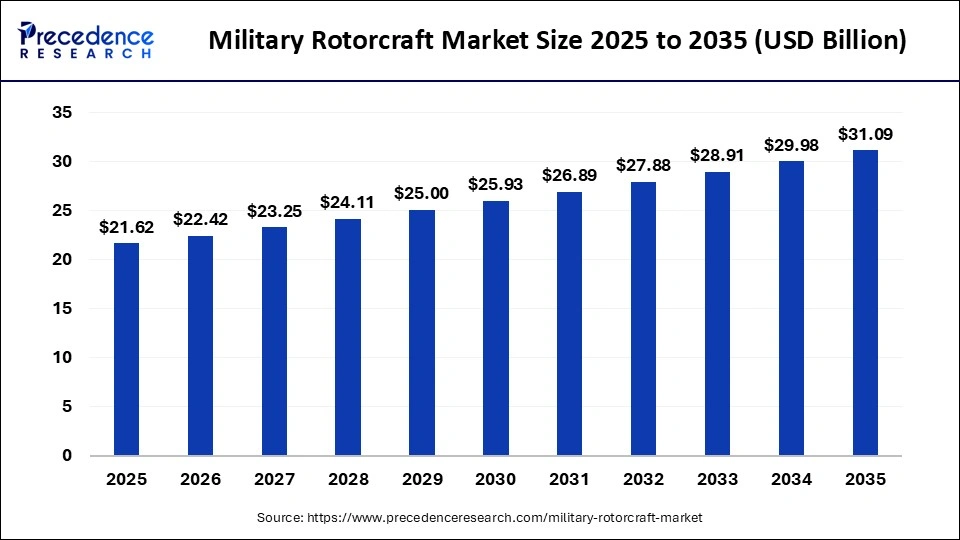
The global military rotorcraft market size was calculated at USD 21.62 billion in 2025 and is predicted to increase from USD 22.42 billion in 2026 to approximately USD 31.09 billion by 2035, expanding at a CAGR of 3.70% from 2026 to 2035. The market growth is attributed to rising defense modernization programs and increasing investment in next-generation rotorcraft technologies globally.
Key Takeaways
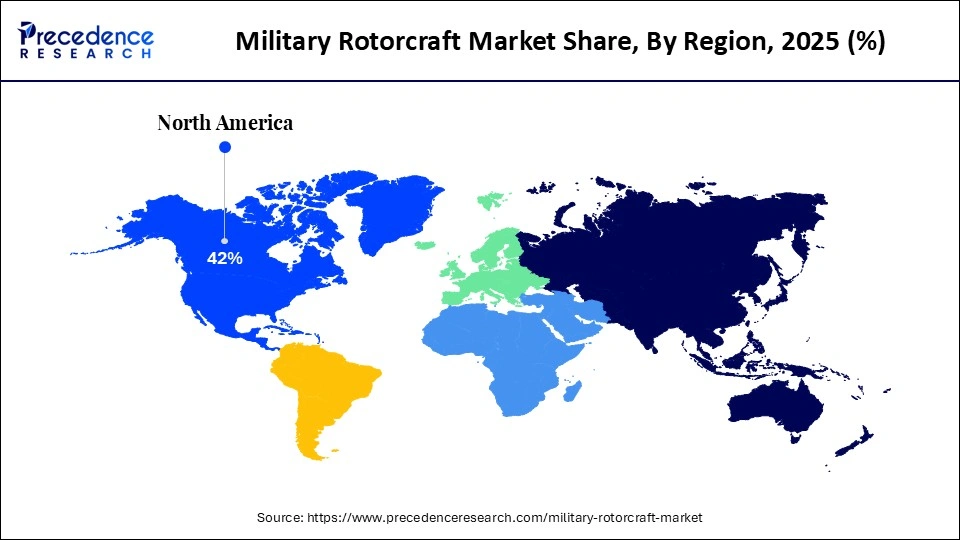
- North America dominated the global market with the largest share of 42% in 2025.
- Asia-Pacific is expected to grow at the fastest CAGR between 2026 and 2035.
- By type, the attack helicopters segment contributed the highest military rotorcraft market share of 43.5% in 2025.
- By type, the transport helicopters segment is expected to grow at a strong CAGR between 2026 and 2035.
- By application, the combat/attack operations segment held a major market share of 42% in 2025.
- By application, the surveillance and reconnaissance segment is expected to expand at a rapid CAGR from 2026 to 2035.
- By weight/size class, the medium military helicopters segment captured the highest market share of 45% in 2025.
- By weight/size class, the light military helicopters segment is poised to grow at a fast rate between 2026 and 2035.
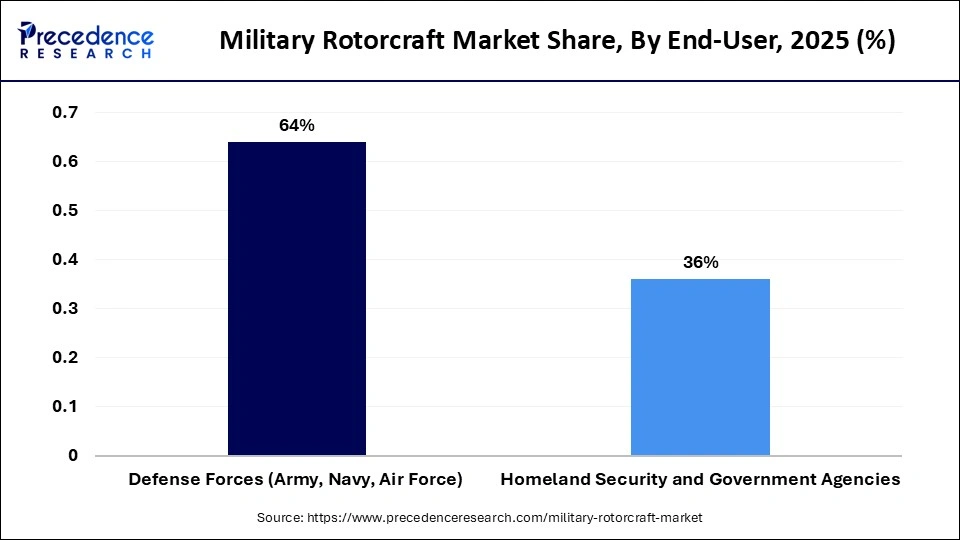
- By end-user, the defense forces (army, navy, air force) segment generated the biggest market share of 64% in 2025.
- By end-user, the homeland security and government agencies segment is expanding at the fastest CAGR between 2026 and 2035.
Which Factors Influence the Military Rotorcraft Industry?
Rising defense spending to strengthen battlefield mobility and rapid response capabilities is a primary driver accelerating the military rotorcraft market. Modern military rotorcrafts are advanced helicopters with turbine engines, composite airframes, digital avionics, mission computers, and weapon integration systems. This facilitates troop transport, combat search-and-rescue, and logistics operations in both terrestrial and naval settings. Furthermore, the sustained demand for military rotorcraft is still being supported by the growing geopolitical tensions, the rapid response missions' needs, and the increasing military procurement programs globally.
Military Rotorcraft Market Growth Factors
- Expansion of Military Helicopter Modernization Programs: Rising fleet upgrade initiatives are driving demand for advanced avionics, engines, and survivability enhancement technologies globally.
- Increasing Emphasis on Rapid Troop Mobility Capabilities: The growing need for fast battlefield deployment and air assault operations is propelling the procurement of versatile transport rotorcraft.
- Rising Maritime Security and Naval Aviation Requirements: Increasing naval patrol, anti-submarine warfare, and shipborne aviation needs are fuelling the deployment of specialized naval helicopters.
Strategic Procurement and Industrial Expansion Driving Operational Fleet Growth in the Military Rotorcraft Market
- Southern Europe continues fleet expansion, as Spain signed a contract for 31 additional NH90 tactical transport helicopters in December 2025, increasing its total contracted NH90 fleet to 76 helicopters across its Army, Air Force, and Navy, making it one of the largest operators in Europe.
- The United States Department of Defense allocated approximately USD 4.2 billion to rotorcraft procurement in 2023, with nearly 60% directed toward AH-64E Apache attack helicopters and 30% toward UH-60 Black Hawk transport helicopters, reflecting continued prioritization of tactical aviation modernization within the U.S. Army aviation budget.
- Belgium's Strategic Vision defense plan allocated approximately €1.389 billion (USD 1.4 billion) for the acquisition of medium and heavy transport helicopters, underscoring rotorcraft modernization as a core national defense priority.
- Airbus Helicopters secured 544 gross orders from 205 customers across 50 countries in 2026, demonstrating sustained manufacturing scale across both military and civil rotorcraft programs.
- Lockheed Martin subsidiary Sikorsky has manufactured over 5,000 UH-60 Black Hawk helicopters globally, with approximately 3,940 aircraft currently in service and 920 additional units on order, reflecting one of the largest military rotorcraft production runs in aviation history.
Impact of Artificial Intelligence on the Military Rotorcraft Market
Artificial intelligence (AI) drives significant growth in the market by enhancing combat effectiveness and operational readiness globally. The future of military helicopters is their AI-powered mission systems that are able to process the data of the battlefield and make faster tactical decisions. Furthermore, the U.S. Army incorporates AI into Future Vertical Lift programs to enhance autonomous navigation and mission coordination. AI significantly reduces workload on pilots and helps them make effective decisions.
Military Rotorcraft Market Trends
- Integration of Crewed-Uncrewed Teaming (MUM-T) Systems Across Combat Helicopters: Military forces continue to incorporate crewed-uncrewed teaming systems in the military to enable helicopters to control drones on the battlefield. This enhances awareness of the battlefield and minimizes the exposure of pilots to enemy fire. The trend is driving the demand for rotorcrafts with high mission computers, secure datalink, and drone control interface.
- Deployment of High-Speed Compound and Tiltrotor Military Platforms: Defense programs are hastening the use of the compound and tiltrotor helicopters, which are intended to provide a higher rate and operational length. Such platforms assist swift attack and in-depth intrusion operations over a vast area of operation. This change is causing the substitution of traditional helicopters with next-generation vertical lift planes that are of a much faster nature.
Market Scope
| Report Coverage | Details |
| Market Size in 2025 | USD 21.62 Billion |
| Market Size in 2026 | USD 22.42 Billion |
| Market Size by 2035 | USD 31.09 Billion |
| Market Growth Rate from 2026 to 2035 | CAGR of 3.70% |
| Dominating Region | North America |
| Fastest Growing Region | Asia Pacific |
| Base Year | 2025 |
| Forecast Period | 2026 to 2035 |
| Segments Covered | Type, Application, Weight/Size Class, End-User, and region |
| Regions Covered | North America, Europe, Asia-Pacific, Latin America, and Middle East & Africa |
Segmental Insights
Type Insights
Why the Attack Helicopters Segment Dominated the Military Rotorcraft Market?
The attack helicopters segment dominated the market in 2025, as close-quarters warfare and precision strike capabilities have been given precedence by militaries in recent conflicts. Solutions, such as the AH-64 Apache, had demonstrated effectiveness in high-threat missions where survivability and advanced targeting were needed. Furthermore, the rising battlefield survivability requirements ensured that attack rotorcraft retained procurement priority across major global military aviation budgets.
The transport helicopter segment is expected to grow at the fastest CAGR in the market between 2026 and 2035, owing to the need for militaries to transport troops quickly and provide them with logistics. Aircraft such as the UH-60 Black Hawk are used to facilitate missions such as air assault, medical evacuation, disaster response, and special operations all around the world. Moreover, the rising disaster response requirements and peacekeeping commitments are likely to further strengthen transport rotorcraft demand in the coming years.
Application Insights
Which Application Segment Dominated the Military Rotorcraft Market?
The combat/attack operations segment held the largest revenue share in the market in 2025, due to the rising need for immediate battlefield firepower support. Dedicated strike rotorcraft was a priority in the armed forces as it provides precision strike on armored vehicles and enhanced enemy positions.
NATO reported in 2025 that attack helicopters supported frontline deterrence missions across Eastern Europe and Baltic defense zones. This functional dependence increased the procurement emphasis on armed platforms rather than on support or utility aviation hardware. Furthermore, the defense agencies strengthened armed rotorcraft roles because they provide rapid response during critical tactical missions.
The surveillance and reconnaissance segment is expected to grow with the highest CAGR in the market during the studied years, owing to the expanding demand for real-time intelligence collection capabilities. Armed forces are expected to increase ISR rotorcraft investment to support network-centric warfare doctrines globally. Additionally, military modernization efforts are likely to position surveillance and reconnaissance as the fastest-growing operational application segment globally.
Weight/Size Class Insights
How the Medium Military Helicopters Segment Dominated the Military Rotorcraft Market?
The medium military helicopters segment dominated the market in 2025, due to its balance between payload capacity, range, and operational flexibility. In 2025, the U.S. Army confirmed over 2,100 of its UH-60 Black Hawk helicopters were still in operation, and this is the largest portion of its aviation capabilities.
These helicopters helped carry out air assault missions, medical evacuation missions, and logistical missions in varying environments. Furthermore, the versatility of medium military rotocrasts facilitates their dominant operational position globally.
The light military helicopters segment is expected to expand rapidly in the market in the coming years, owing to their cost-effectiveness and low maintenance. Light military helicopters are easier to deploy and require less infrastructure for support. They can be used to transport troops into combat zones. Light military helicopters are widely preferred as they can perform multiple functions with a small size and at affordable costs.
End-User Insights
Which End-User Segment Led the Military Rotorcraft Market?
The defense forces (Army, Navy, Air Force) segment led the market in 2025, due to its critical role of helicopters in frontline combat and operational mobility. The aviation ground forces in the army are dependent on helicopters to perform air assaults, reconnaissance, and resupply operations on the battlefield.
Shipborne helicopters are used to assist in anti-submarine warfare and sea surveillance operations using shipborne helicopters by the naval forces. Defense planners focus on helicopters since they help in multi-domain operations. The military is likely to remain at the top of demand as there is increasing modernization and operational deployment needs.
The homeland security and government agencies segment is expected to witness the fastest growth in the market over the forecast period, owing to the increased security issues of the borders and internal defense. The use of helicopters enhances quick reaction in case of an emergency and a threat to national security. Furthermore, the expanding mission scope is estimated to position homeland and government users as the fastest-growing end-user segment.
Regional Insights
North America Military RotorcraftMarket Size and Growth 2026 to 2035
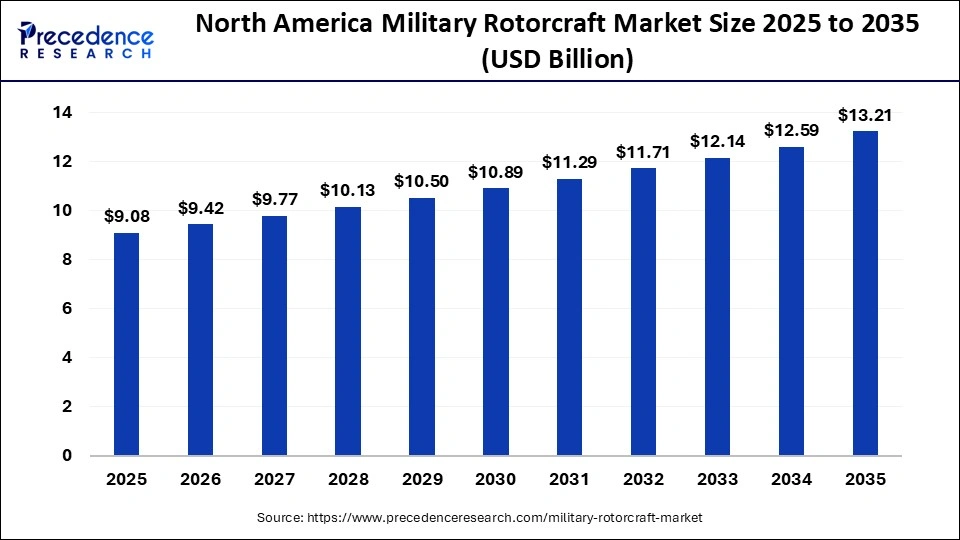
The North America military rotorcraft market size is estimated at USD 9.08 billion in 2025 and is projected to reach approximately USD 13.21 billion by 2035, with a 3.82% CAGR from 2026 to 2035.
Why Did North America Dominate the Military Rotorcraft Market?
North America held a major revenue share of the market in 2025, due to the presence of the world's largest operational military helicopter fleet. The U.S. Department of Defense confirmed in 2025 that it maintained 5913 active helicopters across all service branches.
This giant fleet served in combat operations, worldwide operations, and homeland defense missions at the same time. Furthermore, the strong government funding, domestic manufacturing strength, and operational experience fuel the North American market in the coming years.
U.S. Military Rotorcraft Market Size and Growth 2026 to 2035
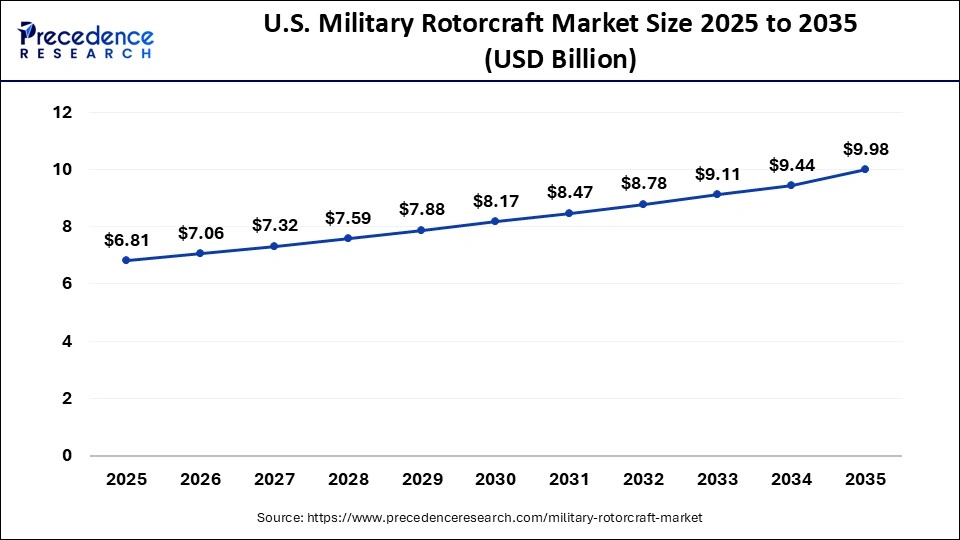
The U.S. military rotorcraft market size is calculated at USD 6.81 billion in 2025 and is expected to reach nearly USD 9.98 billion in 2035, accelerating at a strong CAGR of 3.90% between 2026 and 2035.
U.S. Strengthening Global Leadership through Next-Generation Rotorcraft Programs
U.S. leads the market in North America, supported by aggressive modernization and next-generation helicopter development initiatives. In 2025, the U.S. Army developed the Future Long-Range Assault Aircraft program, and advanced tiltrotor platforms are proposed to substitute UH-60 Black Hawk helicopters. This transition is expected to significantly improve speed, range, and survivability across combat aviation missions, thus boosting the market in this region.
How is Asia-Pacific Growing in the Military Rotorcraft Market?
Asia-Pacific is expected to witness the fastest growth during the predicted timeframe, owing to the increasing defense budgets and local helicopter development schemes. The Indian Ministry of Defence confirmed in 2025 contracts worth Rs 62,700 crore with HAL for the supply of 156 LCH Prachand to the Armed Forces.
This growth made domestic defense capability stronger and made it less dependent on imported military aviation platforms. The increased significance of speed in deployment in both the ocean and remote areas drove a faster procurement of rotorcraft defense units. Moreover, this modernization momentum is estimated to position Asia-Pacific as the fastest-expanding regional market.
India Accelerating Indigenous Helicopter Expansion and Combat Aviation Capability
India is leading the charge in Asia-Pacific, due to the expanding defense budgets and indigenous helicopter development programs. The Indian government also promoted local production to decrease the dependence on external suppliers and enhance the independence of defense in the long term. Such efforts are expected to make India a hub in rotorcraft expansion in the Asia-Pacific.
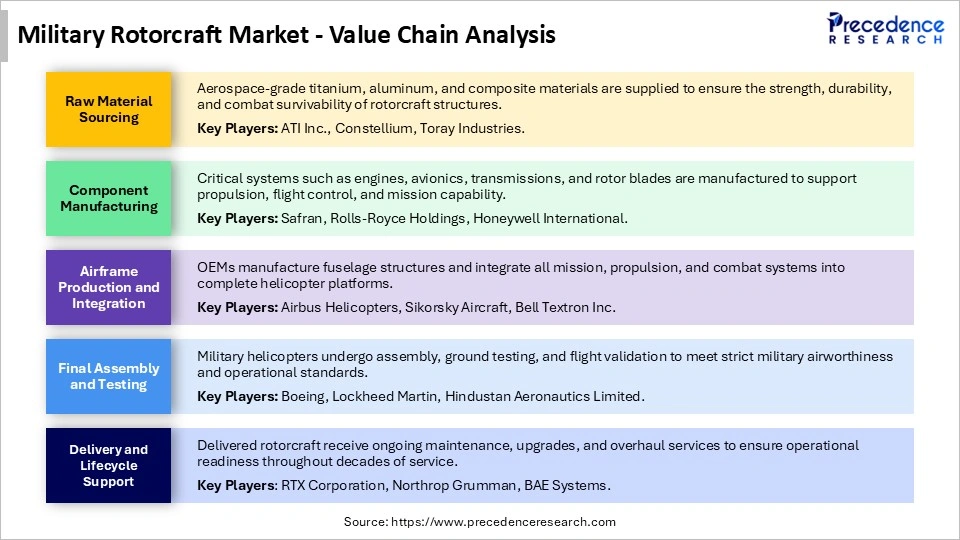
Military Rotorcraft Market Value Chain Analysis
Military Rotorcraft Market Companies
- AgustaWestland
- Airbus Helicopters
- AVIC Helicopter Company
- Bell Textron Inc.
- Changhe Aircraft Industries Corporation
- Denel Aeronautics
- Embraer S.A.
- Hindustan Aeronautics Limited (HAL)
- Kawasaki Heavy Industries, Ltd.
- Korea Aerospace Industries (KAI)
- Leonardo S.p.A.
- Lockheed Martin Corporation
- MD Helicopters, Inc.
- NHIndustries
- Northrop Grumman
- PZL-Swidnik
Recent Developments
- In February 2026, Tata Advanced Systems Limited inaugurated India's first private-sector helicopter Final Assembly Line for the Airbus H125 at Vemagal, Karnataka. Narendra Modi and Emmanuel Macron jointly inaugurated the facility virtually, marking a major step in strengthening India's domestic helicopter manufacturing ecosystem and advancing Indo-French aerospace collaboration.(Source: https://www.airbus.com)
- In September 2025, Honeywell Aerospace introduced the new HON1600 small-thrust engine at the Air, Space & Cyber Conference in Washington, D.C. The engine supports Collaborative Combat Aircraft and unmanned platforms, delivering high-altitude performance up to 40,000 feet and enabling advanced manned-unmanned teaming concepts under the U.S. Air Force's future combat aviation initiatives. (Source: https://aerospace.honeywell.com)
- In October 2025, Boeing announced the development of a new family of tiltrotor drones to operate alongside existing U.S. Army helicopters. The company described these platforms as collaborative rotorcraft intended to support attack, logistics, and multi-mission operations while enhancing coordination between crewed helicopters and autonomous aerial systems.(Source:
https://www.twz.com) - In May 2025, Robinson Helicopter Company unveiled the R66 Army Training helicopter at the Army Aviation Mission Solutions Summit in Nashville, Tennessee. The R66 provides a cost-effective and reliable rotary-wing training platform and supports the U.S. Army's Initial Entry Rotary Wing program with domestically designed and manufactured capability.(Source: https://www.robinsonheli.com)
Segments Covered in the Report
By Type
- Attack Helicopters
- Multi-mission Helicopters
- Maritime/Naval Helicopters
- Transport Helicopters
By Application
- Combat/Attack Operations
- Transport and Logistics
- Search and Rescue (SAR)
- Surveillance and Reconnaissance
By Weight/Size Class
- Light Military Helicopters
- Medium Military Helicopters
- Heavy/Heavy-Lift Helicopters
By End-User
- Defense Forces (Army, Navy, Air Force)
- Homeland Security and Government Agencies
By Region
- North America
- Europe
- Asia-Pacific
- Latin America
- Middle East & Africa
For inquiries regarding discounts, bulk purchases, or customization requests, please contact us at sales@precedenceresearch.com
Frequently Asked Questions
Tags





Ask For Sample
No cookie-cutter, only authentic analysis – take the 1st step to become a Precedence Research client
 Get a Sample




 sales@precedenceresearch.com
 Schedule a Meeting
