



Mobile Mass Spectrometers Market Trends, Companies, Revenue / Sales Performance, Manufacturing Yield, Fab Capacity, Export & Import Dynamics, Supply Chain Analysis, Competitive Landscape, and Growth Forecast
Mobile Mass Spectrometers Market (By Product Type: Portable Mass Spectrometers, Handheld Mass Spectrometers; By Application: Environmental Testing, Homeland Security, Pharmaceutical and Biotechnology, Food and Beverage Testing, Others; By End-User: Government and Research Institutions, Industrial, Others) - Global Industry Analysis, Size, Trends, Leading Companies, Regional Outlook, and Forecast 2026 to 2035
Source: https://www.precedenceresearch.com/mobile-mass-spectrometers-market
 Get a Sample
 Table Of Content


What is the Mobile Mass Spectrometers Market Size in 2026?
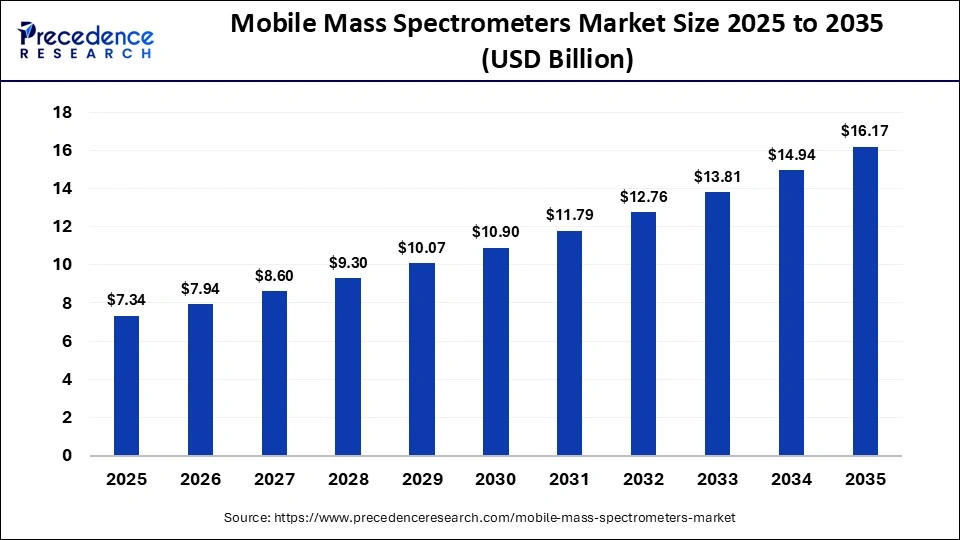
The global mobile mass spectrometers market size was calculated at USD 7.34 billion in 2025 and is predicted to increase from USD 7.94 billion in 2026 to approximately USD 16.17 billion by 2035, expanding at a CAGR of 8.22% from 2026 to 2035.The market is experiencing robust growth, driven by the widespread use of onsite molecular detection and real-time analysis of chemical analytes in multiple industries. Field-portable devices are becoming increasingly important over lengthy waiting periods often caused by centralized laboratory testing.
Key Takeaways
- North America held the largest revenue share in the mobile mass spectrometers market in 2025.
- Asia-Pacific is expected to grow at the fastest CAGR in the market during the forecast period.
- By product type, the portable mass spectrometers segment accounted for a considerable revenue share in the market in 2025.
- By product type, the handheld mass spectrometers segment is expected to grow at the fastest CAGR in the market between 2026 and 2035.
- By applications, the environmental testing segment accounted for the highest revenue share in the market in 2025.
- By applications, the homeland security segment is expected to expand rapidly in the market in the coming years.
- By end-user, the government and research institutions segment accounted for a considerable revenue share in the market in 2025.
- By end-user, the industrial segment is expected to grow at the fastest CAGR in the market between 2026 and 2035.
What is the Mobile Mass Spectrometers Market?
Mobile mass spectrometers are portable analytical tools used to quantify and identify chemical compounds at the site by determining the mass-to-charge ratio of ions. This facility supports rapid and sensitive analysis of molecules outside traditional laboratory settings. Applications range across sectors, including environmental protection, surveillance, security screening, and forensic investigations, with real-time data collection and high flexibility for field missions. Portable, handheld, and benchtop models are the three main types of mobile mass spectrometers that have been developed for mass spectrometry.
Portable mass spectrometers are small instruments that can analyze ion properties to detect and quantify chemicals in situ. Methods used include ion trap mass spectrometry, quadrupole systems, time-of-flight instruments, Fourier transform ion cyclotron resonance (FT-ICR), and sector field configurations. Modes of operation include manual and automatic mobile devices. Applications can include environmental assessments, pharmaceutical and biotechnology industries, food safety assessments, forensic science, industrial applications, and agricultural soil testing.
Impact of AI in the Mobile Mass Spectrometers Market
Mobile mass spectrometers are being subtly revolutionized by artificial intelligence (AI) in the way chemical data is processed. Analysts have invested considerable time in studying fragmentation patterns and comparing them to spectral libraries in the past. AI-augmented algorithms make this easier now, with portable devices identifying compounds almost instantaneously.
Machine learning models that take advantage of large-scale molecular signatures can extract data, so systems can quickly and accurately detect hazardous substances, pharmaceutical agents, or environmental pollutants. This development marks the transition from a simple detection system to an emerging field analytics system. Portable spectrometers are transformed from measuring ions to interpreting them, providing real-time, actionable results to researchers and investigators in a few minutes rather than hours.
Mobile Mass Spectrometers Market Trends
- Proliferation of On-site Chemical Detection Systems:Portable mass spectrometers are also becoming imperative when waiting for laboratory test results is unrealistic. In the real world, this technology plays an essential role as those deployed in field service (security personnel, environmental monitors, emergency personnel) rely on systems of this type to do their work directly on ground-based safety.
- Integrated with Analytics in the Digital and Cloud Age: There is one trend that is already affecting the market, which is the fusion of mobile spectrometers with digital platforms. Such devices today transport spectral data to cloud storage for storage use, collaborative data-sharing, and even for remote inspection. Researchers from different sites can access their data, without visiting a laboratory.
- Growing Regulatory and Environmental Monitoring: With the tightening of environmental controls and an increased public emphasis on pollution issues, more mobile spectroscopy is being adopted to inspect air quality, water sources, and soil conditions. Portable systems enable inspectors to quickly detect pollutants or chemical spills in situ, thus allowing organizations to meet standards while being more responsive.
Market Scope
| Report Coverage | Details |
| Market Size in 2025 | USD 7.34 Billion |
| Market Size in 2026 | USD 7.94 Billion |
| Market Size by 2035 | USD 16.17 Billion |
| Market Growth Rate from 2026 to 2035 | CAGR of 16.17 % |
| Dominating Region | North America |
| Fastest Growing Region | Asia Pacific |
| Base Year | 2025 |
| Forecast Period | 2026 to 2035 |
| Segments Covered | Product Type, Application, End-User, and region |
| Regions Covered | North America, Europe, Asia-Pacific, Latin America, and Middle East & Africa |
Segmental Insights
Product Type Insights
Which Product Type Segment Dominated the Mobile Mass Spectrometers Market?
The portable mass spectrometers segment held a dominant position in the market in 2025, largely due to the optimal hybridization of analyzing precise characteristics and mobility by portable mass spectrometers. Environmental researchers, pharmaceutical teams in the field, and forensic departments had a preference for this sort of transportable system that could still maintain detection capabilities while they moved from site to site. Their broad applicability to multiple uses augmented the segment's growth.
The handheld mass spectrometers segment is expected to show the fastest growth over the forecast period, as prior models were limited by issues such as resolution and detection range. However, technological advancements have gradually developed confidence in those technologies as miniaturized instruments and battery characteristics have made them more reliable and robust.
Handheld units are now employed by security agencies and field agents for rapid chemical identification. In the years ahead, the scope of this section can rapidly grow as the call for rapid molecular detection at the point-of-use field continues to grow. As electronic components become smaller and AI-based spectral analysis interpretation continues to advance, handheld spectrometers are likely to become key tools for frontline chemical assessment in the foreseeable future.
Application Insights
Why Did the Environmental Testing Segment Dominate the Mobile Mass Spectrometers Market?
The environmental testing segment held the largest revenue share in the market in 2025, driven by a growing focus on monitoring and compliance with pollution laws. Mobile mass spectrometers are used in many countries and research facilities to identify air, water, and soil pollutants at their sources of collection. This facilitates the reduction of the time taken to carry samples to laboratories. These tools have played a key role in field assessments and environmental evaluations. This sector is expected to grow due to more demanding environmental policies and the need for fast responses to hazardous substances in industrial inspections and ecological monitoring.
The homeland security segment is expected to witness the fastest growth in the market over the forecast period, due to the increasing demand from defense organizations and border control organizations. Portable spectrometry devices have proved effective for detecting explosives, illicit drugs, and hazardous chemicals during inspections or in emergency-related situations.
Their ability to quickly detect chemicals in uncertain environments provides yet another critical part of their strategic value. That's due in part to governments that have ramped their efforts and budgets towards better chemical identification and sophisticated analytical technologies available for deployment in the field, though certainly, to help them better target and locate such threats, fostering the segment's growth.
End-User Insights
Which End-User Segment Led the Mobile Mass Spectrometers Market?
The government and research institutions segment led the market in 2025, largely because academic institutions and national laboratories were amongst the first to adopt state-of-the-art analytical methodologies. They use mobile mass spectrometers for different applications, such as environmental assessments, forensic investigations, and chemical monitoring initiatives. They are very capable of getting funding and focus on technological innovation, which has helped the user community. This part is projected to improve with research grants, public-sector oversight programs, and partnerships in atmospheric chemistry, toxicology, and environmental studies.
The industrial segment is expected to expand rapidly in the market in the coming years. Traditionally, chemical analyses were performed with centralized labs. The petrochemical, pharmaceutical, and manufacturing industries are moving from traditional laboratory testing methods to mobile spectrometry tools to assure quality and track changes as they occur in the production process. These segments of firms attempt to increase monitoring of processes in a more regulatory manner and reduce the downtime that otherwise results from traditional lab-based testing methods.
Regional Insights
Why North America Dominated the Mobile Mass Spectrometers Market?
North America held a major revenue share in the market in 2025, driven by a mature ecosystem of analytical instrument manufacturers, advanced research facilities, and active government investment in chemical detection technologies. Portable spectrometry systems have also been installed routinely in the region, such as in environmental monitoring, forensic tests, and homeland security projects. Field-deployable analytics equipment, widely embraced in both the pharma and defense industries, consolidated its market leadership.
U.S. Market Trends
The U.S. is the dominant country in the North American market, as it has made significant investments in scientific instrumentation and analytics on a security front. Its scientific applications have been heavily influenced by U.S. companies. Federal agencies, environmental regulators, and pharmaceutical research institutions have utilized mobile mass spectrometers during the course of their on-site operations. Research strength in the country and cooperation between universities, national labs, and manufacturers of instruments encouraged continuous development.
Why is Asia-Pacific Experiencing the Fastest Growth in the Mobile Mass Spectrometers Market?
Asia-Pacific is expected to experience the fastest growth during the predicted timeframe, driven by the growing demand for industrial activities and environmental monitoring. Governments are stepping up the investment in analytical technologies to address challenges ranging from pollution control to food safety assessments and monitoring of industrial emissions.
At present, the proliferation of pharmaceutical production and biotechnology research centers also encourages the use of portable analytical instruments. The demand for compact mass spectrometry systems for a wide range of applications will continue to rise, depending on advances in modern scientific methods, increasing with the ongoing construction of the scientific infrastructure and regulations.
China Market Trends
China market is growing rapidly in the Asia-Pacific, owing to major innovations in environmental safety and monitoring, the chemical industry, and pharmaceutical manufacturing. State initiatives to improve pollution supervision and industrial safety have also been driving increased use of advanced field-based analytical equipment. Meanwhile, research labs and technology companies are increasing their investments in portable scientific equipment. Such as a mobile mass spectrometer, which is adopted at both the environmental testing stage, along with industrial-based applications, will increase considerably.
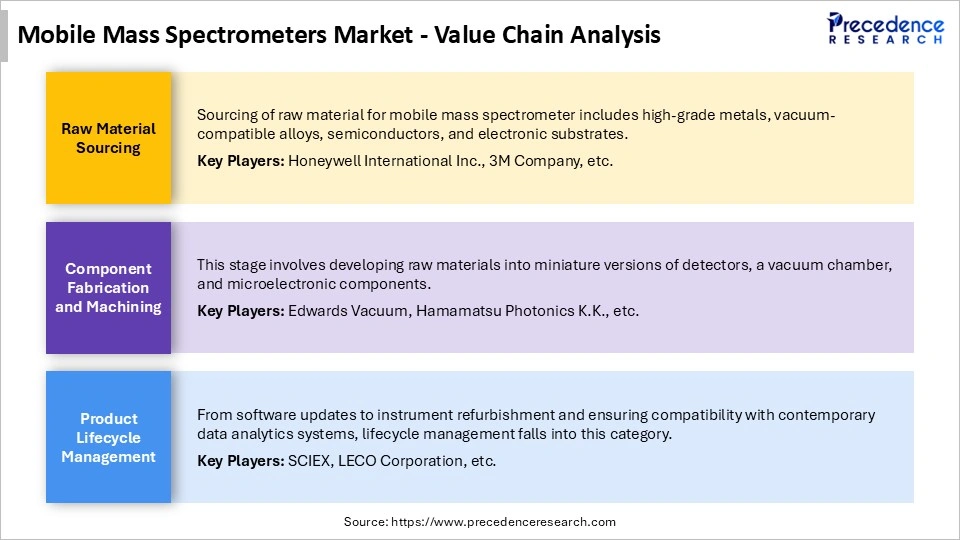
Mobile Mass Spectrometers Market Value Chain Analysis
Mobile Mass Spectrometers Market Companies
- Agilent Technologies
- Thermo Fisher Scientific
- PerkinElmer
- Bruker Corporation
- Shimadzu Corporation
- Focused Photonics
- Advion, Inc.
- FLIR Systems, Inc.
- Hiden Analytical
- Waters Corporation
- SCIEX (a Danaher Company)
- JEOL Ltd.
- LECO Corporation
- Microsaic Systems plc
- IonSense, Inc.
- Owlstone Medical
- 1st Detect Corporation
- Smith's Detection
- Teledyne FLIR,
- Extrel CMS, LLC
- MassTech Inc.
- Kore technology
- BaySpec, Inc.
- Microsaic Systems plc
- IonSense, Inc.
- Owlstone Medical
- 1st Detect Corporation
- Smith's Detection
Recent Developments
- In February 2026, 908 Devices Inc. launched upgraded analytical features of the MX908 handheld mass spectrometer that include new drug-target detection capabilities and new software modifications that help first responders detect new narcotics or chemical hazards directly at the scene of an incident. The enhancements included a mission mode for hazardous vapor sampling and addition of five priority drug targets.(Source: https://908devices.com)
- In July 2025, the U.S. Department of Energy's Pacific Northwest National Laboratory (PNNL) launched VaporID, a portable air sampling system incorporated with a miniature mass spectrometer, to detect trace levels of fentanyl, methamphetamine, cocaine, and explosives like TNT with great accuracy. The instrument will be manufactured and commercialized by BaySpec.(Source: https://www.spectroscopyonline.com)
Segments Covered in the Report
By Product Type
- Portable Mass Spectrometers
- Handheld Mass Spectrometers
By Application
- Environmental Testing
- Homeland Security
- Pharmaceutical and Biotechnology
- Food and Beverage Testing
- Others
By End-User
- Government and Research Institutions
- Industrial
- Others
By Region
- North America
- Latin America
- Europe
- Asia-pacific
- Middle and East Africa
For inquiries regarding discounts, bulk purchases, or customization requests, please contact us at sales@precedenceresearch.com
Frequently Asked Questions





Ask For Sample
No cookie-cutter, only authentic analysis – take the 1st step to become a Precedence Research client
 Get a Sample




 sales@precedenceresearch.com
 Schedule a Meeting
