



Molecular Nucleic Acid Testing Transfusion Medicine Market Trends, Leading Companies, Company Revenue / Sales Performance, Procedure Volume, Healthcare Spending, Technology Adoption, Reimbursement Analysis, Competitive Landscape, and Growth Outlook
The molecular nucleic acid testing transfusion medicine market reached USD 1053.61 million in 2026. This growth is driven by the rising prevalence of genetic disorders, advances in molecular diagnostics, and increasing investments. These trends were analyzed by our Senior Research Analyst, Deepa Pandey, to curate this report. This report benefits several stakeholders, including major biotech giants, healthcare conglomerates, large-scale commercial reference laboratories, and medical device manufacturers.
Source: https://www.precedenceresearch.com/molecular-nucleic-acid-testing-transfusion-medicine-market
 Get a Sample
 Table Of Content


Molecular Nucleic Acid Testing Transfusion Medicine Market Size, Share, Trends, and Growth Forecast 2035
The molecular nucleic acid testing transfusion medicine market is forecasted to expand from USD 1053.61 million in 2026 to USD 1710.27 million by 2035, growing at a CAGR of 5.53% from 2026 to 2035.
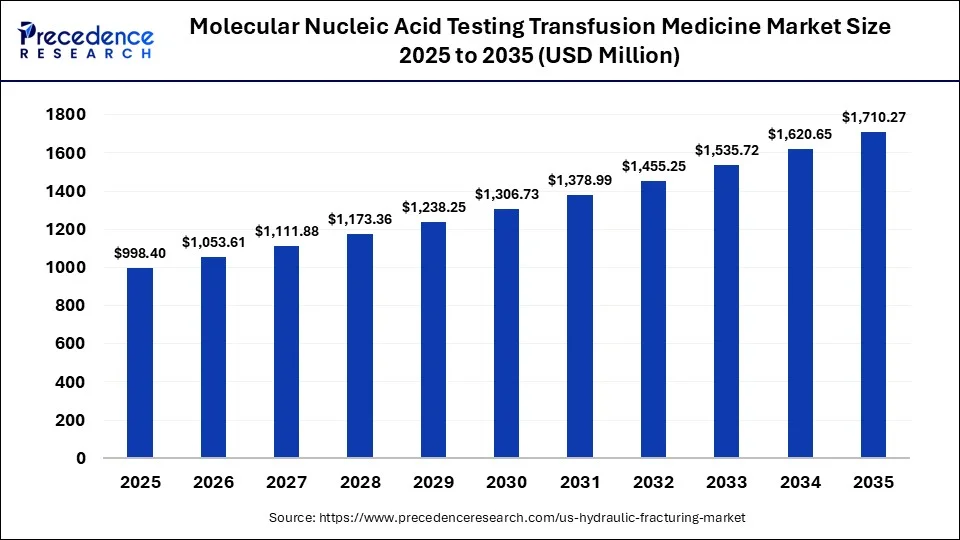
Key Takeaways
- PCR-based NAT represented approximately 54.2% of market revenue in 2025, supported by its broad use in molecular donor screening.
- HBV accounted for 29.8% of the market in 2025 and is projected to expand at approximately a 7.3% CAGR, making it the leading pathogen segment.
- Blood bank and blood centers represented approximately 53.4% of the market in 2025, ahead of hospitals, transfusion centers, and donor-screening laboratories.
- North America held approximately 37.1% of global market revenue in 2025, supported by mature blood-screening infrastructure and stringent safety requirements.
- Grifols Procleix assays screen more than 36 million blood donations annually, with more than 70 donations screened per minute.
- Hologic reports that approximately 75% of the U.S. donated blood supply is screened using its blood-testing platform heritage, highlighting its established installed footprint.
What are the growth factors for the Molecular Nucleic Acid Testing Transfusion Medicine Market?
The market is defined by recurring use, high regulatory requirements, growing automation, and more widespread adoption of multiplex molecular screening for infections that can spread through transfusions.
The market can be segmented based revenue, testing volumes, number of instruments in use, reagent consumption, regional adoption, pathogen targets, technology types, end users, and opportunities at regional levels. It also evaluates base, upside, and downside scenarios.
Key Coverage
- Historical market development
- Incremental revenue opportunity
- Regional contribution
- Testing-volume economics
- Instrument versus recurring consumable revenue
- Scenario-based market forecasts
Segmentation Analysis
Which Product and Technology were Predominantly Used in 2025?
This market study covers products, technology, pathogen target, end use, and geography. By product, reagents and consumables are leading the market. Every donor screening process requires assay kits, controls, calibrators, extraction materials, reaction vessels, pooling supplies, and other disposables. These items make up 83.5% of total revenue, showing installed systems mainly serving as entry points to reagent spending.
By technology, PCR-based NAT accounted for revenue of around 54.2% in 2025. Transcription-mediated amplification (TMA) continues to hold a meaningful position, supported by its use in established blood-screening programs and the installed base of compatible platforms.
By pathogen, HBV contributed 29.8% of the market, expecting to grow at a CAGR of about 7.3%, one of the most important revenue stream. Other factors expanding the opportunities for testing menu are HIV-1/HIV-2, HCV, West Nile virus, and other emerging or region-specific pathogens.
By end use, blood banks and blood centers estimated 53.4% of share in 2025. Next were hospitals and transfusion centers, followed by donor-screening laboratories.
Key Coverage
- Product revenue and share
- PCR versus TMA economics
- HBV, HCV, HIV and emerging pathogen opportunity
- Individual-donation versus minipool NAT
- Blood-bank versus centralized-laboratory adoption
- Country-level penetration
- Fastest-growing and emerging segments
Market Dynamics
Demand Drivers and Restraints of Molecular NAT Transfusion Medicine.
The biggest driver is the ability of NAT to detect genetic material before traditional antigen or antibody markers appear. This helps reduce the risk of transmitting infections through blood transfusions. Regulatory bodies are increasingly recognizing testing as a critical part of donor screening. For example, U.S. Guidelines now include NAT for HIV-1, HCV, and HBV in blood and plasma donor testing.
Because of factors like upfront costs, the need to qualify instruments, ongoing reagent expenses, laboratory staffing, quality control, and uneven donation volumes in low-resource areas, the commercial potential is strongest where large numbers of donations justify centralized automated NAT systems.
Emerging pathogens is also a potential segment. Commercial testing menus are expanding beyond HIV, HBV, and HCV to include HEV, WNV, Babesia, malaria/Plasmodium, dengue, chikungunya, Zika, and parvovirus B19, depending on location and regulatory approval.
Pricing Analysis of the Molecular Nucleic Acid Testing Transfusion Medicine Market.
Factors like cost per screened donation, reagent use, pool size, testing throughput, instrument placement, service agreements, controls and calibrators, labor, maintenance, and confirmatory testing are influencing the NAT pricing.
High-throughput automated systems are proving more favourable economically but, as volume is increasing, the cost of reagents and labor per donation is going down. Minipool NAT lowers cost per donation by spreading the assay cost across donations. Individual-donation NAT offers precision and easier identification of reactive units.
The competition is shifting from instrument price to cost of ownership. Suppliers are now differentiating the market based on walk-away automation, continuous loading, hands-on time integrated pooling, software connectivity, and broader assay menus.
Key Coverage
- Cost per donation
- Cost per test
- Instrument ASP
- Reagent economics
- Pool-size economics
- Service and maintenance costs
- Labor contribution
- TCO comparison
- Regional pricing differences
- Premium versus value-oriented platforms
How does the Installed Platform Base Shift Value Capture Toward Recurring Consumables and Increase Supplier?
The molecular NAT transfusion medicine value chain covers reagents, enzymes, primers and probes, sample preparation/extraction, pooling, amplification and detection, software, donor screening, and blood-component release. As instrument placement is generating capital-equipment revenue, economics are expected to increasingly shift to recurring assay consumption once platforms are installed. Installed instrument base serves as a critical leading indicator of reagent demand, with platform compatibility, assay availability, regulatory approvals, service infrastructure, and test throughput determining the depth and durability of downstream revenue capture.
The integrated workflows are strengthening supplier stickiness across the blood-screening ecosystem. Workflow integration of pooling, extraction, amplification, detection, software connectivity, and validated donor-screening protocols can require additional validation, staff training, workflow modification, and regulatory qualification for switching suppliers.
The significant implication is that competition increasingly occurs at the platform ecosystem level rather than solely at the individual assay level. Suppliers should focus on combining high-throughput instrumentation with pathogen menus, reliable reagent supply, automation, and technical support, positioning themselves to convert one-time instrument placements into long-term recurring consumables revenue.
This is expected to create an opportunity for suppliers to prioritize installed-base expansion, assay-menu breadth, workflow integration, and recurring-revenue conversion over competing primarily on instrument pricing. The trade-off increasingly shifts from equipment economics to total cost of ownership, including reagent consumption, labor requirements, throughput, maintenance, and operational continuity for switching suppliers.
How is Multiplexing and Workflow Automation Increasing the Scalability and Commercial Value of Molecular NAT?
Multiplex pathogen detection, higher analytical sensitivity, automated pooling, integrated extraction, continuous loading, reduced hands-on intervention, and laboratory-information-system connectivity has driving innovation in molecular NAT, especially after the launch of a donor-screening assay capable of simultaneously detecting HIV, HCV, HBV, and HEV on automated molecular platforms in March 2026. This suggests that expanding pathogen coverage without requiring proportional increases in instrument complexity can improve the economic value of existing NAT infrastructure along with broader screening requirements.
Multiplexing is becoming a more commercially significant innovation than incremental improvements in standalone assay performance. Suppliers can potentially increase testing density, simplify laboratory operations, and strengthen utilization of automated platforms by combining multiple pathogen targets within a single workflow. At the same time, automated pooling, extraction, and continuous loading address the operational constraints associated with high-volume donor screening. Rather than assay sensitivity alone, the most significant implication is technology leadership increasingly depending on workflow-level automation and platform scalability.
Integrated extraction-and-amplification workflows can reduce infrastructure and staffing requirements as parallel opportunities emerge is emerging in decentralized and resource-constrained markets, like Asia-Pacific and Africa. This indicates towards a two-track technology opportunity: high-throughput centralized systems competing on automation, multiplexing, and processing capacity, while emerging-market platforms differentiating through workflow integration, simpler deployment, and lower operational complexity.
Why Regulatory Qualification Remains a Major Entry Barrier for Molecular NAT Transfusion Medicine?
As assay failure can directly affect blood-product safety, NAT in transfusion medicine has to be operated under a higher regulatory burden than many routine molecular-testing applications.
Regulatory requirements cover analytical sensitivity, specificity, donor eligibility, quality control, traceability, validation, reactive-unit disposition, assay performance, software, instrument reliability, and manufacturing consistency. U.S. requirements specifically address NAT screening for blood and blood components and provide guidance for pooled and individual-donation testing. This environment favours companies with established regulatory histories, validated platforms, and long-term relationships with national blood services.
Competitive Landscape
How do the Platform Installed Base and Assay Breadth Determine Long-Term Market Power?
A small number of established global suppliers control major automated blood-screening platforms. Regional and emerging companies compete through lower-cost PCR systems, localized manufacturing, specialized pathogen menus, and flexible pooling solutions. So, the competitive environment for this market is moderately concentrated.
Established players have a competitive edge around assay technology, installed instruments, regulatory approvals, reagent availability, service infrastructure, blood-center relationships, workflow validation, assay breadth, and switching costs.
Grifols
Grifols is one of the strongest players for NAT donor screening through its Procleix portfolio. Its Procleix Ultrio Elite assay detects HIV-1, HIV-2, HCV, and HBV and supports individual-donation and pooled formats of 4, 8, 16, and 96 samples.
Its diagnostic products screen more than 36 million blood donations annually, with more than 70 donations screened per minute using Procleix assays.
A strong advantage for Grifols is the combination of blood-screening specialization, installed-base economics, broad pathogen coverage, and recurring reagent consumption.
F. Hoffmann-La Roche
F. Hoffmann-La Roche is known for itys high-throughput cobas molecular systems and broad laboratory automation. The cobas 6800/8800 platform family was upgraded in 2025 to improve throughput, run flexibility, and sample prioritization.
In 2026, Roche further expanded its donor-screening portfolio through a four-target multiplex assay covering HIV, HCV, HBV, and HEV that has strengthened its position in high-throughput molecular blood screening.
Hologic
Hologic has long been in molecular blood screening through TMA technology and the Procleix lineage. Its molecular platform strategy also benefits from assay-menu consolidation across infectious disease and other applications. Hologic reports that approximately 75% of the U.S. donated blood supply is screened using its blood testing platform heritage, highlighting the strength of its installed technological footprint.
GFE
GFE is a specialist rather than a diversified diagnostics conglomerate. Its PoET system combines automated NAT processing with on-board pooling, while its portfolio targets HCV, HBV, and HIV donor screening. It collaborated with Seegene in 2026 to expand international distribution of PoET and create an avenue for joint product development.
Emerging Asian Competitive Cluster
Asian suppliers are offering localized, integrated, and cost-sensitive PCR workflows, hence they are in high demand.
Sansure Biotech provides blood NAT screening supporting both individual-donation and minipool formats and multiplex detection of HBV, HCV and HIV.
DaAn Gene offers RT-PCR blood-screening solutions targeting HBV, HCV, and HIV and integrates extraction and PCR capabilities across its molecular-diagnostics portfolio.
Shanghai Kehua Bio-Engineering is known for its 96-test molecular blood-screening kit covering HBV, HCV, and HIV-1/HIV-2.
Tianlong has developed integrated blood-screening workflows combining extraction, real-time PCR, and NAT reagents, with support for individual and six-sample pooling formats.
Mylab Discovery Solutions represents an emerging Indian competitor through NATSpert, an RT-PCR-based blood-screening solution targeting HIV, HBV, and HCV.
Leading Company Universe
| Company | Headquarters | Market Position | Core Strength |
| Grifols | Spain | Global leader | Procleix donor NAT |
| F. Hoffmann-La Roche | Switzerland | Global leader | High-throughput PCR |
| Hologic | U.S. | Global technology leader | TMA/molecular platform |
| GFE | Germany | Specialist | Dedicated blood NAT |
| Sansure Biotech | China | Emerging global challenger | PCR blood screening |
| DaAn Gene | China | Regional challenger | HBV/HCV/HIV NAT |
| Shanghai Kehua Bio-Engineering | China | Regional challenger | Integrated PCR |
| Tianlong | China | Emerging challenger | Automated blood NAT |
| Mylab Discovery Solutions | India | Emerging challenger | Cost-sensitive NAT |
| Seegene | South Korea | Technology challenger | Multiplex molecular diagnostics |
| Fujirebio | Japan | Regional diagnostics player | Infectious-disease testing |
| Bio-Rad Laboratories | U.S. | Blood-screening incumbent | Serology and blood diagnostics |
| Abbott Laboratories | U.S. | Global diagnostics leader | Blood-screening infrastructure |
| bioMérieux | France | Global diagnostics player | Infectious-disease diagnostics |
| Thermo Fisher Scientific | U.S. | Molecular technology supplier | PCR and laboratory systems |
| QIAGEN | Germany/Netherlands | Molecular technology supplier | Sample preparation/molecular workflows |
| DiaSorin | Italy | Diagnostics specialist | Infectious-disease testing |
| Fapon Biotech | China | Emerging supplier | Molecular diagnostics |
| Maccura Biotechnology | China | Regional diagnostics player | Molecular/IVD systems |
| Sansure-associated regional partners | China/Asia | Emerging ecosystem | NAT implementation |
| GeneProof | Czech Republic | Specialist | Molecular infectious disease |
| Seegene Germany | Germany | Distribution challenger | Blood-NAT commercialization |
| National Genetics Institute | U.S. | Specialist | Molecular infectious disease |
| Ortho Clinical Diagnostics | U.S. | Transfusion diagnostics player | Blood-bank diagnostics |
What is the Competitive Ranking of the Molecular Nucleic Acid Testing Transfusion Medicine Market?
Suppliers lead the competitive ranking due to the presence of substantial installed donor-screening infrastructure compared to companies having the broadest overall molecular diagnostics revenue.
The analysis distinguishes between total company revenue and transfusion-NAT revenue, avoiding the common error of ranking diversified diagnostics companies solely by corporate size.
Key competitive metrics include:
- Installed NAT instruments
- Annual donations processed
- Revenue attributable to donor NAT
- Reagent utilization
- Geographic penetration
- Approved pathogen menu
- Individual-donation/minipool capability
- Throughput
- Regulatory approvals
- Service coverage
What are the Competitive Benchmarking Factors of Molecular NAT Transfusion Medicine?
| Competitive Factor | Global Leaders | Specialist Players | Emerging Regional Players |
| Installed base | Very strong | Strong | Developing |
| Regulatory approvals | Very strong | Strong | Variable |
| Pathogen breadth | Very strong | Strong | Moderate |
| Automation | Very strong | Strong | Moderate-strong |
| Cost competitiveness | Moderate | Moderate | Strong |
| Geographic reach | Very strong | Moderate | Regional |
| Local manufacturing | Moderate | Moderate | Strong |
| Service infrastructure | Very strong | Strong | Developing |
| Emerging-pathogen flexibility | Strong | Strong | Strong |
| Switching barriers | Very high | High | Moderate |
The analysis indicates that regulatory credibility and installed-base depth remain the most defensible competitive advantages, while cost and localized manufacturing provide the principal entry routes for challengers.
Product Portfolio Benchmarking
Broad Menus Are Becoming More Valuable Than Single-Pathogen Assays
Leading suppliers increasingly compete through HBV, HCV, HIV-1/HIV-2, WNV, HEV, Babesia, Plasmodium, dengue, Zika, chikungunya and other geographically relevant pathogens.
The Procleix portfolio, for example, already extends beyond the traditional HIV/HBV/HCV combination into multiple emerging and region-specific pathogens.
The resulting competitive white space is not simply another assay; it is the ability to add new pathogens to an already-installed automated workflow without materially increasing laboratory complexity.
Regional Analysis
How does North America Lead and Asia Pacific Offer the Largest Expansion Runway?
North America represented approximately 37.1% of global revenue in 2025, reflecting mature blood-screening infrastructure and stringent safety requirements. Asia Pacific, at approximately 26.2%, offers stronger structural growth, with a forecast CAGR of about 8.4% through 2035.
India is particularly attractive: its molecular NAT transfusion medicine market was estimated at USD 26.9 million in 2025, projected to reach USD 66.7 million by 2035, representing approximately 12.8% CAGR.
China was estimated at approximately USD 98.2 million in 2025 and is projected to reach USD 193.2 million by 2035, equivalent to approximately 9.3% CAGR.
This creates a two-speed market: North America and Western Europe monetize mature installed bases, while Asia Pacific increasingly drives incremental adoption.
Why National Blood Services Offer the Largest High-Value Accounts in the Market?
Principal customers include national blood services, blood banks, centralized donor-screening laboratories, hospitals, transfusion centers, and plasma organizations.
Procurement decisions are driven by:
- Regulatory clearance
- Analytical sensitivity
- Throughput
- Cost per donation
- Pathogen menu
- Instrument footprint
- Service availability
- Reagent continuity
- LIS connectivity
- Existing installed base
Large national contracts can materially alter regional market shares because one procurement decision can generate recurring testing revenue over multiple years.
What is the M&A Landscape of the Molecular Nucleic Acid Testing Transfusion Medicine Market?
The market exhibits relatively limited transformational M&A compared with broader diagnostics. Strategic activity is instead concentrated around new assay launches, platform upgrades, regional distribution agreements, manufacturing investments, and partnerships.
Recent developments include Roche's 2026 expansion into four-pathogen donor screening and the GFE-Seegene Germany collaboration to distribute PoET blood-screening solutions.
This suggests that the next competitive cycle will be driven primarily by menu expansion and platform utilization rather than wholesale industry consolidation.
What is the White-Space Analysis of the Molecular Nucleic Acid Testing Transfusion Medicine Market?
Asia Pacific represents the most significant geographic white-space opportunity. The market expansion is increasingly shifting toward countries where NAT adoption remains below the maturity levels of established markets. Beyond geography, substantial whitespace exists in individual-donation NAT adoption, centralized donor-screening laboratories, national blood-service modernization, and emerging-pathogen testing, creating multiple demand pools rather than a single growth pathway.
Convergence of geographic penetration and workflow modernization is expected to boost the next phase of this market. Multiplex HIV/HBV/HCV/HEV assays, automated pooling, low-cost integrated PCR, and software-enabled workflow integration can address both throughput and operational-complexity constraints, particularly in emerging and high-volume blood-screening environments. In our assessment, the combination of rising NAT adoption with broader pathogen coverage creates a stronger commercial opportunity than incremental expansion of conventional single-pathogen testing alone.
the most significant strategic opportunity refers to the development of affordable and less complex solutions for NAT deployment with high testing coverage and laboratory throughput. This creates opportunities across regional reagent manufacturing, integrated PCR platforms, automation, software, and national blood-service infrastructure, while centralized laboratories remain attractive deployment points because they can combine testing volumes and improve utilization of automated systems. Suppliers capable of adapting high-throughput workflows to cost-sensitive Asian markets may capture a disproportionate share of incremental demand.
Which High Regulatory Barriers Offset the Threat of New Entrants?
| Force | Assessment | Strategic Interpretation |
| Supplier power | Medium | Specialized molecular inputs and regulated manufacturing matter |
| Buyer power | High | National blood services can negotiate large contracts |
| New entrants | Low-Medium | Regulatory validation and installed-base barriers are substantial |
| Substitutes | Low | Serology remains complementary rather than a complete substitute |
| Rivalry | High | Established platforms compete on menus, TCO and service |
What is the PESTLE Analysis of the Molecular Nucleic Acid Testing Transfusion Medicine Market?
- Political: National blood-safety programs and public-health funding influence adoption.
- Economic: Budget limitations can delay NAT deployment in lower-income blood systems.
- Social: Increasing expectations for safer transfusions raise demand for layered donor screening.
- Technological: Multiplex PCR, TMA, automation, and LIS integration are reshaping workflows.
- Legal: Donor-screening regulations create significant barriers to market entry.
- Environmental: Lower consumable waste, reduced laboratory footprint, and more efficient automation increasingly influence procurement.
Which Growth Drivers will Define the Next Cycle of Molecular NAT Adoption and Profit Pool Expansion?
The market's future is shifting from conventional three-pathogen donor screening toward broader multiplex panels, flexible pathogen selection, and increasingly automated workflows. Continued adoption of molecular donor screening provides the underlying growth base, while expansion into additional pathogens and more automation testing models creates incremental demand opportunities. The upside scenario is particularly linked to faster emerging-market implementation and wider individual-donation NAT adoption, whereas constrained healthcare budgets, slower regulatory adoption, and longer installed-platform replacement cycles affecting the trajectory.
This directs towards the market's structural opportunity is moving from simply increasing NAT penetration toward increasing the testing intensity and value generated per installed platform. Multiplexing and flexible pathogen selection can expand assay coverage without requiring a proportional increase in workflow complexity, while automation can improve utilization and scalability. As blood-screening requirements evolve, these factors are believed to make emerging-pathogen assays and advanced workflow configurations increasingly important contributors to future market expansion.
Recurring reagents and consumables will remain the most attractive profit pool, supported by the ongoing consumption generated by installed NAT platforms. Specialized instruments, workflow software, service contracts, and emerging-pathogen assays are expected to represent complementary value pools as laboratories prioritize automation, operational efficiency, and broader pathogen coverage. The strategic implication is that suppliers with strong recurring-revenue models and the ability to extend assay menus across established platforms may be better positioned to capture the next phase of value creation.
Key Strategic Questions Addressed
- How large is the global molecular NAT transfusion medicine market in 2025, and how rapidly will it expand through 2030-2035?
- Which product segment captures the largest recurring revenue pool?
- Why do reagents and consumables account for the majority of market revenue?
- Will PCR-based NAT continue to outperform TMA, or will platform specialization preserve both technologies?
- Why is HBV the largest pathogen-target segment?
- Which emerging pathogens represent the strongest future assay opportunity?
- How does individual-donation NAT compare economically with minipool testing?
- Which regions offer the largest incremental NAT adoption opportunity?
- Why is Asia Pacific growing substantially faster than the global market?
- Which companies control the most strategically important donor-screening platforms?
- How significant are installed-base and regulatory barriers to new entrants?
- Which competitive factors determine reagent share after an instrument has been installed?
- How are multiplex assays changing the economics of blood screening?
- Which countries offer the strongest white-space opportunities for NAT expansion?
- Which technologies, companies and business models are best positioned to capture the next generation of transfusion-medicine molecular testing demand?
Molecular Nucleic Acid Testing Transfusion Medicine Market Segments
By Technology
- PCR-Based NAT
- Transcription-Mediated Amplification (TMA)
- Isothermal Amplification
- Other Technologies
By Test Type
- Individual-Donation NAT (ID-NAT)
- Minipool NAT (MP-NAT)
- Hybrid/Reflex NAT
By Pathogen
- HIV
- Hepatitis B Virus (HBV)
- Hepatitis C Virus (HCV)
- Hepatitis E Virus (HEV)
- Emerging/Other Pathogens
By Product
- Reagents & Consumables
- Instruments/Analyzers
- Software
- Services & Maintenance
By Workflow
- Manual/Semi-Automated
- Fully Automated
- Integrated Sample-to-Answer
By Application
- Blood Donor Screening
- Blood Component Screening
- Plasma Screening
- Emerging-Pathogen Screening
- Other Transfusion-Medicine Applications
By End User
- Blood Banks/Blood Centers
- Hospitals
- Diagnostic Laboratories
- National/Regional Blood Services
- Other Healthcare Institutions
By Sample Type
- Whole Blood
- Plasma
- Serum
- Other Sample Types
By Throughput
- Low Throughput
- Medium Throughput
- High Throughput
By Region
- North America
- Europe
- Asia Pacific
- Latin America
- Middle East & Africa
For inquiries regarding discounts, bulk purchases, or customization requests, please contact us at sales@precedenceresearch.com
Frequently Asked Questions





Ask For Sample
No cookie-cutter, only authentic analysis – take the 1st step to become a Precedence Research client
 Get a Sample
.webp)



 sales@precedenceresearch.com
 Schedule a Meeting
