



North America Multi-Modality Aesthetic Platforms Market Size, Key Companies, Company Market Share, Patient Volume, Treatment Adoption Rates, Pricing Analysis, Regulatory Landscape
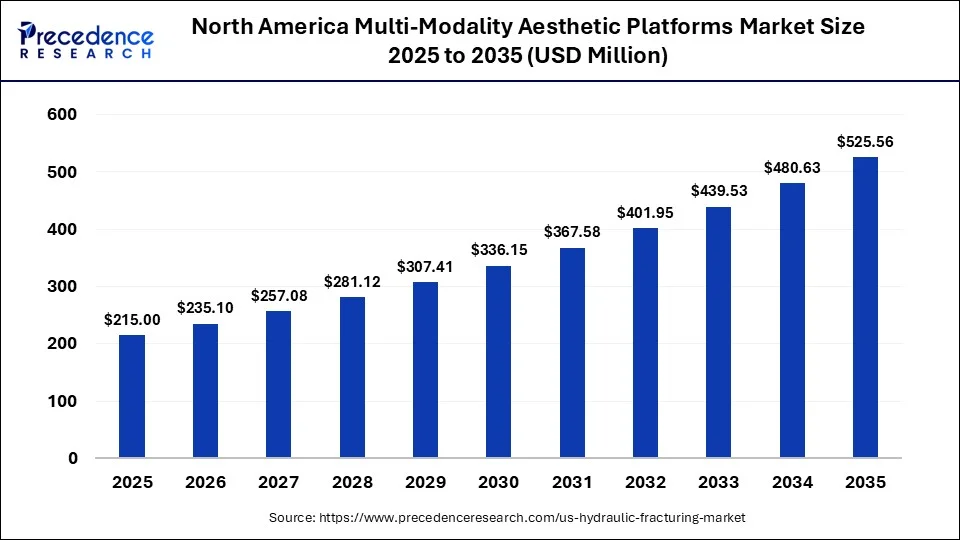
North America Multi-Modality Aesthetic Platforms Market was valued at USD 235.10 Million in 2026 and is expected to grow at a CAGR of 9.35% throughout the forecast period. The markets growth is characterized by a growing inclination towards minimally invasive treatments, which are perceived as safer and more convenient. Furthermore, the rise of social media platforms has amplified the visibility of aesthetic trends, influencing consumer choices and fostering a culture of beauty that prioritizes self-expression. As a result, the aesthetics market is witnessing a surge in innovative offerings, catering to diverse demographics and preferences. Deepa Pandey, our Senior Research Analyst, has over 5 years of experience in the healthcare and medicine industry. According to her, the market is expanding as aesthetic practices increasingly adopt versatile energy-based systems that can address multiple indications through different lasers, intense pulsed light.
Source: https://www.precedenceresearch.com/north-america-multi-modality-aesthetic-platforms-market
 Get a Sample
 Table Of Content


North America Multi-Modality Aesthetic Platforms Market Size, Share, Trends, and Forecast Analysis 2035
The North America multi-modality aesthetic platforms market is forecasted to expand from USD 235.10 million in 2026 to USD 525.56 million by 2035, growing at a CAGR of 9.35% from 2026 to 2035. The aesthetics market in North America is evolving rapidly, driven by a mix of consumer preferences and technological advances. Increasing awareness regarding personal appearance and self-care is propelling demand for various aesthetic procedures and products. The US remains the largest market for aesthetic treatments, driven by a robust demand for non-invasive procedures. Key drivers such as increasing demand for aesthetic treatments and advancements in medical technology are helping to propel market growth.
Key Takeaways
- By modality combination, the Laser + RF dominated the market in 2025, capturing a share of 26.85%.
- By technology, the laser segment captured the highest share of 28.65% in 2025.
- By application, the skin rejuvenating and resurfacing segment held the largest market share of over 27.85% in 2025.
- By treatment area, the face segment dominated the global market share in 2025, with a share of 39.85%.
- By end user, dermatology clinics dominated the market, capturing a share of 31.85% in 2025.
- By patient type, the female gender segment held the largest market share of over 68.45% in 2025.
- By distribution channel, the direct sales segment dominated the global market landscape, capturing a share of 48.65%.
How is the Multi-Modality Aesthetic Platforms Market Growing in 2025?
The Multi-Modality Aesthetic Platforms Market is expected to grow significantly at a CAGR of 9.35% from 2026 to 2035. The growth of social media platforms has increased the exposure to aesthetic trends, thus shaping consumer preferences and fostering a culture that emphasizes self-expression. Consequently, the aesthetics market is experiencing a rise in innovative products that serve a wide range of demographics and tastes. Meanwhile, North American regulators are updating policies to support the rapid expansion of the market, with a focus on safety and efficacy, potentially boosting consumer trust. Additionally, emerging technologies like artificial intelligence and telemedicine are transforming how aesthetic services are delivered.
Expert Analyst View
The supplied forecast implies that the market increases from USD 215 million in 2025 to approximately USD 525.44 million by 2035.
The underlying demand environment is supported by high utilization of minimally invasive aesthetic procedures. ASPS reported that U.S. minimally invasive procedures increased 1.5% in 2024, while the broader procedure base exceeded 28.5 million treatments.
For platform manufacturers, the commercial proposition is increasingly centered on treatment-menu expansion from a single capital-equipment investment. A clinic can use one workstation across several indications rather than purchasing an entirely separate console for every treatment category.
Segmental Analysis
Which Combinations are Gaining the Most Market Share?
The Laser + RF segment dominated the market, due to the fact that this segment addresses a broad range of aesthetic concerns by combining laser-based skin and tissue treatment with radiofrequency-based thermal energy storage. This helps to improve treatment versatility and support higher clinical adoption. On the other hand, the RF + electromagnetic segment is expected to have the fastest rate of growth, due to a growing consumer preference for non-invasive procedures and its thermal effects on skin tissue. This enables practitioners to address both skin and any underlying muscle-related concerns as well.
Analyst View
Laser + RF is the largest combination at 26.85%, reflecting the broad range of facial rejuvenation, skin resurfacing, tightening, and contouring applications that can be addressed through these energy modalities. However, RF + Electromagnetic has the highest supplied CAGR at 11.34%, while RF + ultrasound grows at 10.29%. This indicates increasing commercial interest in platforms that extend beyond traditional laser/light applications into body contouring, tissue tightening, and muscle-focused treatments. The competitive trend is visible in current product development.
Which Technologies are Driving Multi-Modality Platform Development?
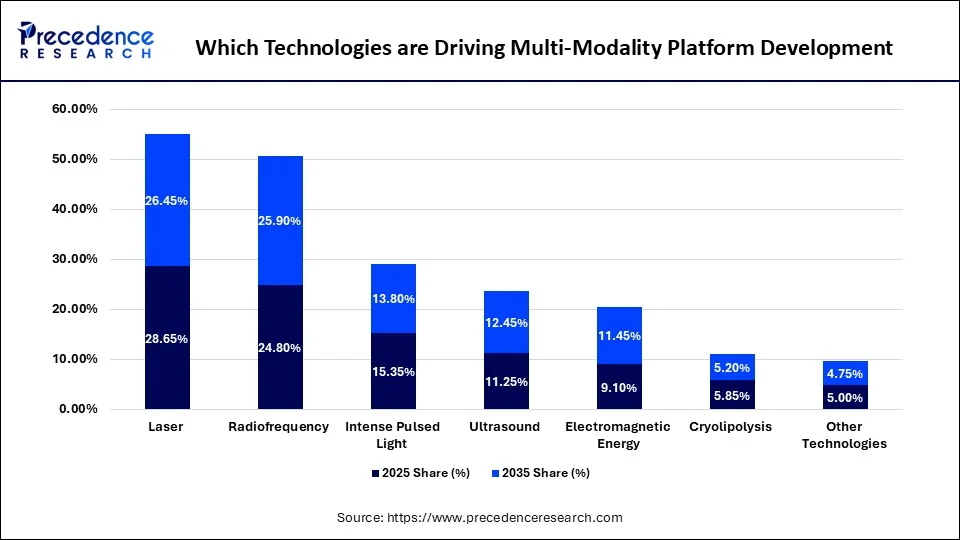
The laser segment dominated the market as of this year, due to its well-established clinical use and its broad applicability across various aesthetic procedures. It helps to provide a precise yet controlled energy delivery, enabling practitioners to address multiple aesthetic concerns. On the other hand, the electromagnetic energy market is expected to grow at the fastest rate, driven by the increasing demand for non-invasive treatment. This segment can target deeper tissue while still requiring less downtime, making it popular.
Analyst View
- Laser remains the largest technology category at 28.65%, but its share declines to 26.45% by 2035.
- Electromagnetic energy is the fastest-growing technology at 12.05% CAGR, followed by ultrasound at 10.47%. The shift reflects the broadening of aesthetic platforms from traditional skin-focused laser/light treatments toward body contouring and muscle stimulation.
- The FDA identifies RF, light-based energy, ultrasound, cryolipolysis, and magnetic-field technologies among the technologies used in non-invasive body-contouring devices.
Which Aesthetic Applications Represent the Largest Demand Pools?
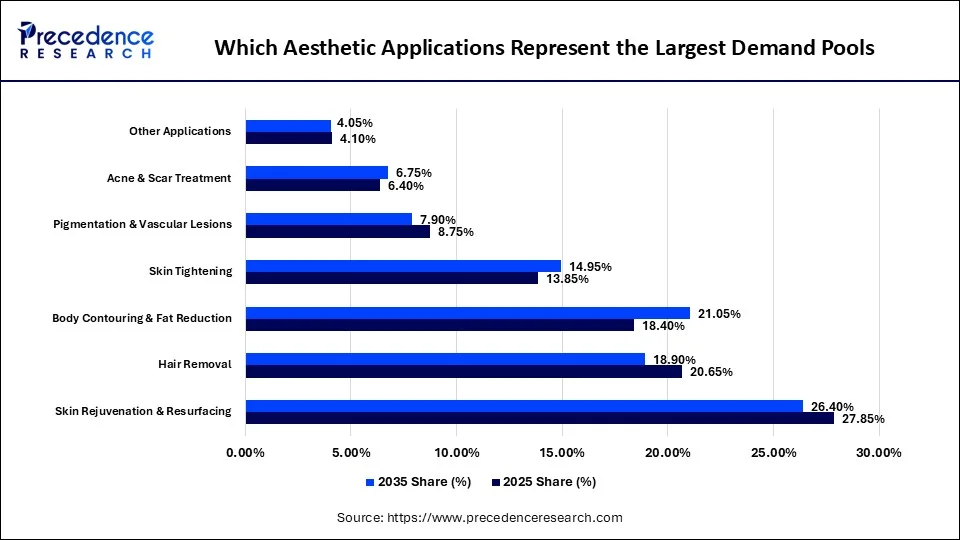
The skin rejuvenation and resurfacing segment dominated the market due to its strong and sustained demand for procedures that specifically target wrinkles, acne scars, uneven skin textures, fine lines, pigmentation, and any other visible signs of skin aging. On the other hand, body contouring and fat reduction is expected to grow at the fastest rate throughout the forecast period, due to an increasing consumer preference for shorter recovery periods and personalized body shaping procedures in a non-invasive way.
Analyst View
- Skin rejuvenation and resurfacing remains the largest application at 27.85%, but body contouring and fat reduction records the highest supplied CAGR at 10.91% and gains 2.65 percentage points of share by 2035.
- This is consistent with the broader aesthetic environment. ASPS reported 317,196 liposuction procedures in 2025, while multiple body-lift categories also recorded strong year-over-year growth.
- The FDA describes non-invasive body contouring as a group of procedures that can alter body circumference, reduce small areas of visible fat, improve muscle tone/firmness or improve the appearance of cellulite.
Which Anatomical Areas Generate the Highest Platform Utilization?
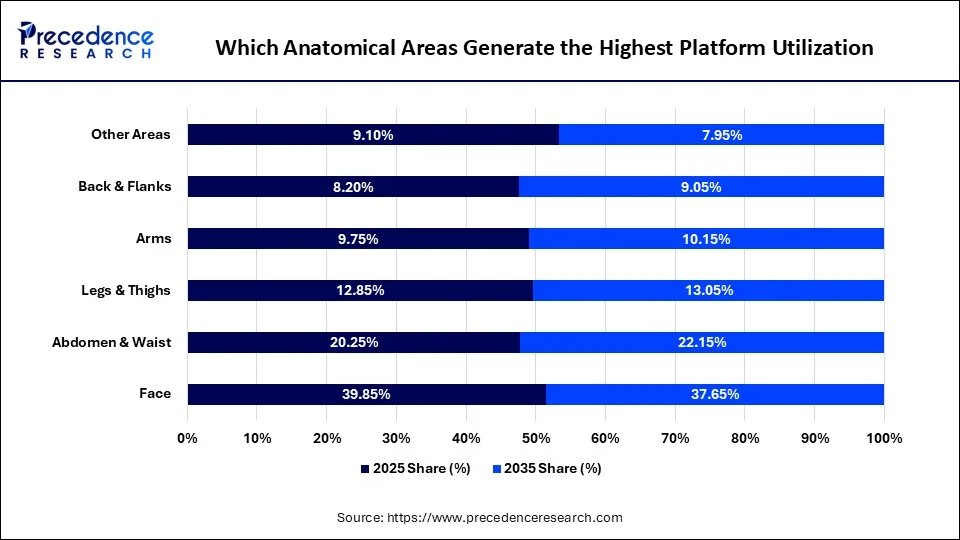
The face segment dominated the market, primarily due to the high demand for facial and aesthetic procedures. This segment is the most highly sought after, while the availability of multiple technologies and combination procedures helps to further enhance the versatility of multi-modality platforms. On the other hand, the abdomen and waist segment is expected to grow at the fastest rate, driven by the increasing demand for localized fat reduction procedures. Growth is also because many patients seek to reduce stubborn fat deposits and improve overall body definition without undergoing any surgery.
Analyst View
- The face accounts for 39.85% of the 2025 market, reflecting the breadth of facial rejuvenation, resurfacing, pigmentation, vascular, acne, and hair-removal indications.
- However, the abdomen & waist and back & flanks categories have CAGRs of 10.34% and 10.40%, respectively. This reinforces the broader movement toward multi-purpose systems capable of supporting both facial and body applications.
- FDA product classifications specifically identify areas such as the flank, abdomen, thighs, waist and hips for certain aesthetic body-contouring technologies.
Which Facilities are Purchasing Multi-Modality Aesthetic Platforms?
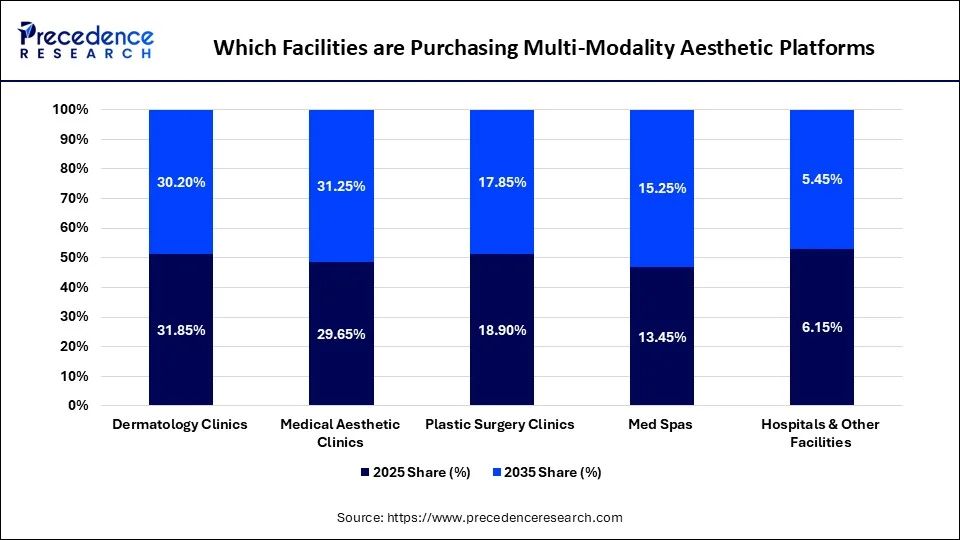
Dermatology clinics dominated the market as of this year, due to their well-established medical infrastructure, access to skilled and highly qualified practitioners, and the ability to provide a broad range of aesthetic procedures and clinically driven treatments. On the other hand, med spas are expected to have the fastest growth rate throughout the forecast period, driven by rising consumer interest in convenient aesthetic treatments in specialized wellness and beauty-focused settings. Med spas are increasingly incorporating multi-modality platforms into their portfolios, thus improving their operational versatility.
Analyst View
- Dermatology clinics are the largest end-user segment at 31.85%, but medical aesthetic clinics will become the largest segment by 2035 in the supplied forecast.
- Med spas have a 10.76% CAGR, significantly above the overall 9.35% market CAGR. Their business model is particularly compatible with platforms that offer several treatments from one workstation.
- InMode explicitly markets multi-modality platforms to med spas and highlights the ability to add multiple treatment capabilities through expandable systems.
How is the Patient Mix Changing?
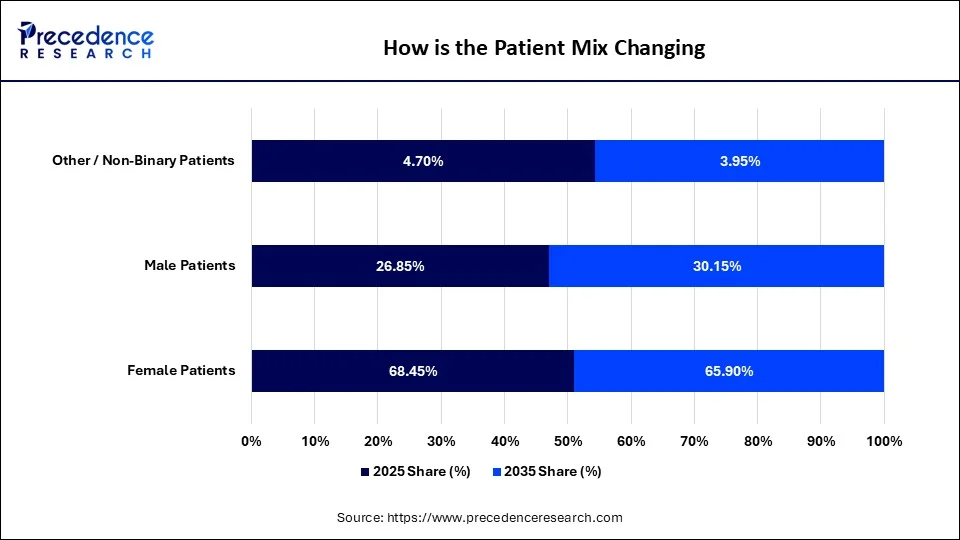
The female segment remains dominant in the aesthetics market due to longstanding cultural trends that celebrate beauty and personal grooming among women. This segment is characterized by a diverse range of services, including skincare, cosmetic procedures, and body treatments, all of which cater to womens evolving needs. On the other hand, the male segment is growing rapidly, driven by changing perceptions of masculinity and grooming. Men are increasingly interested in aesthetics, not just as a means of self-care but as a statement of personal style. The growth of this segment also indicates a shift in market dynamics, with brands and providers rapidly adapting to cater to male consumers and their specific requirements.
Analyst View
Female patients remain the largest modeled patient group, but the supplied data show the male segment growing at 10.63%, faster than the total market. The resulting share movement, from 26.85% to 30.15%, suggests a widening addressable patient base for platforms capable of supporting multiple facial and body indications. The 2025 ASPS report also identifies continued male participation in aesthetic procedures, with body-contouring procedures such as lifts increasing among male patients.
How are Multi-Modality Aesthetic Platforms Sold?
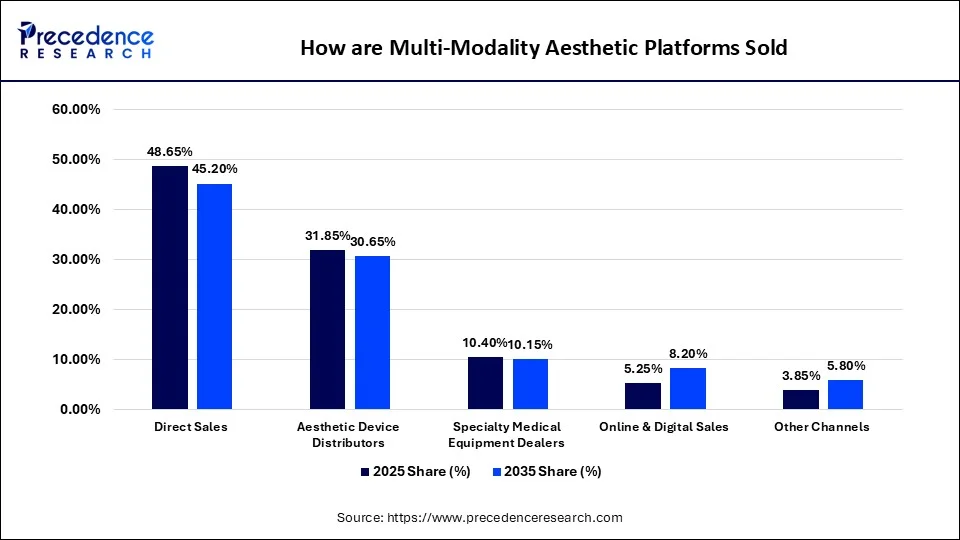
Direct sales dominated the market, due to the fact that these systems are high-value, technically sophisticated, and provide a direct engagement between manufacturers and clinics. The need for technical assistance, practitioner training, maintenance, and ongoing manufacturer support further makes this particular segment a preferred one. On the other hand, the online and digital sales segment is expected to have the fastest growth rate, supported by the increasing digitalization of medical devices procurement and the growing use of online platforms for product discovery. As purchasing decisions become more digital in nature, suppliers are able to expand their online presence, and online channels are expected to gain traction.
Analyst View
Direct sales remain dominant at 48.65%, reflecting the technical nature and relatively high capital value of aesthetic platforms.
However, Online and Digital Sales have the highest supplied CAGR at 15.12%. This does not necessarily mean that clinics are buying sophisticated capital equipment through conventional e-commerce; rather, digital channels can increasingly influence product discovery, demonstrations, lead generation, financing inquiries, distributor selection, and procurement research.
Manufacturers are already using digital platform configurations and online lead-generation models to promote multi-modality workstations directly to aesthetic practices.
Regional Analysis
How is the North American Market Divided Between the United States and Canada?
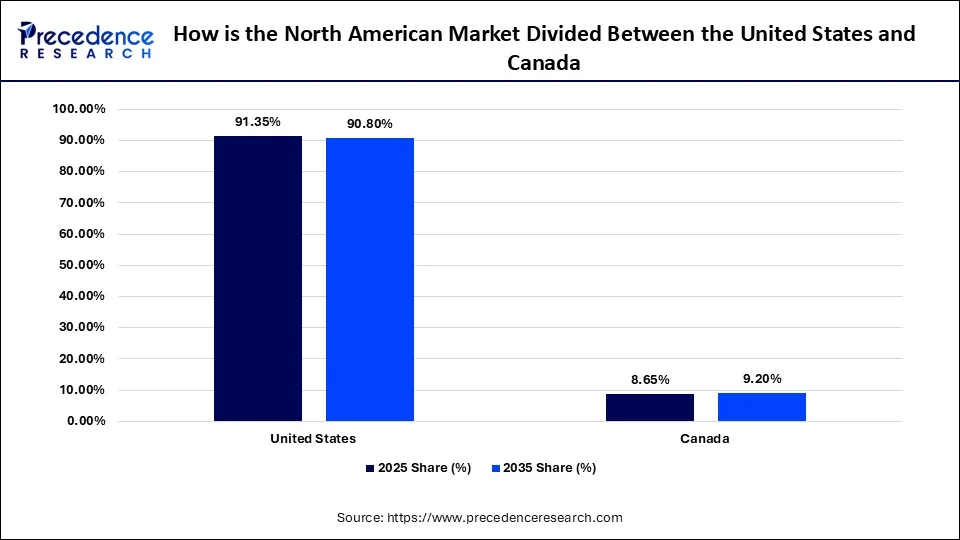
The North American multi-modality aesthetic platforms industry is experiencing robust growth, driven by the high volume of aesthetic procedures, increasing preference for minimally invasive treatments, technological advancements in energy-based devices, and the expansion of aesthetic practices and medical spas. U.S. consumers increasingly favor procedures that provide visible results with limited downtime, creating demand for technologies such as laser resurfacing, IPL, RF, ultrasound, and RF microneedling.
- US: Key growth drivers include a rising demand for minimally invasive procedures, increased consumer awareness, and advancements in technology. Regulatory support from the FDA has facilitated the introduction of new products, while government initiatives promoting health and wellness further stimulate market growth. The robust healthcare infrastructure and a high concentration of aesthetic clinics enhance accessibility for consumers.
- Canada: Growth is driven by increasing disposable incomes, a growing aging population, and heightened interest in aesthetic treatments. Regulatory bodies like Health Canada ensure product safety and efficacy, fostering consumer trust. The market is also supported by government initiatives aimed at promoting health and wellness, which encourage the adoption of aesthetic procedures across various demographics.
Analyst View
- The United States accounts for 91.35% of the supplied 2025 North American market, making it the primary commercial market.
- Canada, however, has the higher supplied CAGR at 10.00%, compared with 9.28% for the United States. This raises Canadas modeled share from 8.65% to 9.20%.
- The regulatory environment differs between the two countries. In the U.S., the FDA regulates medical devices and radiation-emitting products, with aesthetic devices potentially subject to device regulation depending on intended use.
- In Canada, Health Canada regulates relevant energy-emitting devices, including laser, ultrasound, RF and other radiation-emitting technologies.
Competitive Technology Landscape
Which Companies Demonstrate Multi-Modality Platform Strategies?
| Company | Platform / Technology Evidence | Strategic Relevance |
| InMode | OptimasMAX integrates Morpheus8, Lumecca Peak IPL, Forma RF, and Fusion Hair Removal | Multi-modality expandable platform |
| Cutera | Secret DUO combines 1540 nm laser and Secret RF; broader portfolio includes multi-application laser/light systems | Laser + RF integration |
| Cynosure | Broad laser and energy-based aesthetic portfolio | Multi-indication treatment coverage |
| BTL | Body-contouring and aesthetic energy technologies | Body and facial aesthetic applications |
| Solta Medical | Multiple laser, RF and light-based systems | Skin rejuvenation and aesthetic treatment breadth |
InMode states that OptimasMAX integrates eight revenue-generating technologies and allows practices to add handpieces according to patient demand.
Cuteras current portfolio includes Secret RF and Secret DUO, with Secret DUO combining 1540 nm laser and RF microneedling, while its laser/light platforms address pigment, vascular conditions, hair removal and skin revitalization.
Analyst View
Competition is increasingly moving toward platform architecture rather than individual device architecture.
Manufacturers can differentiate through:
- Number of integrated modalities
- Expandability
- Interchangeable handpieces
- Treatment indications
- Clinical evidence
- Treatment speed
- Energy delivery control
- Applicator ergonomics
- Software/interface
- Training and service
- Financing
- Consumables and recurring revenue
- Regulatory clearances
The ability to expand a platform after initial purchase can also reduce the need for clinics to make several separate capital purchases.
Key Companies and Their Offerings
- Allergan Aesthetics (AbbVie Inc.): Global leader in medical aesthetics with dominant neuromodulator and filler portfolio, complemented by body contouring and skin-health platforms.
- Cynosure LLC: Major energy-based device manufacturer delivering multi-application laser and body-contouring platforms for aesthetic physicians and med-spas.
- Candela Corporation: Established aesthetic device company specializing in laser hair removal and vascular treatment systems with a large installed base globally.
- Lumenis Be Ltd.: Technology-focused vendor offering premium laser and IPL platforms across aesthetics, ophthalmology, and surgical specialties.
- Cutera Inc.: U.S.-based aesthetic device firm known for body-contouring and energy-based skin treatments, increasingly targeting med-spa channels.
What are the Major Growth Factors in the Multi-Modality Aesthetic Platforms Market?
Rise of Non-Invasive Procedures
There is a notable shift towards non-invasive aesthetic treatments, as consumers seek effective solutions with minimal downtime. This trend reflects a broader preference for procedures that offer natural-looking results without the need for extensive recovery periods.
Technological Integration
The aesthetics market is increasingly incorporating advanced technologies, such as virtual consultations and AI-driven diagnostics. These innovations enhance the consumer experience and streamline service delivery, making aesthetic procedures more accessible.
Focus on Personalization
Consumers are gravitating towards personalized aesthetic solutions tailored to their unique needs and preferences. This trend indicates a growing demand for customized treatments that address individual concerns, fostering a more engaging client-provider relationship.
What are the Challenges in the Multi-Modality Aesthetics Market?
- High Cost: Multi-modality aesthetic platforms require a substantial amount of upfront investment due to their integration of multiple energy-based technologies that are present within a single system. High acquisition costs can limit growth and adoption for small-scale or medium-scale clinics and even start-ups.
- Regulatory Requirements: Aesthetic platforms that use laser, RF, electromagnetic energy, and other similar technologies are subject to stringent regulatory requirements that are related to device safety, performance, and clinical use. Manufacturers and practitioners may face lengthy approval processes, thus slowing down growth.
- Skill Shortages: The effective and safe use of multi-modality platforms requires practitioners who have the necessary knowledge and expertise. The availability of highly skilled professionals can be limited, especially in emerging markets or smaller aesthetic practices.
How are Aesthetic Energy Platforms Regulated in North America?
| Market / Authority | Regulatory Consideration |
| United States - FDA | Aesthetic devices can be regulated as medical devices depending on intended use |
| United States - 510(k) | Many Class II aesthetic devices use premarket notification pathways |
| United States – Device Classification | Laser, RF, ultrasound, magnetic-field and other technologies have specific classifications/product codes |
| Canada – Health Canada | Relevant aesthetic energy devices are subject to applicable medical-device requirements |
| Canada – REDA | Covers radiation-emitting devices, including ultrasound, RF and light-based technologies |
| Both Markets | Intended use, safety, effectiveness, labeling and professional use requirements affect commercialization |
Regulatory oversight has a significant impact on the multi-modality aesthetic platforms industry, as manufacturers must demonstrate the safety, performance, and appropriate intended use of energy-based technologies before commercializing devices in major markets. Regulatory requirements are particularly important for multi-modality platforms because a single system may incorporate different wavelengths, energy sources, handpieces, or treatment modes, requiring manufacturers to establish appropriate safety and performance characteristics for the intended applications.
The FDAs classification database identifies, among others, Class II aesthetic devices for low-level laser fat reduction and focused ultrasound.
Health Canada states that energy-based devices used for therapeutic or cosmetic indications, including laser, ultrasound, RF, IPL and LED, require evidence supporting an acceptable risk-benefit profile.
Analyst View
Regulatory clearance is particularly important for multi-modality platforms because adding a new energy source or indication can change the regulatory requirements applicable to the system. Manufacturers therefore compete not only on engineering but also on their ability to develop clinical evidence, obtain clearances, manage labeling, and train users
The U.S. regulatory environment also became more directly aligned with ISO 13485 quality-management principles in 2026, when FDAs Quality Management System Regulation became effective on February 2, 2026.
Safety and Clinical Evidence
Why does Clinical Validation Matter for Multi-Modality Platforms?
FDA information identifies risks associated with non-invasive body-contouring technologies, including pain, redness, swelling, bruising and, depending on technology, burns, pigmentation changes, nerve damage and other complications.
The FDA also issued a 2025 safety communication concerning certain uses of RF microneedling, reporting serious complications including burns, scarring, fat loss, disfigurement and nerve damage.
Analyst View
As platforms integrate more modalities, clinical evidence becomes a commercial differentiator. A multi-modality platform must demonstrate that each treatment mode is appropriately characterized and that clinicians can safely select the correct energy, applicator, treatment area, and patient parameters.
Consequently, buyers are likely to evaluate clinical publications and regulatory clearances alongside purchase price.
Strategic Outlook
The North America multi-modality aesthetic platforms market is evolving from conventional single-purpose energy devices toward integrated aesthetic workstations capable of addressing several patient needs.
The supplied 9.35% CAGR indicates sustained expansion through 2035, while the segmentation points to several particularly important shifts:
- Laser remains the largest technology, but RF and electromagnetic energy gain share.
- Body contouring becomes increasingly important, reaching 21.05% of the supplied application mix by 2035.
- Medical aesthetic clinics and med spas increase their market participation.
- Male patients represent a growing share of the addressable patient base.
- Canada grows slightly faster than the United States in the supplied country forecast.
- Expandable platforms become increasingly important as manufacturers seek to increase utilization and create recurring upgrade opportunities.
- Clinical evidence and regulatory compliance remain central to commercial adoption.
The technology direction is already visible in current industry portfolios. InModes OptimasMAX integrates multiple technologies within one workstation, while Cutera combines RF and laser capabilities in its Secret platform family.
The market competitive structure is therefore likely to depend not only on individual energy technologies but on how effectively manufacturers integrate modalities, demonstrate clinical value, simplify workflows, support practitioners and build expandable platforms around evolving aesthetic demand.
Our Experts
- The primary market research process was carried out by Deepa Pandey, Senior Research Associate, who also designed the methodology and did market segmentation, regional trend analysis, buyer intelligence, competitive analysis, and forecasts, laying the foundation for the analytical part of the report.
- Aman Singh, Head of Research, has gathered and checked regulatory policies, company financial information, genome sequencing information, production information, commodity price information, and various other quantitative information sources, which were obtained independently, thereby increasing the quality of evidence supporting the calculations of the market values.
- Aditi Shivarkar, VP Research, has validated and refined the research material, verified facts, corrected inconsistencies, and completed the research document, making it accurate and to the point.
North America Multi-Modality Aesthetic Platforms Market Segments Covered in the Report
By Modality Combination
- Laser + RF
- Laser + IPL
- RF + Ultrasound
- Laser + RF + IPL
- RF + Electromagnetic
- Laser + Ultrasound
- Other Combinations
By Technology
- Laser
- Radiofrequency
- Intense Pulsed Light
- Ultrasound
- Electromagnetic Energy
- Cryolipolysis
- Other Technologies
By Application
- Skin Rejuvenation & Resurfacing
- Hair Removal
- Body Contouring & Fat Reduction
- Skin Tightening
- Pigmentation & Vascular Lesions
- Acne & Scar Treatment
- Other Applications
By Treatment Area
- Face
- Abdomen & Waist
- Legs & Thighs
- Arms
- Back & Flanks
- Other Areas
By End User
- Dermatology Clinics
- Medical Aesthetic Clinics
- Plastic Surgery Clinics
- Med Spas
- Hospitals & Other Facilities
By Patient Type
- Female Patients
- Male Patients
- Other / Non-Binary Patients
By Distribution Channel
- Direct Sales
- Aesthetic Device Distributors
- Specialty Medical Equipment Dealers
- Online & Digital Sales
- Other Channels
By Country
- United States
- Canada
For inquiries regarding discounts, bulk purchases, or customization requests, please contact us at sales@precedenceresearch.com
Frequently Asked Questions





Ask For Sample
No cookie-cutter, only authentic analysis – take the 1st step to become a Precedence Research client
 Get a Sample
.webp)



 sales@precedenceresearch.com
 Schedule a Meeting
