


North America Ultrasound Guided Therapy in Minimally Invasive Surgery Market Size, Key Companies, Company Production Capacity, Healthcare Infrastructure Growth, Product Utilization, Company Investment Strategies, and Market Outlook
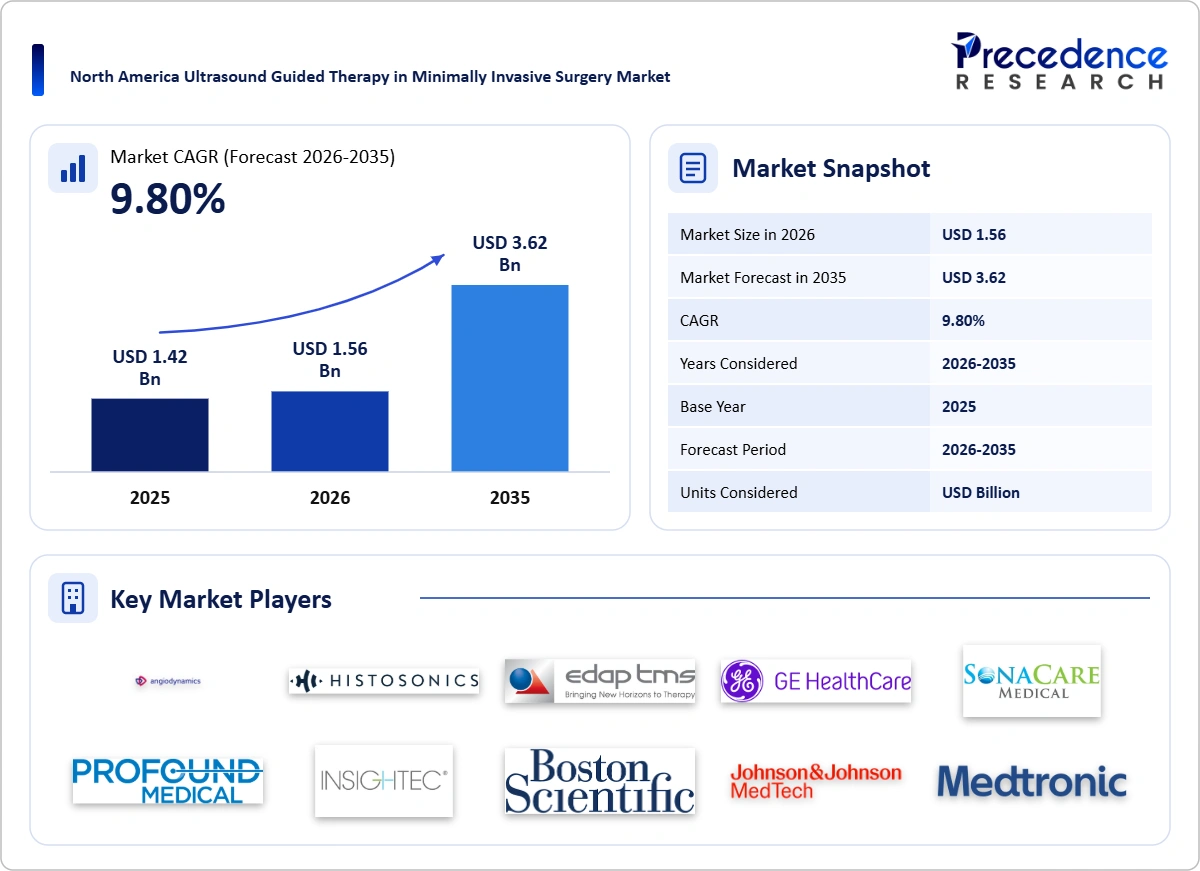
Payal Rabde, a Healthcare Industry Expert, highlights that the North America ultrasound-guided therapy in minimally invasive surgery market has reached USD 1.56 billion in 2026 and is on track to reach USD 3.62 billion by 2035, advancing at a CAGR of 9.80%. Key North America ultrasound-guided therapy in minimally invasive surgery market companies shaping the market include Medtronic, HistoSonics, Boston Scientific, INSIGHTEC, while major growth segments span technology, component, application, end user.
Source: https://www.precedenceresearch.com/north-america-ultrasound-guided-therapy-in-minimally-invasive-surgery-market
 Get a Sample
 Table Of Content
Key Takeaways
Market Size & Growth Outlook
- Market size in 2025: USD 1.42 billion
- Estimated market size in 2026: USD 1.56 billion
- Projected market size by 2035: USD 3.62 billion
- CAGR (2026-2035): 9.80%
Regional Market Spotlight
- U.S. dominates the market with a 90.00% share in 2025.
- Canada accounted for 7.00% of the market share in 2025.
- Mexico held a 3.00% share in 2025 and is projected to be the fastest-growing country, at a CAGR of 11.33% from 2026 to 2035.
Segmental Highlights
- By technology, Ultrasound-Guided Thermal Ablation (RF & Microwave) held the largest share of 41.00% in 2025.
- By component, the Systems segment accounted for 48.00% market share in 2025.
- By application, the Oncology segment captured 52.00% share in 2025.
- By end user, Hospitals contributed 66.00% of the market share in 2025.
North America Ultrasound Guided Therapy in Minimally Invasive Surgery Market Size and Forecast, 2025-2035 (USD Billion)
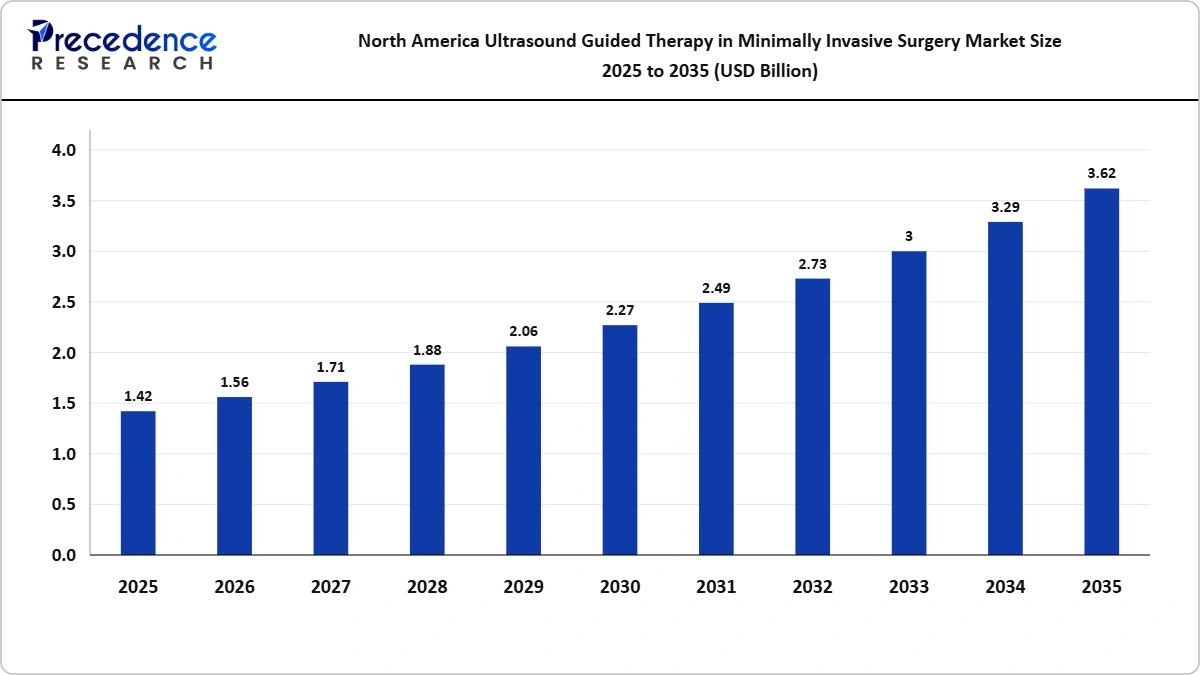
Note: 2025 is the base year; 2026-2035 values are forecasts.
Sources: Expert interviews, secondary sources, Precedence Research database, and Precedence Research analysts.
The North America ultrasound-guided therapy in minimally invasive surgery market is projected to grow from USD 1.42 billion in 2025 to USD 3.62 billion by 2035 because ultrasound lets surgeons see and treat tumors without large incisions, and new non-thermal methods such as histotripsy are expanding the number of treatable patients. New indications, outpatient migration, rising cancer cases, and patient preference for non-invasive treatment support strong growth, lifting the market to USD 2.27 billion by 2030 and sustaining a CAGR of 9.80% from 2026 to 2035. Ultrasound-guided therapy complements intravascular imaging and other image-guided procedures in interventional suites.
Analyst View: The market is poised for strong growth, driven by increasing adoption of ultrasound-guided, minimally invasive cancer treatments and the emergence of innovative technologies such as histotripsy. Opportunities are being created by the increased demand for precision-based treatment, the expansion of clinical applications, and the growing desire for outpatient operations. Market adoption will be further strengthened by ongoing technical developments and integration into interventional suites.
Market Trends
- Non-thermal histotripsy is gaining traction as an innovative approach to tumor destruction without thermal damage to surrounding tissues.
- Focal therapy for prostate cancer is expanding as a targeted treatment option.
- The shift toward outpatient tumor ablation is increasing demand for efficient, minimally invasive treatment procedures.
- AI-assisted targeting and fusion imaging are improving treatment accuracy, procedural guidance, and clinical outcomes.
- Robotic ultrasound delivery is emerging as an opportunity to enhance precision and procedural control.
- New reimbursement codes are supporting broader clinical adoption by improving access to ultrasound-guided therapies.
Drivers, Restraints and Opportunities
Driver
Rising cancer incidence and growing patient preference for non-invasive treatment options are driving demand for ultrasound-guided therapies. While new FDA indications are expanding therapy possibilities, improved clinical results and the growth of outpatient care are also encouraging uptake.
Restraint
High system costs and limited reimbursement for emerging treatment methods may restrict adoption. In addition, specialized training requirements and competition from established treatment options, such as surgery and radiation therapy, pose challenges to market growth.
Opportunity
Expanding applications in kidney and pancreas treatments, along with growing interest in focal prostate therapy, are creating new growth opportunities. Moreover, the market's growth potential is anticipated to be expanded by growing acceptance across ambulatory surgery centers (ASCs), possible neurological applications, and increasing investments by private hospitals in Mexico.
Market Drivers - Impact & CAGR Contribution (2026-2035)
| Driver | Impact | ≈ CAGR Contribution | Time Horizon | Key Regions |
| Cancer incidence rises | High | +3.83 pp | Short to long term | North America-wide, strongest in U.S. |
| Patients prefer non-invasive options | Medium | +3.23 pp | Medium to long term | North America-wide, fastest uptake in Mexico |
| Outcomes data improve | Medium | +2.75 pp | Short to medium term | North America-wide |
| Outpatient care grows | Low | +2.15 pp | Long term | U.S. and Mexico |
Note: Contributions are indicative estimates of each factor's effect on annual growth.
Sources: Expert interviews, secondary sources, Precedence Research database, and Precedence Research analysts.
Taken together, these drivers add about 11.96 percentage points to the annual growth of the North America ultrasound-guided therapy in minimally invasive surgery market, with cancer incidence rises having the largest effect. Their influence is strongest in the U.S., while uptake grows fastest in Mexico.
Market Restraints - Impact & Negative CAGR Contribution (2026-2035)
| Restraint | Impact | ≈ Negative CAGR Contribution | Time Horizon | Key Regions |
| High system costs | High | -0.97 pp | Short to medium term | North America-wide |
| Limited reimbursement for new methods | High | -0.71 pp | Medium term | Smaller and price-sensitive markets |
| Training needs | Medium | -0.47 pp | Short term | U.S. and other mature markets |
Note: Contributions are indicative estimates of each factor's effect on annual growth.
Sources: Expert interviews, secondary sources, Precedence Research database, and Precedence Research analysts.
These restraints are expected to reduce annual growth of the North America ultrasound-guided therapy in minimally invasive surgery market by about 2.16 percentage points, led by high system costs. Their effect eases over the forecast period as suppliers, buyers, and regulators adapt, leaving a net CAGR of 9.80% from 2026 to 2035.
Market Segmentation: 2025 Share and Size
North America Ultrasound-Guided Therapy in Minimally Invasive Surgery Market by Technology 2025 Share
| Segments | 2025 Share | 2035 Share | CAGR 2026-2035 |
| Ultrasound-Guided Thermal Ablation (RF & Microwave) | 41.00% | 37.85% | 8.91% |
| High-Intensity Focused Ultrasound (HIFU) | 22.00% | 20.99% | 9.31% |
| Histotripsy | 14.00% | 19.06% | 13.31% |
| Ultrasound-Guided Interventional & Others | 23.00% | 22.10% | 9.31% |
Note: 2025 is the base year; 2035 shares and CAGRs are forecasts.
Sources: Expert interviews, secondary sources, Precedence Research database, and Precedence Research analysts.
Ultrasound-Guided Thermal Ablation (RF & Microwave) accounted for 41.00% in 2025, High-Intensity Focused Ultrasound (HIFU) for 22.00%, Histotripsy for 14.00%, and Ultrasound-Guided Interventional & Others for 23.00%. Ultrasound-Guided Thermal Ablation (RF & Microwave) leads, while Histotripsy is growing the fastest.
Ultrasound-Guided Thermal Ablation (RF & Microwave): The segment captured 41.00% of the total market in 2025 and is anticipated to register a CAGR of 8.91% between 2026 and 2035. Ultrasound-guided thermal ablation leads because radiofrequency and microwave ablation of liver, kidney, thyroid, and lung tumors are widely reimbursed. The ultrasound-guided thermal ablation (RF & microwave) segment is expected to grow slower than the overall market over the forecast period.
High-Intensity Focused Ultrasound (HIFU): Representing 22.00% of the market in 2025, this segment is forecast to maintain steady growth at a CAGR of 9.31% over the forecast period. High-intensity focused ultrasound is used for prostate tissue ablation and uterine fibroids. The high-intensity focused ultrasound (HIFU) segment is expected to grow slower than the overall market during the forecast period.
Histotripsy: With a market contribution of 14.00% in 2025, the segment is expected to witness expansion at a CAGR of 13.31% from 2026 to 2035. Histotripsy grows fastest after FDA clearance for liver tumors and the expected kidney indication. The histotripsy segment is expected to grow faster than the overall market between 2026 and 2035.
Ultrasound-Guided Interventional & Others: The segment held a 23.00% share of the market in 2025, with its growth projected at a CAGR of 9.31% through 2035. Ultrasound-guided biopsy, nerve block, and vascular access procedures complete demand. The ultrasound-guided interventional & others segment is expected to grow slower than the overall market over the forecast period.
Segment Outlook: Ultrasound-Guided Thermal Ablation (RF & Microwave) remains the largest technology segment through 2035, holding about 37.85% of the market in 2035, while Histotripsy records the highest CAGR of 13.31% from 2026 to 2035. Although Histotripsy starts from the smallest base, its faster growth shows how demand is shifting within the market.
North America Ultrasound-Guided Therapy in Minimally Invasive Surgery Market by Component 2025 Share
| Segments | 2025 Share | 2035 Share | CAGR 2026-2035 |
| Systems | 48.00% | 45.30% | 9.14% |
| Consumables & Probes | 36.00% | 39.23% | 10.74% |
| Services | 16.00% | 15.47% | 9.54% |
Note: 2025 is the base year; 2035 shares and CAGRs are forecasts.
Sources: Expert interviews, secondary sources, Precedence Research database, and Precedence Research analysts.
Systems accounted for 48.00% in 2025, Consumables & Probes for 36.00%, and Services for 16.00%. Systems leads, while Consumables & Probes is growing the fastest.
Systems: In 2025, the segment represented 48.00% of the market share and is expected to achieve a CAGR of 9.14% over the 2026-2035 period. Systems lead because each site must buy a treatment platform and imaging console. The systems segment is projected to grow slower than the overall market from 2026 to 2035.
Consumables & Probes: The segment's market share stood at 36.00% in 2025, while its growth trajectory is expected to reflect a CAGR of 10.74% during 2026-2035. Consumables and probes grow fastest because each procedure uses needles, applicators, or transducer covers. The consumables & probes segment is expected to grow faster than the overall market over the forecast period.
Services: This segment contributed 16.00% of the North America ultrasound-guided therapy in minimally invasive surgery market in 2025 and is projected to grow at a CAGR of 9.54% from 2026 to 2035. Services include maintenance, training, and procedure support. The services segment is expected to expand broadly in line with the overall market over the forecast period.
Segment Outlook: Systems remain the largest component segment through 2035, holding about 45.30% of the market in 2035, while Consumables & Probes record the highest CAGR of 10.74% from 2026 to 2035. Services hold the smallest share and serve more specialized needs within the North America ultrasound-guided therapy in minimally invasive surgery market.
North America Ultrasound-Guided Therapy in Minimally Invasive Surgery Market by Application 2025 Share
| Segments | 2025 Share | 2035 Share | CAGR 2026-2035 |
| Oncology | 52.00% | 49.72% | 9.34% |
| Urology | 18.00% | 17.96% | 9.74% |
| Gynecology | 10.00% | 9.94% | 9.74% |
| Neurology & Pain Management | 12.00% | 14.36% | 11.74% |
| Others | 8.00% | 8.01% | 9.74% |
Note: 2025 is the base year; 2035 shares and CAGRs are forecasts.
Sources: Expert interviews, secondary sources, Precedence Research database, and Precedence Research analysts.
Oncology captured 52.00% in 2025, Urology at 18.00%, Gynecology at 10.00%, Neurology & Pain Management at 12.00%, and Others at 8.00%. Oncology leads, while Neurology & Pain Management is growing fastest.
Oncology: This segment accounted for 52.00% of the market in 2025 and is estimated to expand at a CAGR of 9.34% from 2026 to 2035. Oncology leads because liver, kidney, prostate, thyroid, and lung tumors are the main targets. The oncology segment is projected to grow slower than the overall market during the forecast period.
Urology: Holding an 18.00% market share in 2025, this segment is expected to expand at a CAGR of 9.74% during the forecast period. Urology includes prostate tissue ablation and BPH treatment. The urology segment is estimated to grow broadly in line with the overall market over the forecast period.
Gynecology: The segment captured 10.00% of the total market in 2025 and is anticipated to register a CAGR of 9.74% between 2026 and 2035. Gynecology covers fibroid ablation. The gynecology segment is expected to grow broadly in line with the overall market during the forecast period.
Neurology & Pain Management: Representing 12.00% of the market in 2025, this segment is forecast to maintain the fastest growth at a CAGR of 11.74% over the forecast period. Neurology & pain management grow fastest with focused ultrasound for tremor and nerve ablation. The neurology & pain management segment is projected to expand faster than the overall market from 2026 to 2035.
Others: With a market contribution of 8.00% in 2025, the segment is expected to witness sustained expansion at a CAGR of 9.74% from 2026 to 2035. Other uses include vascular and cosmetic procedures. The other segments are expected to grow broadly in line with the overall market over the forecast period.
Segment Outlook: Oncology remains the largest application segment through 2035, holding about 49.72% of the market in 2035, while Neurology & Pain Management records the highest CAGR of 11.74% from 2026 to 2035. Others hold the smallest share and serve more specialized needs within the North America ultrasound-guided therapy in minimally invasive surgery market.
North America Ultrasound-Guided Therapy in Minimally Invasive Surgery Market by End User 2025 Share
| Segments | 2025 Share | 2035 Share | CAGR 2026-2035 |
| Hospitals | 66.00% | 63.54% | 9.36% |
| Ambulatory Surgical Centers | 19.00% | 21.55% | 11.26% |
| Specialty Clinics | 15.00% | 14.92% | 9.76% |
Note: 2025 is the base year; 2035 shares and CAGRs are forecasts.
Sources: Expert interviews, secondary sources, Precedence Research database, and Precedence Research analysts.
Hospitals contributed 66.00% in 2025, Ambulatory Surgical Centers at 19.00%, and Specialty Clinics at 15.00%. Hospitals lead, while Ambulatory Surgical Centers are growing fastest.
Hospitals: The segment held a substantial 66.00% of the market share in 2025, with its growth projected at a CAGR of 9.36% through 2035. Hospitals lead because complex tumor ablation needs anesthesia and multidisciplinary teams. The hospitals segment is expected to grow slower than the overall market over the forecast period.
Ambulatory Surgical Centers: In 2025, the segment represented 19.00% of the overall market and is expected to achieve a CAGR of 11.26% over the 2026-2035 period. Ambulatory surgical centers grow fastest as procedures become outpatient. The ambulatory surgical centers segment is projected to expand faster than the overall market during the forecast period.
Specialty Clinics: This segment captured 15.00% of the North America ultrasound-guided therapy in minimally invasive surgery market in 2025 and is projected to expand at a CAGR of 9.76% from 2026 to 2035. Specialty clinics include urology and interventional radiology centers. The specialty clinics segment is expected to grow broadly in line with the overall market over the forecast period.
Segment Outlook: Hospitals remain the largest end user segment through 2035, holding about 63.54% of the market in 2035, while Ambulatory Surgical Centers record the highest CAGR of 11.26% from 2026 to 2035. Specialty Clinics hold the smallest share and serve more specialized needs within the North America ultrasound-guided therapy in minimally invasive surgery market.
Analyst View: The market is led by ultrasound-guided thermal ablation (RF & microwave), supported by established clinical adoption and reimbursement. Systems dominate the component segment, whereas consumables & probes benefit from recurring procedural demand. While neurology & pain management have encouraging growth prospects through expanding focused ultrasound uses, oncology continues to be the most popular application. Although ambulatory surgical centers are gaining traction as minimally invasive treatments move more and more toward outpatient settings, hospitals still account for the majority of end-user adoption.
Country Analysis
North America Ultrasound-Guided Therapy in Minimally Invasive Surgery Market by Country 2025 Share
| Country | 2025 Share | 2035 Share | CAGR 2026-2035 |
| U.S. | 90.00% | 89.50% | 9.72% |
| Canada | 7.00% | 7.18% | 10.12% |
| Mexico | 3.00% | 3.31% | 11.32% |
Note: 2025 is the base year; 2035 shares and CAGRs are forecasts.
Sources: Expert interviews, secondary sources, Precedence Research database, and Precedence Research analysts.
U.S. accounted for 90.00% in 2025, Canada for 7.00%, and Mexico for 3.00%. U.S. leads, while Mexico is growing fastest.
U.S.: This country accounted for 90.00% of the North America ultrasound-guided therapy in minimally invasive surgery market in 2025 and is estimated to expand at a CAGR of 9.72% from 2026 to 2035. The U.S. leads because of early FDA clearances, high procedure reimbursement, and leading cancer centers adopting histotripsy and focused ultrasound. U.S. is expected to grow broadly in line with the overall market between 2026 and 2035.
Canada: The country's market share stood at 7.00% in 2025, while its growth trajectory is expected to reflect a CAGR of 10.12% during the forecast period. Canada is supported by academic cancer centers and focused ultrasound research in Toronto. Canada is projected to grow faster than the overall market from 2026 to 2035.
Mexico: With a market contribution of 3.00% in 2025, the country is expected to witness sustained expansion at a CAGR of 11.32% from 2026 to 2035. Mexico grows fastest from a small base with private hospital adoption. Mexico is estimated to grow faster than the overall market between 2026 and 2035.
Analyst View: The U.S. dominates the regional market, supported by early regulatory approvals, strong reimbursement frameworks, and advanced cancer treatment infrastructure. While Mexico offers new growth prospects through rising private hospital investments and the usage of less invasive treatments, Canada gains from academic research and the expanding use of focused ultrasound technologies.
Competitive Landscape
Top 10 Companies in the North America Ultrasound-Guided Therapy in Minimally Invasive Surgery Market, 2025
| Rank | Company Name | Key Products / Business | Headquarters |
| 1 | Medtronic | Emprint microwave ablation and RF ablation systems | Ireland |
| 2 | HistoSonics | Edison histotripsy system | United States |
| 3 | Boston Scientific | RF ablation and interventional oncology devices | United States |
| 4 | Insightec | Exablate MR-guided focused ultrasound | Israel |
| 5 | EDAP TMS | Focal One robotic HIFU | France |
| 6 | Johnson & Johnson MedTech | NEUWAVE microwave ablation | United States |
| 7 | SonaCare Medical | Sonablate HIFU for prostate tissue | United States |
| 8 | AngioDynamics | Solero microwave and NanoKnife systems | United States |
| 9 | GE HealthCare | Interventional ultrasound imaging | United States |
| 10 | Profound Medical | TULSA-PRO and Sonalleve systems | Canada |
Note: Company shares are 2025 estimates.
Sources: Company press releases, expert interviews, secondary sources, Precedence Research database, and Precedence Research analysts.
Medtronic led the North America ultrasound-guided therapy in minimally invasive surgery market, followed by HistoSonics and Boston Scientific. Medtronic leads with Emprint microwave ablation and RF ablation systems, HistoSonics competes with the Edison histotripsy system, and Boston Scientific offers RF ablation and interventional oncology devices. Insightec, EDAP TMS, Johnson & Johnson MedTech, SonaCare Medical, AngioDynamics, GE HealthCare, and Profound Medical compete through exablate MR-guided focused ultrasound, focal One robotic HIFU, NEUWAVE microwave ablation, sonablate HIFU for prostate tissue, solero microwave and NanoKnife systems, interventional ultrasound imaging, and TULSA-PRO and Sonalleve systems.
The North America ultrasound-guided therapy in minimally invasive surgery market is moderately concentrated, and competition centers on clinical evidence, FDA indications, reimbursement codes, treatment precision, workflow, and installed base.
Company Snapshots
Medtronic: Medtronic is headquartered in Ireland. Its offering centers on Emprint microwave ablation and RF ablation systems. In the Precedence Research Companies Quadrant, it is positioned as a Leader.
HistoSonics: Headquartered in the U.S., HistoSonics focuses on its flagship Edison histotripsy system and is classified as a Leader in the Precedence Research Companies Quadrant.
Boston Scientific: This company is headquartered in the United States. Its offering centers on RF ablation and interventional oncology devices. Boston Scientific is categorized as a leading player in the Precedence Research Companies Quadrant.
Insightec: An Israel-based company is positioned as a Leader in the Precedence Research Companies Quadrant. Its offering centers on Exablate MR-guided focused ultrasound.
EDAP TMS: Headquartered in France. Its offering centers on Focal One robotic HIFU. It features in the Leader category of the Precedence Research Companies Quadrant.
Johnson & Johnson MedTech: Based in the U.S., Johnson & Johnson MedTech focuses on its NEUWAVE microwave ablation platform and is recognized as a leading player in the Precedence Research Companies Quadrant.
SonaCare Medical: Headquartered in the United States. The company's portfolio features Sonablate HIFU for prostate tissue treatment, and it is classified as an Innovator in the Precedence Research Companies Quadrant.
AngioDynamics: AngioDynamics is headquartered in the United States. Its offerings center on Solero microwave and NanoKnife systems. It is recognized as an Innovator in the Precedence Research Companies Quadrant.
GE HealthCare: GE HealthCare is headquartered in the United States. Its offering centers on Interventional ultrasound imaging. In the Precedence Research Companies Quadrant, it is positioned as an Innovator.
Profound Medical: Profound Medical is headquartered in Canada, with a portfolio featuring TULSA-PRO and Sonalleve systems. It is classified as an Innovator in the Precedence Research Companies Quadrant.
Companies Ecosystem
The North America ultrasound-guided therapy in minimally invasive surgery ecosystem links component suppliers, therapy system makers, imaging partners, providers and payers & regulators, with each stage adding value before products reach end users. Clinical trials for kidney and pancreatic indications shape future adoption.
| Ecosystem Stage | Role in the Market | Key Companies |
| Component Suppliers | Supply transducers, generators, and electronics | Transducer and electronics makers |
| Therapy System Makers | Develop ablation and focused ultrasound systems | Medtronic, HistoSonics, Insightec, EDAP |
| Imaging Partners | Provide ultrasound and MR guidance | GE HealthCare, Siemens Healthineers, Philips |
| Providers | Perform procedures | Hospitals, ASCs, cancer centers |
| Payers & Regulators | Approve and pay for procedures | FDA, CMS, private payers, Health Canada |
Sources: Company press releases, expert interviews, secondary sources, Precedence Research database and Precedence Research analysts.
Component Suppliers: Supply transducers, generators, and electronics. Key participants include Transducer and electronics makers.
Therapy System Makers: Develop ablation and focused ultrasound systems. Key participants include Medtronic, HistoSonics, Insightec, and EDAP.
Imaging Partners: Provide ultrasound and MR guidance. Key participants include GE HealthCare, Siemens Healthineers, and Philips.
Providers: Perform procedures. Key participants include Hospitals, ASCs, and cancer centers.
Payers & Regulators: Approve and pay for procedures. Key participants include FDA, CMS, private payers, and Health Canada.
Value in the North America ultrasound-guided therapy in minimally invasive surgery market flows from upstream material and technology suppliers to manufacturers and service providers, then through distribution partners to end users. Companies that integrate several stages or build long-term relationships with end users capture a larger share of this value.
Precedence Research Companies Quadrant
The Precedence Research Companies Quadrant positions key participants in the North America ultrasound-guided therapy in minimally invasive surgery market by market strength, reflecting revenue scale, market share and geographic reach, and by innovation and growth strategy, reflecting product portfolio breadth, R&D intensity and partnerships. Positions reflect each company's estimated 2025 share of the North America ultrasound-guided therapy in minimally invasive surgery market and our assessment of its product innovation, portfolio breadth and partnerships.
Sources: Company press releases, expert interviews, secondary sources, Precedence Research database, and Precedence Research analysts.
Leaders: Medtronic, HistoSonics, Boston Scientific, Insightec, EDAP TMS, and Johnson & Johnson MedTech combine high market share with broad portfolios and strong innovation.
Innovators: SonaCare Medical, AngioDynamics, GE HealthCare, and Profound Medical bring newer technologies and specialized products.
Recent Developments
- May 2026: HistoSonics submitted a De Novo request to the FDA seeking to expand the Edison Histotripsy System's indication to kidney tumors, supported by clinical evidence from its 67-patient #HOPE4KIDNEY pivotal trial.
- August 2025: HistoSonics was acquired by an investor consortium for USD 2.25 billion. The investment is intended to accelerate the global expansion of its Edison Histotripsy System into new clinical indications and markets.
North America Ultrasound Guided Therapy in Minimally Invasive Surgery Market Segments
By Technology
- Ultrasound-Guided Thermal Ablation (RF & Microwave)
- High-Intensity Focused Ultrasound (HIFU)
- Histotripsy
- Ultrasound-Guided Interventional & Others
By Component
- Systems
- Consumables & Probes
- Services
By Application
- Oncology
- Urology
- Gynecology
- Neurology & Pain Management
- Others
By End User
- Hospitals
- Ambulatory Surgical Centers
- Specialty Clinics
By Country
- U.S.
- Canada
- Mexico
Research Methodology: The market was defined as therapeutic and interventional systems that use ultrasound to guide or deliver minimally invasive or non-invasive treatment in the U.S., Canada, and Mexico, including histotripsy and high-intensity focused ultrasound systems, ultrasound-guided radiofrequency and microwave ablation, ultrasound-guided biopsy and interventional devices, and related consumables and services, used in oncology, urology, gynecology, neurology, and pain management in hospitals, ambulatory surgical centers, and specialty clinics.
The 2025 base year was built bottom-up from demand volumes and average prices by technology, component, application, end user, and region, and checked top-down against the market-specific revenues of leading companies and published estimates. Segment, country and company values were allocated from technology, component, application and end user and country demand.
Key estimates were verified by cross-checking company disclosures, regulatory and industry data and published third-party estimates, and inputs that could not be reconciled were excluded. All segment, regional, and company figures were reconciled to the same 2025 base year, and the 2026-2035 forecast, which applies a constant CAGR from the 2025 base, was recalculated and validated.
Analyst View: The North American market is positioned for sustained growth, driven by expanding clinical applications, rising adoption of minimally invasive tumor treatments, and the shift toward outpatient procedures. New uses of focused ultrasound and histotripsy in renal and prostate treatments offer enormous development potential, but adoption is still hampered by expensive equipment, little reimbursement, and the need for specialized training.
Sources and References
- "HistoSonics Edison histotripsy system submitted for FDA approval of kidney tumor indication". May 2026. https://www.businesswire.com/news/home/20260511268688/en/HistoSonics-Moves-to-Advance-Additional-Histotripsy-Applications-Announcing-FDA-Submission-for-Kidney-Tumors
- "Transformational milestone reached in evolution of focused ultrasound: HistoSonics acquired for $2.25 billion". August 2025. https://www.businesswire.com/news/home/20250807749442/en/HistoSonics-Announces-$2.25B-Acquisition-by-Consortium-of-Top-Tier-Investors
For inquiries regarding discounts, bulk purchases, or customization requests, please contact us at sales@precedenceresearch.com
Frequently Asked Questions





Ask For Sample
No cookie-cutter, only authentic analysis – take the 1st step to become a Precedence Research client
 Get a Sample




 sales@precedenceresearch.com
 Schedule a Meeting