



Oil Storage Market Size, Key Companies, Company Market Share, Power Generation Capacity, Energy Consumption, Pricing Trends, Investment Analysis, Competitive Positioning, and Demand Forecast
Oil Storage Market (By Product Type: Crude Oil, Gasoline, Aviation Fuel, Middle Distillates, LPG, Diesel, Others; By Storage Type: Open Top Tanks, Fixed Roof Tanks, Floating Roof Tanks, Other Storage Facilities; By Material: Steel, Carbon Steel, Fiberglass-reinforced Plastic (FRP); By Reserve Type: Strategic Petroleum Reserve, Commercial Petroleum Reserve) - Global Industry Analysis, Size, Trends, Leading Companies, Regional Outlook, and Forecast 2026 to 2035
Source: https://www.precedenceresearch.com/oil-storage-market
 Get a Sample
 Table Of Content


What is the Oil Storage Market Size?
The global oil storage market size is calculated at USD 14.55 billion in 2025 and is predicted to increase from USD 15.40 billion in 2026 to approximately USD 25.45 billion by 2035, expanding at a CAGR of 5.75% from 2026 to 2035. Oil storage market growth driven by expanding energy demand, rising global energy consumption, increasing crude oil production, strategic petroleum reserve expansion, and growing investments in storage infrastructure are driving oil storage market growth.
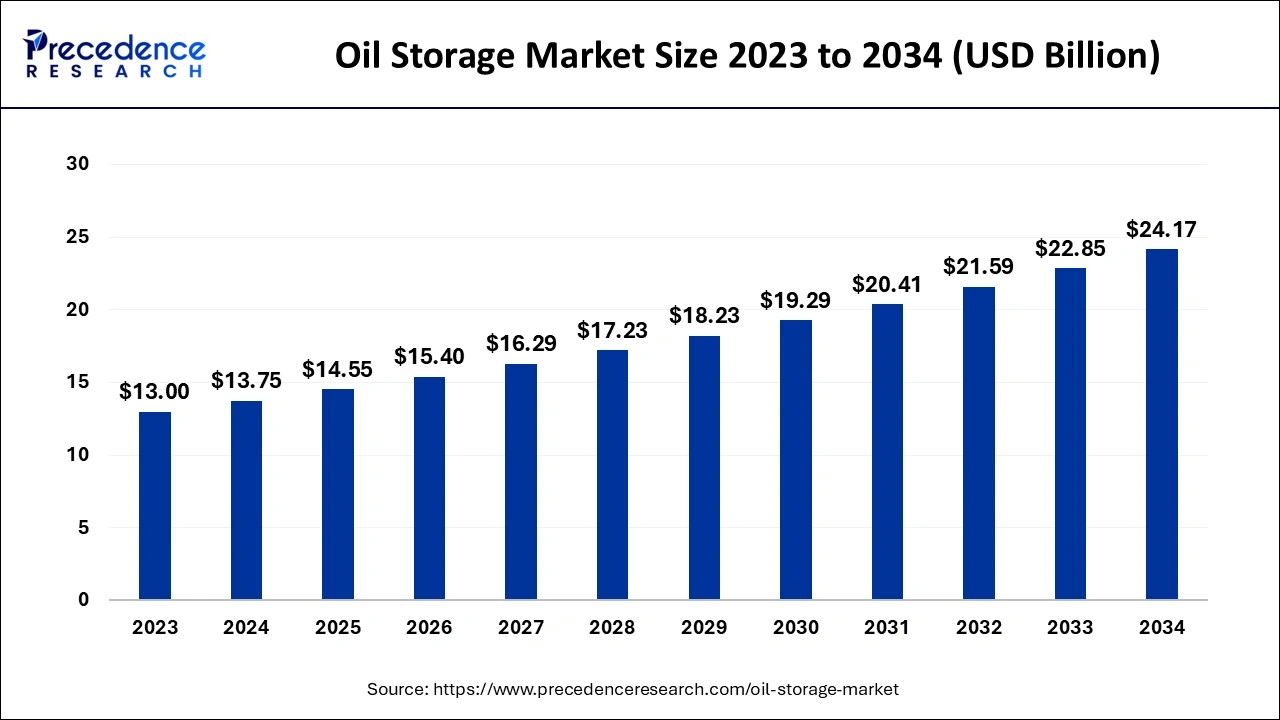
Market Highlights
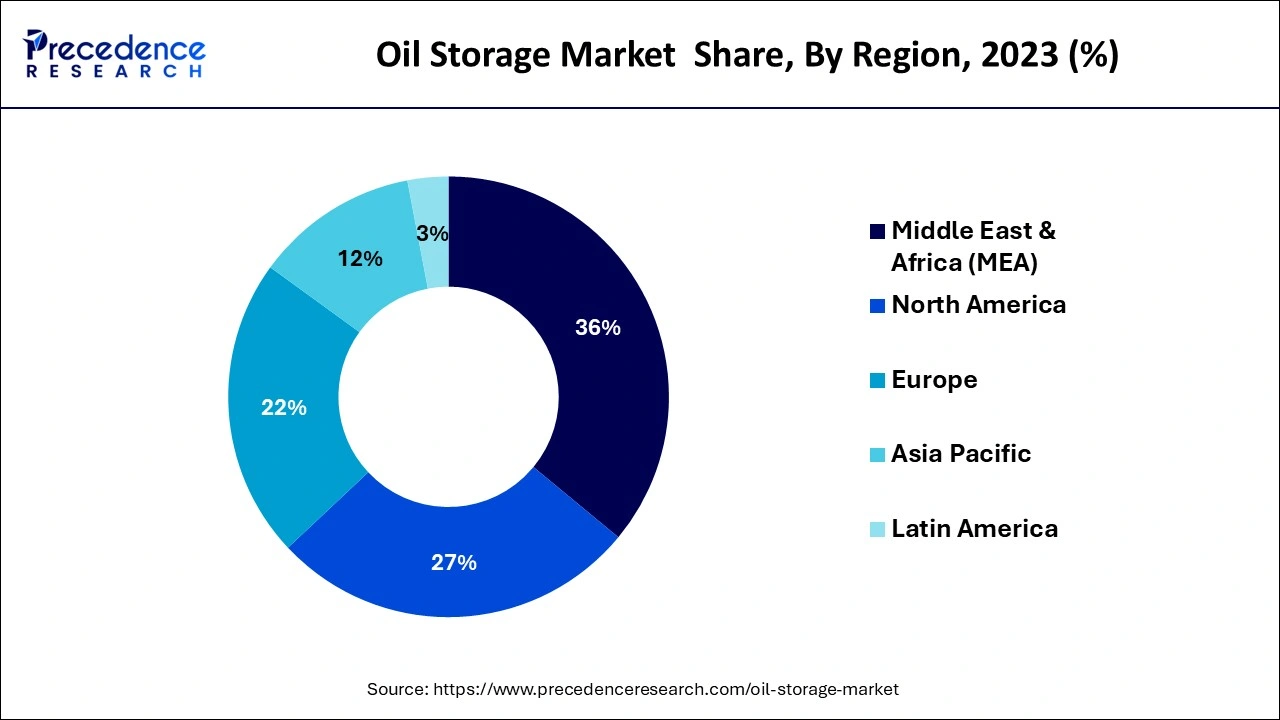
- Middle East and Africa held a majority revenue share of the 36% market in 2025.
- Asia Pacific is expected to grow at a notable CAGR in the foreseeable future.
- By product type, the crude oil segment held a dominant position in the market with a share of 52% in 2025.
- By product type, the gasoline segment is expected to grow with the highest CAGR in the market during the studied years.
- By storage type, the fixed roof oil segment held a major revenue share of 49% in the market in 2025.
- By storage type, the floating roof segment is expected to show the fastest growth with a CAGR of 4.3% over the forecast period.
Market Overview
Terminals or tanks used to store generated or processed oil above or below ground is referred to as oil storage facilities. The tanks transfer and treat the reservoir through several phases. The type of oil and its characteristics influence the material and form of tanks. There are several distinct styles of storage tanks, including open-top, fixed roof, floating roof, single skin, double skin, and bunded. Wooden storage tanks were used in the early 1980s; they have since been replaced with those made of stainless steel, polyethylene, carbon steel, or reinforced concrete. Security from short-term supply changes of crude oil and its derivatives is another benefit of oil storage. When compared to the market from end-use sectors, the growth rate of oil production is much higher. Storage tanks come in a variety of sizes and forms. Tanks may need to be rectangular, in the shape of horizontal cylinders, or even spherical depending on the use. Hydrocarbon or chemical materials are frequently stored in full loads in horizontal cylinders and spheres. The vertical, cylindrical storage tank is the most often utilized design.
In What Way is Artificial Intelligence Transforming Oil Storage Market?
Artificial Intelligence plays a crucial role in revolutionizing the oil storage market since it increases both efficiency and reliability of oil facilities as well as inventory management processes. The technology makes usage of predictive analytics systems allowing continuous monitoring of tanks, pipelines and their surroundings for any kind of discrepancy, forecasts about potential failure of the equipment and implementation of timely preventive maintenance so that there are fewer cases of equipment downtime. The usage of Machine Learning algorithms improves oil storage management practices by being able to analyze demand and supply fluctuations as well as assess storage space utilization. Due to Artificial Intelligence technologies levels of safety such as detecting leaks, corrosion and risks related to the operations of oil storage facilities are being enhanced as there are systems that check the processes automatically. Furthermore, usage of digital twins and optimization tools contribute to whole processes in the facilities such as improved results.
Oil Storage Market Growth Factors
The global oil storage market is primarily propelled by an ongoing improvement in the energy picture together with rising anxiety about meeting the need for emergency crude oil supplies. The market is expanding as a result of rising import-export activity in the petroleum sector. Logistics and transportation are essential tasks in the oil and gas sector.
- The growing end-user demand
- Low cost of crude oil
Future Trends in the Oil Storage Market
- Intelligent Storage: The oil industry will deploy IoT, AI, and digital solutions such as online monitoring systems to enable effective tank operation, predictive maintenance, leaks detection, inventory management, and safety improvement.
- Strategic Reserves: Countries will invest in increasing their strategic oil reservoirs to ensure security of energy supply, guarantee fuel supply during times of crisis, and meet the requirements during political upheavals and natural disasters.
- Green Infrastructure: Storage facilities will have to invest in eco-friendly terminals and renewable energy powered systems, vapor recovery devices, and carbon reduction technologies to comply with environmental goals and standards as well as companies' sustainability initiatives.
- Multifuels Storage: Storage systems will be developed for different types of fuels including crude oil, biofuels, renewable diesel, sustainable aviation fuel, and hydrogen products which will make the storage systems more flexible.
- Terminal Construction: As global trade and oil refining capacity are growing, investments will be made in larger and more automated storage facilities with loading systems capable of moving oil.
Market Outlook
- Industry Outlook: The industry is moving towards more automation, the use of sensors for real-time data, and better safety measures. Meeting environmental standards and controlling emissions are gradually taking over as the main focus of the operating strategy.
- Global expansion: Global expansion is concentrated on major trade routes, logistics hubs at seaports, and fast, growing consumption markets. To share costs and minimize the impact of regulatory risks, companies are rationalizing their investment in joint ventures.
- Startup Economy: The startup ecosystem in the oil storage market is small but full of innovative energy. Young companies are directing their efforts towards digitizing monitoring processes, forecasting maintenance needs, and safety management systems.
Market Scope
| Report Coverage | Details |
| Market Size in 2025 | USD 14.55 Billion |
| Market Size in 2026 | USD 15.40 Billion |
| Market Size by 2035 | USD 25.45 Billion |
| Growth Rate from 2026 to 2035 | CAGR of 5.75% |
| Largest Market | Middle East and Africa |
| Fastest Growing Market | Asia Pacific |
| Base Year | 2025 |
| Forecast Period | 2026 to 2035 |
| Segments Covered | Product Type, Storage Type, Material, Reserve Type, and Geography |
| Companies Mentioned | VTTI, Containment Solutions, Inc., Shawcor, Belco, CST Industries, Superior Tank Co., Inc., DELTA OIL TANKING BV, Royal Vopak, Oiltanking GmbH, Buckeye Partners, LP |
Market Dynamics
Drivers
Increased production of crude oils
- Due to the U.S. shale oil revolution and continuous investments in the discovery and production of oil reserves in several nations, including Saudi Arabia, the output of crude oil has dramatically expanded during the past few years. The difference between supply and demand for crude oil has been caused by excess. The development of oil storage facilities is thus anticipated to spur investment, expanding the worldwide market for oil storage.
Increased attention to finding alternative oil storage solutions
- Due to rising demand from various end-use sectors, the oil and gas business has grown impressively during the past few decades. Oil storage has become a crucial need since the demand for various types of oil, such as gasoline, aviation fuel, intermediate distillates, and crude oil, is still rising quickly. In order to get a firm footing in the competitive market environment, players in the oil storage market are actively allocating resources to the development of new technologies, oil storage product manufacturing, and oil storage methods. Oil storage is a crucial component of the whole oil supply chain since oil and gas are typically transported across vast distances throughout the world. This aspect is anticipated to drive innovations and new development throughout the oil storage market throughout the forecast period.
- Due to the requirement for large storage systems for marine transport, particularly at export-import ports. This factor is predicted to support the expansion of the global oil storage market over the assessment period. The need for oil storage to store strategic reserves to guarantee the supply of oil during a crisis has steadily increased over the past few decades.
Rising oil & gas industry
- Due to the considerable expansion of the global oil and gas sector, the oil storage market is consistently growing in a northerly direction. The growing need for efficient oil storage facilities is a result of the desire for large-scale refining centers and infrastructure for import and distribution, particularly in emerging countries like Venezuela, Saudi Arabia, Iran, and Iraq. The rise of the oil storage industry is also being driven by government bodies' increasing usage of strategic petroleum reserves (SPRs) to maintain substantial oil stockpiles and guarantee a consistent supply of energy.
- Exploratory operations, both on and offshore, are expanding globally, which is causing a significant increase in demand for oil storage facilities. This is anticipated to boost the growth of the oil and gas market throughout the forecast period. Hence, the oil & gas industry drives the market.
Challenges
- Adoption of renewable energy sources - The growing use of alternative energy sources to produce power is severely limiting the demand for oil storage. Environmental concerns have superseded energy security as the main driver of government programs to favor renewable fuels since they often emit less pollution. The focus of current research and development on alternative automotive fuel technology has been on hydrogen fuel cells, electric vehicles (EVs), and biofuels generated from plant material, such as ethanol, and biodiesel.
Opportunities
- Increasing demand creates opportunity in the oil storage market - The demand for oil has risen as a result of rising demand from numerous end-use industries. Oil production and transportation increase in response to the rise in demand, creating possibilities for storage containers. The need for oil storage is fueled by the dependence of the supply chain on storage tanks. Another factor opening up the market is the increase in crude oil output.
Segments Insights
Product Type Insights
On the basis of product type, the crude oil segment is expected to have the largest market share of around 52% in the coming years period. Over the projected period, rising crude oil output is anticipated to enhance storage, combined with declining downstream and midstream demand. The development of more cutting-edge refinery facilities and the increased demand for low-sulfur distillates are responsible for the expansion. The installation of upgrade units, which increase the productivity of middle distillates and consequently fuel its storage market expansion, is anticipated to be a result of expanding refining investments throughout Asia-Pacific nations.
The category for gasoline is anticipated to see the greatest CAGR throughout the projection period. Due to its high blazing energy, the segment's rise can be ascribed to reasons related to its use as a car fuel. It is more frequently utilized in production, forestry, landscaping, and agricultural equipment.
Storage Type Insights
On the basis of storage type, the fixed roof oil storage market category held the greatest market share, representing more than 49% of the total market volume. The fixed roof oil storage's high degree of containment, which lowers the chance of a fire occurrence, can be credited with the segment's expanding penetration. Furthermore, it is anticipated that falling installation costs associated with fixed-roof designs would further increase demand for these goods.
During the projection period, the floating roof sector is anticipated to have substantial expansion. The efficient design of the floating roof, which lessens corrosion and evaporative losses, is what is largely driving demand in this market. This segment's oil storage market is anticipated to increase as a result of the consistently rising demand for the storage of hydrocarbons with medium and low flash points.
Regional Insights
The Middle East and Africa Region was Dominated the Oil Storage Market
The Middle East and Africa region was dominated the market in 2025 with a revenue share of around 36%.
The LAMEA is expected to continue to be among the most alluring markets and this region is accounted for the majority revenue share in the market throughout the projection period. The expansion of the oil storage industry in the area is being driven by an increase in the number of productive refineries and rising oil production in nations like the UAE, Saudi Arabia, and Kuwait.
The Middle Eastern market will continue to dominate the market in terms of revenue during the anticipated period as a result of the growing demand for petroleum products across multiple industrial and commercial sectors in numerous countries throughout the region. In countries like the UAE, Saudi Arabia, and Kuwait, improved refinery throughput and increasing oil output are predicted to grow the industry. The demand for petroleum and distillates in the industrial sectors is predicted to cause the requirement for storage tanks in the area to keep growing.
What is the Middle East and Africa Oil Storage Market Size?
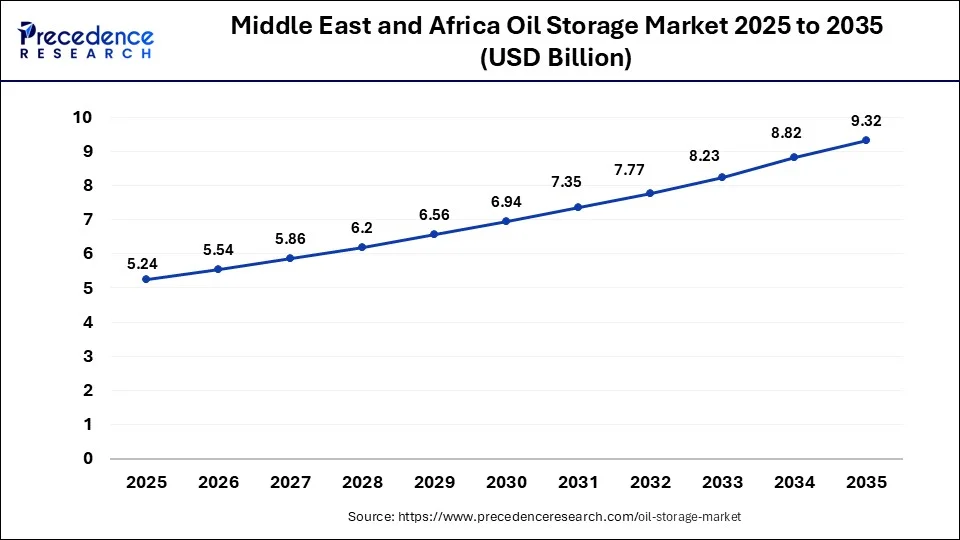
The middle east and Africa oil storage market size is evaluated at USD 5.54 billion in 2026 and is predicted to be worth around USD 9.32 billion by 2035, rising at a CAGR of 5.93% from 2026 to 2035.
By 2035, it is expected that Asia Pacific would account for more than 43% of the global oil storage market. To satisfy the soaring petroleum demand, there is an increasing focus on hoarding crude oil for commercial and emergency uses, which will boost regional industry share. Key oil manufacturing enterprises are expanding both greenfield and brownfield across the country. Additionally, the region will use a lot more storage containers as a result of the increase in yearly refinery throughput.
Why is the Oil Storage Market Gaining Momentum in North America?
North America is a well, established as well as vital oil storage market from the perspective of strategy, considering its high production capacity level, its extensive pipeline network, and in-house refining infrastructure. The storage demand in the area is affected by shale production cycles, seasonal consumption patterns, as well as strategic reserve requirements. The region focuses on operational efficiency, safety, and automation of storage facilities.
The dominance of the regional market by the United States is mostly due to its huge production of crude oil, several storage hubs in the commercial sector, and strategic petroleum reserves. Most of the storage facilities are so tightly connected with the pipeline and export infrastructure that they can easily accommodate domestic and international trade. Canada is playing its part in the market through storage associated with oil sands production and cross-border logistics.
Why is the Oil Storage Market Gaining Momentum in Asia Pacific?
Asia Pacific is considered as the second largest region in the market holding in the forecast period, owing to the surge in energy consumption, growth in refining capacity, and the increase in strategic petroleum reserve construction of major economies. The region is seeing demand for large-scale storage facilities as a result of rapid industrialization, urbanization, and increasing import reliance. Governments are investing in energy security initiatives for greater fuel supply resilience and long-term economic growth. Moreover, the market is expanding as a result of trade activities and the growth of investments in port and terminal infrastructure.
China Oil Storage Market Trends
China in the Asia Pacific oil storage market can be attributed to the significant amounts of crude oil it imports, its huge refinery infrastructure and high capital expenditure on strategic petroleum reserves. India is seeing robust growth, as energy demand continues to grow, refining capacity has been expanding, and the government has been working hard to boost fuel storage in the country. The Japanese market is still important thanks to its concerns about energy security and advanced petroleum storage facilities. South Korea is also playing a major part in the development of the region as a main refining and petroleum trading centre, equipped with modern storage terminal facilities.
Why is the Oil Storage Market Gaining Momentum in Europe?
Europe is considered the second-largest region in the market, with a growing emphasis on energy security, modernization of storage infrastructure, and expansion of strategic oil reserves. Demand for advanced storage solutions is growing across the region as investments continue to be made in energy infrastructure and reliable energy supply chains. The rich refining network and high level of international energy trade activity in the region are also contributing to the market. Also, terminal operators are focusing on improving operational efficiency and complying with regulations through investments in digitalization and sustainability.
Germany Oil Storage Market Trends
Germany is the top market for the storage of oil in Europe because of its strategic geographic position, the large existing energy infrastructure and the high demand for the petroleum products in the industry. The Netherlands will continue to be an important market because of its large storage facilities and its major energy trading centres, which are linked to international shipping routes. The United Kingdom is seeing consistent expansion with investments in energy resilience and modernization of fuel storage facilities. Ongoing terminal upgrading, a growing energy logistics focus and a greater emphasis on secure supply chain management of fuel are also playing a key role in market expansion in the region, in particular from France and Belgium.
Latin America Oil Storage Market Trends
Latin America's oil storage market is shaped by a mix of production-driven and import-oriented demand. Infrastructure development is uneven, with capacity concentrated near refineries, ports, and major consumption centres. Market growth is supported by energy sector reforms and increasing fuel demand in urbanizing economies. However, aging infrastructure and capital constraints remain challenges.
Brazil Oil Storage Market Trends
Brazil leads the region with storage capacity tied to offshore production, refining, and fuel distribution networks. Mexico is expanding storage to support downstream liberalization and improve supply resilience. Argentina's storage demand is linked to upstream development and refinery modernization. Colombia and Peru show moderate growth, driven by domestic fuel consumption and logistics optimization.
Competitive Landscape
Oil Storage Market is moderately consolidated with established providers of storage infrastructures competing with regional players. High level of capital investments, abiding with regulations, and ownership of strategic assets result in moderate entry barriers and facilitate long-time competition.
Market leaders, such as Vopak, Kinder Morgan, Royal Vopak, and Oiltanking strengthen their positions through development of large terminal networks, diversified storage capacities, global presence and long-term contracts with clients.
Competition is based on the expansion of terminals, acquisitions, use of digital terminal management, investments in sustainability, partnerships and improvements of capacity. The strict legislation in the field of environmental protection, elevated infrastructure costs, land availability, and permissions as central barriers that obstruct development are challenges in this market.
Oil Storage Market Companies
- Shawcor: (A global leader in pipeline and tank coatings, providing essential services to enhance the longevity and safety of oil and gas infrastructure.)
- Belco: (Specializes in environmental solutions, particularly in the treatment of water and wastewater, contributing to sustainability in the energy sector.)
- CST Industries: (Known for manufacturing storage tanks and pressure vessels, pivotal in the safe storage of liquids in various industries.)
- Superior Tank Co. Inc.: (Offers reliable tank construction and maintenance services, important for effective storage solutions in oil and gas, water, and chemical industries.)
- DELTA OIL TANKING BV: (Provides oil storage and handling services, critical for the logistics of petroleum products in the supply chain.)
- Royal Vopak: (A key player in the tank terminal industry, facilitating the storage and handling of bulk liquids, enhancing efficiency in global trade.)
- Oiltanking GmbH: (Operates tank terminals for the storage of oil and chemicals, playing a vital role in ensuring a smooth supply chain for energy resources.)
- Buckeye Partners, LP: (Engaged in the transportation and terminalling of petroleum products, critical for maintaining the flow of resources in the energy market.)
Other Major Key Players
Recent Developments
- In May 2026, Ingersoll Rand and announced a strategic partnership to develop advanced oil-free industrial technologies. The collaboration aims to deliver high-efficiency, sustainable compressed air and industrial solutions, helping manufacturers reduce maintenance needs, improve operational performance, and lower environmental impact.
- In March 2026, the proposed releasing 400 million barrels of oil from strategic reserves to stabilize global energy markets amid supply concerns. The proposal highlighted the importance of coordinated international emergency stockpiles in maintaining energy security and reducing price volatility.
- In March 2026, Japan announced the release of oil from its national strategic petroleum reserves to strengthen domestic energy security and support stable fuel supplies. The move reflected the country's continued use of strategic reserves to address market disruptions and reinforce supply resilience.
- In August 2026, Oman launched a tender to expand the Ras Markaz oil storage terminal, increasing its strategic crude storage capacity. The expansion is intended to strengthen the country's position as a regional energy storage and export hub while supporting growing international oil trading activities.
- In August 2026, India approved a new ONGC-led strategic oil storage plan to expand the country's petroleum reserves. The initiative aims to enhance long-term energy security, strengthen emergency crude oil stockpiles, and improve resilience against global supply disruptions and geopolitical uncertainties.
Segments Covered in the Report
By Product Type
- Crude Oil
- Gasoline
- Aviation Fuel
- Middle Distillates
- LPG
- Diesel
- Others
By Storage Type
- Open Top Tanks
- Fixed Roof Tanks
- Floating Roof Tanks
- Other Storage Facilities
By Material
- Steel
- Carbon Steel
- Fiberglass-reinforced Plastic (FRP)
By Reserve Type
- Strategic Petroleum Reserve
- Commercial Petroleum Reserve
By Geography
- North America
- Europe
- Asia-Pacific
- Latin America
- Middle East & Africa (MEA)
For inquiries regarding discounts, bulk purchases, or customization requests, please contact us at sales@precedenceresearch.com
Frequently Asked Questions
Tags





Ask For Sample
No cookie-cutter, only authentic analysis – take the 1st step to become a Precedence Research client
 Get a Sample




 sales@precedenceresearch.com
 Schedule a Meeting
