



Polyolefin Films Market Size, Key Companies, Company Market Share, Production Volume, Sales Performance, Export & Import Dynamics, Adoption Rates, Recycling Rate, Material Efficiency, and Demand Trends
Polyolefin Films Market (By Material: HDPE, LDPE, LLDPE, BOPP, CPP; By Application: Film & Sheets, Blow Molding, Injection Molding, Fibers, Others; By Film Type: Shrink Film, Stretch Film, Others; By End-Use: Packaging, Construction, Agricultural, Others) - Global Industry Analysis, Size, Trends, Leading Companies, Regional Outlook, and Forecast 2026 to 2035
Source: https://www.precedenceresearch.com/polyolefin-films-market
 Get a Sample
 Table Of Content


What is the Polyolefin Films Market Size?
The global polyolefin films market size is expected to be valued at USD 321.67 billion in 2025 and is predicted to increase from USD 353.20 billion in 2026 to approximately USD 808.80 billion by 2035, expanding at a CAGR of 9.66% over the forecast period 2026 to 2035.
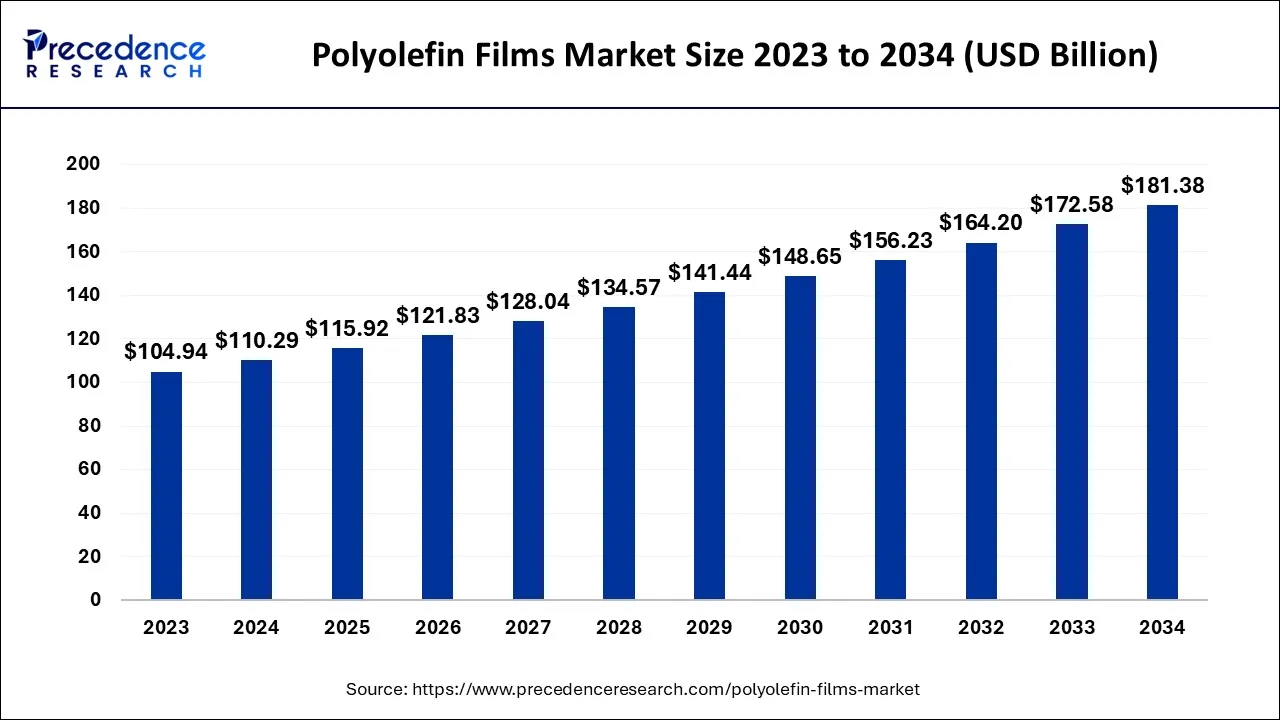
Polyolefin Films Market Key Takeaways
- Asia-Pacific has generated more than 40% of revenue share in 2025.
- By material, the LLDPE segment is expected to expand at the fastest CAGR between 2026 to 2035.
- By end-use, the packaging segment is predicted to grow at a remarkable CAGR between 2026 to 2035.
What are polyolefin films?
Recent packaging trends indicate that consumers favor transparent packaging over nontransparent, flexible packaging over rigid packaging. Films made of polyolefin (POF) appear to be the greatest option for these current altering trends. These may be transparent, flexible, and light. Plastics and a family of polymers called polyolefin (POF) films are produced by the polymerization of monomers. Stretch films, shrink films, and other uses for POF films are common. Polyethylene (PE) is the POF most frequently used. Low-Density Polyethylene (LDPE) and Linear-Low Density Polyethylene (LLDPE) are the PEs that are most frequently utilised. These films are employed in a variety of industries, including food and beverage production, agriculture, cosmetics, and industrial packaging. The film might be as thick as thick sheets or as thin as a few microns.
Polyolefin Films Market Growth Factors
Recent developments in the packaging sector demonstrate that polyolefin films perform and are of higher quality than PVC films. PVC has downsides despite being the third most produced plastic in the world. At cold temperatures, it becomes hardened and as temperature increases it becomes soften, therefore compromising the strength of plastic. Polyolefin films have desirable qualities such as high flexibility storage, greater seal strength, and reduced odor when sealed. Since they lack chlorine, they do not form hydrogen chloride gas. Due to the lack of plasticizers in polyolefin film, temperature is not a concern.
The key factor boosting the market for packaging polyolefin films is the expansion of the agricultural markets in China and India. Rising industrial automation, safety regulations, and worldwide industrial output all have a direct or indirect impact on the market for polyolefin films. Recent changes in logistics and e-commerce demonstrate a rise in the use of polyolefin films for bundling goods or packages.
Market Outlook
- Industry Growth Overview:
The polyolefin films market is experiencing significant growth, driven by strong demand in packaging, growing disposable incomes, and sustainability trends favoring recyclable services such as PE and PP films. - Global Expansion:
The polyolefin films market expanded globally due to huge demand for sustainable, lightweight packaging in the rapidly growing food/beverage and e-commerce sectors, as well as use in automotive and healthcare applications. Asia Pacific is dominant in the market due to government support/incentives and increasing industrial use. - Major investors:
Major investors are the large, integrated petrochemical organizations and specialized packaging film producers. Such as ExxonMobil Chemical, Amcor Plc, Berry Global Inc., and SABIC
Market Scope
| Report Coverage | Details |
| Market Size in 2025 | USD 321.67 Billion |
| Market Size in 2026 | USD 353.20 Billion |
| Market Size by 2035 | USD 808.80 Billion |
| Growth Rate from 2026 to 2035 | CAGR of 9.66% |
| Largest Market | Asia Pacific |
| Base Year | 2025 |
| Forecast Period | 2026 to 2035 |
| Segments Covered | By Material, By Application, By Film Type, and By End-Use |
| Regions Covered | North America, Europe, Asia-Pacific, Latin America and Middle East & Africa |
Market Dynamics
Driver
Highly adaptable due to polyolefins advanced properties
Due to its many beneficial characteristics, polyolefins are appropriate for a wide range of applications. It is exceedingly ductile and has good impact strength while having low strength and hardness; it will stretch rather than break. In comparison to other polymers, polyolefins are more durable and resistant to water, therefore they survive longer when exposed to the weather. Although polyolefins are excellent electrical insulators and give electric trembling resistance, they are susceptible to electrostatic charging. Antistatic substances will stop this.
It can range from being practically transparent to opaque, depending on the thickness of the polyolefins. Low-density polyolefins are useful for packaging applications because to their clarity. Recycling polyolefins like HDPE into other products is more economical than creating a new product from fresh plastic.
Restraints
Stringent environmental regulations
In 2018, it is predicted that there will be 380 million tonnes of plastic produced worldwide. Around 6.3 billion tonnes of plastics have been produced globally between 1950 and 2018, of which 9% and 12% have been recycled or burned. Researchers have predicted that the weight of plastic in the oceans could surpass that of fish by the year 2050. Polyolefin-based plastics have a non-biodegradable nature, are produced using non-renewable resources, and can endure for a number of years in the environment. One of the main causes of the dangers to the environment and human health is the use of plastic made of polyolefin, such as HDPE, LLDPE, and LDPE bags. Plastic wastes have been demonstrated to be a significant environmental problem due to the widespread manufacture of plastics and the ensuing environmental degradation. Public concern over how plastic garbage affects humans, animals, and the environment as a whole necessitates saving the ecosystems and life inside them.
Thus, stricter laws are being enacted as a result of the increased environmental concern, which is impeding market expansion. Governments all across the world have taken steps to outlaw plastic, though. For instance, a "Plastic Ban" law was enacted in France in 2016. By 2025, the law wants to have reduced the nation's use of plastic bags by half.
Opportunities
Rising demand for polyolefins across various industry verticals
Several industries, including automotive, electrical and electronics, food and beverage, and consumer goods, are seeing an increase in demand for polyolefins. Due to their high stiffness, strong moisture resistance, and chemical resistance, polyolefins are well-suited for industrial applications, particularly for the packaging of electrical and automotive replacement parts. While in the automotive sector, manufacturers are concentrating on improving vehicle economy by making them lighter.
Material made of polyolefins is popular because it is lightweight, easy to process, and has sealing and rigidity properties. The development of packaging materials for food and beverages is driving an increase in the consumption of polyethylene in the food and beverage sector. Due to its resilience to physical pressures, durability, flexibility in packaging, and ease of product moulding, polyethylene is increasingly used in fashion, toys, and sports.
Segment Insights
Material Insights
During the forecast period, the segment of the global polyolefins market with the highest CAGR is expected to be LLDPE. This increase is the result of the widespread usage of LLDPE in a variety of industries, including packaging, transportation, agriculture, medicine, and electronics. LLDPE is also incredibly resilient to chemicals, adaptable, and customizable. The several varieties of packaging, including rigid, flexible, and semi-flexible types, offer a wonderful alternative to suit the product and make it very versatile in addition to providing protection. It provides multiple thicknesses, clarities, and designer colors for a more personalized alternative.
Since polyolefins are nonpolar, odorless, and nonporous materials, they are employed as packaging materials in the food industry. In food packaging, polyolefins such linear low-density polyethylene (LLDPE), isotactic polypropylene (PP), high-density polyethylene (HDPE), low-density polyethylene (LDPE), and other polyethylene-based copolymers are frequently employed. Films made of polyolefin are reasonably cheap and have improved gas and moisture barriers. They also resist food leaks and tolerate heat. Additionally, they properly fit the food's form and contribute less weight to the package, requiring less room for storage and delivery. The food sector is growing in developing nations like India and China as the population influences and drives the market.
Applicational Insights
The films and sheet are extensively used in the food and beverages sector, agricultural sector, cosmetics sector, and industrial packaging sector. The films and sheets are available in various ranges depending on the thickness. The films and sheets are commonly used in production of beverage bottles, for packing food items, and for making packages for cosmetic products. Moreover, new developments in the films and sheets include protection from UV rays of the sun, fluorescent films, and NIR-blocking films. Therefore, growing application along with product advancements is fueling the growth of the segment.
End User Insights
The packaging sector is expected to grow at a strong CAGR over the course of the forecast period. This increase is linked to the packaging industry's increasing need for polyethylene films as a replacement for glass and metal, which also fuels the market's expansion. Additionally, a rise in the need for flexible and hygienic food packaging materials is anticipated to fuel market expansion. The National Centre for Biotechnology Information estimates that 23 million tonnes of plastic packaging are manufactured in Europe year, with a projected increase to 92 million tonnes by the year 2050.
Additionally, the industry is growing as a result of rising disposable incomes in developing nations like China and India and plastic package recycling in Europe. As an illustration, DoW Packaging and Specialty Plastics (P&SP) in India created a novel formulation of polyethylene (PE) resins in 2018 that resulted in a totally recyclable polyethylene packaging solution.
Regional Insights
What is the Asia Pacific Polyolefin Films Market Size?
The Asia Pacific polyolefin films market size is exhibited at USD 46.37 billion in 2025 and is projected to be worth around USD 77.17 billion by 2035, growing at a CAGR of 5.23% from 2026 to 2035.
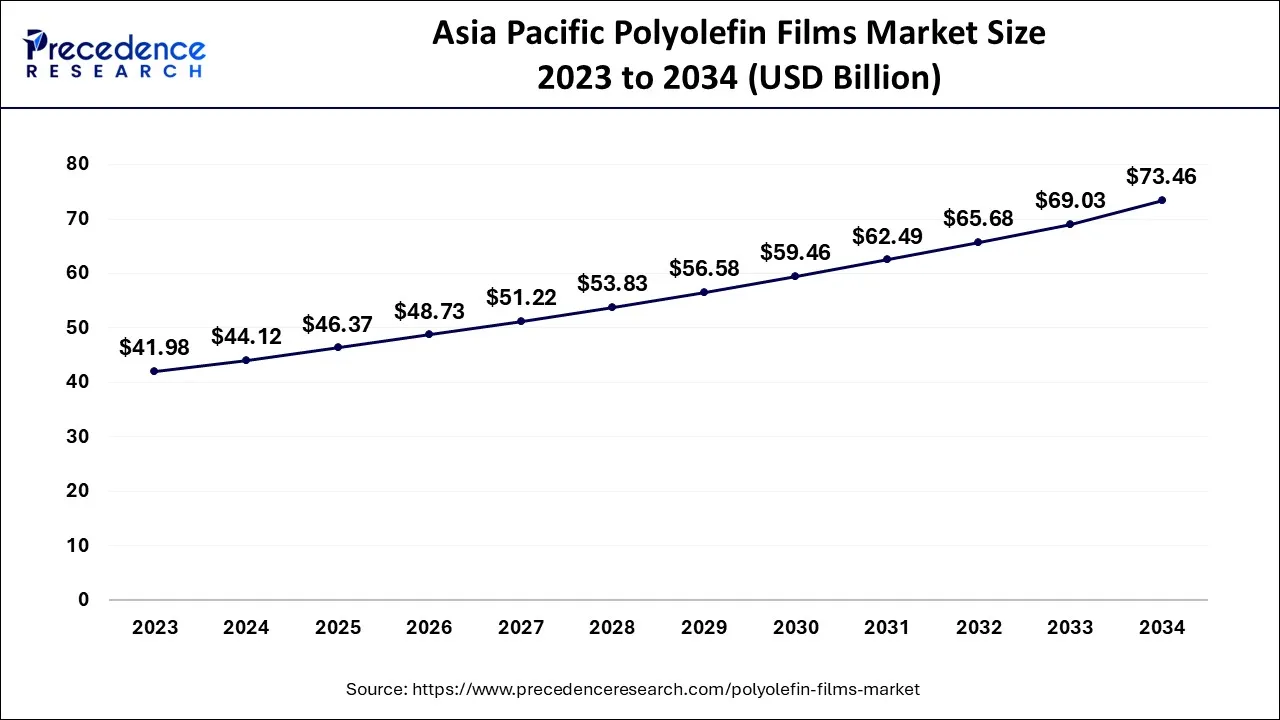
Asia Pacific: Increasing middle-class consumer spending
With a share above 40%, Asia-Pacific led the global market in 2023. The need for polyolefin shrink films is rising in the region as the packaging and healthcare sectors expand in nations including China, India, Japan, and South Korea. The packaging industry in China is the second-largest in the world. Due to the rise of customized packaging and the rising demand for packaged consumer goods, the nation is predicted to grow steadily during the projection period.
Additionally, the fast-moving consumer goods (FMCG) industry in the nation has recently experienced tremendous growth. The country's middle-class consumers' increased spending on higher-end and healthier goods was a big factor in the FMCG market's expansion. Additionally, India's packaging business is the fifth-largest in the world and is expanding quickly. The increased need for compact and portable products across industries is a primary driver of the nation's packaging sector. The market for polyolefin shrink films in the area is anticipated to increase steadily over the course of the forecast period as a result of all of these factors.
India Polyolefin Films Market Trends
In India, the expansion of the food and beverage companies, e-commerce development, and increasing consumer demand for packaged and ready-to-eat foods. Rising government programs such as the Production Linked Incentive (PLI) scheme inspire domestic manufacturing, increase industries using polyolefin films (like electronics and packaging), and supports reducing import dependency.
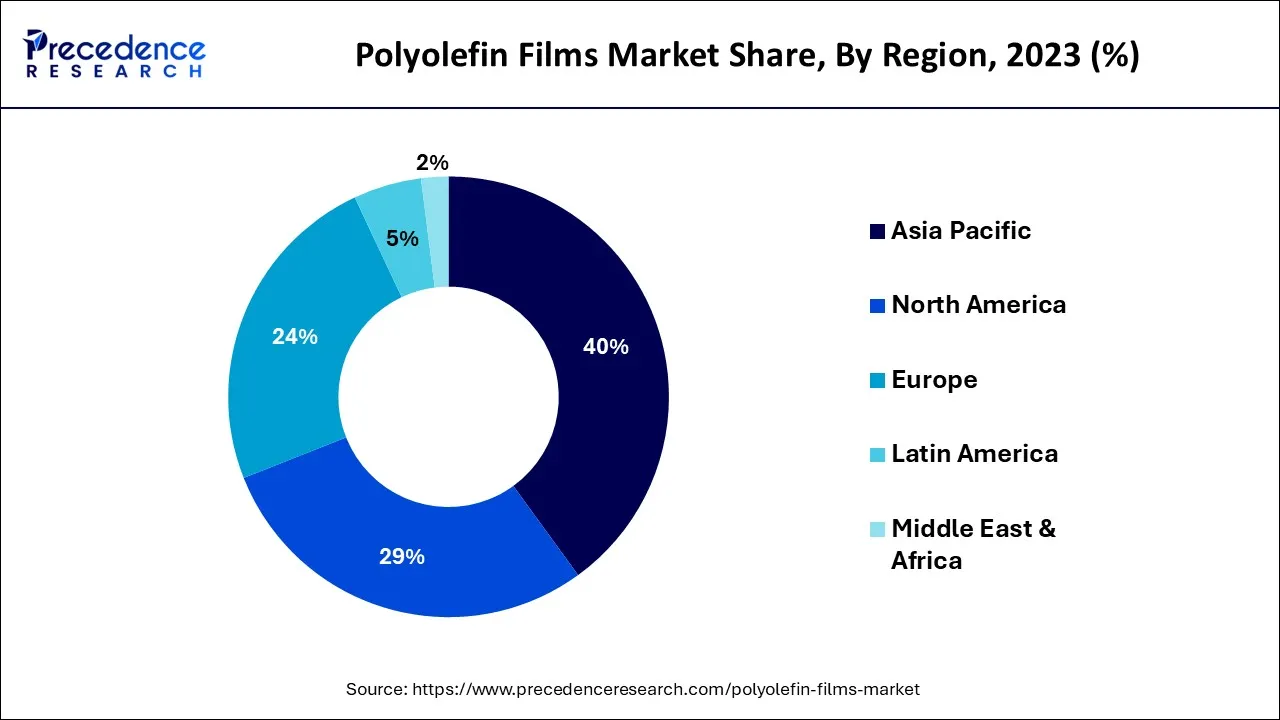
North America: Increasing demand for packaged food and beverages
North America is the market, as the advanced pharmaceutical sector demands films with superior barrier characteristics, tamper-evident sealing, and strict safety submission. Busy lifestyles and an increasing consumption rate of ready-to-eat and frozen foods drive the requirement for high-quality, long-lasting packaging.
U.S. Polyolefin Films Market Trends
The U.S. healthcare field's rising demands for high-purity, sterilization-accomplished polyolefin films and compounds for healthcare tubing, containers, and protective packaging. Strong focus on advanced recyclable, bio-based, and high-performance polyolefins to tackle the rising environmental regulations and customer demand for environmentally friendly products.
Europe: Increasing government initiative
Europe is significantly growing in the market as stringent environmental guidelines boost recyclability, circular economy principles, and the advancement of bio-drives substitutes, creating a market for well-advanced, eco-friendly polyolefin films. A large system of international and domestic manufacturers with sophisticated manufacturing support, which contributes to the growth of the market.
The UK Polyolefin Films Market Trends
The UK has noteworthy polymer manufacturers, such as INEOS, and has a strong network of over 5,700 plastic organizations, including major global packaging companies with a UK presence, like Amcor plc, which support a complex and strong supply chain. Polypropylene-based films like BOPP are gaining traction as companies focus on recyclable, lightweight, and high-performance packaging solutions. The use of post-consumer recycled resins is rising in response to UK and EU sustainability regulations, although the raw material price is volatile.
Which Factors Drive the Polyimide Films Market in Europe?
Europe is expected to grow at a notable CAGR in the foreseeable future due to strict environmental regulations, recycling of packaging materials, and increased consumption of lighter industrial materials. Polyimide films are extensively used for packaging foods, drugs, and crops owing to their characteristics of being durable, clear, and sealable. The use of biodegradable films is also common among manufacturers who are increasingly concerned about sustainability in their operations.
Germany Market Trends
The German market is growing due to the country's developed packaging industry, automotive industry, and growing focus on sustainability through packaging. The use of polyimide films in packaging for protection and in automotive interiors and industrial wrap has grown. Investments in technologies for recycling and environmentally friendly packaging products helped in the growth of the market in the country.
Will Latin America grow in the Polyimide Films Market?
Latin America is considered to be a significantly growing area, as a result of the increased activity of the food processing industry, the increased demand for packaging from the retail industry, and the increase in the use of agricultural films. Polyimide film is increasingly used in applications such as packaging, shrink wrap, and agricultural film due to its durability.
Brazil Market Trends
The Brazilian market is an important market owing to the strong agricultural industry, increasing consumption of packaged foods, and an increase in packaging needs from the industrial sector. Increased investment in the area of plastic recycling also contributed towards product demand.
What are the Advancements of the Polyimide Films Market in the Middle East and Africa?
The Middle East and Africa are expected to grow at a considerable CAGR in the upcoming period. Infrastructural developments, growing demand for food packages, and agricultural production activities in the area propel the market. There is a rise in the popularity of polyimide films for their strength and ability to withstand weather changes when used in industries for films for construction or agriculture.
UAE Market Trends
The UAE market is driven by extensive expansion in retail, increasing demand for food packaging, and increased investments in the logistics and construction industries. There was increased usage of polyolefin films in areas such as protective packaging and industrial applications.
Value Chain Analysis - Polyolefin Films Market
- Raw Material:
Significantly, raw materials in the polyolefin films market are Polyethylene (PE), particularly LDPE and LLDPE, and Polypropylene (PP), used as base resins
Key Players: Hitachi and Johnson Controls - Manufacturing Processes:
Polyolefin film manufacturing significantly uses extrusion, either cast or blown, involving melting resins (PE/PP), shaping them, and cooling.
Key Players: Panasonic and Samsung SDI - Waste Management:
The waste management methods used in the polyolefin film market prioritize prevention, reuse, recycling, energy recovery, and disposal.
Key Players: CATL and LG Energy Solution
Polyolefin Films Market Companies
|
Company |
Headquarters |
Key Strengths |
Latest Info (2025) |
|
Jindal Poly Films |
New Delhi |
Largest flexible packaging film producer |
In October 2025, Jindal Poly Films Shareholders Approve INR 3,000 Crore Increase in Investment Limits and Promoter Consent Amendment |
|
Mitsui Chemicals Tocello |
Japan |
Expertise in solar panel materials |
In May 2025, the Mitsui Chemicals Group announced its policy to split off the Basic & Green Materials business. |
|
Toray |
Japan |
Innovative advanced materials |
In July 2025, Toray Industries, Inc., announced that it had developed the STF-2000, a photosensitive polyimide solution that allows high-aspect-ratio fine patterning. |
|
Berry Plastics C |
United States |
Broad and diverse product portfolio |
In January 2025, Amcor plc and Berry Global Group, Inc. announced that an important milestone towards the completion of their previously announced all-stock transaction had been reached, with the filing of the definitive joint proxy statement with the U.S. SEC. |
|
Toyobo |
Japan |
Collaborative product development |
In April 2025, Toyobo developed a new 20-micrometer-thick PET film for shrink labels, SC836-20, leveraging film-forming technologies cultivated over many years. |
Other Major Key Players
- Amcor Flexible
- Innovia Films
- Vibac Group
- Garware Polyester Limited
- Uflex Limited
Recent Developments
- In April 2026, Nextek and Coveris opened a demo plant to produce high-value food contact recyclate from post-consumer polyolefin packaging waste by using the technology developed by Nextek, namely, the COtooCLEAN system. This plant was meant to boost recycling of flexible packaging material, achieve the goals of circular packaging, and lower reliance on virgin plastic in food packaging. (Source: https://www.packagingnews.co.uk)
- In June 2025, Clariant introduced AddWorks™ PPA, a new range of additives free from perfluoroalkyl substances (PFAS), to enhance the processing of polyolefin extrusions. These additives helped improve the efficiency of extrusion, reduce shark skin effects, and increase film surface quality while ensuring recyclability in accordance with international PFAS restrictions. (Source: https://www.clariant.com)
- In Panjin, China, LyondellBasell Industries NV and Liaoning Bora Enterprise Group (Bora) entered into a joint venture in March 2020 to construct a 1.1 million tonnes per year ethylene cracker and related polyolefin derivatives complex.
- The first parallel commercial-scale manufacturing of bio-based polypropylene and bio-based low-density polyethylene will begin in 2019, according to a joint announcement from Neste Corporation and LyondellBasell. The initiative was successful in producing several thousand tonnes of bio-based plastics, which are now being sold under the brand names Circulen and Circulen Plu and are authorised for use in the manufacture of food packaging.
- The commissioning of LyondellBasell's new high-density polyethylene (HDPE) factory in La Porte, Texas, started in November 2019. The new facility generated 500,000 tonnes of HDPE annually using the unique Hyperzone technology of LyondellBasell.
Segments Covered in the Report
By Material
- HDPE
- LDPE
- LLDPE
- BOPP
- CPP
By Application
- Film & Sheets
- Blow Molding
- Injection Molding
- Fibers
- Others
By Film Type
- Shrink Film
- Stretch Film
- Others
By End-Use
- Packaging
- Construction
- Agricultural
- Others
By Geography
- North America
- Europe
- Asia-Pacific
- Latin America
- Middle East and Africa
For inquiries regarding discounts, bulk purchases, or customization requests, please contact us at sales@precedenceresearch.com
Frequently Asked Questions





Ask For Sample
No cookie-cutter, only authentic analysis – take the 1st step to become a Precedence Research client
 Get a Sample




 sales@precedenceresearch.com
 Schedule a Meeting
