



AI Ethics and Governance Solutions Market Revenue to Attain USD 23.51 Bn by 2035
Published: 27 Apr 2026
Author: Precedence Research



AI Ethics and Governance Solutions Market Revenue and Trends 2026 to 2035
The global AI ethics and governance solutions market revenue reached USD 1.90 billion in 2025 and is predicted to attain around USD 23.51 billion by 2035 with a CAGR of 28.60%. AI ethics and governance solutions have evolved from advisory frameworks into critical infrastructure as regulations tighten, AI systems become more autonomous, and organizations are increasingly required to demonstrate algorithmic transparency and accountability rather than merely claim it.
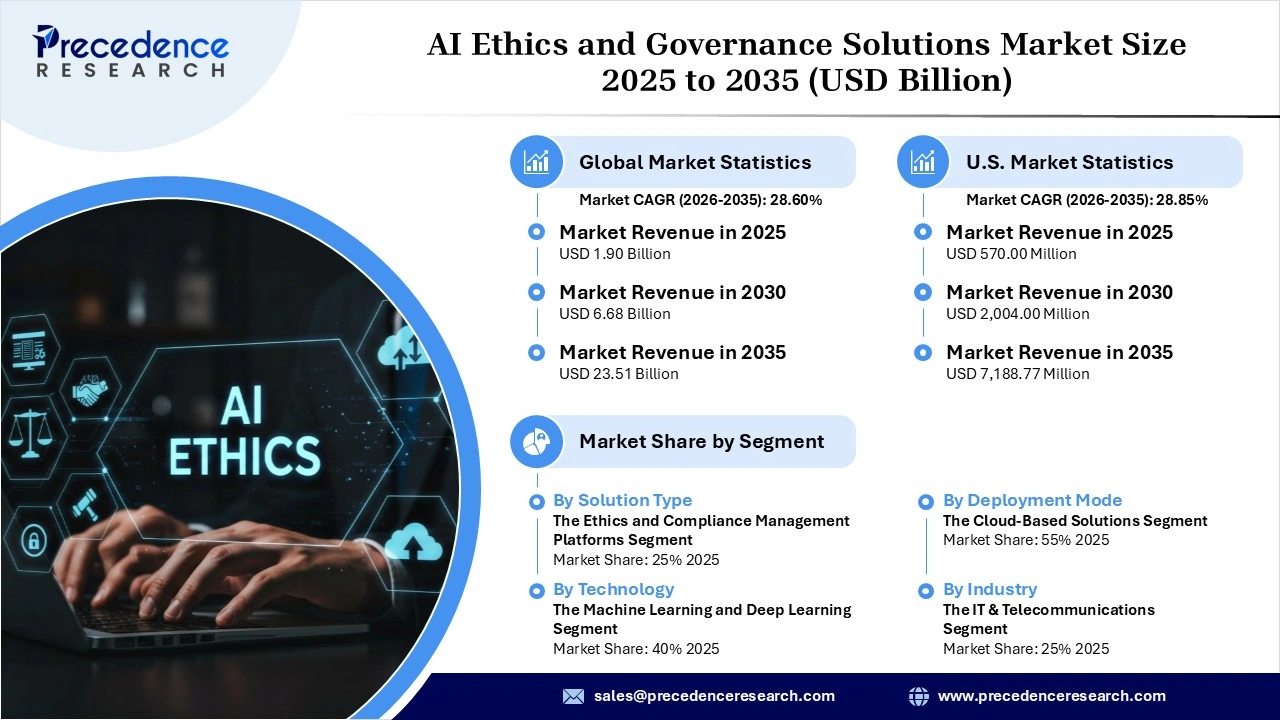
Market at a Glance
The AI ethics and governance solutions market comprises tools, platforms, and services designed to ensure that artificial intelligence systems operate in a transparent, fair, and accountable manner. It includes capabilities such as bias detection, model explainability, risk assessment, compliance management, and continuous monitoring of AI systems throughout their lifecycle. These solutions help organizations align AI development and deployment with regulatory requirements, ethical standards, and internal policies. The market is growing as businesses increasingly rely on AI while facing stricter regulations and rising concerns around responsible and trustworthy AI use.
What are the Key Trends in the AI Ethics and Governance Solutions Market?
- Stringent Regulation: The enforcement of the EU AI Act from 2025 is compelling organizations to operationalize AI governance rather than treat it as a compliance exercise. The regulation introduces stringent requirements for high-risk AI systems, with penalties reaching up to €35 million or 7% of global annual revenue, making governance investment a necessity rather than a choice.
- Rise of Agentic AI: Enterprises are increasingly adopting agentic AI systems capable of autonomous decision-making without continuous human intervention. This shift is driving demand for real-time monitoring, continuous auditing, and dynamic governance frameworks, moving enterprises away from periodic audits toward always-on oversight systems.
EU AI Regulation: Industry Preparedness and Compliance Trends
- Nearly 40% of EU companies are not familiar with the AI Act, while only about 10% of small and medium-sized enterprises (SMEs) feel prepared to comply with its requirements.
- Around 65% of businesses expect increased compliance costs, with total annual adherence expenses estimated at approximately €31 billion.
- About 55% of organizations plan to increase investment in AI governance, reflecting a strong shift toward regulatory readiness and risk management.
- AI adoption remains uneven, with 68% of large enterprises already using AI compared to only 8% of SMEs, creating a gap where larger firms are driving early governance investments while smaller firms lag behind.
- The regulation has global implications, as 82% of non-EU companies expect to be affected, influencing nearly 85% of the global AI market.
- Strong public support also reinforces this trend, with 92% of EU citizens endorsing AI regulation, indicating growing trust in regulated AI systems.
Market Segmentation Overview
- By solution type, the ethics and compliance management platform segment held a 25% share of the AI ethics and governance solutions market in 2025, due to increasing regulatory requirements concerning AI accountability, fairness, and transparency. Organizations are increasingly adopting these platforms to embed compliance directly into operations, shifting governance from periodic reviews to continuous, system-integrated processes.
- By solution type, the AI bias & fairness auditing tools segment is expected to grow at the fastest CAGR between 2026 and 2035, driven by increasing regulatory and organizational focus on eliminating bias in AI-driven decision-making. The need for continuous detection, evaluation, and mitigation of bias is especially critical in high-impact domains such as finance, legal systems, and social services.
- By technology, the machine learning and deep learning tools segment held a major revenue share of 40% in the market in 2025, as these technologies form the core of most AI systems. Their widespread use in governance stemmed from the need to directly address fairness, bias reduction, and transparency in AI systems where risks actually originate inside the models themselves.
- By technology, the explainable AI (XAI) tools segment is expected to grow at a significant CAGR in the market between 2026 and 2035, due to their ability to make AI-related decision-making processes more transparent and accessible. These tools help stakeholders understand not only AI outputs but also the reasoning behind them, strengthening trust and accountability at scale.
- By deployment mode, the cloud-based solutions segment led the AI ethics and governance solutions market, accounting for a share of 55% in 2025, owing to their scalability, cost-effectiveness, and compatibility with enterprise systems. Organizations increasingly prefer cloud environments as they support flexible, real-time governance without disrupting ongoing operations.
- By deployment mode, the hybrid solutions segment is expected to expand rapidly in the market in the coming years, as organizations seek to balance cloud scalability with on-premises control. This approach enables businesses to scale governance capabilities while maintaining tighter oversight of sensitive data and critical compliance processes.
- By industry, the IT & telecommunications segment accounted for a considerable revenue share of 25% in the market in 2025, driven by heavy reliance on AI for network optimization, customer service automation, and large-scale data processing. Governance solutions are essential in this sector to ensure reliability, trust, and regulatory alignment across complex AI systems.
- By industry, the healthcare segment is expected to grow at the fastest CAGR in the market between 2026 and 2035, due to increasing integration of AI in diagnostics, treatment planning, and patient care systems. Strong governance frameworks are critical to ensuring fairness, transparency, and compliance in applications that directly impact patient outcomes.
Regional Insights
North America dominated the global AI ethics and governance solutions market with a share of 40% in 2025, driven by its advanced AI research ecosystems and strong regulatory momentum. The presence of major technology firms has further accelerated adoption, embedding governance as an integral layer within AI systems rather than an external control mechanism. In the U.S., active policy development and large-scale enterprise AI deployments have significantly increased demand for governance solutions, while Canada has strengthened the region’s position through responsible AI frameworks and research-led governance initiatives. Together, these factors provide both commercial scale and regulatory clarity.
Asia Pacific held a market share of 20% in 2025 and is expected to grow at the fastest CAGR during the forecast period, supported by strong government investment in AI and proactive regulatory initiatives. This dual approach, promoting innovation while establishing governance frameworks, creates a favorable environment for AI ethics and governance solutions. China is advancing AI development under structured regulatory oversight, India is expanding adoption across sectors such as IT and healthcare, and Japan is focusing on integrating AI with ethical and societal considerations. As a result, the region is shifting from AI adoption catch-up to building governance-by-design ecosystems from the outset.
AI Ethics and Governance Solutions Market Coverage
| Report Attribute | Key Statistics |
| Market Revenue in 2025 | USD 1.90 Billion |
| Market Revenue by 2035 | USD 23.51 Billion |
| CAGR from 2026 to 2035 | 28.60% |
| Quantitative Units | Revenue in USD million/billion, Volume in units |
| Largest Market | North America |
| Base Year | 2025 |
| Regions Covered | North America, Europe, Asia-Pacific, Latin America, and the Middle East & Africa |
Top Companies in the AI Ethics and Governance Solutions Market
Top companies operating in the market include IBM Corporation, Microsoft Corporation, Accenture Plc, Google LLC (Alphabet Inc.), SAS Institute Inc., SAP SE, Bain & Company, PwC (PricewaterhouseCoopers), EY (Ernst & Young Global Limited), Deloitte, Oracle Corporation, and others. These companies are embedding responsible AI principles directly into their platforms, enabling built-in compliance, transparency, and bias mitigation across AI systems. At the same time, consulting firms support adoption by translating complex regulations into practical governance frameworks that help organizations operationalize ethical and compliant AI at scale.
Segments Covered in the Report
By Solution Type
- Ethics and Compliance Management Platforms
- AI Bias & Fairness Auditing Tools
- AI Transparency & Explainability Solutions
- AI Risk Management & Mitigation Tools
- AI Accountability and Trust Solutions
By Technology
- Machine Learning (ML) and Deep Learning (DL) Tools
- Natural Language Processing (NLP) for Bias Detection
- Explainable AI (XAI) Tools
- Predictive Analytics for Risk Assessment
- Governance Automation Tools
By Deployment Mode
- Cloud-based Solutions
- On-premises Solutions
- Hybrid Solutions
By Industry
- IT & Telecommunications
- Healthcare
- Financial Services (BFSI)
- Government & Défense
- Retail & E-commerce
- Automotive & Mobility
- Energy & Utilities
- Others
By Region
- North America
- Latin America
- Europe
- Asia-pacific
- Middle and East Africa
Get this report to explore global market size, share, CAGR, and trends, featuring detailed segmental analysis and an insightful competitive landscape overview @ https://www.precedenceresearch.com/sample/8342
You can place an order or ask any questions, please feel free to contact us at sales@precedenceresearch.com |+1 804 441 9344