



Brain Pacemaker Market Revenue to Attain USD 6.23 Bn by 2035
Published: 12 Feb 2026
Author: Precedence Research



Brain Pacemaker Market Revenue and Trends 2026 to 2035
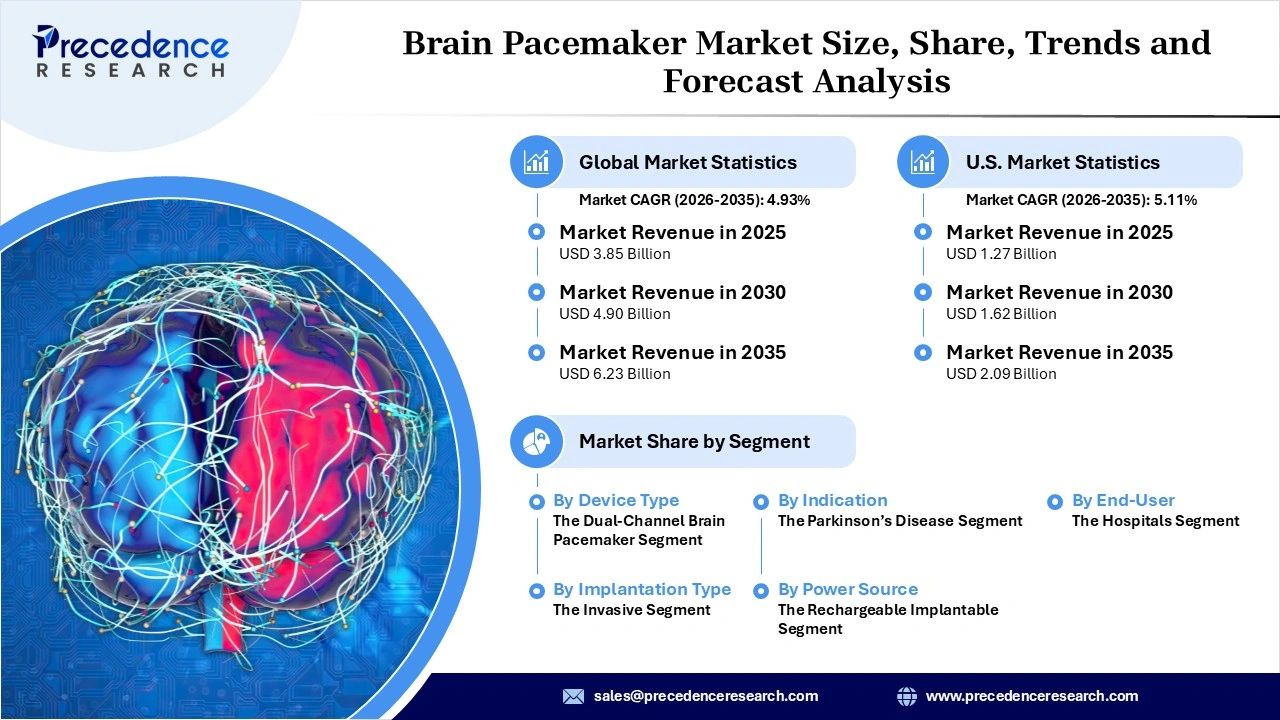
The global brain pacemaker market revenue was valued at USD 3.85 billion in 2025 and is expected to attain around USD 6.23 billion by 2035, growing at a CAGR of 4.93% during forecast period.This market is experiencing unprecedented growth, driven by rising neurological disorder prevalence.
What Drives the Growth of the Brain Pacemaker Market?
The brain pacemaker market is mainly driven by an aging population, which is contributing to an increase in the prevalence of neurological conditions like epilepsy and Parkinson's disease. Adoption and treatment results are being enhanced by technological advancements such as rechargeable adaptive systems and directional leads. The market is growing faster due to factors like supportive reimbursement and growing clinical applications.
Segment Insights
- By device type, the dual-channel brain pacemaker segment registered its dominance in the market because it offers more precise and flexible neuromodulation by independently stimulating two separate brain targets, which improves treatment efficacy for complex neurological disorders like Parkinson’s disease and dystonia.
- By implantation type, the invasive segment contributed the biggest market share in 2025 because it provides precise direct stimulation to parts of the brain. Its dominance is supported by strong physician confidence and long-term clinical outcomes that have been proven. Moreover, the majority of FDA-approved brain pacemakers are implanted invasively. Procedural risks have also decreased thanks to advanced surgical techniques.
- By indication, the Parkinson's disease segment registered its dominance in the market in 2025, driven by the disorder's high worldwide prevalence. Brain pacemakers are commonly used to treat motor symptoms that don't improve with medication. Long-term effectiveness and solid clinical evidence have boosted physician adoption.
- By power source, the rechargeable implantable segment dominated the market with the largest share in 2025 because fewer replacement surgeries are required, and batteries last longer. These tools lessen patient burden and long-term treatment expenses. Safety and charging efficiency have increased due to technological advancements.
- By end user, the hospitals segment registered its dominance in the market, driven by the availability of specialized neurology and neurosurgery departments. Hospitals handle the majority of DBS implantation procedures and follow-up care. Access to advanced imaging and surgical infrastructure supports higher procedure volumes.
Regional Insights
North America holds the dominant position in the brain pacemaker market by capturing the largest share. The region’s dominance is primarily attributed to the early adoption of neuromodulation technologies and sophisticated healthcare infrastructure. The region’s dominance in the market is also reinforced by robust reimbursement frameworks and the high prevalence of neurological disorders. Innovation is accelerated by the presence of top device manufacturers.
Asia Pacific is anticipated to grow at the fastest rate in the market during the forecast period, driven by an increase in the prevalence of neurological diseases and better access to healthcare. Adoption is being accelerated by rising healthcare spending and developing neurosurgical capabilities. Medical tourism and rising awareness both contribute to market growth.
Brain Pacemaker Market Coverage
| Report Attribute | Key Statistics |
| Market Revenue in 2025 | USD 3.85 Billion |
| Market Revenue by 2035 | USD 6.23 Billion |
| CAGR from 2026 to 2035 | 4.93% |
| Quantitative Units | Revenue in USD million/billion, Volume in units |
| Largest Market | North America |
| Base Year | 2025 |
| Regions Covered | North America, Europe, Asia-Pacific, Latin America, and the Middle East & Africa |
Recent Development
- In February 2025, Medtronic plc announced FDA approval for the BrainSense Adaptive deep brain stimulation system and BrainSense Electrode Identifier for Parkinson’s disease. The closed-loop adaptive DBS system self-adjusts therapy based on real-time brain activity, representing a major advance in personalized neuromodulation.(Source: https://news.medtronic.com)
Get this report to explore global market size, share, CAGR, and trends, featuring detailed segmental analysis and an insightful competitive landscape overview @ https://www.precedenceresearch.com/sample/7625
You can place an order or ask any questions, please feel free to contact us at sales@precedenceresearch.com |+1 804 441 9344