



Digital Twin in Life Science Market Revenue and Forecast by 2035
Published: 11 Dec 2025
Author: Precedence Research



Digital Twin in Life Science Market Revenue and Trends 2026 to 2035
The global digital twin in life science market is expected to expand significantly with biopharmaceutical companies using digital twins for process monitoring, trial design, and advanced manufacturing solutions. The market is expanding due to the increasing demand for personalized medicines and compliance with safety regulations in the healthcare sector, along with governments' support for leveraging smart solutions in life sciences, accelerating the market's growth.
What are the Leading Factors Supporting the growth of Digital Twin in Life Science Market?
The global digital twins in life science market is witnessing significant growth due to increasing investments from healthcare stakeholders to gain a competitive edge by using smart solutions for operational efficiency and improved patient outcomes. A leading reason is stringent regulatory requirements for highly precise, verifiable simulation models, which are made possible by digital twins that offer real-time validation and compliance documentation.
Moreover, the growing demand for personalized medicine and patient-centric approaches is encouraging industry leaders to adopt highly personalized, data-driven solutions. The increasing awareness among consumers of digitally powered healthcare solutions is further accelerating the digital twin in the life sciences market.
Digital Twin in Life Science Market Coverage
Segments Insights
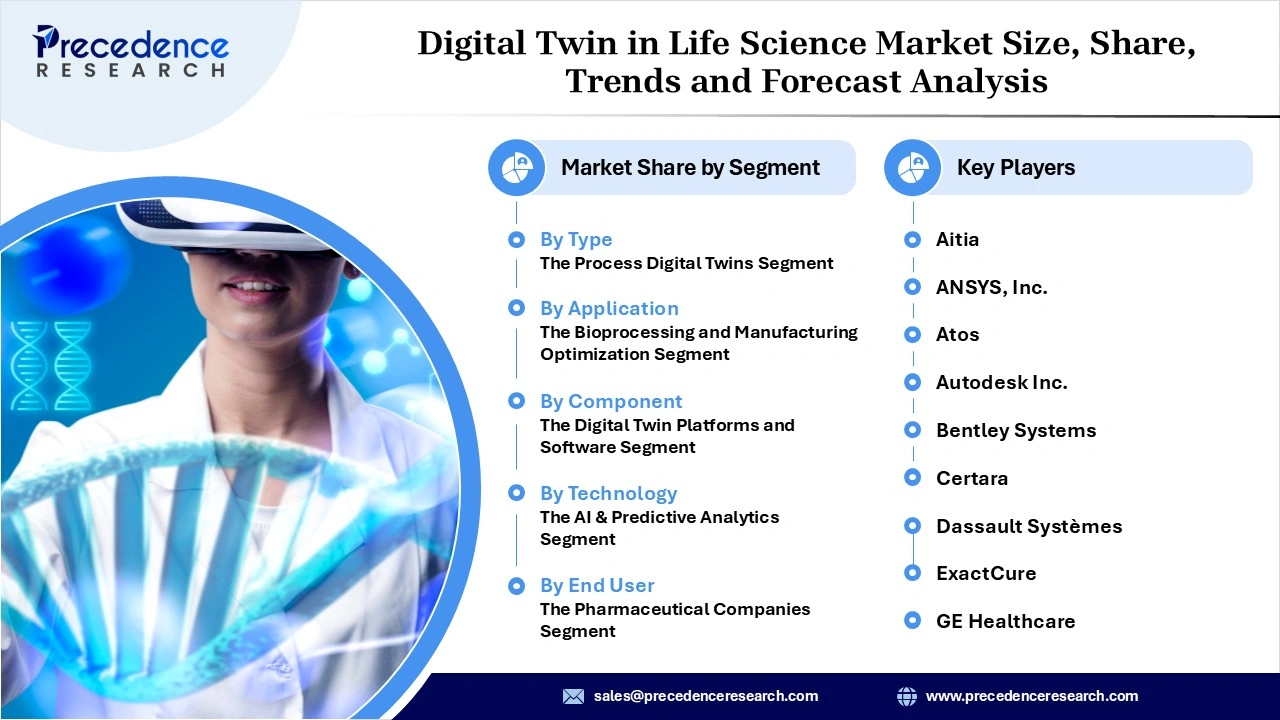
- By type of digital twin, the process digital twin segment held the largest market share in 2024, due to its direct relation with the basic biopharmaceutical manufacturing processes, where regulatory compliance with efficiency is critical.
- By application, the bioprocessing and manufacturing optimization segment held the largest market share in 2024. The segment's growth is attributed to the explosive growth of biologics, cell therapy, and vaccines that require highly advanced modelling solutions.
- By component, the digital twin platforms and software segment held the largest market share in 2024 due to its excellent feature offerings like data integration, 3D and multiscale modelling, process simulation, and real-time monitoring.
- By technology, the AI and predictive analytics segment held the largest market share in 2024. The segment's growth is related to the unmatched offerings of extensive data analysis of large datasets from various devices, such as sensors, patient monitoring systems, and bioprocessing devices.
By end user, the pharmaceutical companies segment held the largest market share in 2024. This is due to its major role in the drug development cycle, including R&D and clinical trial design
Regional Insights
North America held the largest share in the digital twin in life science market due to its well-established digital health ecosystem, high levels of research and development activity in the pharmaceutical and biotechnology sectors, and the region’s early adoption of AI and machine-learning technologies supported by federal incentives. The United States continues to lead regional growth, strengthened by national programs that encourage computational innovation in drug discovery and clinical development. For instance, the National Institutes of Health (NIH) invested more than USD 47 billion in biomedical research in 2023, including major allocations for genomics, data science, and AI integration through the NIH Data Science Strategic Plan 2023–2028.
Federal frameworks such as the FDA’s 2023 guidance on AI/ML-enabled medical products facilitate the responsible deployment of advanced analytics and accelerate the development and commercialization of novel drugs. The presence of a dense network of high-throughput research centers, advanced clinical trial infrastructure, and strong adoption of cloud-based computational platforms further reinforces North America's leadership in the market.
Asia Pacific is projected to grow at the highest CAGR during the foreseeable period, driven by increasing government spending on digital healthcare, large-scale adoption of smart manufacturing systems, and rapid expansion of biotechnology research activities. The region conducts a substantial share of global preclinical and clinical trials due to large patient populations, decreasing operational costs, and accelerated regulatory pathways in several countries. China remains the primary contributor to regional growth.
Government-led initiatives, such as China’s 14th Five-Year Plan (2021–2025) and funding programs under the National Natural Science Foundation of China (NSFC), continue to support large investments in computational biology, AI-enabled drug development, and smart pharmaceutical-production lines. China’s biopharmaceutical industry has also expanded significantly through the development of intelligent manufacturing demonstration zones, which integrate robotics, real-time analytics, and automated quality-control systems into drug-development workflows. Japan, South Korea, India, and Singapore are also scaling national digital-health and precision-medicine programs, further increasing the adoption of advanced analytics platforms across the region.
Recent Development
- In April 2025, Siemens is expecting to collaborate with Dotmatics to leverage its drug research and development applications, aiming to create an AI-based research and manufacturing cycle for the life sciences sector.
Get this report to explore global market size, share, CAGR, and trends, featuring detailed segmental analysis and an insightful competitive landscape overview @ https://www.precedenceresearch.com/sample/7186
You can place an order or ask any questions, please feel free to contact us at sales@precedenceresearch.com |+1 804 441 9344