



Ethoxyquin Market Revenue to Attain USD 446.00 Mn by 2035
Published: 10 Jun 2026
Author: Precedence Research



Ethoxyquin Market Revenue and Trends 2026 to 2035
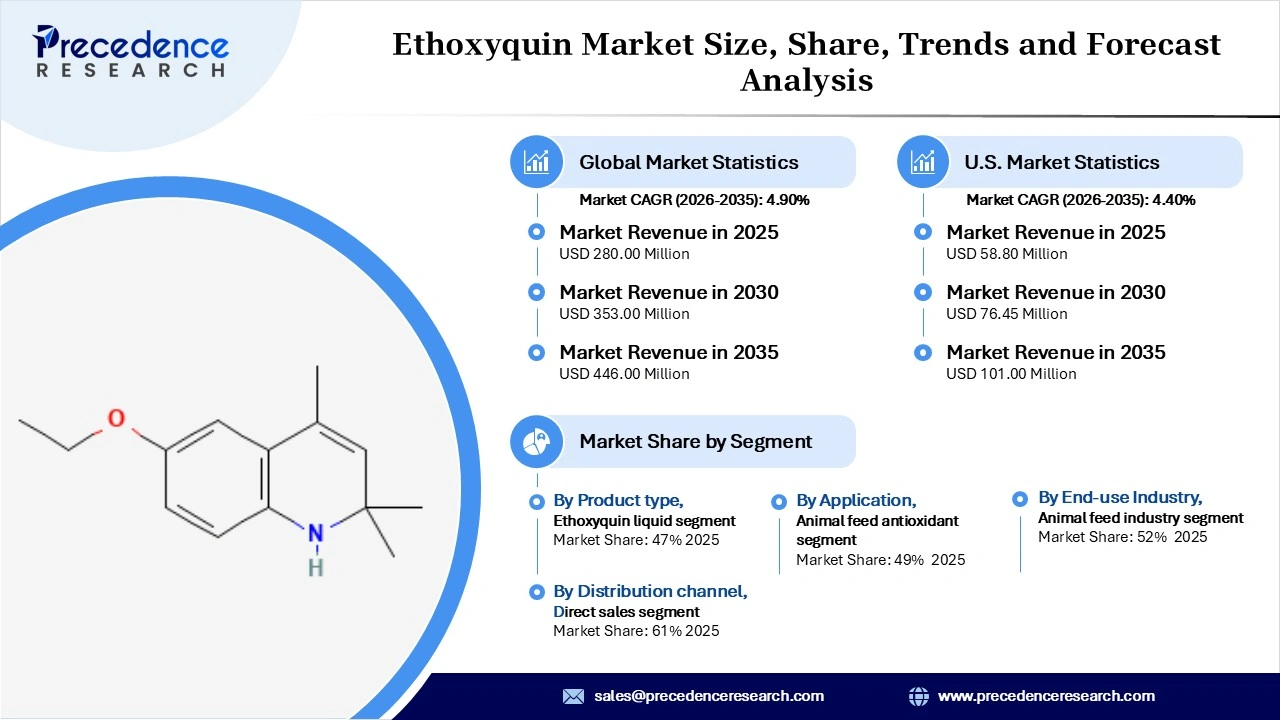
The global ethoxyquin market revenue surpassed USD 280.00 million in 2025 and is predicted to attain around USD 446.00 million by 2035, growing at a CAGR of 4.90%. The market is rapidly growing because of the extensive adoption of ethoxyquin in animal feed as an affordable antioxidant and preservative, as it keeps lipid oxidation at bay and ensures nutrients stay fresh, especially in poultry, swine, and aquaculture feed.
Market Overview
The ethoxyquin market involves the production and distribution of ethoxyquin, a synthetic antioxidant (1,2-dihydro-6-ethoxy-2,2,4-trimethylquinoline) used primarily to prevent lipid oxidation in animal feed and pet food. It is very beneficial because it gets rid of those pesky free radicals and binds metal ions, helping fats last longer. Manufacturers offer different grades of ethoxyquin, including technical-grade products for animal feed applications and higher-purity variants for specialized uses such as pet food formulations.
It is mainly used by poultry, swine, fish, and cattle feed makers, and is also used in dog and cat food and to keep spices like paprika fresh and colorful. The market comprises liquid and powder formulations, premixes, and blends of this compound with other antioxidants. Rules set by the EU and FDA regarding maximum residue limits and approval statuses for feed additives play a big role in market access. Ethoxyquin is widely adopted by feed mills, livestock operators, pet food makers, and spice processors.
What are the Major Factors Driving the Ethoxyquin Market?
Scientific Validation for Mycotoxin Control
Emerging research suggests that ethoxyquin may play a role beyond antioxidant preservation by supporting mycotoxin mitigation in animal feed. Studies indicate it can activate detoxification pathways in poultry, helping reduce liver and kidney damage caused by aflatoxins and improving key biochemical health markers under contaminated feed conditions. A study in 2025 found that laying hens fed ethoxyquin at 80.8mg/kg of body weight had lower plasma ALT and AST levels, along with optimal protein levels. The birds also showed less liver and kidney swelling from dietary aflatoxins ranging from 0.0-1.5mg/kg over 72 weeks.
Shift Toward Ethoxyquin-Free Aquafeed Formulations
The feed industry is moving away from using ethoxyquin because of regulatory bans and trade restrictions in important markets. The EU ban and Nigeria’s decision to prohibit ethoxyquin have pushed aquafeed makers to find natural or synthetic antioxidant replacements. This is essential to stay compliant and meet demand for cleaner labels, and big manufacturers are changing their formulas for shrimp and fish feed. Skretting, Nutreco’s aquaculture division, launched upgraded versions of its famous shrimp feeds, Lorica and Optiline, at Aqua Expo 2025 in Ecuador. These new formulations use plant-based EDGEOS PhytoComplexes instead of synthetic antioxidants.
Government Restrictions on the Use of Feed Antioxidants for Livestock
Governments across the world are tightening controls on synthetic feed antioxidants because of health concerns and worries that they might show up in human food and cause cancer. These restrictions force feed makers to come up with new recipes without ethoxyquin. Governments have taken initiatives to speed up the search for safer options, such as plant extracts and tocopherols. In 2025, Nigeria’s NAFDAC banned ethoxyquin from animal feed entirely, right after issuing its regulatory directive. This immediate action highlights the seriousness of their health concerns about this compound. So, now researchers are scrambling to find safe and effective alternatives to meet these stricter regulations.
Novel Detection Technique for Ethoxyquin Reduces Lipid Interference by 97%
In 2026, researchers in the Microchemical Journal shared their findings that lipid co-extraction leads to false negatives in ethoxyquin tests for high-fat foods. So, they created a polarity-selective extraction method. This new approach removes over 97% of those pesky lipids, making on-site detection reliable down to 10 micro-g/kg. Phosphatidylcholine, by the way, was pinpointed as the main troublemaker causing the interference.
Market Segmentation Overview
- By product type, the ethoxyquin liquid segment led the ethoxyquin market with a 47% share in 2025 and is expected to expand at the highest CAGR of 5.4% during the forecast period. This is because liquid form spreads evenly and is easier to handle on a large scale. It lets producers dose and mix precisely, quickly, and dust-free. Liquid ethoxyquin is able to sprayed right onto feed pellets or added to liquids, making operations simpler and ensuring steady antioxidant protection.
- By product type, the ethoxyquin powder segment held the second-largest market share of 43% in 2025 due to the fact that it has better storage stability and lasts longer than liquid. This makes it perfect for manufacturers wanting to stockpile the antioxidant or send it far away without losing quality. Farmers who do not have the right equipment for liquids love how straightforward it is to use the powdered stuff.
- By application, the animal feed antioxidant segment dominated the ethoxyquin market with a 49% share in 2025, owing to its widespread use in poultry, swine, and aquaculture feeds, and its significant effectiveness at preventing lipid peroxidation and preserving nutritional value during storage. This makes it a top choice for large-scale manufacturers, boosting its overall consumption.
- By application, the aquaculture feed segment is expected to grow at the fastest CAGR of 6.2% from 2026 to 2035, since aquafeeds have high lipid content and thus potent antioxidants like ethoxyquin are needed to stop rancidity and keep feed quality intact during storage and transport, especially in tropical regions. The growing production amount and longer supply chains in aquaculture increase the risk of oxidative stress, which makes ethoxyquin ever more important.
- By end-use industry, the animal feed industry led the ethoxyquin market with a 52% share in 2025 due to the fact that it uses fats, oils, and fat-soluble vitamins in poultry, swine, and aquaculture feeds. Ethoxyquin stops rancidity and keeps nutritional quality intact during storage and transport. It has been extensively adopted because it is cheap and super effective and beats natural and synthetic choices for large-scale feed makers.
- By end-use industry, the aquaculture industry segment is expected to expand at the highest CAGR of 6.4% during the forecast period. This is because the industry heavily uses high-fat feeds that need ethoxyquin to stop lipid oxidation during storage and transport in hot and humid weather. Also, lengthy supply chains and intensive breeding ramp up oxidative stress, making ethoxyquin crucial for preserving feed quality and nutrition.
- By distribution channel, the direct sales segment dominated the ethoxyquin market with a 61% share in 2025, since ethoxyquin makers mostly sell bulk quantities straight to big animal feed producers. This lets them provide steady quality, technical support, and long-term contracts. It cuts out extra costs and enables producers to offer custom blends and timely deliveries, which is vital for price-sensitive, high-volume production.
- By distribution channel, the online sales segment is expected to grow at the fastest CAGR of 6.8% from 2026 to 2035 because small feed makers and aquaculture farms in developing areas need ethoxyquin in smaller amounts via B2B platforms. They don’t need long-term contracts, and digital channels let them instantly compare prices, find various suppliers, and get fast deliveries.
Regional Analysis
Asia Pacific led the ethoxyquin market with a 39% share in 2025 and is expected to expand at the highest CAGR of 6.5% during the forecast period, owing to its high animal feed production, especially for poultry, swine, and aquaculture, which use ethoxyquin as a cost-effective antioxidant to keep fats and vitamins intact. China dominates the market in Asia Pacific since it is the top feed producer globally, with huge livestock and aquaculture operations, and ethoxyquin is extensively used for feed stability throughout long supply chains. India is a significant contributor to the market due to rapid growth in the poultry and dairy sectors, as well as its rise as a substantial feed manufacturing base and expanding aquaculture production.
North America held the second-largest market share of 28% in 2025, owing to its well-established and industrialized animal feed sector, which includes poultry, swine, and aquaculture, where ethoxyquin is a favored, affordable antioxidant. The U.S. leads the market in North America due to its enormous feed manufacturing industry, and FDA backing by reauthorizing ethoxyquin use up to 150 ppm, which drives demand for big livestock and poultry farms. Canada witnessed notable market growth because of its significant feed production and aquaculture industry, particularly salmon farming, where ethoxyquin is used to stop lipid oxidation in high-fat feeds throughout storage and transport.
Europe held the third-largest market share of 20% in 2025, due to the fact that it adheres to strict feed additive rules and effective antioxidants that keep nutrients intact, while catering to eco-friendly practices. Germany dominates the market in Europe because of its mature chemical and feed additive sector and the significant presence of prominent ethoxyquin manufacturers such as BASF and Clariant. France is a significant contributor to the market owing to its robust farming and aquaculture sector and significant emphasis on keeping fish feed fresh for longer periods, especially with farmed salmon and trout, which helps them comply with the EU’s tough guidelines for safe and sustainable foods.
Ethoxyquin Market Coverage
| Report Attribute | Key Statistics |
| Market Revenue in 2025 | USD 280.00 Million |
| Market Revenue by 2035 | USD 446.00 Million |
| CAGR from 2026 to 2035 | 4.90% |
| Quantitative Units | Revenue in USD million/billion, Volume in units |
| Largest Market | Asia Pacific |
| Base Year | 2025 |
| Regions Covered | North America, Europe, Asia-Pacific, Latin America, and the Middle East & Africa |
Top Companies in the Ethoxyquin Market
Eastman Chemical Company, Perstorp Holding AB, and Camlin Fine Sciences are some of the key players that lead the production of ethoxyquin and its applications in preserving animal feed, spices, and pesticides. Novus International, Kemin Industries, Addisseo, and Alltech blend ethoxyquin into antioxidant formulas for pets, fish farming, and chicken feed. DSM-Firmenich, BASF SE, Evonik Industries, and Solvay make a variety of feed additives and industrial chemicals. Nutreco, Cargill Incorporated, and Anpario plc supply ethoxyquin for fish farming and meat meal preservation. Impectraco NV deals with distributing and trading ethoxyquin and related antioxidants. The European Union has banned animal feed since 2017, so it pushes manufacturers and farmers to opt for natural alternatives like tocopherols and rosemary extracts, especially in developed countries.
Segments Covered in the Report
By Product Type
- Ethoxyquin Powder
- Ethoxyquin Liquid
- Ethoxyquin Premix
By Application
- Animal Feed Antioxidant
- Pet Food Preservation
- Aquaculture Feed
- Pesticide Formulations
- Fruit & Vegetable Preservation
- Others
By End-Use Industry
- Animal Feed Industry
- Pet Food Industry
- Aquaculture Industry
- Agriculture Industry
- Food Processing Industry
- Others
By Distribution Channel
- Direct Sales
- Distributors & Wholesalers
- Online Sales
By Region
- North America
- Latin America
- Europe
- Asia-pacific
- Middle and East Africa
Get this report to explore global market size, share, CAGR, and trends, featuring detailed segmental analysis and an insightful competitive landscape overview @ https://www.precedenceresearch.com/sample/8465
You can place an order or ask any questions. Please feel free to contact us at sales@precedenceresearch.com |+1 804 441 9344