



Green Facade Market Revenue to Attain USD 1,710 Mn by 2033
Published: 20 Oct 2025
Author: Precedence Research



Green Facade Market Revenue and Trends 2025 to 2033
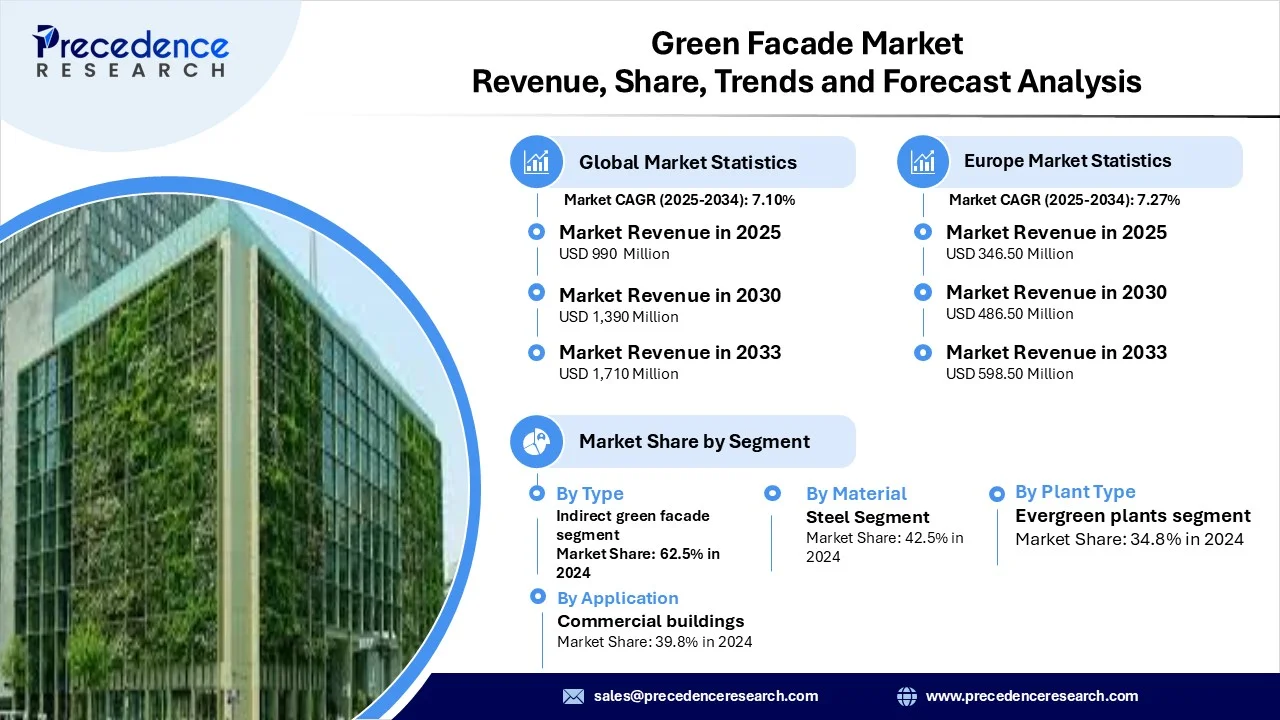
The global green facade market revenue reached USD 990 million in 2025 and is predicted to attain around USD 1,710 billion by 2033 with a CAGR of 7.10%. The market growth is driven by increasing global concerns over urban heat islands, declining air quality, carbon emissions, and rising energy costs. In response, governments, developers, and architects are turning to vegetation-covered building surfaces as a sustainable, aesthetic, and functional solution aligned with biophilic design principles and environmental regulations.
What are the Key Factors Boosting the Growth of the Green Facade Market?
The green facade market is experiencing robust growth, fueled by several key drivers. Firstly, developed nations often have regulatory mandates, such as building codes and green building certifications, which either require or incentivize energy-efficient designs incorporating green infrastructure. Secondly, heightened awareness of climate change, urban heat islands, air pollution, and the health benefits of vegetation is increasing demand from end-users and property owners. Thirdly, advancements in material science and modular systems are fostering technological developments in areas like irrigation and monitoring (e.g., lightweight support materials, automated watering systems, and more resilient plant varieties), thereby reducing installation and maintenance risks.
Additionally, rapid urbanization and real estate development in regions like Asia-Pacific and Latin America are generating substantial opportunities for green facade integration. Financial considerations are also significant; energy cost savings, increased property values, branding as an environmentally conscious entity, and commitments to ESG/CSR are making green facades economically appealing, alongside their environmental benefits.
Segment Insights:
- By type, the indirect green facades dominated the market in 2024. This is due to the widespread use of support structures such as trellises, cables, or frames that allow climbing plants to grow without directly altering or attaching to the building envelope.
- By material, the steel segment continues to dominate the market throughout the forecast period. The dominance of the segment is attributed to its superior strength, durability, and corrosion resistance (especially when treated or using specialized alloys), making it ideal for integration into modular green facade systems.
- By plant type, the evergreen plant segment led the market in 2024 and is expected to maintain its upward momentum. The preference is driven by its year-round foliage, lower maintenance needs, and continuous functional advantages such as shading, thermal insulation, and visual screening across all seasons.
- By application, the commercial building segment dominated the market in 2024. This is primarily due to the sector’s demand for enhanced building aesthetics, environmental performance, regulatory compliance, and energy efficiency, particularly in offices, hotels, malls, and institutional facilities.
Regional Insights:
Europe dominated the green facade market in 2024 due to a combination of stringent environmental regulations, progressive urban planning policies, and a strong cultural emphasis on sustainability and energy efficiency in building design. The European Union’s Green Deal and national-level commitments to achieving net-zero emissions have accelerated the adoption of green infrastructure, including vegetated building envelopes.
Asia Pacific is expected to grow at the fastest rate in the upcoming period due to a confluence of factors. Rapid urbanization in countries like China and India created a high demand for sustainable building solutions. Supportive government regulations and initiatives, such as green building codes, further fueled market growth. Increased environmental awareness and rising disposable incomes in the region also played a crucial role.
Green Facade Market Coverage
| Report Attribute | Key Statistics |
| Market Revenue in 2025 | USD 990 Million |
| Market Revenue by 2033 | USD 1,710 Million |
| CAGR from 2025 to 2033 | 7.10% |
| Quantitative Units | Revenue in USD million/billion, Volume in units |
| Largest Market | Europe |
| Base Year | 2025 |
| Regions Covered | North America, Europe, Asia-Pacific, Latin America, and the Middle East & Africa |
Recent Development:
- On January 13, 2025, Tracer, the French green façade manufacturer, is shifting to low-carbon XCarb® recycled and renewably produced Magnelis® steel for its ventilated façade substructures, offering a more sustainable alternative to galvanized steel, aluminium, and stainless steel.
(Source- https://europe.arcelormittal.com)
Get this report to explore global market size, share, CAGR, and trends, featuring detailed segmental analysis and an insightful competitive landscape overview @ https://www.precedenceresearch.com/sample/7000
You can place an order or ask any questions, please feel free to contact us at sales@precedenceresearch.com |+1 804 441 9344