



Healthcare ERP Market Revenue to Attain USD 13.38 Bn by 2035
Published: 14 May 2026
Author: Precedence Research



Healthcare ERP Market Revenue and Trends 2026 to 2035
The global healthcare ERP market size was estimated at USD 7.09 billion in 2025, and it is prdicted to surpass around USD 13.38 billion by 2035, growing at a CAGR of 6.56% during the forecast period 2026 to 2035. Growth is driven by increasing digitalization of healthcare systems and rising demand for efficient data management and integrated hospital operations.
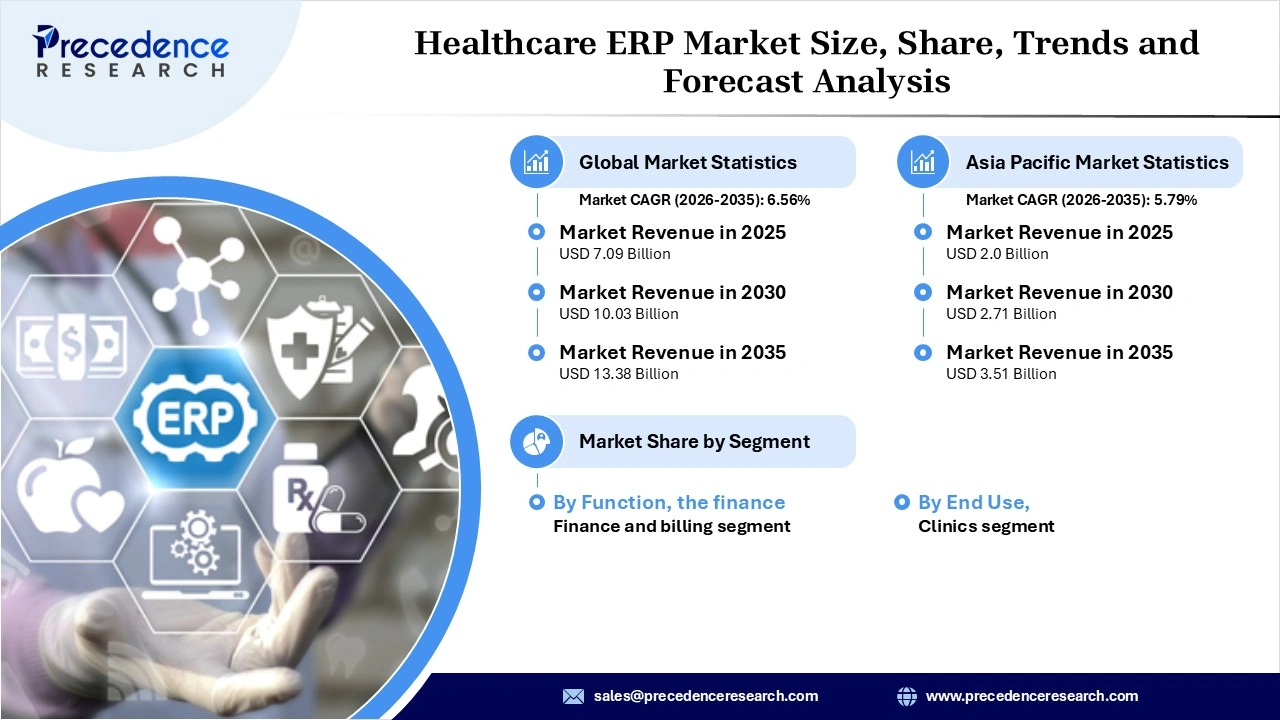
Market at a Glance
The healthcare ERP market comprises software systems integrating core administrative, financial, and operational processes such as supply chain, human resources, and patient data. It is a unified software solution tailored for healthcare providers, helpful to manage, automate, and streamline backend operations and clinical data. The core components of the market involve financial management, supply chain management, and human resource management.
- Growing Cloud Adoption- Growing usage of cloud-based ERP platforms due to their lower costs, high scalability, and flexibility is one of the major factors helpful for the market’s growth.
Oracle Fusion Cloud ERP and NetSuite – Such platforms are helpful for financial reporting, supply chain planning, and lowering the cost of care. - AI Integration- Nowadays, ERP systems are increasingly using AI and IoT for predictive inventory management, optimized staffing, and enhanced clinical workflows.
Salesforce Health Cloud- The platform helps to improve patient engagement and integration with IoT data.
Market Forecast
- Supply Chain Resilience- Higher demand for tools helpful to improve inventory management and logistical efficiency for handling supply chain disruptions is another major opportunity to propel the market’s growth.
Infor CloudHealthcare- The platform offers strong supply chain automation along with voice-assisted inventory lookup, suitable for large networks. - Patient Relationship Management- Another major opportunity fueling the market’s growth involves higher demand for health ERP systems, enhancing patient experiences through automated scheduling, billing transparency, and personalized communication.
Microsoft Dynamics 365 Healthcare- The platform combines ERP and CRM capabilities for enhanced patient communication, tracking, and personalized patient portals. - Improved Financial and Administrative Efficiency- ERP systems fueling cost efficiency, managing revenue cycle, and lowering manual errors are also a major opportunity for the market’s growth.
Automated Accounts Payable and Invoicing- ERPs help to automate invoice generation and claims submission to insurers to reduce manual errors and accelerate reimbursements.
Secondary Data
| Vertical | Estimated Market Share |
| Manufacturing | 22% |
| BFSI | 17% |
| Healthcare | 14% |
| Retail | 12% |
| Government | 11% |
| Aerospace and Defense | 10% |
| Telecom | 9% |
| Others | 10% |
The table above represents the demand for ERP systems for the management of various functions in different domains, along with the estimated market share. The major chunk of the ERP usage systems is captured by the manufacturing segment. The ERPs were originally evolved from the manufacturing-specific tools, hence they have a bigger share. The other major segments with the highest usage of ERP systems involve the BFSI and healthcare segments. Such systems are helpful to manage heavy-data service industries seamlessly. Other segments with higher usage of such management systems and tools are retail, governments, aerospace and defense, telecom, and many other industries.
Market Segmentation Overview
- By Function, the finance and billing segment led the global healthcare ERP market in 2025. Growing demand for automated revenue cycle management, reducing billing errors, and improving financial transparency are some of the major factors propelling the growth of the market.
- By Function, the patient relationship management segment is observed to be the fastest-growing segment with the highest CAGR in the foreseen period. The ERP systems help to handle healthcare backend operations efficiently at a low cost, further fueling the growth of the market.
- By Deployment, the premises segment dominated the global market in 2025. Higher demand by healthcare institutions for maintaining complete control over their ERP systems for data security and assurance is a major growth factor.
- By Deployment, the cloud segment is observed to be the fastest-growing segment with the highest CAGR in the forecast period. Scalability, cost-effectiveness, and remote access are the major pointers helpful to fuel the market’s growth.
- By End-use, the finance and billing segment had a major dominance over the market’s growth in 2025. Such systems help the healthcare providers to manage complex billing systems, insurance claims, and regulatory compliance, to improve revenue cycle management.
- By End-use, the inventory and material management segment is observed to be the fastest-growing segment in the foreseen period. It helps in cost optimization, supply chain efficiency, and real-time tracking of medical supplies.
Regional Analysis
North America led the global healthcare ERP market with a share of 33.60% in 2025. Higher adoption of digital and automated technologies in the healthcare infrastructure is one of the major factors fueling the growth of the market in the region. Increased healthcare infrastructure and growing healthcare expenses are also some of the major market drivers. The ERP systems also help to provide personalized patient services. The U.S. has a major impact on the growth of the market, mainly due to factors such as operational efficiency, cost reduction, cloud adoption, and propelling demand for streamlining various functions.
Asia Pacific is observed to be the fastest-growing region with the highest CAGR in the forecast period. The increasing government investments to improve the technology of the healthcare infrastructure of the region are one of the major factors helping to fuel the market’s growth in the foreseeable period. The growing prevalence of chronic diseases, along with the growing geriatric population, is also a major market driver. China has a major contribution to the market’s growth due to its massive manufacturing sector, government-led digitalization efforts, and rapid hospital infrastructure improvement.
Major Companies of the Healthcare ERP Market
- Microsoft Corporation- The well-renowned company offers cloud-based, AI-driven solutions through Microsoft Cloud for Healthcare and Dynamics 365 platforms.
- Oracle Corporation- The company has maintained its position through the acquisition of Cerner to form Oracle Health, along with providing a cloud-based platform to integrate clinical, financial, and supply chain operations.
- McKesson Corporation- The company is a dominant global player in the market, offering cloud-based solutions focused on financial management, supply chain optimization, and AI-driven clinical operations.
- Sage Group Plc.- The company provides secure, HIPAA-compliant, and cloud-based solutions like Sage Intacct for financial and operational management.
Segments Covered in the Report
By Function
- Supply Chain & Logistics
- Finance & Billing
- Inventory Management
- Patient Relationship Management
- Others
By Deployment
- On Premise
- Cloud
By End User
- Hospitals
- Clinics
- Nursing Homes
- Others
By Region
- North America
- Europe
- Asia Pacific
- Middle East & Africa
- Latin America
Get this report to explore global market size, share, CAGR, and trends, featuring detailed segmental analysis and an insightful competitive landscape overview @ https://www.precedenceresearch.com/sample/1675
You can place an order or ask any questions, please feel free to contact us at sales@precedenceresearch.com |+1 804 441 9344