



Inorganic Scintillators Market Revenue to Attain USD 1,520.10 Mn by 2035
Published: 21 Apr 2026
Author: Precedence Research



Inorganic Scintillators Market Revenue and Trends 2026 to 2035
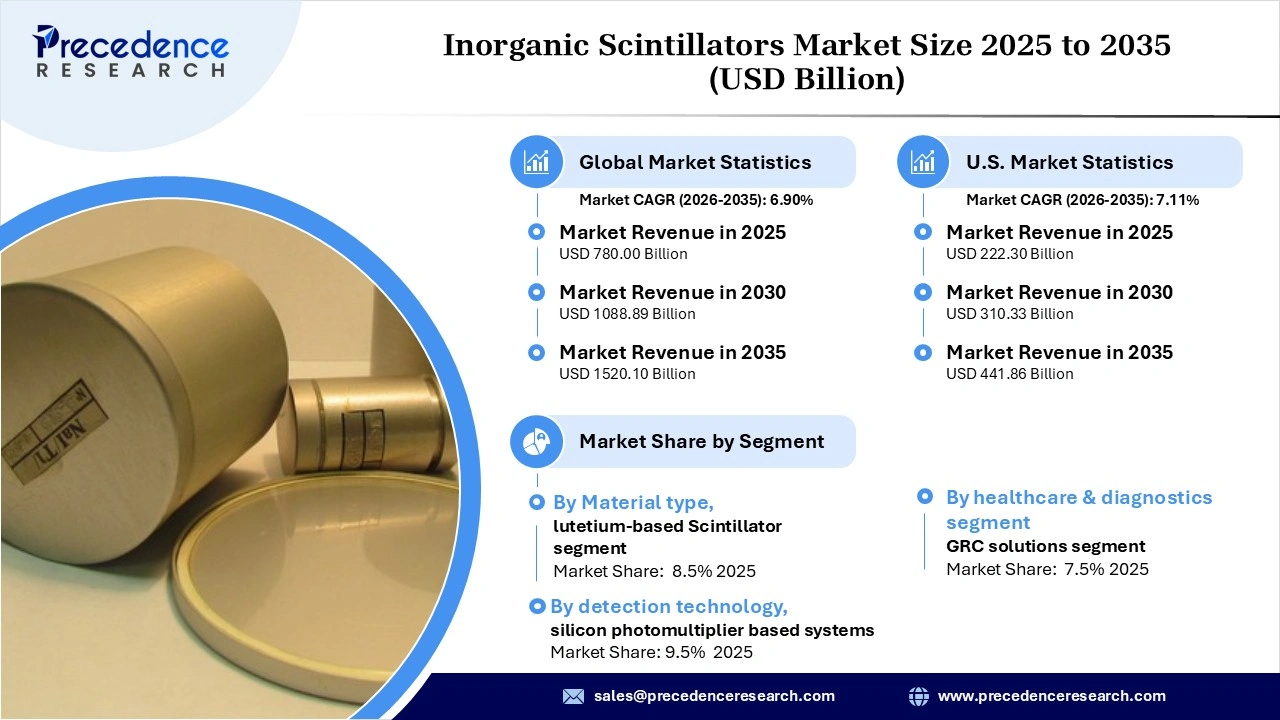
The global inorganic scintillators market revenue was valued at USD 780.00 million in 2025 and is expected to attain around USD 1,520.10 million by 2035, growing at a CAGR of 6.90% during forecast period. The inorganic scintillators market is gaining momentum because the world is leaning toward radiation-based technologies. Increasing use of scintillators in medical imaging, tighter nuclear safety norms, and a strong focus on homeland security also drive the market.
Market at a Glance
The inorganic scintillators market revolves around crystalline substances that react to ionizing radiation by producing light. This light-emission property enables precise radiation detection and measurement across various applications. Common materials include alkali halides, oxides, and rare-earth–based compounds. These scintillators play a crucial role in bridging theoretical radiation physics with practical applications in medical imaging, nuclear safety, and security screening.
Inorganic scintillators are used in medical imaging applications such as PET, CT, and X-ray systems to enable accurate radiation detection and high-resolution diagnostic imaging. They are also widely applied in radiation monitoring, nuclear safety, industrial inspection, and security screening for reliable detection and measurement of ionizing radiation.
What Drives the Inorganic Scintillators Market?
- Growing Demand for Medical Imaging and Nuclear Medicine: The increasing use of diagnostic imaging technologies such as PET, CT, and X-ray systems is a major factor driving the market. Rising prevalence of chronic diseases and the need for early, accurate diagnosis are further boosting demand for high-performance radiation detection materials.
- Rising Need for Radiation Detection: Inorganic scintillators are widely used in radiation monitoring systems for nuclear safety, border security, and industrial inspection. Increasing concerns over nuclear threats, safety regulations, and quality control requirements are driving their adoption across these critical sectors.
- Industrial & Research Use Cases are Expanding the Edges: Beyond healthcare, applications in oil exploration, environmental monitoring, and high-energy physics are expanding the reach of the market for inorganic scintillators. These materials are increasingly being used in critical operational roles, moving from niche applications to essential tools in advanced detection and measurement systems.
Market Segmentation Overview
- By material type, the sodium iodide (NaI) segment held a major revenue share of 35% in the market in 2025, because it delivered a practical balance of cost-effective production paired with high light yield. Its widespread use across radiation detection and medical imaging applications has established it as a reliable industry standard rather than a premium material.
- By material type, the lutetium-based scintillators segment is expected to grow at the fastest CAGR of 8.5% in the market between 2026 and 2035, owing to their superior resolution and faster response times. Increasing adoption in PET imaging systems reflects a broader shift toward high-precision, quality-driven diagnostic technologies where accuracy and speed are critical.
- By application, the medical imaging segment led the inorganic scintillators market with a share of 40% in 2025, supported by rising demand for advanced diagnostic tools and increasing prevalence of chronic diseases. The strong reliance on PET, SPECT, and CT imaging systems has made scintillators integral to routine clinical decision-making.
- By application, the high energy physics research segment is expected to grow at a significant CAGR of 6.8% in the market between 2026 and 2035, as research institutions deepen their involvement in particle physics and advanced scientific studies. The need for high-performance scintillators to detect subatomic interactions highlights its role as a specialized but steadily expanding application area.
- By end-use, the healthcare & diagnostics segment accounted for the largest market share of 45% in 2025, driven by the widespread use of scintillators in imaging technologies such as PET and CT. Their critical role in early disease diagnosis and patient monitoring has made them an essential component in hospitals and diagnostic centers across both developed and emerging markets.
- By end-use, the research institutes & laboratories segment is expected to expand at a CAGR of 6.8% in the coming years, supported by increasing demand for advanced scintillation materials in scientific research. Rapid advancements in physics and material science are transforming these institutions into key end-users rather than secondary consumers.
- By detection technology, the photomultiplier tube (PMT)-based systems segment held a share of 55% in the market in 2025, owing to their high sensitivity and long-established use in radiation detection applications. Their proven reliability across multiple industries has sustained their dominance, particularly in applications where performance consistency is prioritized over miniaturization.
- By detection technology, the silicon photomultiplier (SiPM)-based systems segment is expected to grow at the fastest CAGR of 9.5% in the market between 2026 and 2035, driven by their compact design, higher efficiency, and growing integration into modern imaging systems. As demand increases for smaller and more efficient devices, SiPM technology is emerging as a strong next-generation alternative to traditional systems.
Regional Insights
North America registered dominance in the global inorganic scintillators market with a share of 38% in 2025, driven by a well-established healthcare infrastructure and widespread adoption of advanced imaging technologies. Hospitals across the U.S. have extensively deployed PET and CT systems, while strong federal support for nuclear safety and scientific research continues to sustain demand. Canada also contributes to the market through investments in diagnostic imaging and research facilities.
Asia Pacific held a market share of 25% in 2025 and is expected to grow at the fastest CAGR of 8.8% in the market during the forecast period. The regional market growth is driven by expanding healthcare infrastructure, increasing government support for nuclear energy projects, and rising industrial applications. China is expected to lead the market due to strong state-backed initiatives strengthening nuclear and imaging capabilities. India is witnessing rapid growth driven by rising diagnostic demand and healthcare expansion.
Inorganic Scintillators Market Coverage
| Report Attribute | Key Statistics |
| Market Revenue in 2025 | USD 780.00 Million |
| Market Revenue by 2035 | USD 1,520.10 Million |
| CAGR from 2026 to 2035 | 6.90% |
| Quantitative Units | Revenue in USD million/billion, Volume in units |
| Largest Market | North America |
| Base Year | 2025 |
| Regions Covered | North America, Europe, Asia-Pacific, Latin America, and the Middle East & Africa |
Top Companies in the Inorganic Scintillators Market
Major companies in the market include Saint-Gobain Crystals, Hamamatsu Photonics K.K., Hitachi Metals, Ltd., Crytur, spol. s r.o., Amcrys-H Ltd., Scionix Holland B.V., Korth Kristalle GmbH, EPIC Crystal Company Limited, and Shanghai SICCAS. These companies are driving growth through continuous innovation in crystal growth techniques, material engineering, and detector integration technologies to improve sensitivity, speed, and radiation detection accuracy. They are also expanding application reach by developing customized and high-performance scintillation solutions for medical imaging, nuclear safety, industrial inspection, and advanced research applications.
Segments Covered in the Report
By Material Type
- Sodium Iodide (NaI)
- Cesium Iodide (CsI)
- Bismuth Germanate (BGO)
- Lutetium-based Scintillators (LSO/LYSO)
- Other Advanced Inorganic Scintillators
By Application
- Medical Imaging (PET, SPECT, CT)
- Nuclear Power & Radiation Detection
- Homeland Security & Defense
- High Energy Physics Research
- Oil & Gas Exploration
By End-Use
- Healthcare & Diagnostics
- Energy & Nuclear Industry
- Defense & Security Agencies
- Research Institutes & Laboratories
- Industrial Applications
By Detection Technology
- Photomultiplier Tube (PMT)-based Systems
- Silicon Photomultiplier (SiPM)-based Systems
- Hybrid Detection Systems
By Region
- North America
- Latin America
- Europe
- Asia-pacific
- Middle and East Africa
Get this report to explore global market size, share, CAGR, and trends, featuring detailed segmental analysis and an insightful competitive landscape overview @ https://www.precedenceresearch.com/sample/8322
You can place an order or ask any questions, please feel free to contact us at sales@precedenceresearch.com |+1 804 441 9344