



Open Banking Systems Market Revenue to Attain USD 176.87 Bn by 2035
Published: 01 Jun 2026
Author: Precedence Research



Open Banking Systems Market Revenue and Trends 2026 to 2035
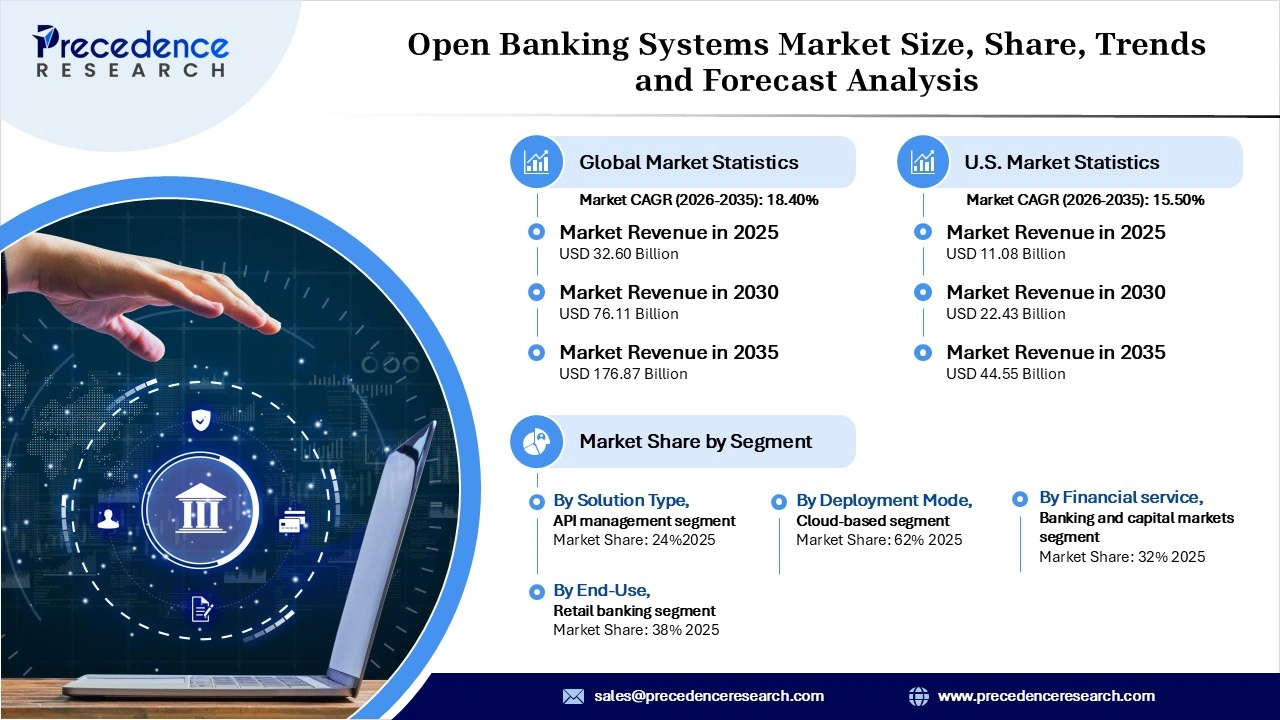
The global open banking systems market revenue was valued at USD 32.60 billion in 2025 and is expected to attain around USD 176.87 billion by 2035, growing at a CAGR of 18.40% during forecast period. The market for open banking systems has seen tremendous growth as banks, fintechs, and digital platforms strive to convert financial data into faster payment systems, bespoke lending options, and integrated finance services that people now expect to work like streaming or ride-hailing applications as a matter of course.
Market at a Glance
The open banking systems market includes a network of platforms, applications, APIs, and digital tools that banks deploy to allow transmission of authorized financial information to third-party providers. These are platforms that enable services such as near real-time payments, budget tools, digital lending tools, and embedded finance applications. The ecosystem consists of brick-and-mortar banks, fintech companies working together with payment processors, and cloud vendors towards driving connectedness in the delivery of data-supported financial services.
The market in this area is wider than just banking, and extends into digital payments processing, account aggregation services to service users’ financial management needs, embedded financing methods, loan origination platforms, wealth management advisory technologies, and merchant services. Its impact also permeates other categories beyond traditional banking systems, such as e-commerce, insurance, telecommunications, and mobility, where real-time communication with consumer-permitted data is a key component of modern business models.
Market Forecast for the Open Banking Systems Market
- Rising Fintech Competition Supported by Consumer Data Portability: The Consumer Financial Protection Bureau recognized Financial Data Exchange standards supporting more than 94 million connected accounts. As consumers gain greater control over financial data sharing, banks and fintech firms are expected to increase investments in AI-driven financial insights, cybersecurity systems, and consent-based banking applications.
- Variable Recurring Payments: Variable Recurring Payments (VRPs) represented 13% of UK open banking transactions by 2025, according to Open Banking Limited. Utility companies, insurers, and digital subscription services will likely see their adoption rise thanks to the benefits of using VRPs, including lower transaction fees, better payment options, and less dependence on the traditional card-based feature of recurring payment methods.
Secondary Data
- By March 2025, it was estimated that 13.3 million UK active users of open banking were active. This means that close to one-fifth of consumers and small businesses are now using API-based financial services for their daily banking functions.
- Open banking payments were already running at 31 million transactions each month and represent 7.9% of the Faster Payments network in the UK, which means that the direct transfer back and forth between accounts is slowly but surely becoming the norm in finance.
- Increased transaction volumes by 70% YOY, and 13% of all operations were Variable Recurring Payments, signaling an increased adoption of automated billing systems and subscription payment models.
- The ecosystem now supports 145 live third-party providers and contributes nearly £4 billion annually to the UK economy.
Market Segmentation Overview
- By solution type, the payments and transactions segment dominated the open banking systems market with a 28% market share in 2025 and is expected to maintain its leading position with a CAGR of 20.5% in the coming years, because of the rapid adoption of instant and account-to-account payment processes in digital banking environments. As mobile banking usage and digital wallet integration grow in both retail and commercial financial services, financial institutions, including banks and fintech companies, have heavily invested in seamless payment solutions.
- By deployment mode, the cloud-based segment dominated the market with a 62% market share in 2025 and is expected to maintain its leading position with a CAGR of 22% in the coming years, as financial institutions increasingly migrate toward scalable digital banking infrastructure. Banks are increasingly valuing real-time data access while facilitating better integration of AI technologies, analytics tools, fraud detection systems, and customer intelligence platforms.
- By financial service, the banking and capital markets segment held a major revenue share of 32% in the market in 2025, due to increasing API-driven banking innovation and rising digital transformation initiatives among banks, which are driving customer engagement and transaction processing. Traditional banks increasingly adopted open banking frameworks to support personalized banking experiences.
- By financial service, the digital wallets segment is steadily growing with a CAGR of 23% in the open banking systems market between 2026 and 2035, due to the rising adoption of smartphone-based payments and consumers switching to contactless transactions. With QR-code payment systems growing in incidence and companies from fintech and neobanks aggressively expanding their network of customers, wallet ecosystems powered by open banking tech are likely to experience positive demand growth.
- By enterprise size, the large enterprises segment accounted for a considerable revenue share of 68% in the market in 2025, because major banks and financial institutions invested aggressively in enterprise-wide API integration strategies and digital banking infrastructure. Their commitment to enhancing omnichannel customer engagement played a pivotal role in boosting the uptake of open banking technologies.
- By enterprise size, the small and medium enterprises (SMEs) segment is expected to expand rapidly in the market with a CAGR of 23% in the coming years, because of the growing popularity of cloud-based open banking platforms. Increased demand for low-priced digital financial services and an increasing propensity of global SMEs to adopt fintech-driven banking solutions are anticipated to stimulate demand for effective payment solutions, increased access to lending alternatives, and automation of financial management.
- By end-use, the retail banking segment dominated the market with a 38% market share in 2025 and is expected to maintain its leading position with a CAGR of 20% in the coming years, as consumers increasingly adopt mobile and online banking platforms for daily financial activities. Banks expanded open API integration capabilities to improve customer experience, personalize digital services, and support seamless interactions across payments, savings, and financial management applications.
Regional Analysis
Europe dominated the global open banking systems market with a share of 34% in 2025, due to the strong implementation of PSD2 regulations, which facilitated the sharing of financial data and information securely during operations in the banking industry. This market has seen significant collaborations among major banks and fintech sector players to build API-based financial services and digital payment solutions in this part of the world. Moreover, with consumers’ rising requests for frictionless digital banking experiences, this is part of what also drove growth in this market. Thanks to its rapid adoption of open banking practices and a strong fintech backbone, the UK has become a prominent player in this field.
Asia-Pacific held 26% of the market share in 2025 and is expected to grow at the fastest CAGR of 24% in the market during the forecast period, as countries across the region accelerate digital banking transformation and financial connectivity initiatives. Rising smartphone penetration, burgeoning fintech ecosystems, and better government support for open finance frameworks are all sure to create big potential markets in the industry. India is sure to be a key driver of growth through its account aggregator system and accelerated advancements in digital payment solutions.
Open Banking Systems Market Coverage
| Report Attribute | Key Statistics |
| Market Revenue in 2025 | USD 32.60 Billion |
| Market Revenue by 2035 | USD 176.87 Billion |
| CAGR from 2026 to 2035 | 18.40% |
| Quantitative Units | Revenue in USD million/billion, Volume in units |
| Largest Market | North America |
| Base Year | 2025 |
| Regions Covered | North America, Europe, Asia-Pacific, Latin America, and the Middle East & Africa |
Top Companies in the Open Banking Systems Market
Fintech players, such as Plaid Inc., Tink AB, Yodlee Inc., and Finicity, have large fintech footprints as they provide account aggregation, API integration, and real-time access to financial data, key components for contemporary fintech solutions. Mastercard Open Banking and Visa Open Banking used their massive payments frameworks to improve data connectivity, fight fraud, and offer real-time financial authentication services. At the same time, Oracle Financial Services, IBM Corporation, and Accenture plc expanded their role in consulting services alongside AI analytics, cybersecurity measures, and banking modernization initiatives to meet the growing trends in consumer financial services as financial institutions rapidly transitioned to a more connected digital finance ecosystem.
Segments Covered in the Report
By Solution Type
- API Management
- Payments and Transactions
- Digital Banking Platforms
- Data Analytics and Personal Finance Management
- Identity and Fraud Management
- Lending and Credit Solutions
By Deployment Mode
- Cloud-based
- On premises
- Hybrid
By Financial Service
- Banking and Capital Markets
- Payments
- Digital Wallets
- Personal Finance Management
- Insurance
- Lending Platforms
By End-use
- Retail Banking
- Corporate Banking
- Investment Banking
- Financial Institutions
- Government and Regulatory Bodies
By Region
- North America
- Latin America
- Europe
- Asia-pacific
- Middle and East Africa
Get this report to explore global market size, share, CAGR, and trends, featuring detailed segmental analysis and an insightful competitive landscape overview @ https://www.precedenceresearch.com/sample/8436
You can place an order or ask any questions. Please feel free to contact us at sales@precedenceresearch.com |+1 804 441 9344