



Smart Pills Market Revenue to Attain USD 6.64 Bn by 2035
Published: 09 Jan 2026
Author: Precedence Research



Smart Pills Market Revenue and Trends 2026 to 2035
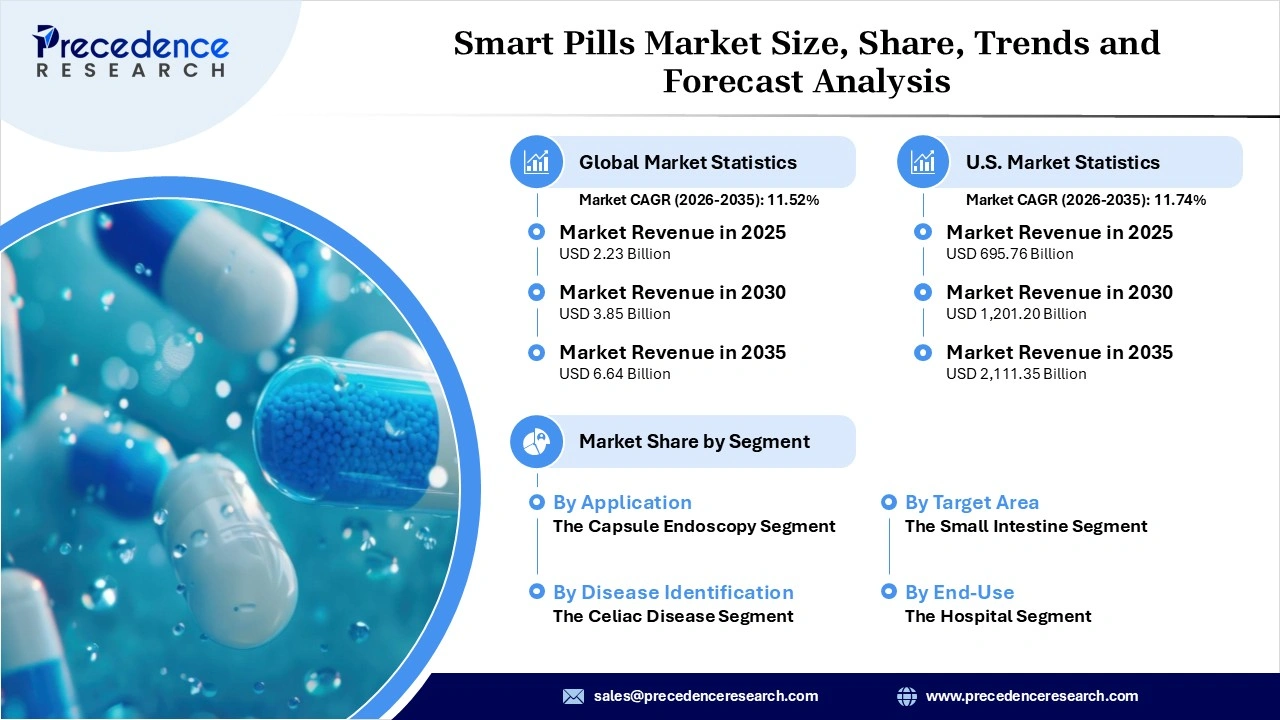
The global smart pills market revenue reached USD 2.23 billion in 2025 and is predicted to attain around USD 6.64 billion by 2035 with a CAGR of 11.52%. The market's growth is driven by the growing consumer awareness of digital health solutions and increasing patient preference for minimally invasive procedures.
What are the Factors That Have a Significant Contribution to the Growth of the smart pills market?
The increasing prevalence of chronic diseases, such as GI disorders and cardiovascular diseases, and the rising geriatric population are the major drivers, accelerating the growth of the market in the coming years. Smart pills enhance the management of chronic diseases by providing accurate and real-time data on medication adherence and physiological parameters. This allows for personalized treatment plans and timely intervention to improve overall patient outcomes. The market’s growth is also primarily supported by the rapid telemedicine adoption, growing demand for remote patient monitoring, rising shift towards personalized care, and rapid technological innovation in digital health and AI.
Smart Pills Market Coverage
| Report Attribute | Key Statistics |
| Market Revenue in 2025 | USD 2.23 Billion |
| Market Revenue by 2035 | USD 6.64 Billion |
| CAGR from 2026 to 2035 | 11.52% |
| Quantitative Units | Revenue in USD million/billion, Volume in units |
| Largest Market | North America |
| Base Year | 2025 |
| Regions Covered | North America, Europe, Asia-Pacific, Latin America, and the Middle East & Africa |
Segment Insights
- By application, the capsule endoscopy segment dominated the smart pills market with the highest market share in 2025. A Capsule endoscopy is a non-invasive and painless way to visualize the entire gastrointestinal tract. It captures thousands of images, visualizing areas that often become difficult to reach with standard endoscopes. It offers an effective way to diagnose conditions like Crohn's, bleeding, and small bowel tumors.
- By disease identification, the celiac disease segment contributed the highest market share in 2025. The increasing burden of the global population with celiac disease boosts the demand for non-invasive diagnostic tools. Smart pills or digital pills, allow for continuous monitoring of disease progression and provide real-time gut data that supports personalized treatment strategies.
- By target area, the small intestine segment accounted for the majority of the market share in 2025, owing to the increasing cases of small intestine disorders. Smart pills are non-invasive diagnosis tools that offer better visualization than traditional methods for hard-to-reach areas like the small intestine. These pills provide real-time data and crucial insights on motility, pH, and biomarkers
- By end-use, the hospital segment held the largest market share in 2025. Hospitals are the major end users in the smart pills market. The hospital has advanced infrastructure, skilled healthcare professionals, and is investing in modern technology to enhance patient-centric care. Hospitals are leveraging smart pills for enhancing monitoring, optimizing drug delivery, and improving treatment outcomes.
Regional Insights
North America holds the dominant share in the global smart pills market. The region’s leadership is driven by the presence of sophisticated healthcare infrastructure, increasing demand for minimally invasive diagnostics (capsule endoscopy), surging demand for real-time patient monitoring solutions, growing emphasis on data-driven healthcare, and significant investment in R&D in biodegradable/AI-enhanced pills by key players. In addition, the increasing patient population with gut disorders, along with the increasing number of academic & research institutes, hospitals, and clinical & diagnostic laboratories, is expected to boost the market’s growth in the North America region.
According to the article published in June 2024, at the USC Viterbi School of Engineering, innovations in wearable electronics and AI have led to the development of ingestible sensors that not only detect stomach gases but also provide real-time location tracking. Developed by the Khan Lab, these capsules are tailored to identify gases associated with gastritis and gastric cancers. The research has shown how these smart pills have been accurately monitored through a newly designed wearable system.
On the other hand, the Asia Pacific region is anticipated to grow at the fastest rate in the market during the forecast period. The fastest growth of the region is attributed to the rising investments in advancing diagnostic infrastructure, a rise in the geriatric population, a surge in R&D funding, an increasing shift towards personalized care, and rapid technological innovation in digital health technologies. The rising incidence of GI conditions like Crohn's, celiac disease, and IBS is driving the need for non-invasive diagnosis, accelerating the market’s expansion in the region.
Recent Developments
- In January 2025, CapsoVision, a leader in capsule endoscopy, announced that its flagship product, CapsoCam Plus, had received FDA clearance for use in pediatric patients aged two and above. This milestone enables children to benefit from the ease and accuracy of capsule endoscopy via a non-invasive, comfortable diagnostic option that reduces the stress associated with traditional capsule endoscopy procedures. (Source: https://www.prnewswire.com)
Get this report to explore global market size, share, CAGR, and trends, featuring detailed segmental analysis and an insightful competitive landscape overview @ https://www.precedenceresearch.com/sample/7295
You can place an order or ask any questions, please feel free to contact us at sales@precedenceresearch.com |+1 804 441 9344