



Printed Circuit Board Market Outlook 2035: Powering Next-Generation Electronics with Advanced PCB Technologies
The Printed Circuit Board (PCB) market is witnessing robust growth due to the increasing adoption of smart devices, electric vehicles, AI infrastructure, and high-speed 5G networks. As industries demand more compact, reliable, and high-performance electronic systems, advanced PCB solutions such as HDI, multilayer, and rigid-flex boards are becoming essential. Continued investments in domestic electronics manufacturing, semiconductor ecosystems, and IoT-enabled technologies are expected to drive sustained market expansion through 2035.
Source: https://www.precedenceresearch.com/printed-circuit-board-market
 Get a Sample
 Table Of Content


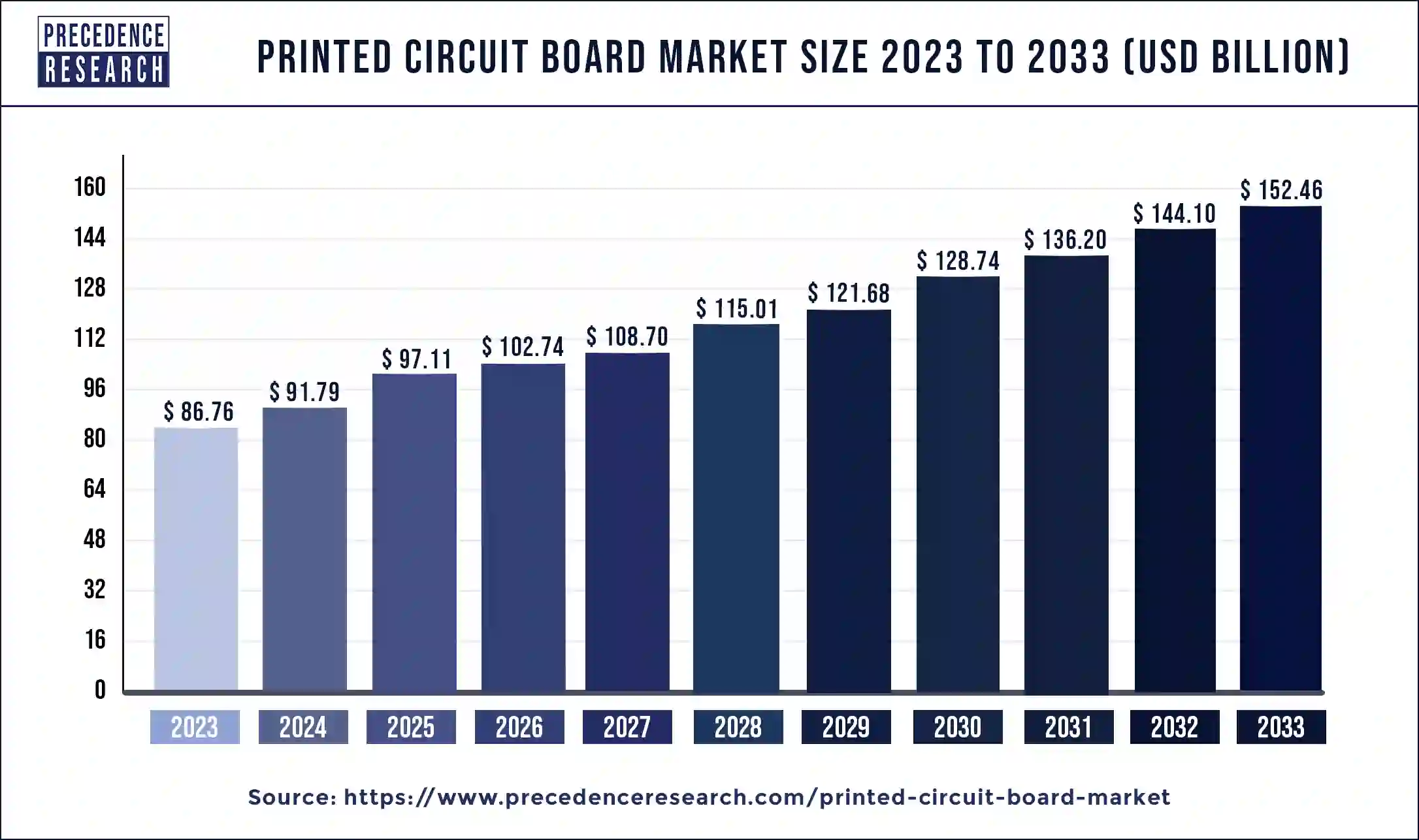
The global printed circuit board market size was estimated at USD 97.11 billion in 2025 and is predicted to increase from USD 102.74 billion in 2026 to approximately USD 169.18 billion by 2035, expanding at a CAGR of 5.71% from 2026 to 2035. The market is witnessing substantial growth driven by smart devices, ADAS, and vehicle electrification in the automotive industry, accelerating demand for advanced connectivity and safety. This market's growth is further supported by HDI miniaturization and robust AI, cloud, and 5G investments, ultimately transforming performance across both consumer electronics and medical devices.
Key Takeaways
- Asia Pacific dominated the market with a major market share in 2025.
- North America is expected to grow at the fastest CAGR between 2026 and 2035.
- By product, the HDI/build-up/microvia segment captured the highest market share in 2025.
- By product, the standard multilayer segment is poised to grow at a healthy CAGR between 2026 and 2035.
- By substrate, the rigid segment contributed the highest market share in 2025.
- By substrate, the rigid-flex segment is growing at a strong CAGR between 2026 and 2035.
- By laminate materials, the FR-4 segment held a major market share in 2025.
- By laminate materials, the flexible segment is expected to expand at a notable CAGR from 2026 to 2035.
- By raw material, the glass fabric segment generated the biggest market share in 2025.
- By raw material, the polyimide film segment is expanding at the fastest CAGR between 2026 and 2035.
- By application, the consumer electronics segment accounted for the largest market share in 2025.
- By application, the automotive segment is projected to grow at a solid CAGR between 2026 and 2035.
Market Overview
The printed circuit board market involves the design, fabrication, and assembly of circuit boards used in various sectors, including consumer electronics, automotive, telecommunications, and industrial applications. The market is evolving from traditional rigid boards to advanced, miniaturized, and flexible circuit models. This shift is driven by the rapid adoption of High-Density Interconnect (HDI) technologies, IoT devices, AI servers, and electric vehicles. The increasing integration of smart devices, the growing demand for high-speed 5G communications, and the miniaturization of electronic components are fueling market expansion.
Government initiatives and supportive industrial policies are also contributing to market growth by promoting domestic electronics manufacturing and localizing supply chains. Programs such as Production-Linked Incentive (PLI) schemes, the US CHIPS Act, and the European Chips Act are enhancing production capabilities and modernizing electronics fabrication. Additionally, advancements in automated Surface-Mount Technology and additive manufacturing are improving market efficiency, production speed, and overall growth.
How is AI Transforming the Printed Circuit Board Market?
Artificial intelligence (AI) is transforming the global market by shortening design cycles, automating component placement, and optimizing thermal management. Deep learning is now integrated into Automated Optical Inspection, enabling rapid scanning for micro-defects in solder joints and hidden component anomalies. Smart manufacturing and automation facilitate the scaling of production from prototypes to high-volume manufacturing with minimal human error. Additionally, AI workflows utilize specialized solvers, such as Flux and Quilter, to handle part selection, stack-up selection, and routing validation based on schematic constraints.
Major Trends in the Printed Circuit Board Market
- Shift to High-Density Interconnects: The need for smaller, lighter, and more powerful consumer electronics is driving widespread adoption of HDI technology. HDI boards enable tighter lines, smaller vias, and closer component placements, making them ideal for modern smartphones, tablets, and wearable technologies.
- Demand for Ultra-Complex Printed Circuit Boards: The rise of artificial intelligence and data centers is fundamentally altering the requirements for printed circuit boards. Hyperscale data operators are now demanding ultra-complex PCBs with over 40 layers and premium dielectric materials, and handling high-speed signaling.
- Robust Printed Circuit Boards for Electric Vehicles and ADAS: The shift toward EVs and ADAS is increasing demand. Modern vehicles require strong and flexible PCBs that can manage high power loads, endure extreme temperatures, and reliably process data from multiple sensors and cameras.
- Transition to Domestic Electronics Manufacturing: Many countries are working to localize and secure their critical electronics components. Initiatives like the US CHIPS and Science Act and India's Electronics Component Manufacturing Scheme incentivize domestic PCB fabrication to reduce reliance on imports.
Printed Circuit Board Market Statistics and Data
- The Indian government has launched programmes to support indigenous manufacturing, especially within Micro, Small, and Medium-Sized Enterprises (MSMEs), under the Atmanirbhar Bharat project. This includes the implementation of a 10 percent import charge on PCBs in order to stimulate indigenous manufacture, as well as the government has offered special grants worth Rs. 50,000 crores. and funding such as the Rs. 50,000 crores.
- By May 2023, China exported printed circuit boards of $1.4 billion.
- To ensure the domestic production of printed circuit boards (PCBs), U.S. president signed a Defence Production Act in March 2023 with $50 million in order to boost the manufacturing of advanced chips and PCBs.
- Taiflex Scientific, the manufacturer of FCCL, moved quickly, committing US$35 million up front to the construction of a factory in Thailand by the end of 2022. The new facility will make double-sided, non-adhesive copper foil substrates; mass production is anticipated to start in the middle of 2024.
- The northern Vietnamese province of Nam Dinh granted an investment certificate to Quanta Computer, an Apple supplier, in 2023 in order that the Taiwanese electronics manufacturer would be able to build a $120 million factory.
Market Outlook
- Industry Growth Overview: The printed circuit board market is experiencing significant growth, driven by the expansion of customer electronics, automotive technology, and the proliferation of 5G and IoT devices.
- Global Expansion: The market is experiencing significant global expansion, driven by the transition to electric vehicles (EVs) and the incorporation of developed driver-assistance systems (ADAS) are significant drivers, as modern vehicles need a greater number of high-reliability PCBs for battery management, sensors, and control systems. Asia Pacific is dominated in the market as a huge electronics production base.
- Major investors: Major investors in the market include large electronics manufacturers, diversified conglomerates (Sumitomo), specialized PCB firms such as Zhen Ding, Unimicron, AT&S, TTM Technologies, governments (EU, China, India), and various VC/Investment funds.
Market Report Coverage and Key Metrics
| Report Coverage | Details |
| Market Size in 2025 | USD 97.11 Billion |
| Market Size in 2026 | USD 102.74 Billion |
| Market Size by 2035 | USD 169.18 Billion |
| Growth Rate from 2026 to 2035 | CAGR of 5.71% |
| Base Year | 2025 |
| Forecast Period | 2026 to 2035 |
| Segments Covered | Product, Substrate, Laminate Materials, Raw Material, and Application |
| Regions Covered | North America, Europe, Asia-Pacific, Latin America, and Middle East & Africa |
Market Dynamics
Driver
Increasing Integration in Electric Vehicles and 5G
The rapid shift toward electric and autonomous vehicles, coupled with the global expansion of 5G infrastructure, is transforming the PCB industry. Modern vehicles and communication networks require complex, highly reliable electronic control units capable of handling significant power and high-frequency data. The integration of PCBs into these high-growth sectors provides manufacturers with a substantial, long-term revenue stream for advanced industrial and automotive applications.
Restraint
Volatility of Raw Material Prices and Manufacturing Complexity
Despite its strong potential, the market faces significant challenges due to the volatile prices of essential raw materials, including copper, gold, and specialty laminates. Price fluctuations can shrink profit margins and disrupt production cost structures. Additionally, the push for miniaturization introduces complex design rules, requiring extraordinarily precise manufacturing techniques and rigorous quality control, leading to significant bottlenecks for manufacturers.
Opportunity
Advancements Driven by Miniaturization and IoT
The ongoing development of wearable technology and the Internet of Things presents exceptional opportunities for specialized components, such as rigid-flex PCBs. These flexible circuits can bend and fold into compact spaces without sacrificing electrical conductivity, enabling the creation of thinner, lighter, and more intricate devices. Moreover, incorporating AI-driven platforms directly into the PCB design and fabrication process significantly reduces turnaround times and material waste.
Market Segmentation Analysis
Product Insights
Why did the HDI/Build-up/Microvia Segment Dominate the Printed Circuit Board Market?
The HDI/build-up/microvia segment dominated the market in 2025. This leadership is primarily due to significant miniaturization, cost reduction, and improved electrical performance. HDI technology employs sequential build-up processes, as well as blind and buried vias, which enable designers to place more components in smaller spaces. This makes it possible to fit complex computing power into compact devices like smartphones and wearables. Using microvias in a via-in-pad configuration allows for intricate routing with fewer layers, resulting in substantial savings on raw materials.
The standard multilayer segment is expected to experience the fastest growth during the forecast period. This growth is primarily driven by the increasing demand for smaller, highly reliable electronic devices that require complex circuit densities. As manufacturers continue to trend toward thinner and lighter smartphones, wearables, and IoT devices, they are compelled to integrate more functionality into limited spaces. Multilayer boards facilitate this by routing traces across multiple internal layers. The expansion of 5G infrastructure and data centers necessitates designs managing bandwidths with minimal latency.
Substrate Insights
How did the Rigid Segment Lead the Printed Circuit Board Market?
The rigid segment led the market in 2025 due to its high usage as foundational substrate materials, primarily FR-4, which provide an ideal balance of structural durability, heat resistance, and electrical insulation. The structural integrity of rigid boards is crucial for applications in servers, desktops, and industrial machinery, where components remain stationary. Manufacturers are increasingly employing rigid boards for High-Density Interconnect (HDI) and multilayer configurations, which support complex, high-heat workloads in enterprise data centers without compromising physical stability.
The rigid-flex segment is anticipated to experience the fastest growth during the forecast period. This growth is driven by the trend toward miniaturization and heightened reliability. Smartphone and tablet manufacturers demand ultra-thin foldable designs, requiring bendable substrates that optimize internal space without sacrificing performance. EVs and smart cars utilize these substrates for intricate battery management circuitry and in-cabin navigation systems, reducing failure-prone connectors and wiring. The adoption of polyimide substrates is particularly suited to address the physical space.
Application Insights
What made Consumer Electronics the leading Segment in the Printed Circuit Board Market?
The consumer electronics segment dominated the market in 2025. This dominance is primarily driven by consumer demand for thinner, lighter, and more feature-rich mobile devices. As a result, there is a need for advanced multi-layer PCBs and substrate-like PCBs that can provide greater circuit density within smaller footprints. Regular consumer upgrades and the rapid integration of advanced features such as AI, AR, VR, and 5G connectivity ensure continuous and high-volume production. The proliferation of IoT devices requires integrated circuit boards for everyday appliances, home electronics, and wearables.
The automotive segment is expected to experience the fastest growth during the forecast period. This growth is mainly due to the swift shift toward EVs and advanced vehicle technologies. Features such as collision avoidance, adaptive cruise control, and automated braking rely on complex, high-density PCBs to process multi-sensor data in real-time. EVs require as many printed circuit boards as conventional internal combustion engine cars. Modern passenger and commercial vehicles are equipped with large digital dashboards, 5G connectivity, and telematics systems handling higher frequencies and power loads.
Laminate Materials Insights
What made FR-4 the Dominant Segment in the Printed Circuit Board Market?
The FR-4 segment held a dominant position in the market in 2025 due to its favorable balance of cost-effectiveness, electrical insulation, and mechanical strength. FR-4 is a highly affordable substrate compared to specialized high-frequency materials, making it the preferred choice for high-volume, price-sensitive consumer electronics. Furthermore, it features excellent dimensional stability and reliable drilling and etching properties, integrating seamlessly with single-sided, double-sided, and standard multilayer printed circuit board stack-ups.
The flexible segment is projected to grow at the fastest rate during the forecast period. This growth is driven by a strong emphasis on device miniaturization and widespread applications in modern consumer electronics, automotive electrification, and 5G telecommunications. Flexible materials, typically polyimide and its variants, provide exceptional heat resistance, mechanical strength, and physical flexibility, ensuring reliability in dynamic bending operations. Flexible laminates are commonly used in foldable smartphones, wearable health monitors, and compact IoT sensors with space-saving interconnects.
Raw Material Insights
Why did the Glass Fabric Segment Lead the Printed Circuit Board Market?
The glass fabric segment led the market in 2025, primarily due to its role as a foundational structural and dielectric substrate, especially in FR-4. These tightly woven fabrics offer excellent dimensional stability, flame retardancy, and high tensile strength to prevent warping during intense manufacturing processes. The rise of advanced materials such as E-glass, S-glass, and ultra-low-loss specialty fabrics aims to reduce signal distortion in high-frequency environments. This trend is further driven by the miniaturization of consumer electronics, 5G telecommunications, and the expansion of EV battery management systems.
The polyimide film segment is expected to experience the fastest growth during the forecast period. This growth is largely attributable to its unmatched thermal stability, high dielectric strength, and mechanical flexibility, allowing PCBs to be ultra-thin, lightweight, and bendable for foldable smartphones, wearables, and modern laptops. Polyimide films offer a low dielectric constant and low signal loss at high frequencies for manufacturing advanced circuits used in 5G infrastructure. They withstand harsh environmental and chemical conditions, making them ideal for compact medical devices and aerospace hardware.
Market Regional Analysis: North America, Europe, Asia-Pacific
Asia Pacific Printed Circuit Board Market Size and Growth 2026 to 2035
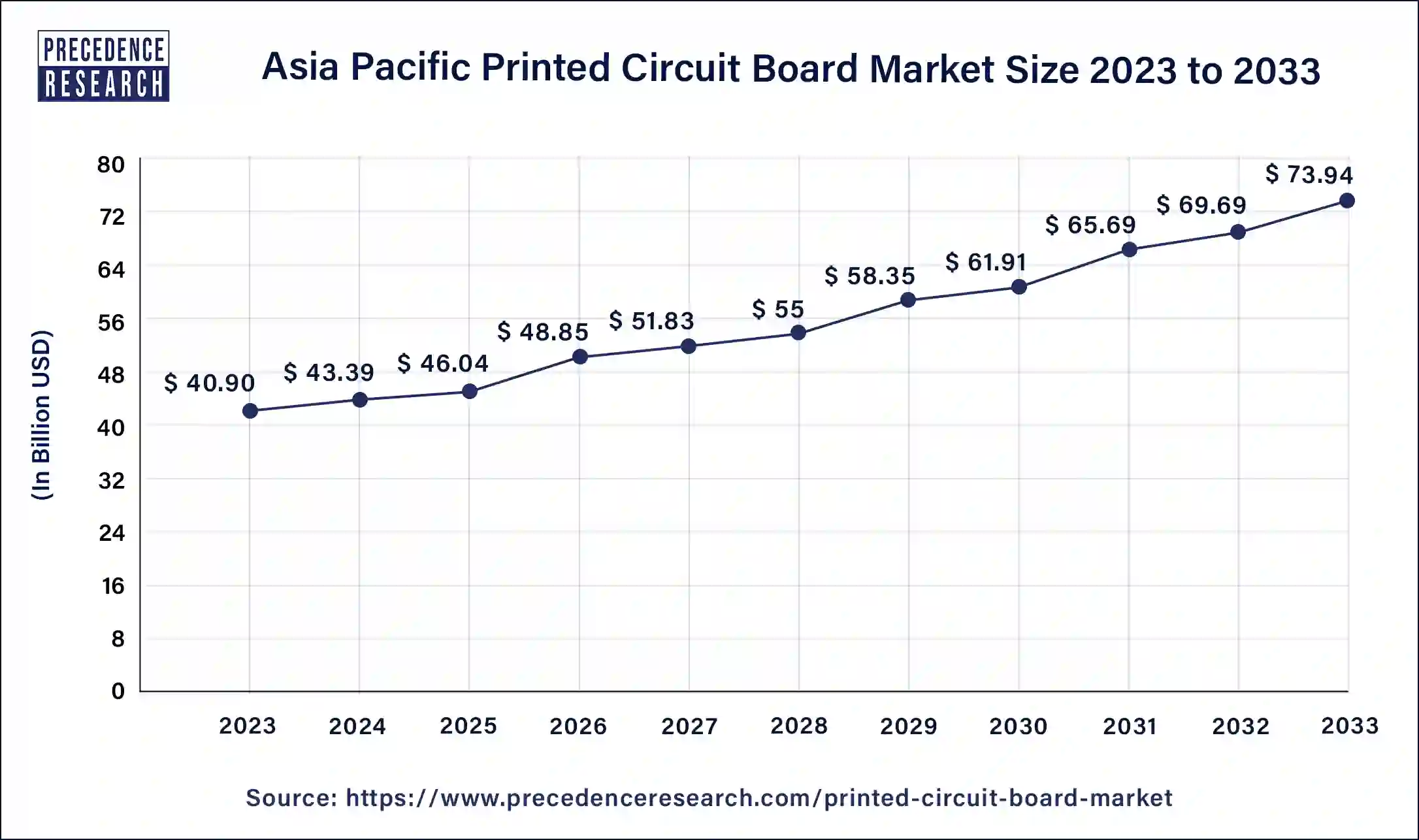
The Asia Pacific printed circuit board market size is estimated at USD 46.04 billion in 2025 and is predicted to be worth around USD 82.15 billion by 2035, at a CAGR of 5.96% from 2026 to 2035.
What Made Asia Pacific the Dominant Region in the Printed Circuit Board Market?
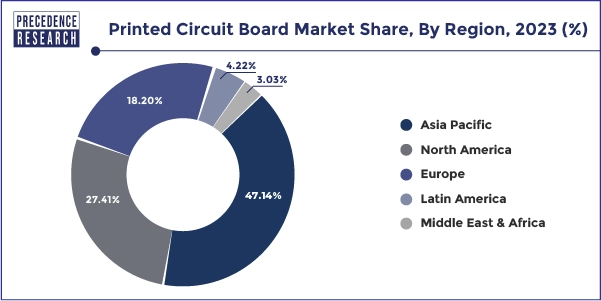
Asia Pacific dominated the market by holding a major share in 2025, primarily due to its unmatched electronics manufacturing ecosystem, competitive production costs, and evolving government-backed initiatives supporting domestic semiconductor and PCB supply chains. Countries like China, Taiwan, Japan, and South Korea have well-established electronics manufacturing supply chains. Competitive labor rates, accessible raw materials, and extensive manufacturing infrastructure make this region the most cost-effective option for global consumer electronics brands in both consumer technology and electric vehicles.
India Market Trends
India plays a crucial role within the Asia Pacific market as a key global assembly hub. This position has emerged from its ability to supply high-volume, cost-effective PCBs for the rapidly growing domestic consumer electronics, smartphone, and telecom industries. Recent initiatives, including the Production-Linked Incentive Scheme, the SPECS Program, and the Make in India initiative, collectively drive electronics and telecom manufacturing to localize production and reduce reliance on external supply chains.
How is North America Growing in the Printed Circuit Board Market?
North America is anticipated to grow at a rapid pace during the forecast period. This is largely driven by the increasing demand for AI and hyperscale data centers, significant investments in automotive and aerospace defense electronics, and robust supply chain reshoring initiatives. The transition to electric and autonomous vehicles has significantly increased the PCB content per vehicle, heavily relying on complex boards for battery management systems, sensors, and ADAS. Geopolitical shifts have also prompted the U.S. and Canadian governments to invest heavily in domestic semiconductor and PCB manufacturing.
U.S. Market Trends
The U.S. plays a distinctive role within North America, largely due to its focus on low-volume, high-complexity PCBs. It is a global leader in manufacturing PCBs for aerospace, defense systems, AI servers, and medical equipment. Recent initiatives, including the CHIPS and Science Act, proposed PCB legislation, and Defense Department contracts, are driving domestic manufacturing and strengthening the electronics supply chain.
How is the Opportunistic Rise of Europe in the Printed Circuit Board Market?
Europe is a notably growing region, primarily due to the rapid advancements in industrial automation, electric vehicles, and the demand for secure, localized supply chains. The transition to electric vehicles requires highly specialized, multi-layered, and heavy-copper PCBs for battery management systems, zone controllers, and 800-volt inverters. Europe has a dense manufacturing infrastructure that depends on PCBs embedded in industrial robots, AI-driven computing equipment, and sensor technology, driving demand for highly versatile and flexible PCBs.
Germany Market Trends
Germany stands out within Europe as a core producer of highly complex rigid-flex assemblies, integrated circuit (IC) substrates, and rapid-turnaround prototypes for the automotive, medical, and industrial automation sectors. The country is actively investing its share of the European Chips Act to reduce reliance on Asian microchip suppliers while heavily supporting the production of specialized PCBs for EV battery systems and autonomous driving technologies.
How will Latin America Emerge in the Printed Circuit Board Market?
Latin America is emerging as a significantly growing region in the global market. This is due to expanding automotive and EV production and regional telecom infrastructure upgrades. Countries like Mexico are benefiting as firms seek shorter lead times, lower transport costs, and tariff protections. Mexico and Brazil are major hubs for vehicle manufacturing and are shifting toward vehicle electrification and advanced safety systems that require complex PCBs. High internet penetration in nations like Argentina, Brazil, and Mexico fuels local demand for 5G telecommunications and consumer IoT devices, which require HDI PCBs.
Brazil Market Trends
Brazil plays an emerging role within the region, primarily as an electronics manufacturing hub, driven by its robust automotive, consumer electronics, and home appliance sectors. Brazil's ecosystem excels in specialized prototyping and multilayer board manufacturing for complex industries. Government-backed incentives to boost foreign direct investment and digital skills, along with industry-led research and development in advanced techniques like HDI and laser depaneling, support global EV supply chains.
What Drives the Middle East & Africa Printed Circuit Board Market?
The Middle East & Africa market is driven by the region's transition toward diversified economies, rapid telecommunications development, increasing demand for consumer electronics, electric vehicles (EVs), and large-scale investments in smart city infrastructure. As countries reduce dependence on traditional energy sectors and accelerate digital transformation initiatives, the demand for advanced printed circuit boards (PCBs) is increasing across multiple industries.
Countries such as the UAE and Saudi Arabia are investing heavily in AI-powered smart cities and digital infrastructure projects, creating demand for high-performance PCBs used in IoT devices, automated energy grids, smart transportation systems, and connected infrastructure. The expansion of 5G networks, edge computing, and intelligent urban solutions is further supporting PCB adoption in the region.
UAE Market Trends
The UAE plays a significant role within the region, largely because it is considered the most dynamic technology hub, focusing on the adoption and design of high-reliability boards required for demanding climates. In ADAS, the UAE's demand for specialized PCBs is surging. To support this growth, the government is utilizing tech-friendly free zones at DSO and KIZAD to advance prototyping and promote IoT integrations to fuel smart city developments.
Competitive Landscape: Leading Companies and Strategies
The printed circuit board market is highly competitive, and many leading companies like Foxconn, Flex, and TTM Technologies are focusing on sustainability and AI integration to capture these demands, notably scaling up domestic manufacturing in various regions through government incentives. For instance, TTM Technologies invested USD $130 million in a new facility to meet high-density demands.
Leading firms like Elephatech Inc., Log9 Materials, Green Circuits, and TLB are also capitalizing on future opportunities in electric vehicles and 5G and 6G communications. However, market entry barriers remain high. These players face severe restraints due to the escalating costs of raw materials, strict environmental regulations, and the massive capital investments required for advanced fabrication facilities.
Top Companies in the Printed Circuit Board Market & Their Offerings
|
Company |
Headquarters |
Key Strengths |
Latest Info (2025) |
|
Germany |
Comprehensive customer service |
In October 2025, Wireless modules powered by the Nordic nRF54L15 SoC offer high performance and development flexibility. |
|
|
United States |
Integrated lifecycle solutions and deep engineering expertise |
TTM is a global leading printed circuit board manufacturer for Industrial and Instrumentation applications. |
|
|
Becker & Müller Schaltungsdruck GmbH |
Germany |
Development and manufacturing of demanding PCBs |
Becker & Müller is a medium-sized family business specializing in the development and manufacture of demanding printed circuit boards in sample, small and medium series. |
|
Advanced Circuits Inc. |
United States |
Focus on high-growth industrial and automotive |
Advanced Circuits is the third-largest PCB Manufacturer in the US. |
|
Sumitomo Corporation |
Japan |
Integrated logistics and commitment to long-term |
In August 2024, Telkomsel and Sumitomo Corporation are committed to working together in the development of B2B business in Indonesia, specifically focusing on IoT services. |
Other Printed Circuit Board Market Companies
- Murrietta Circuits
- Unimicron Technology Corporation
- Tripod Technology Corporation
- Nippon Mektron Ltd.
- Zhen Ding Technology Holding Limited
Recent Developments in the Printed Circuit Board Market (2025–2026)
- In March 2026, OKI will launch Comprehensive Electronics Manufacturing Services (EMS) for AI server equipment, covering the entire process from design to production of large multi-layer printed circuit boards with high heat dissipation technology. As demand for AI servers with densely mounted semiconductors rises, OKI's services will utilize its high-density mounting technology, high-speed X-ray inspection, and functional testing automation to ensure high quality and reduced lead times. (Source: https://www.businesswire.com)
- In February 2026, Crown Defence has also initiated a new electronics facility in Verna, Goa, set to begin operations. This facility, part of Aviatech Enterprises Pvt. Ltd., will produce Printed Circuit Board Assemblies (PCBAs) crucial for defense and civil applications, capable of handling sizes from 80 × 80 mm to 460 × 460 mm. (Source: https://defence.newsd.in)
- In March 2026, Teradyne, Inc. launched Omnyx, a test platform for PCBAs designed to meet the unique requirements of AI and data centers. Omnyx integrates various tests into a single platform to improve quality and reduce defects in complex assemblies, addressing evolving testing challenges in modern manufacturing. (Source: https://markets.ft.com)
- In August 2023, With characteristics that allow industrial-grade applications, IDEC Corporation announced launching its new printed circuit board (PCB) relays, the RC Series. The relays offer high-capacity power switching, are available in several low-profile variants, and function dependably in harsh conditions. According to the manufacturer, the RJxV Series PCB mount relays are upgraded and replaced by the RC Series.
- In October 2023, Krypton Solutions, a Texas-based company, plans to invest USD 100 million (about Rs 832 crore) to establish a Printed Circuit Board production unit in Karnataka. Meanwhile, Texas Instruments, a semiconductor manufacturing giant, has reaffirmed its commitment to expanding research and development in the state. This was discovered during a meeting in the US between the company representatives and an official delegation headed by M B Patil, the Minister of Large and Medium-Sized Industries for Karnataka.
- In January 2021, Orbotech, one of the key manufacturers of the printed circuit board has declared an R2R (roll to roll) manufacturing solution for the flexible PCBs that will elevate the mass production as well as the designing of modern electronic devices such as modern automobiles, advance medical gadgets, 5G smartphones, and others.
- In 19 Oct 2021, Luminovo acquired PCB software provider Electronic Fellows to create next-generation software tools. This is a Wiesbaden-founded startup of Electronic Partners rising the growth of existing processes as well as creating new opportunities of interconnectedness for the electronics industry.
- In March 2020, Zhen Ding Technology Holding Ltd was acquired by Boardtek Electronics Corporation by Share-swap. Boardtek Electronics Corporation would become the exclusively kept secondary of Zhen Ding. Boardtek Electronics Corporation is involved in research and, development sales of the multilayer printed circuit boards, a production that mainly focuses on high-frequency microwave, high-performance computing as well as higher efficiency of thermal dissipation.
- In Feb 2020, TTM Technologies Inc. declared Advanced Technology Center in Chippewa Falls. The Advanced Technology Center in Chippewa Fall Wisconsin strengthened the 40,000 sq. ft. facility which is situated at 850 Technology Way. Advanced Technology Center offers the most advanced printed circuit board manufacturing solutions with the capability to manufacture substrate-like printed circuit boards offered in North America.
Segments Covered In The Report
By Product
- Rigid PCBs
- Standard multilayer
- HDI/build-up/microtia
- Flexible circuits
- IC substrate
- Others
By Substrate
- Rigid
- Flexible
- Rigid-flex
By Laminate Materials
- FR-4
- FR-4 high Tg
- FR-4 halogen free
- Standard & Others
- Flexible (PI,PET)
- Paper
- Composites
- Others
By Raw Material
- Glass fabric
- Epoxy resin
- Kraft paper
- Phenolic resin
- Polyimide film
By Application
- Industrial electronics
- Aerospace & defense
- IT & telecom
- Automotive
- Consumer electronics
- Others
By Geography
- North America
- Europe
- Asia-Pacific
- Latin America
- Middle East & Africa (MEA)
For inquiries regarding discounts, bulk purchases, or customization requests, please contact us at sales@precedenceresearch.com
Frequently Asked Questions





Ask For Sample
No cookie-cutter, only authentic analysis – take the 1st step to become a Precedence Research client
 Get a Sample




 sales@precedenceresearch.com
 Schedule a Meeting
