



Railway Multiple Units Market Size, Share and Trends 2026 to 2035
Railway Multiple Units Market (By Propulsion Type: Electric Multiple Units (EMU), Diesel Multiple Units (DMU), Hybrid/Battery/Hydrogen Multiple Units; By Application: Urban (Metro/Light Rail), Suburban (Commuter Rail), Intercity & High-Speed; By Automation Level: GoA 1 & 2 (Semi-automated) (approx. 65%), GoA 3 & 4 (Driverless/Unattended)) - Global Industry Analysis, Size, Trends, Leading Companies, Regional Outlook, and Forecast 2026 to 2035
Source: https://www.precedenceresearch.com/railway-multiple-units-market
 Get a Sample
 Table Of Content


What is Railway Multiple Units Market Size?
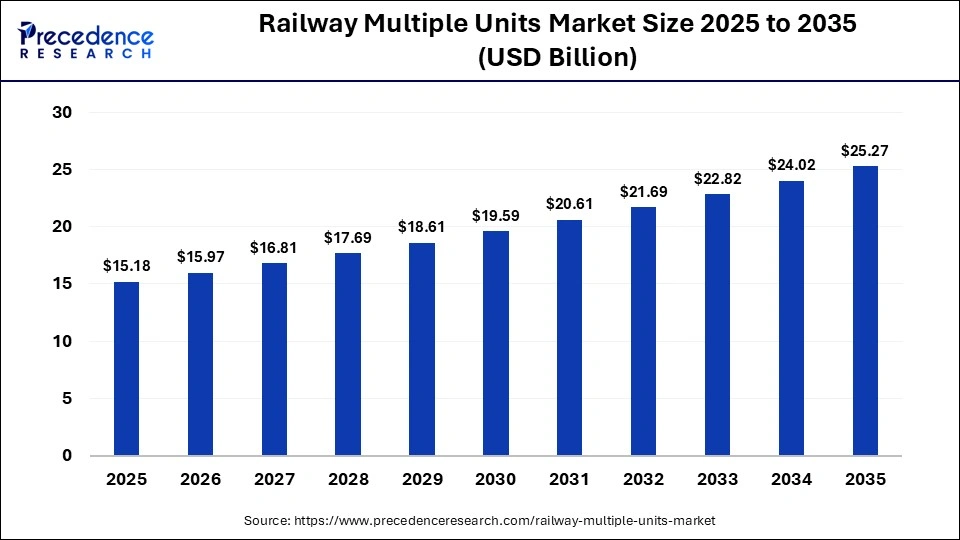
The global railway multiple units market size was calculated at USD 15.18 billion in 2025 and is predicted to increase from USD 15.97 billion in 2026 to approximately USD 25.27 billion by 2035, expanding at a CAGR of 5.23% from 2026 to 2035. The growing demand for high-quality transportation solutions, as well as the rapid investment by the government in rail electrification, has driven the market expansion. Also, technological advancements in the railway industry, along with the surging adoption of hydrogen trains in the developed nations is playing a prominent role in shaping the industry in a positive direction.
Market Highlights
- Asia Pacific led the market with the largest share of 48% in 2025.
- Europe is expected to grow at the fastest CAGR during the forecast period.
- By propulsion type, the electric multiple units (EMU) segment held the largest share of 72% in 2025.
- By propulsion type, the hybrid/battery/hydrogen multiple units segment is expected to grow at the highest CAGR between 2026 and 2035.
- By application, the urban (metro & light rail) segment held the largest share of 46% in the market in 2025.
- By application, the intercity & high-speed segment is expected to expand at the fastest CAGR during the forecast period.
- By automation level, the GoA 1 & 2 (semi-automated) segment held the highest market share of 65% in 2025.
- By automation level, the GoA 3 & 4 (driverless/unattended) segment is expected to grow at the fastest CAGR during the forecast period.
Market Overview
The railway multiple units market is a prominent segment of the railway sector. The market deals with the production and distribution of different types of self-propelled trains across the world. Unlike conventional locomotive-hauled trains, RMUs provide faster acceleration, better energy efficiency, and greater operational flexibility, making them ideal for urban, suburban, and intercity passenger transport. Market growth is being driven by increased investment from locomotive companies in new production facilities and the rising adoption of hydrogen-powered trains, particularly in the European Union, which is fostering technological advancement and industrial expansion.
Railway Multiple Units Market Trends
- Joint Venture: Numerous railway providers are joining hands with engineering companies to increase the production output of rolling stocks. For instance, in September 2025, Texmaco Rail joined hands with RVNL. This joint venture is aimed at developing a wide range of rolling stock across India.
- Business Expansions: Several railway component manufacturers are increasingly focusing on opening new manufacturing plants to expand their business in different regions. For instance, in August 2025, Frauscher Sensortechnik opened a new manufacturing plant in Mysore, India. This plant was inaugurated to increase the production output of railway components in this nation.
- Government Initiatives: Governments of several nations, including the UK, Canada, India, Sweden, and the U.S., have started launching various initiatives for developing the railway sector. For instance, in July 2025, the government of Germany announced to invest 106.5 billion euros. This investment is done for modernizing the railway infrastructure in Germany by 2029.
What is the significance of AI in the Railway Multiple Units Industry?
Artificial Intelligence plays an important role in shaping the railway industry. Nowadays, railway manufacturers have started deploying AI in their production units to enhance safety, improve supply chain optimization, and automate assembly processes. Additionally, AI is being integrated into multiple units to enhance several features, such as driver assistance, crowd management, energy management, and obstacle detection.
- In November 2025, Microsoft partnered with FS Italiane. This partnership aims at developing an AI-based platform for transforming the railway infrastructure across Europe.
Market Scope
| Report Coverage | Details |
| Market Size in 2025 | USD 15.18 Billion |
| Market Size in 2026 | USD 15.97 Billion |
| Market Size by 2035 | USD 25.27 Billion |
| Market Growth Rate from 2026 to 2035 | CAGR of 5.23% |
| Dominating Region | Asia Pacific |
| Fastest Growing Region | Europe |
| Base Year | 2025 |
| Forecast Period | 2026 to 2035 |
| Segments Covered | Propulsion Type, Application, Automation Level, and region |
| Regions Covered | North America, Europe, Asia-Pacific, Latin America, and Middle East & Africa |
Segment Insights
Propulsion Type Insights
Why Did the Electric Multiple Units (EMU) Segment Dominate the Railway Multiple Units Market?
The electric multiple units (EMU) segment dominated the market with the largest share of 72% in 2025. This is mainly due to the increased adoption of EMUs in transit rail networks, driven by their frequent service capabilities, high acceleration, and pollution-free operations. Additionally, the rapid investment by the governments in several countries, for the electrification of the railway sector, as well as the opening of new EMU production units in different regions, has contributed to segmental growth. Partnerships among locomotive brands and public operators to deploy EMUs in developing nations are expected to sustain the segment's dominance in the market.
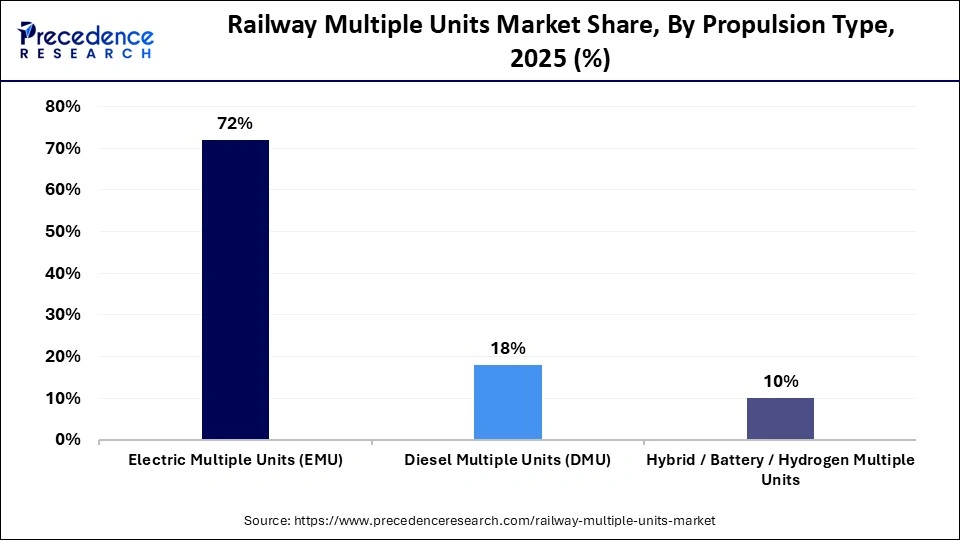
The hybrid/battery/hydrogen multiple units segment is expected to grow at the highest CAGR during the forecast period. The growth of the segment is driven by surging adoption of electric and low-emission trains by private operators in Europe to reduce pollution. Growing investments in hydrogen train R&D by railway companies, along with advancements by battery manufacturers in developing high-performance rail batteries, are further accelerating market growth. Additionally, collaborations between railway authorities and hybrid train manufacturers to deploy sustainable trains in densely populated regions are significantly shaping and expanding the market.
Application Insights
What Made Urban (Metro & Light Rail) the Leading Segment in the Railway Multiple Units Market?
The urban (metro & light rail) segment led the market with a 46% share in 2025. This is mainly due to the rising adoption of diesel-propelled trains by the transport authorities for operating urban transportation. Surging investment by the governments of several nations in strengthening the metro railway infrastructure is playing a prominent role in shaping the industrial landscape. Moreover, joint ventures among railway operators and electric train manufacturers on deploying battery electric trains in urban routes to lower emissions are expected to accelerate the segmental growth.
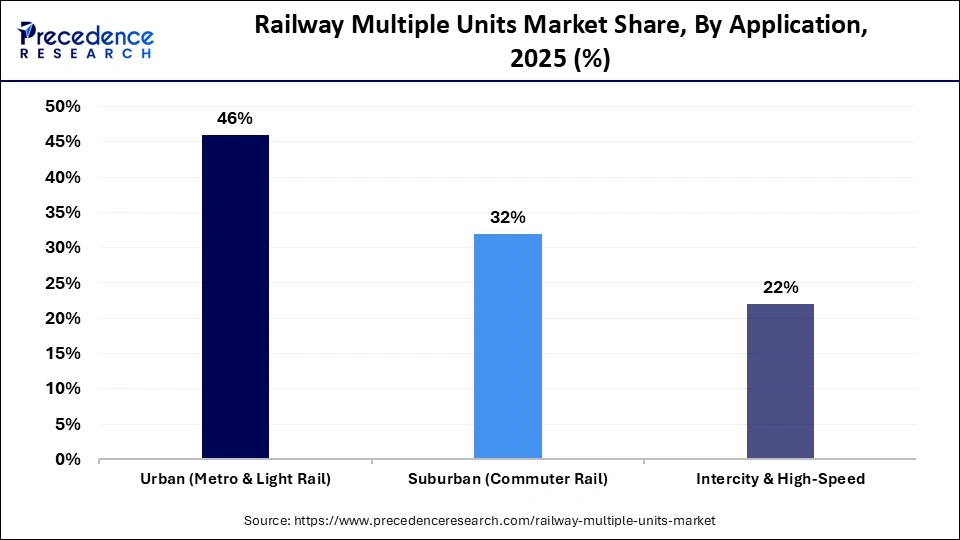
The intercity & high-speed segment is expected to grow at the fastest CAGR during the forecast period, supported by the growing emphasis of locomotive manufacturers on developing advanced high-speed trains for intercity operations. Significant government investments in countries such as China and Sweden to deploy high-speed rail networks at affordable fares are further accelerating segmental growth. Additionally, the rising preference for bullet trains among elite and business-class travelers seeking faster and more comfortable travel is expected to fuel the growth of the segment.
Automation Level Insights
Why Did the GoA 1 & 2 (Semi-Automated) Segment Lead the Railway Multiple Units Market?
The GoA 1 & 2 (semi-automated) segment led the market while holding a 65% share in 2025 because it offers an optimal balance between automation, safety, and cost efficiency. These systems retain a driver for supervision while integrating automated functions such as speed control and braking, making them easier and less expensive to deploy than fully automated trains. Additionally, their proven reliability, regulatory acceptance, and widespread use across urban and suburban rail networks have encouraged rapid adoption by railway operators worldwide.
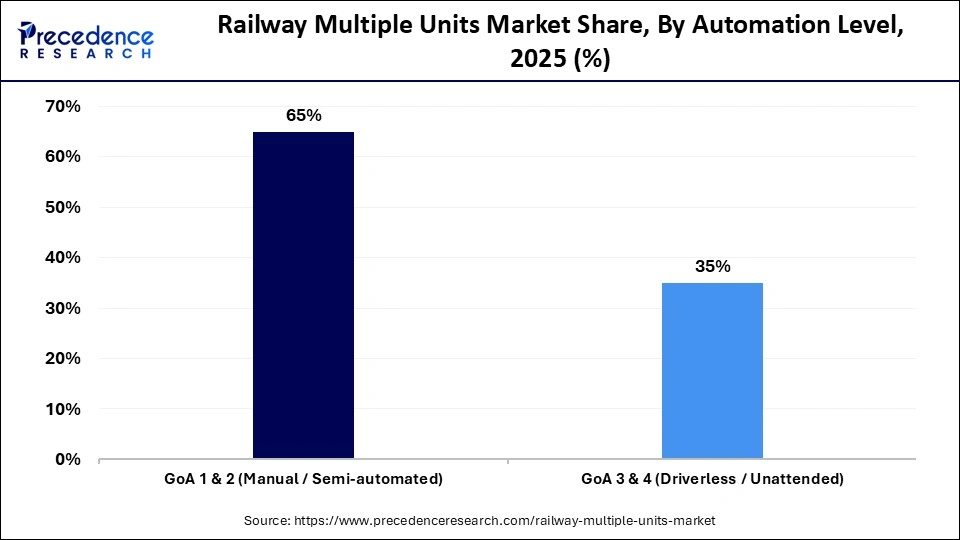
The GoA 3 & 4 (driverless/unattended) segment is expected to grow at the fastest CAGR during the forecast period due to the rising demand for higher operational efficiency, safety, and reduced labor costs. Advanced automation enables precise train control, higher service frequency, and improved energy efficiency, making these systems attractive for metro and high-capacity urban networks. Moreover, increasing investments in smart transportation infrastructure and supportive government initiatives for fully automated rail systems are accelerating the adoption of GoA 3 and GoA 4 technologies.
Regional Insights
What is the Asia Pacific Railway Multiple Units Market Size?
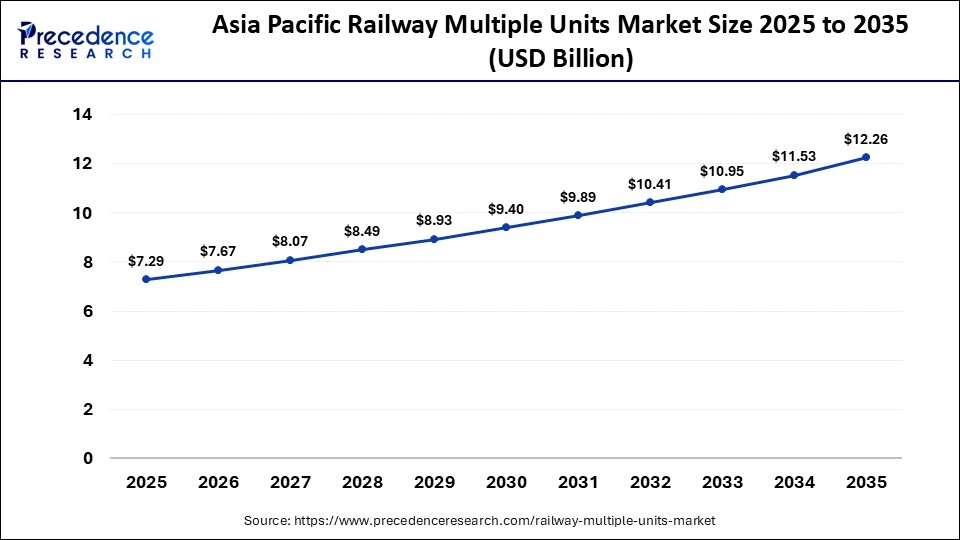
The Asia Pacific railway multiple units market size is expected to be worth USD 12.26 billion by 2035, increasing from USD 7.29 billion by 2025, growing at a CAGR of 5.34% from 2026 to 2035.
What Made Asia Pacific the Dominant Region is the Railway Multiple Units Market?
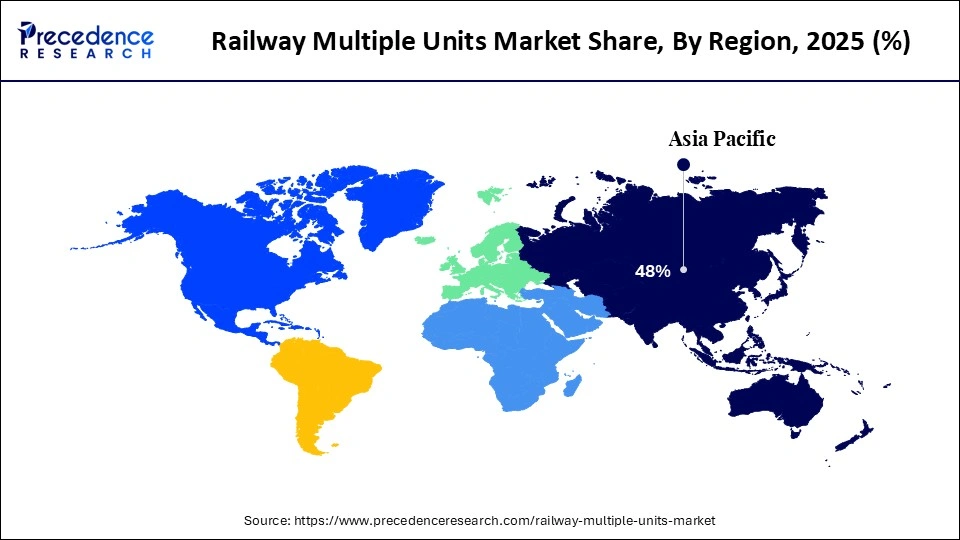
Asia Pacific dominated the railway multiple units market with the largest share of 48% in 2025. This is mainly due to the increased demand for high-speed railways in several nations, including China, India, South Korea, and Japan. Numerous government initiatives aimed at strengthening the railway infrastructure, along with the rapid investment by railway companies in opening new manufacturing centers, are playing a crucial role in shaping the industrial landscape. Moreover, the presence of various market players, such as Hitachi Rail Ltd, Hyundai Rotem Company, and Kawasaki Heavy Industries, Ltd., and early adoption of advanced rail technologies have further strengthened the region's market leadership.
- In December 2025, THACO partnered with Hyundai Rotem Company. This partnership aims to open a new rolling stock production center in Vietnam.
China Railway Multiple Units Industry Trends
The market in China is expanding as a result of rising adoption of fully autonomous trains by the railway authorities to lower the dependency on manual operators, as well as the rapid expansion of the smart transportation sector. Additionally, the surging focus of local market players in opening new assembly centers and the expansion of rail infrastructure are positively contributing to market growth.
In October 2025, CRRC Corporation launched a fully autonomous high-speed train in China. This train has a carrying capacity of 844 passengers and is capable of attaining speeds up to 200 km/h.
Why is Europe Considered the Fastest-Growing Region in the Railway Multiple Units Market?
Europe is expected to expand at the fastest CAGR during the forecast period. This is mainly due to the increasing adoption of EMUs by public operators in several countries, including France, Sweden, Germany, Italy, the UK, and Denmark. The surging focus of the government on modernizing the railway infrastructure, along with the growing popularity of hybrid trains, is positively contributing to the market. Moreover, the presence of various market players, including Škoda Transportation a.s, Talgo, Siemens Mobility, and Alstom SA, is expected to propel the growth of the market in this region.
- In December 2025, Alstom collaborated with Hellenic Train. Under this collaboration, Alstom will supply 23 Coradia Stream Electric Multiple Units (EMUs) to the Hellenic Train for operating in Greece.
Germany Railway Multiple Units Industry Analysis
The market in Germany is growing at a steady rate, driven by increasing investments from railway providers in deploying modern hydrogen-powered trains for intercity transportation to reduce emissions. Technological advancements in railway manufacturing, along with the rapid adoption of battery-electric trains by public transport operators, are further strengthening the country's rail ecosystem.
In December 2025, Siemens Mobility announced to deliver 61 battery electric trains to the Westphalia-Lippe transport authority. These trains will be deployed to deliver eco-friendly transportation to the passengers of Germany.
How is the Opportunistic Rise of North America in the Railway Multiple Units Market?
North America is expected to grow at a notable rate in the market, driven by increasing investments in urban transit modernization and the expansion of metro and light rail networks across major cities. Growing emphasis on sustainable transportation, along with the adoption of electric and battery-powered multiple units, is supporting market growth. Additionally, government funding for rail infrastructure upgrades and rising demand for efficient commuter transport are creating new opportunities for market expansion in the region.
Railway Multiple Units Market Value Chain Analysis
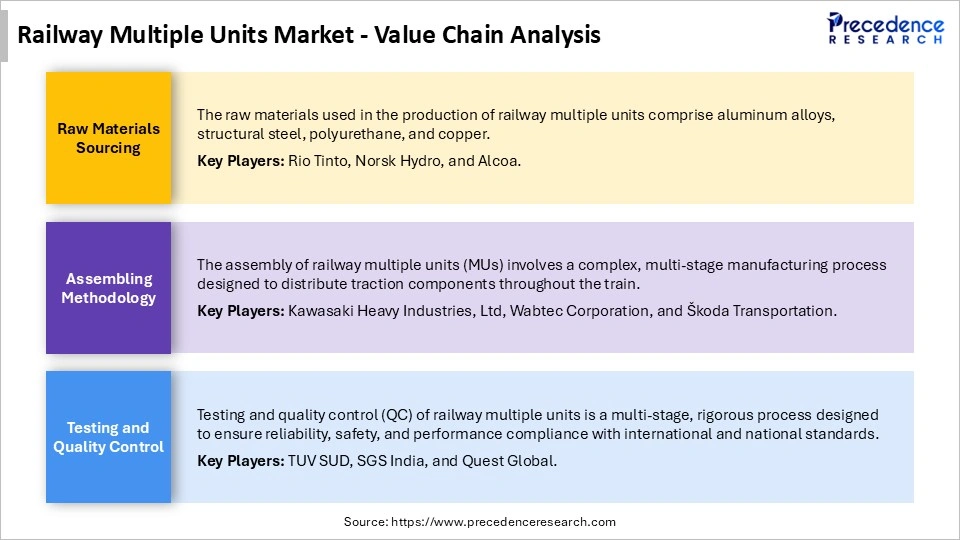
Who are the Major Players in the Global Railway Multiple Units Market?
The major players in the railway multiple units market include CRRC Corporation Limited (China), Alstom SA (France), Siemens Mobility (Germany), Stadler Rail AG (Switzerland), Hitachi Rail Ltd. (Japan/UK), Hyundai Rotem Company (South Korea), Construcciones y Auxiliar de Ferrocarriles (CAF) (Spain), Kawasaki Heavy Industries, Ltd. (Japan), Wabtec Corporation (USA), Škoda Transportation a.s. (Czech Republic), BEML Limited (India), The Kinki Sharyo Co., Ltd. (Japan), Nippon Sharyo, Ltd. (Japan), Talgo (Patentes Talgo) (Spain), and Transmashholding (TMH) (Russia)
Recent Developments
- In January 2026, the Czech Railways launched tenders for the purchase of 120 battery-electric multiple units (BEMU). These BEMUs are designed to enhance the capabilities of regional transport services. (Source: https://www.railwaypro.com)
- In January 2026, Stadler launched a hybrid passenger train in Portugal. This train has a capacity of 369 passengers and a maximum speed of around 160 km/h. (Source: https://rollingstockworld.com)
- In September 2025, Wabtec announced to start a diesel locomotive assembly project in Kazakhstan from 2026. This project is supported by an engineering institute of Kazakhstan. (Source: https://rollingstockworld.com)
Segments Covered in the Report
By Propulsion Type
- Electric Multiple Units (EMU)
- Diesel Multiple Units (DMU)
- Hybrid/Battery/Hydrogen Multiple Units
By Application
- Urban (Metro/Light Rail)
- Suburban (Commuter Rail)
- Intercity & High-Speed
By Automation Level
- GoA 1 & 2 (Semi-automated) (approx. 65%)
- GoA 3 & 4 (Driverless/Unattended)
By Region
- North America
- Europe
- Asia-Pacific
- Latin America
- Middle East & Africa
For inquiries regarding discounts, bulk purchases, or customization requests, please contact us at sales@precedenceresearch.com
Frequently Asked Questions





Ask For Sample
No cookie-cutter, only authentic analysis – take the 1st step to become a Precedence Research client
 Get a Sample




 sales@precedenceresearch.com
 Schedule a Meeting
